Glutton Abroad: Downtown to Chinatown

Lunch at Crystal Harbour

After my last post, people could be forgiven for mistaking me for a rabidly nationalistic Australian (not true), or a grumpy chubby person (true). Things have changed in 2011. The rain in New Zealand has stopped, the sun is in the sky, swimmers are in the water, and rugby players are on the fields. All is right in the world. Well, except if you are trying to blog on an iPad, which is a bit like writing with a wet squid head (I had to throw one complaint in there. I am, after all, still me).

Yes, I am still in fabulously sun-shiny Auckland, but you wouldn’t know it from what I’ve been eating. Oh, let’s start from the beginning: my parents are here to visit. They are wonderful people, but also very old-school Thais when it comes to their food choices. Rule no. 1: there must be rice, at least every other day. Rule no. 2: chilies, somehow, every day. And rule no. 3: when in doubt, go for Chinese.

Not just any Chinese, mind you. For old-school people like my parents, it must be Cantonese, or nothing at all. I think Thais look to Cantonese the same way British people used to see French food — as the foundation of their cuisine and as the most noble embodiment of cuisine. Naturally, in NZ, there are plenty of Cantonese restaurants, in keeping with the many Asians who have come to live on the Island of the Long White Cloud in the past few decades.

If you are like many people and judge the quality of a chinese restaurant by the number of chinese diners inside, then Enjoy Inn (530 Great South Road, Greenlane) is the place for you. Packed to the gills with Chinese, the restaurant offers good-value dishes of frankly gargantuan proportions, with en emphasis on “crayfish” (basically lobster without claws) and Peking duck (delicious) which is served three ways: meat and skin with pancakes, minced meat with lettuce, and the carcass as soup.

In keeping with the restaurant’s reputation as THE go-to place for the local Chinese community, the waitstaff don’t speak much English, and much gesticulating is needed. Just like in the homeland! But they try very hard, are more pleasant and personable than they need to be, and are prompt and efficient.

Which is more than I can say for Grand Harbour (Pakeham St and Custom St West, Viaduct Harbour). Not to say the food is lacking — aside from the usual suspects, there are alarmingly large crayfish, stuffed with noodles; fresh abalone, sliced thinly and stir-fried with snow peas; and a personal favorite, geoduck. But communicating with the servers (in English) can sometimes be a bit like talking to a box of rocks. Just a wee, tiny bit.

For service that goes all out, look no further than Crystal Harbour (39 Market Place, Viaduct Harbour), distinguishable from its other Harbour neighbor by the flash dining room. Whatever your whim, be it SIX plates of ice cream Mochi (my husband) to an assortment of tofu-like treats (SpecialKRB) to Thai-Chinese flat fried noodles in gravy to finish the meal (my parents), it is fulfilled in the blink of an eye. A bit of a shame the cooking is characterized by, in SpecialKRB’s words, “gentle flavors”. Some real subtlety at work here, unfortunately going over the heads (and tongues) of chili-addled Neanderthals like us. Again, a shame.

This is my last post from NZ, mainly because I am not masochistic enough to post regularly from this #%*+ing iPad (hence the lack of photos for now, sorry SpecialKRB). Happy new year, folks, and here’s hoping 2011 will be great.

(All photos by @SpecialKRB)

Leave a comment

Filed under Asia

Glutton Abroad: Adventures in Kiwiana

First off, I want to tell you all a secret. It’s a secret because, apparently, no one seems to know this. This is what makes it a secret.What is this earth-shattering secret, you may ask? Well, I’ll tell you, but hold onto your hats. Hold onto your hats, and your boots, and your gloves and keys, because it is that shocking. Prepare yourself. Are you ready?

I AM NOT PREGNANT. You wouldn’t know this, since New Zealanders appear to be falling all over themselves to point out my burgeoning belly, to congratulate me, to quiz me –“how many months?” — with great big wide smiling faces, they are just full of stupid fat goodwill, these New Zealanders. But I am not pregnant. Again, NOT PREGNANT.

All that leaves me with is: Really New Zealand? Are we really going to go there? Is there really such a glut of svelte supermodel types running around town that someone like me sticks out like a sore thumb, sore enough to warrant mistaking me for a pregnant person? Call me a big fat jerk, something that starts with an “ass” and ends with “hole”, but I’m just not buying it. Nope, sorry.

Newsflash: many of you are not thinner than me. Sure, there are the ropy, leathery outdoor types who hike daily and go camping and wear those pants that convert into shorts when you unzip the legs. But most of you are not that person. That person lives in Queenstown and is a sea kayak guide. There are still 4,499,999 of you out there.

Somehow, this brings me to my next point: what is New Zealand food? When someone asked me at a dinner party what my favorite Kiwi dish was, I drew a complete blank, able only to list ingredients: lamb, venison …. …… …. Funnily enough, when asking New Zealanders to define their own food, the results were similar: a blank stare, the listing of some ingredients, and the exhortation to drink more. Not surprisingly, I did not get many invites to dinner parties.

So I decided to make it a sort of mission to find New Zealand dishes and try them. It turned out to be a lot harder than I anticipated, mainly because no one else wanted to eat them. Unlike Hawaiian poke or Tahitian poussin cru, there didn’t seem to be a dish that was distinctly Kiwi, as such. There are fish and chips, and custard bars, and a stuffed leg of lamb referred to as “colonial goose”. There is pavlova, which, is basically a giant meringue topped with fruit, but gooier. There is tea, and cakes, and scones. There is whitebait, folded into an omelette.

This is all grouped under the heading of “cuisine Kiwiana”, a culinary heritage that is said to be disappearing from New Zealand tables. This makes me laugh. It sounds like a complaint from old-timers who yearn for the bygone era when white settlers had just wrestled the land from the Maori. Isn’t there an entire other country with food just like this, known as Great Britain? There, they have also heard of deviled kidneys, and roast lamb, and scotch eggs, and Cornish
pasties.

Indeed, for a country with a much-maligned culinary lexicon, British food does appear to travel well, making inroads not only among the Anglo settlers of the southern hemisphere, but also among the Maoris themselves. Yes, the Maoris’ Hangi — a collection of meats and vegetables cooked in a hole in the ground filled with hot rocks and covered with sand bags and dirt — could be considered a local dish, the equivalent of the Hawaiian luau feast. It is marketed as such, the highlight to tours in Rotorua alongside visits to the sulphur springs.

But there is also the Maori “boil-up”– a collection of meats and vegetables cooked via … You guessed it! This, apparently, is an example of a cooking method adopted by the locals, much like how the Thais adapted Chinese methods to their own cuisine. Not much mention of the new arrivals adopting local techniques and digging holes in the ground for their meat, though. No, not much of that.

I would like to tell you how much I enjoyed my Hangi meal, ordered from The Hangi Shop as I had planned, but my husband put the kibosh on that. Indeed, no one I know would eat Hangi with me. Maybe it’s me and not the dish, and everyone is secretly meeting somewhere over a smoking hole in the ground, enjoying morsels of freshly steamed meat as I type this. Well, you haven’t beaten me! I will have my hangi, or my name is not Bangkok Glutton!

In the end, I figured out what real New Zealand food is:

It’s different, really it is! Kiwis don’t use cod or haddock, and go with local fish like hoki, or in this instance, orange roughy. Also available at your better fish and chip shops: steamed mussels with sweet chili sauce; abalone “patties” of minced abalone meat, resembling gravel and tasting like unseasoned matzoh; Bluff sea urchin roe, straight from the container, made palatable with a generous squeeze of lemon; and most interestingly, steamed “mutton bird”, an indigenous fowl hunted only by Maoris and stored in salt to preserve the meat.

Is it delicious? Well, we’re only in the experimental stages. The search for my favorite Kiwi dish continues.

(All photos by @SpecialKRB)

5 Comments

Filed under Uncategorized

Dishes to Try Up North

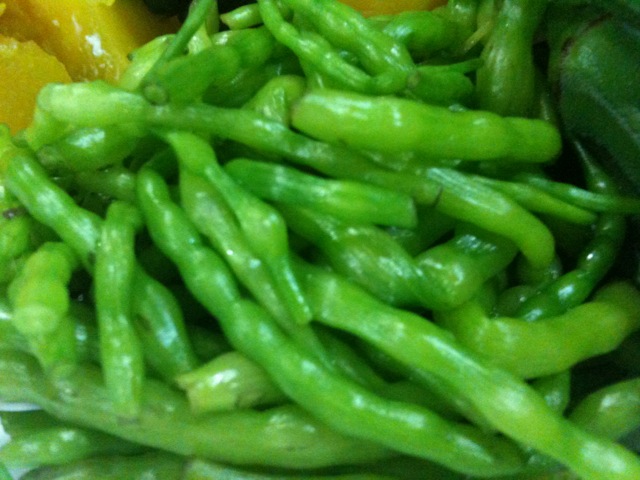
Pak ki hood, blanched and served alongside nam prik

Believe it or not, I am not going to write about kanom jeen nam ngiew or the Steelers today. I know, I know. I know this makes you sad. But I must branch out. Show all my brilliant colors. Spread my wings.

So instead, I will ramble on semi-incoherently about my childhood in the era of Rama VI, back when rickshaws ruled the North and people foraged in the jungle for food. My fascinating reminiscences include memories of being abandoned at the post office as my nanny chatted up her then-boyfriend, and being menaced by a homicidal goose tethered to a pole in the middle of her front yard. Did you know geese are thoroughly unpleasant creatures? Now you do.

I also remember my Aunt Priew, who lived right next door to my grandmother’s house — easily accessible from our yard once you managed to jump over a tiny hill of ferocious red ants. Somehow, I never really made the jump and was bitten every time I tried. Yet day after day would find me once again testing the anthill because my Aunt Priew is a tremendous cook, possibly the best cook of Northern Thai food in the kingdom.  Roasted lin fa (sky tongue) beans, julienned and stir-fried with glass noodles or paired with a fatty raw larb; a touch of magorg, or water olive, added to a fiery nam prik num (roasted green chili dip) — my aunt is full of these little touches with the local produce that set her dishes apart from the rest. Now if I could just convince her to open a restaurant …

These are some of the Northern Thai dishes that are worth the long trek up to the tip of the country. They go just as well with khao suay (jasmine rice) as they do with khao niew (sticky rice). Try them for a real taste of Northern Thai food:

(Note: Please forgive the photos. They are a little … blurry. No, it wasn’t the wine.)

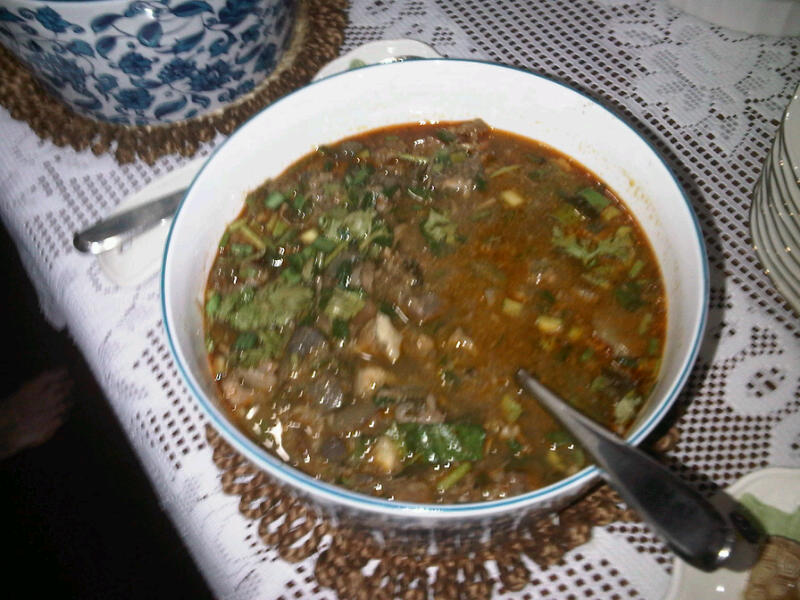
Gaeng om, Northern-style

Gaeng om, sort of


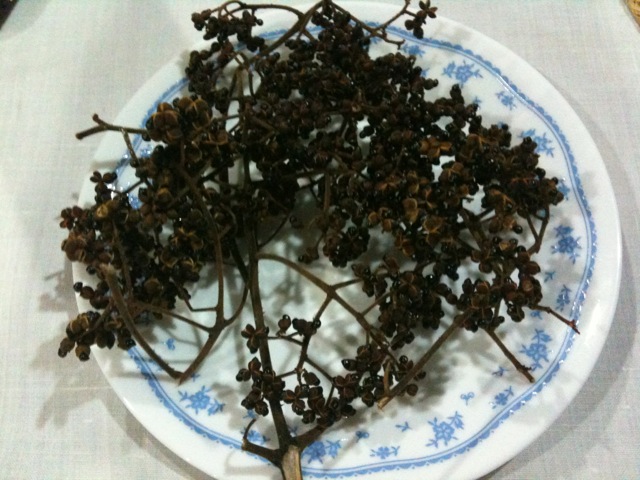
Unlike the light, prickly Isaan gaeng om, the Northern Thai version is — like much of the rest of Northern food — richer, meatier and fattier. The curry paste is that for a typical gaeng muang (Northern curry), with a couple of additions. There is lemongrass, galangal, dry chili, shrimp paste and garlic, plus pla sarak (kind of like pla salid, but bigger) and bakwan, which, if not Sichuan peppercorn, is something very similar, with the same tongue-numbing effects.

The tongue-numbing peppercorn bakwan

This paste is then fried in oil and augmented by fresh chilies, pork innards, bruised lemongrass and red shallot bulbs, and kaffir lime leaves and stewed, and then garnished with dill and coriander. It has a lingering meat taste that is very Northern.

Gaeng gadang

Pork “jelly” with pork rinds


Some dishes seem like they were engineered by mistake. Puff pastry is one; this is another. It’s basically a gaeng muang focused on kaki (fatty pork leg) and/or moo sam chan (three-layer pork), left out in the cold. It’s a distinctly “cold season” dish because traditionally it was left out overnight to congeal; today, it is chilled in the refrigerator and served in slices like a terrine. Very unusual and very porky.

Saa pak

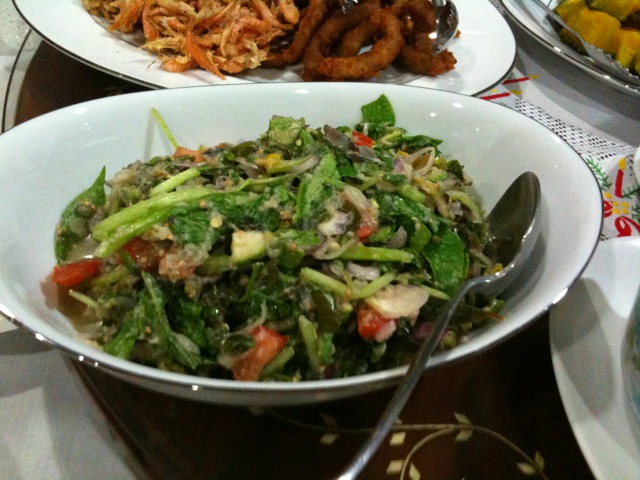
Northern Thai “salad”, or saa pak

This is hands-down my favorite dish up North, but something that, aside from a few vendors in the Chiang Rai wet market, is very difficult to obtain. The reason could possibly be the 10+ types of local leaves (pak puen muang) required for a real saa pak (“spicy leaves”).

Greenery includes thinly sliced brinjals, young mango leaves, water olive leaves, pak pu ya (“grandfather-grandmother leaves,” a kind of edible blossom), plus sliced shallots and chopped fresh tomato. It is then tossed, like a chopped or Caesar salad, with flaked fish meat which has been grilled or boiled (with lemongrass and kaffir lime leaf to lose the fishiness), plus nam prik num (roasted green chili dip) and sliced water olive.

This is a dish I am going to try to recreate at home with plain old lettuce, onions, tomato and avocado. I think it could give me a little taste of home, even in the middle of Bangkok.


9 Comments

Filed under Asia, Chiang Rai, curries, food, food stalls, markets, Northern Thailand, Thailand