Return of the Thai Hobbit: There and back again

A full English breakfast at St. Bees

Someone had the idea to do a coast-to-coast walk across northern England, from the tiny town of St. Bees on the west coast to the tiny town of Robin Hood’s Bay on the east. Along the way, there would be other tiny towns, comprising a total of 190-or-so miles over 12 days. The original person to undertake this walk was Alfred Wainwright, an illustrator who also wrote a series of guidebooks, presumably all about walking. I didn’t know who Alfred Wainwright was. I only knew that it sounded like I’d be traveling from pub to pub, eating lots of English food along the way and magically shedding pounds like I had nearly 15 years ago on the Camino.

It turns out, English food is not like Spanish food, and 15-years-ago-me is not the menopausal me of today: coarsened, stumpy, and prone to weight gain at the whiff of a carb. I did not lose weight, but gained it. But at least I also possibly permanently messed up my ankle! At the very beginning of the walk, full of hope, my friends would sing a song I presume came from the “Hobbit” trilogy, because they thought I looked like one from the back (and probably the front). “Chawadee Baggins,” they would call me, and I was fine with it. Later, with all of my injuries, the Hobbit became “the Hobblit”, my walk more of a hesitant lurch. I did not like to be called “Chawadee Baggins” after that.

The food didn’t help. This is something I didn’t know but kind of wish I knew at the time: pub menus are all pretty much the same. There will be a lasagne, for some reason, and a curry of the week, because of course. There will be a steak and ale pie, and fish and chips. There will be a soup, and if it is “fancy”, a chicken caesar salad. And then, if you are east of the Pennines, there will be fried chicken “parmo” in a sandwich or not, with garlic mayonnaise on the side, obviously. Everything comes with fries, including the fries.

More beans for breakfast in Reeth

I tired of this menu by the third day. This, coupled with a fall I took on a rainy day (because of course) on top of a hill leading down to an abandoned slate mine in the Lake District, made me despair of my choices. I admit to taking to drink, finishing and leaving empty mini bottles of whisky from a trip to Scotland the week before in a string of B&B rooms across the country. Yet my friends and family soldiered on, even as I took my “break days”, no matter how tired or angry it made them. I couldn’t understand why they would do this; had they made some sort of vow to the tour company? Was there a magical dwarf who would spirit away their firstborn if they rested?

Sitting in Bullshit Corner at the King’s Head in Gunnerside

Some B&Bs were kind, even if the surroundings were humble. Some places were not. I remember nearing the very end of the trip and staying in an inn that reminded me of the “Master of the House” inn in “Les Miserables”. By the time we reached Robin Hood’s Bay, I had done half of the walk, presumably to keep my pregnant friend Trude company (but really she was keeping me company). I saw the jubilation on other people’s faces who had finished and thought to myself, “So that’s why.”

By the time I returned to Thailand. I was ready to rest for good. Unfortunately, there was a thing called “work” that I had to do. So a day after I arrived from Manchester, I flew to Champion to do some research for a guidebook. There were hikes in my future, but, in typical fashion, I was hoping my friend Andrew would do them without me.

It turned out that neither of us did much hiking. But we did drink a lot of beer, and ate a lot of food (I am noticing a pattern). One of our favorite discoveries was a recommendation from the owner of Chumphon Cabana Resort, Khun Varisorn, who said the kitchen at this other resort had really fresh seafood and very few people. This seemed like a wonderful and unlikely combination to me.

It was called Lung Rom Resort, and it was the sort of place that we would never have found on our own. While approaching the restaurant, I’ll admit we felt some trepidation, and it made me think of the sinking feeling you get after 8 hours of hiking across rolling English hills to a dilapidated inn on a hillside smelling of cat pee. But Khun Varisorn did not steer us wrong.

Our garrulous host, Lung Rom himself, recommended the hoy waan (sea snails), muk dat diew (sun-dried squid), and a grilled fresh mullet. We didn’t feel very hungry, so we agreed and sat down to what we thought would be a quick lunch. The snails were meaty and fresh, and the plastic bits at the end thoughtfully plucked. The seafood dipping sauce was obviously handmade and full of flavor. This was not pureed leek soup made from water and a can of beans upended on bread. It was something else.

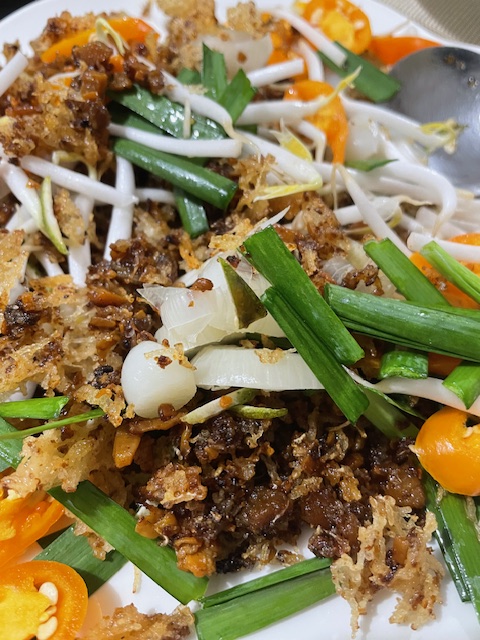
The “muk dat diew” was not the dish that I knew of, anywhere else in the country. There, the squid is dried to concentrate the flavor, and it’s accompanied by a Sriracha sauce. Here, this may possibly be what has happened, but the chef has then dipped the squid in a rice flour, fried it to make it crispy, and plopped it on a plate amongst similarly crispy basil leaves, chilies and garlic. Think “calamari”, but way way better. It is a revelation, and a dish I’ve never eaten anywhere else.

The fish, a whole mullet which took 20 minutes because it had to be grilled over charcoal, was as fresh as anyone could make it, and while most places would make do with the using seafood dipping sauce again, Lung Rom brought us a thick tamarind sauce with chilies and fresh shallots. “Put lots of it on the meat,” he advised, and we did.

If we had regrets after our meal, it was that we did not have enough space to sample the whole menu. But if you were to find yourself in Chumphon with an empty stomach and a hankering for seafood, you could do much worse than going to Lung Rom for lunch. Take it from the Hobblit.

5 Comments

Filed under Uncategorized

What’s Cooking: Aunt Ton’s chicken soup

Memory is a tricky thing. I can tell you the names of all of Taylor Swift’s boyfriends, but I don’t remember if I wrote this post before; I could have sworn I did. If I have, sorry, but I’ve turned into one of those old women who repeats themselves over and over again, with you nodding your head and saying, yes, you told me that already. If not, then, well, that’s a first, at least in a while.

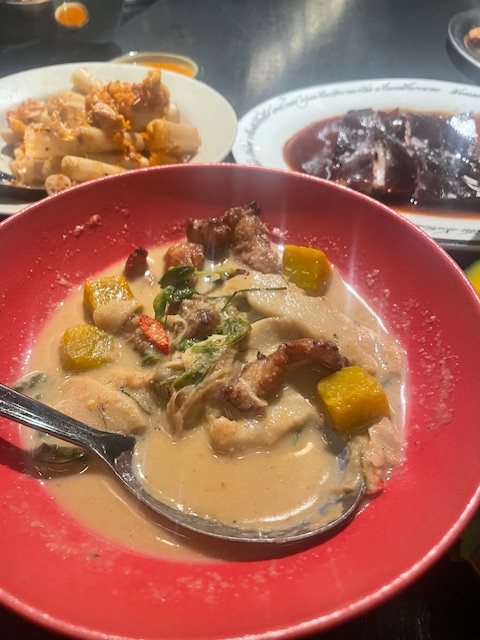
I had an Aunt Ton who is buried in the same cemetery as my Jiao Yai, whom I’ve mentioned before. Even though we are on different branches of the family tree, she would host me every time I was in Chiang Mai, and serve this delicious clear soup made tangy with pickled garlic juice. I think she enjoyed the fact that I could be so easily pleased. Me, being me, never got the recipe from her, or her cook. And then she passed away, and the recipe was lost forever.

So what was left for me to do, besides try to replicate it? (After all, I had a Northern Thai food chapter to fill out for our upcoming cookbook.) It was a clear soup, but too flavorful for gang jued. It didn’t smell like tom yum. And it didn’t have coconut milk like tom kha. It was either a tom kloang or a tom som, and because it had chicken wings in it, I opted for tom som, and substituted pickled garlic juice for the vinegar, adding tamarind and local tomatoes for extra acidity, just like they do in the North.

How did it go? It was absolutely delicious, if I say so myself. Of course, knowing Aunt Ton, she might have thought differently. But, as I said before, memory is a tricky thing, and my memory, for once, was ok with just playing along.

Jiao Ton’s Clear Chicken Wing Soup with Pickled Garlic

Serves 4

Prep time: 5 minutes                                      Cooking time: 30 minutes

  • 1 lb (450 g) chicken wings
  • Enough chicken stock (or hot water with a chicken bouillon cube) to cover the wings, about 2-4 cups (500-700 mL)
  • 2 lemongrass bulbs, crushed
  • 2 slices of galangal, crushed
  • 4-8 makrut lime leaves
  • 3-15 fresh chilies (goat or prik chee fah if your tolerance is low; jinda or bird’s eye if your tolerance is higher. If your spice level is very high, crush these chilies before using)
  • 3-5 dried chilies (if your spice level is very high, chop these chilies before using)
  • 8 cherry tomatoes
  • 6-8 shallots, peeled
  • 3 Tablespoons tamarind paste (macaam piek)
  • 2-3 Tablespoons fish sauce
  • 1 teaspoon salt
  • 3 Tablespoons pickled garlic juice
  • 3 Tablespoons pickled garlic (optional)
  • 1 bunch fresh cilantro and scallions, chopped (for garnish)

First, dry-roast your aromatics in a pan: lemongrass, galangal, lime leaves, fresh and dried chilies, and shallots. Once the chilies and shallots get a little char, and the aromas get pronounced, you can take it off the heat (around 5 minutes) and set aside.

In a stock pot large enough to carry the chicken wings, add chicken stock (or water with bouillon cube, if using) over medium heat. Allow to reach a shimmering surface-level simmer before adding the roasted aromatics for a classic Thai-style infusion. Turn the heat up to medium-high and leave alone for a bit (5 minutes) to allow the flavors to commingle. Add the tops of the scallions too if you have them, because why not? Once the broth reaches a rolling boil, add tamarind, fish sauce, and salt. Taste for seasoning. It should be salty, herbal and tart.

With a spider or tongs, scoop out (or pick out) the aromatics, leaving maybe a chili or two and all of the shallots. Add chicken wings and cherry tomatoes and leave the soup alone for a bit so that the meat can cook (about another 10 minutes). The chicken wings are cooked once the meat starts pulling back from the top of the joint (shoulder). Add pickled garlic juice and, if using, pickled garlic. Taste for seasoning and adjust with more fish sauce and/or tamarind paste if necessary.

Since this was a dish served at a “royal” table, we’re going to remove the bones from the wings. Pick out the chicken and allow to cool in a bowl for a bit. Once you can handle the wings, take the meat off the bones; you’ve done your job right if the meat just falls away (it’s OK if it doesn’t). Put the meat back into the soup and stir. Taste for seasoning again. It should be tart, salty and a little sweet from the pickled garlic and shallots. Leave to simmer for a few minutes (around 5).

Turn off the heat and add the fresh cilantro and scallion garnish. We like a luxurious blanket of herbs, but you can just do a polite little sprinkle. Serve as part of a delicious Northern Thai meal, just like Jiao Ton did.

Leave a comment

Filed under Uncategorized

This is not AI

Flat egg noodles with fish meatballs, a type of bamee

I recently read that a telltale sign of something written by AI is the inclusion of em dashes and colons — essentially, the way that I write. I am pretty sure that people (person) who have been here a while would never accuse me of resorting to ChatGPT, but I still want to explain to you why I write the way I write.

I’m no musician (obviously), but words to me are the melody. Punctuation marks are the percussion. One of my favorite percussionists is Stewart Copeland of the Police, and I like him because he is always surprising you with something that he does, even if it’s on a fairly simple song like “Every Little Thing She Does is Magic” — a song I am fairly sure has been ruined by a romcom scene somewhere involving Nicole Kidman walking across the street or something.

But that is neither here nor there. I like my punctuation marks; I think they add texture. I hate commas that appear in the middle of a sentence that should be two sentences, that is just so irritating to me. I want to surprise … even if it’s not exactly right. If that’s how ChatGPT also wants to express itself, that’s out of my control. In fact, someone quite gleefully informed me a few months ago that ChatGPT can already write exactly like me, and that my services are no longer really needed. So there’s that.

But can ChatGPT do this transition? Meaning: there are the original and ChatGPT versions of food, too. In this case, I’m talking about noodles. Tom yum egg noodles, in fact.

Bamee in broth at Rungrueang (guess which one)

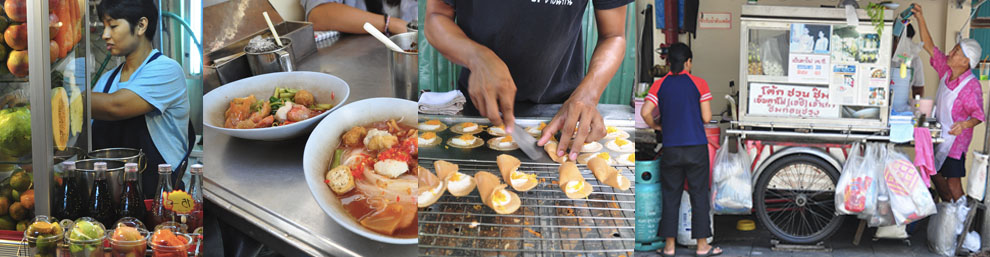
I’ve written about Rungrueang before. There was once one noodle shop, which eventually morphed into two competing (but related) rivals. For whatever reason, both my family and my husband’s family simply favored the right-hand side shop, for no reason other than force of habit. The assumption was that they were both working off of the same original recipe. This remained the assumption until I revisited a couple of weeks ago.

The left hand shop has expanded to across the street, soon after it was awarded a Michelin Bib Gourmand. For that reason, it is considered the “superior” noodle shop, though both are packed at lunchtime. All of the hallmarks of the Michelin Bib Gourmand stop are there: diners lugging suitcases on their way to/from the airport, tense queues full of gimlet-eyed customers, harried waitstaff. To make things easier, there are the dreaded laminated menus (something I used to dread, but which are now at all the street food shops I used to champion). They make ordering easier, it’s true. My husband and I both ordered the tom yum noodles ruammitr (with everything) in broth, and the pork meatballs in broth on the side.

There is a tendency in Thai food to “specialize” one’s own dish with one’s own particular seasonings. My father was a big tinkerer who loved to make his own sauces with whatever he found on the table. You’ll also see it in big Thai group tours to a Western country, where “nam prik”, chili powder and Maggi sauce are employed with impunity. As a result, I have a few (posh) friends who refuse to season their own Western dishes, since this type of flavor customization is such a Thai trait. I believe that noodle shops are the reason why Thais are so free with seasoning things to suit their own palates.

But the “right shop” noodles come already seasoned. I added some pickled chilies because I am stubborn and need to do something, but it wasn’t really needed. The noodles are already salty and a bit sweet. The reason for this, I imagine, is because so many non-Thais are eating there, and they do not have that ingrained desire to mess around with everything. These noodles are meant for them.

To be fair, my husband and I ordered the exact same thing at the right-hand shop: bamee tom yum nam and luk chin moo. There were already differences on the (also laminated) menu, with a couple more side dishes than at the other shop. When the broth arrived, it had the addition of lettuce leaves to make it sweeter, a sort of (now) old-fashioned flourish. And the noodles were definitely made with the Thai predilection for tinkering in mind. I added fish sauce, lime juice, pickled peppers, and a little sugar. I found it more delicious, if only because I felt like I had a part in making it myself. Isn’t that why all Thais do this to noodles?

Pork meatballs at the right-hand shop

So which one is the ChatGPT and which one is the original? I leave that up to you. Time changes all of us, and progress renders us all obsolete in one way or another. Happily for the Thai noodle vendor, the making of good guay thiew has yet to become fully automated. Until then, we should celebrate every bowl that finds its way to us, already seasoned or not.

2 Comments

Filed under Uncategorized