Glutton Onboard: Pit stop in Penang

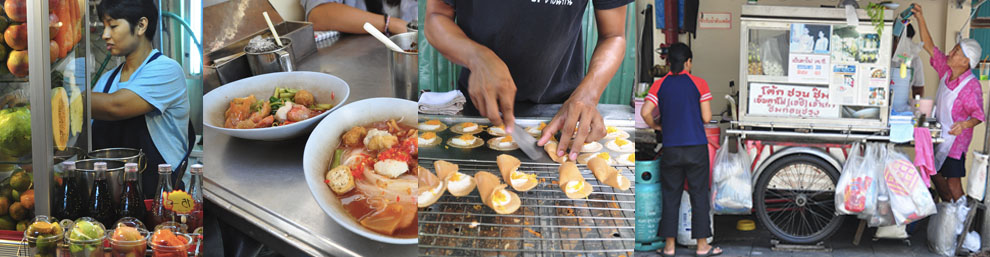
Penang’s “king of noodles” at work

If there is one thing that has been made clear during my world cruise so far, it is the noxious effect that colonization has had on every country it has touched. Some countries, like Papua New Guinea, have been left like empty husks sucked dry, shriveled shadows of what they might have been had they not met the likes of the Dutch; others, like Samoa, held onto simply as an accessory, divided up without its knowledge among strangers who wished to keep up with their neighbors.

Then there is Vietnam, once under the French, who were able to take back their independence after many bloody years. As much as the French claimed to have used colonization as a vehicle by which to spread their culture, quite a few of their subjects appear to have been unwilling to receive this particular gift — Northeast Thailand, full of Vietnamese communities who fled during French occupation, can testify to that.

And then there are the British. Although I personally have not experienced overt colonization, much less by the British, their way of doing things came back all too vividly after a rewatch of the movie “A Passage to India”, based on the anti-colonialist book of the same name by E.M. Forster, which was screened on, of all places, the television on our cruise ship. What I saw was that the British were particularly clever in enriching themselves on your resources, all the while convincing you that they were doing you a favor in doing so. It is a particular skill that, for example, persuades you to go to a garden party at a “whites only” club where you will not be allowed to sit, eat, or take shelter from the sun, and feeling thankful for the so-called privilege. That, in a nutshell, is being part of the British Empire. It made me better understand the prevailing attitudes around the current King Charles and his upcoming fancy hat party.

It made me better understand a lot of things, actually. Although the time for these types of empires is fading, colonialism lives on in a more modern, pertinent way, via capitalism. Like in the days of the British Raj, capitalism prescribes that some people are treated better than others, this time in accordance with how much they are perceived to be able to consume. This is usually dictated via the old rules of colonization, which tends to draw things along racial lines. Hence the old resentments about ancient jewels on crowns, and the toppling of statues, and the demand for old marbles. These are the only actions available to people who cannot protest the system that they live in.

But the most pernicious effect of colonization isn’t poverty. It’s that, when you are accustomed to being treated as “less than” by others, you persist in treating yourself (and others like yourself) as “less than”, even when the others are gone. Events like the ascendance of the Khmer Rouge and Idi Amin are pointed to as evidence of a people not being able to govern themselves, when really they are reactions: what does it matter what they do, when it’s just themselves after all?

This is a strange intro for a post ostensibly about food in Penang, but it feels like it can’t really be helped; colonization hangs like a ghost over every street.  Unlike Kuala Lumpur, which, as global as it is, still feels like a city made by Malaysians for Malaysians, Penang — with its shabby-chic shophouses and well-kept forts — hearkens back to another time. Many people enjoy that feeling; for whatever reason, Penang’s particular brand of charm left me cold.

What did not leave me cold, of course, was the food. Malaysians like their food like their durian: heavy-hitting and potent, intense almost to the point of bitter, just on this side of ponderous. Indeed, Malaysian food tastes like how dark soy sauce looks: glossy and inscrutable. We got our first helping of these flavors at Tek San, which was packed to the gills with the lunchtime crowd. Our generous hosts joked that our meal here would only be an appetizer, a threat that I, alas, did not take seriously. We ordered a dark, shiny stir-fry of lardons and another of pork with capsicum; black-flecked tiger prawns; three-layer pork with soft taro; chili-laced clams; and a stingray curry with okra. All packed enough of a flavor punch for three times as much food, but our hosts weren’t finished.

Two kinds of pork at Tek San
Stir-fried clams

Instead of taking us back to our ship, they took us to see Uncle Tan, dubbed the “King of Noodles” in Malaysia by the BBC. Also known as the “Goggle Man” for the goggles that he wears while cooking, Tan Chooi Hong is famous for his char guay thiew, made with flat rice noodles charred by a supremely hot wok and topped with prawns. Accompanying him were vendors serving oyster omelets, lo bak (various types of tofu on skewers with a dipping sauce), assam laksa (a type of noodle special to Penang), and cendol (green rice flour squiggles with red beans, shaved ice, and coconut milk).

Assam or Penang laksa
Oyster omelet

I’ve had oyster omelets before and the one here is generous, with lots of big, plump oysters on top; the char guay thiew, as well, was familiar yet delicious. What I was most taken by, however, was the assam laksa, which, after its first swampy sip, somehow ingratiates itself to your palate. If Thai food has a funk, this one has a whole symphony of it, a mix of nam prik gapi (shrimp paste chili dip), gang som (sour curry), and nam pla waan (sweet fish sauce) that is leavened by slices of fresh cucumber, pineapple chunks, and glass noodles. Against all my expectations, I ate it all, leaving only a little room for the lo bak and cendol.

Even with all the wonderful food, I must admit I was relieved to finally be deposited by our hosts back to the ship, having had as thorough of a taste of Penang as was humanly possible. I honestly don’t know if I will be back, but I do know that if I do return, it will be for the food.

Cendol

7 Comments

Filed under Uncategorized

Glutton Onboard: Reexamining Singapore

The spread at Ng Ah Sio Bak Kuh Teh

In many respects, Bangkok is locked in a rivalry with Singapore, but it’s one that Singapore doesn’t really know about. It’s like the rivalry between the Cleveland Browns and the Cincinnati Bengals, or between me and Martha Stewart — one side constantly pushing, pushing, the other side going “who?”

So it makes sense to view Singapore with a little bit of trepidation, especially since it’s the one buzzword that every single official in Bangkok’s government chooses when asked about the “vision” for a future Bangkok. When Thais claim to want Bangkok to turn into Singapore, what they mean is “orderly streets”, “clean sidewalks”, “rule of law”, and an obliging, compliant populace. You and I both know that this is never going to happen in Thailand (the ban on online porn alone is impossible). Yet the officials continue to bang their Singapore drum, clearing out the low-hanging fruit, like mobile vendors…(uh, that’s it because no one wants to make the effort to fine litterers) on a quest to one day, some day, be like Big Sis SG, wildly divergent GDPs be damned.

Singapore is often the brunt of jokes from other Southeast Asians. “Disneyland,” sniff some, and “sheep,” decry others; “They stole all our dishes,” claim the Malaysians, who have a case. Yet the evidence is clear — Singapore is a beautiful city, run very well, even if wealth and power are all centralized and the whole system vulnerable to a Singaporean Trump who can ruin everything. The restaurants are good, the parks are lovely, and the hawker centers are well located and clean. It’s little wonder that visitors who view the chaos and arbitrary nature of Thailand and Cambodia as frightening find refuge in the logic inherent in a place like Singapore…even if the service still, even now, kind of sucks.

I can say this because my husband, once again, was miffed after a server bearing a tray laden with soups shouted at him to get out of the way. This was at Ng Ah Sio Bak Kuh Teh, a longtime favorite of the family and much looked-forward-to by a person who professes bak kuh teh, pork ribs stewed in a peppery broth with rice, one of his favorite dishes in the world. Our server was nicer after, with typical Chinese straightforwardness, he noted, “Oh, you ordered a lot.”And we did: there was also three kinds of tofu, and pickled cabbage, beef liver, boiled peanuts, deep-fried crullers, and a smattering of greens. “It’s very light,” he reassured us, noting my stricken face on seeing the crowded tabletop.

The lay of the land

The verdict? Honestly, meh. The meat clung to the bones like Bangkok officials to a Singapore map, victim to too few hours in the soup pot. I told my mother-in-law that she made a better bowl, and I meant it!

That evening, when everyone else was celebrating the end of yet another leg of the cruise at a beautiful venue with too little food, my husband and I met our friends Khim and Galen at Chin Chin Eating House, famous for its Hainanese chicken rice, which is one of Singapore’s national dishes (even though it’s from Hainan?) We got there at 7pm during a torrential downpour, and no chickens were hanging in the window, prompting a mini-panic attack from my husband. “Quick, reserve one!” he said, prodding at my arm, but I was adamant that we would be fine, since the flood of people seated after us would have seriously revolted if left without chicken on their tables.

Prawn mee

Because Galen and Khim might have felt bad for being a bit late, they ordered EVERYTHING: half a chicken, four bowls of fatty rice, sambal-laced morning glory, dou miao (a kind of Taiwanese sprout, seen on every table), a smoky char guay thiew, a mountain of prawn mee, and most intriguingly a “pork chop” with gravy and peas resembling the dish found at Thai cook shops, first started by Hainanese chefs in Bangkok many decades ago.

Chin Chin’s pork chop

Unlike in Thailand, the pork chop is served with the tomatoey gravy on the side, so that the pork retains its tonkatsu-like crispness. I have to say, it’s a great idea.

Half a chicken at the place famous for it

As for the chicken rice, well, both Malaysians and Singaporeans make a much bigger deal over the taste of the chicken and the quality of the rice than we Thais do. Yes, indeed: chicken rice is made by steaming the chicken and cooking the rice in the fat that drips off the flesh, yadayadayadayada. Thais only care about the sauces, and here at Chin Chin? You mix your own. I’m not sure whether to be outraged or elated. My only real criticism is that they do not give you enough fresh garlic or chilies, for when you really want to go Thai on a chicken rice’s ass.

The next day, we walked through Tiong Bahru Market, which hosts a fairly famous food center with not one, but TWO Michelin-starred vendors. There were no Jay Fai-level lines, and no hysteria about getting your food before everyone else, unlike at popular food places in Bangkok. It’s sedate enough that I might even be able to take my mother — that’s how orderly I think it is.

It would make sense to sit down and enjoy a meal there, but the real objective of our trip was just down the road, at De Golden Spoon Seafood. Famous for its crab bee hoon, this restaurant sits right in my sweet spot: old, mostly empty, delicious.

Crab bee hoon with a treasure trove of crab roe

But crab bee hoon (crab with rice vermicelli in a gravy) isn’t the only thing you should order here. There’s also black pepper crab, thick enough to stay under your finger nails, and crab swimming in a lake of tomatoey curry, roe-studded crab parts barely visible above the murk. There are razor clams stuffed with glass vermicelli and garlic, and Chinese kale, stems shaved and served in a thin hoisin sauce. And there is chicken fried rice, for your son who eats nothing.

Razor clams

What transpired was my favorite meal in Singapore, in a fairly rundown restaurant resembling the eateries you find next to the gas station on the highway in Southern Thailand. Cooks were wildly generous with the crab roe, the crabs themselves enormous enough for us to suspect they hailed from Australia instead of Sri Lanka. My only complaint is that I did not have enough space in my stomach to eat it all.

2 Comments

Filed under Uncategorized

Glutton Onboard: Giving up the ghost in Vietnam

Beef pho near Ha Long Bay

I can’t believe I truly thought it would be possible, but I really believed that I would be able to maintain — perhaps even lose! — my weight on this cruise. Well, every remaining shred of delusion I might have had when it comes to my weight has been ripped away by my experience in Vietnam, where every second of my visit was taken over with thoughts about what I was eating at the time, and when I wasn’t eating, then thoughts about what I was about to eat. It’s hard to believe that I’ve been to Vietnam before, but did not spend every second of my time planning my next meal. Whatever was I doing?

The truth is that I’ve come to appreciate Vietnam over time; it’s not a “love at first sight” kind of thing like I’ve had with Istanbul or Tokyo. My first visit to Hanoi was in the early 2000s, when Karen and I stayed in a hotel where ants roamed freely over our morning baguettes. The meals we had were a total blur, and my most vivid memory of that trip was of Karen purchasing a bottle of snake wine for her brother-in-law, only to have it break open in her suitcase, permeating her clothes with its unique smell.

So I’ve always thought I was fair-to-neutral on Vietnamese food … that is, until this trip. Because I’ve had my head blown off daily by what I’ve been eating, even when it’s vegetarian, even when I’m already full, even when it’s 100 degrees outside and I shouldn’t be hungry at all. Even when it’s in Northern Vietnam, where I believed the food was more, shall we say, “gently flavored”. Even when it’s a place where Anthony Bourdain once ate. Vietnam has blown me away, and I think I am truly in love.

Our first meal was at a place paradoxically named “Pho Thin”, in Ha Long Bay (Só 125, Du’òng 25/4, Ha Long). Although everyone in our party was determined to have some good beef pho (which was really good, don’t get me wrong, see photo above), I felt like doing a little stroll on the wild side by pointing at photos and gesticulating wildly, a method that made me super popular with our bemused waiter. I honestly don’t know what I ordered, but I know what I got: a rice dish that came out of a giant vat looking like this:

The rice dish, which I STILL do not know the name of, came with stir-fried slices of beef mixed with pickled vegetables.

The other dish, which I believe was pho xeo, or “stirfried noodles”, was an entire platter of stir-fried noodles, soft and pillowy, with another platter of stir-fried beef with garlic on the side, both enough for a Thai family of four.

Set at each table was a battery of accompaniments, including fish sauce, pickled garlic in its juice, fresh limes and chilies, an entire container of MSG, and THREE different chili sauces. Interestingly, none of these sauces were like the American-style Sriracha sauce; two, however, were similar in flavor to the Thai kind. Everything was good enough that I didn’t notice until after the meal that one of the sauces I had been using liberally was months past its expiration date.

On a tour excursion to a Zen monastery the following day, we lunched at a vegetarian restaurant housed in a sort of park that sought to recreate the Vietnamese village experience, but with $300 agar wood bracelets and knick knacks. Even in the midst of this Epcot Center nonsense, I was delighted. Our guides literally showered us in food, a near-unending parade of dishes so numerous that our table couldn’t hold it all: lotus roots with goji berries, two types of soup, a scrumptious eggplant stir fry, veggie tempura, imitation baby clams on a giant sesame cracker, more veggie stir fries, etc. A particular favorite of mine were the mushrooms cooked in coconut juice and plated in an empty gourd.

The next day, we alighted on Hoi An, a UNESCO World Heritage Site where the streets are mobbed with tourists and rickshaws pulled by porters shouting “beep beep” at you every 10 seconds. In spite of all this, I absolutely loved it. Registering our interest in banh mi, our guide dutifully took us to the extremely packed Banh Mi Phuong, made famous from Anthony Bourdain’s “No Reservations” show. Of course, his visage was featured prominently on the wall, as well as on the sandwich wrappers. While our guide recommended the “mixed” banh mi, my favorites were the cheese with onion, as well as the cheese with garlic (I’m basic when it comes to banh mi).

After Hoi An, we headed south to Ho Chi Minh City, where on yet another tour excursion we were generously invited to make pork-and-shrimp dumplings. It will come as little surprise to discover that I am not very good at making my own dumplings. I am, however, good at eating them.

Superior dumpling makers

Besides the wontons (they wisely fed us with the ones they’d made, because we would have refused to eat our own), deep-fried with a sweet chili dipping sauce, they gave us bowls of the wontons with shrimp in a clear pork broth, as well as the pork meat used to make the broth itself:

Needless to say, I enjoyed myself yet again, and did so on the next day as well, when, post-tai chi routine in the park (done to stirring music, with enormous fans), we visited a vegan restaurant called Ba Xa, which roughly translates to “my wife”. To our amazement and delight, we were told we could order one of anything we wanted, but no one else on the tour wanted to coordinate and share our orders (too much like socialism?), so my daughter, sister-in-law and I each made a mini-meal: the “wife holding hands” noodles, the “wife salad” (version 1), and deep-fried spring rolls.

Wife holding hands noodles
Wife salad 1

The dishes were genuinely good — so much so that it was not until halfway through our meal that I noticed that the stuff I was seeing on the TV screen on the wall was genuinely bonkers: an Asian woman who dressed up in various different outfits complete with detailed makeup — as a red-headed white man, as a black woman, as an older white man dressed as a leprechaun — exhorting the benefits of veganism and condemning meat eaters to die in the flames of hell.

Unwilling to stop our marathon of Vietnamese food and just waddle back off to the ship, we continued on in town, opting to walk to our next stop: Mama Pho, thankfully air-conditioned, and again outfitted with Thai-style Sriracha sauce. Even with our tummies bursting, we ordered a bowl each: the standard Mama pho, in a broth of beef bones, ginger, burnt onion, cardamom, star anise and cinnamon, all boiled for 18 hours; a pho in a beef stew broth; and a “dry pho” of mushrooms and tofu, which in Thailand is basically “nam yak”, or the broth served separately in a different bowl. This one was my favorite, which was lucky because it was my own order (sharing is socialist!).

It was after our second lunch, and only then, when we deemed ourselves ready to go back to the ship. Completely stuffed, we managed to run to catch the waiting shuttle bus without throwing up. We boarded the ship on time and without incident.

Back at the room waiting for me were three banh mi sandwiches, brought back by my husband. Of course, I ate them.

5 Comments

Filed under Uncategorized