Papua New Guinea might not be where your mind first goes when you think about luxury. Yet it ended up being one of the most luxurious meals I’ve ever had. Riding along the potted road — built by the Americans to move their weapons and machinery during WWII — I was struck by the gorgeous, verdant scenery, the lushest I’ve seen yet, a broad, uninterrupted swathe rimmed by a restive, deep blue sea on one side, and thickly forested mountains wreathed in fog on the other. Our guide told us that the creeks and rivers, currently tamed, frequently flooded over the roads, occasionally strengthening enough to wash cars away.
Where we were headed was a village, where we would be taught how to cook “authentic” PNG food. Now, I dislike the word “authentic” and how it is used to either market or police food cooked by others, but Papua New Guinea remains free of this type of navel-gazing. In a place where electricity is shut off during the day and rainwater must be collected for day-to-day use, “authentic” is whatever you can get that day.
At the village, we are greeted by the chief and his sisters, with a passel of young people behind them. Families live together in each house, and everyone — older children included — appears to care for the babies and toddlers together. Banana trees flourish in profusion, and gardens abut every house, bristling with pumpkin and squash shoots, sweet potatoes, taro root, corn, cassava, and … what else is that I see? Long beans? Cherry tomatoes and eggplants? And what is that behind them? “Kam kung,” they say, and I recognize it as our own “pak bung”, or morning glory.
“Morning glory?” says Maureen from Vancouver next to me. “Usually we’re trying to get rid of it, not eat it!”
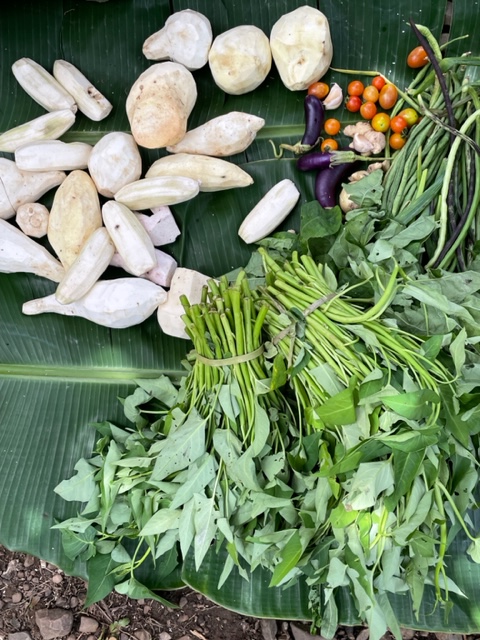
The root vegetables are quickly peeled with paring knives and chopped into bite-sized pieces by mothers and children alike, every one taking part in the meal preparations. What they are preparing is a “mu mu”, which I normally think of as something that I wear, Mrs. Roper-style, on an almost daily basis. Here, it is a big celebratory feast, the ultimate party meal: in this case, made for three busloads of strangers that they’ve only just met.
Next to the vegetables, a young man sits on what Thais would call a “grathai”, shredding the coconut which will later be squeezed into milk to season the meal.

The vegetables, once cut, are eventually bundled onto a large metal “roasting pan” lined with banana leaves. A few feet away, the men are busy cutting what appears to be a mountain of chicken: frozen from the supermarket, not the large rooster and hen looking on from behind a clutch of bushes off to the side. If there is one thing I’ve been especially struck by in my travels so far, it’s how safe and unmolested the chickens have been, from Easter Island to French Polynesia to Papua New Guinea. They run freely along roads, screeching at passersby, pooping on footpaths, making general nuisances of themselves. You and I both know where they would be in Thailand: plucked, beheaded, chopped into 8 pieces and sizzling in hot oil in a wok somewhere. Apologies for the anti-chicken sentiment, animal lovers.
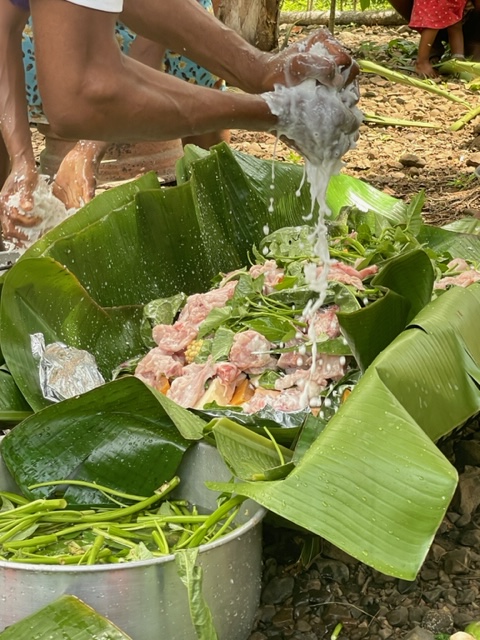
Once properly butchered, wings separated from breasts and thighs separated from drumsticks, the chicken are laid on top of the vegetables, and the coconut meat that has been painstakingly scraped from the shells is bundled into cloth and squeezed with water onto the whole shebang, to which a generous knob of ginger, cloves of garlic, curry powder and Maggi sauce have been added. Then what appears to be an entire roll of aluminum foil is laid over to cover, and then layer upon layer of banana leaf on top of that.
This whole thing is then laid into a shallow hole in the ground, prepared just for this purpose, where rocks have been heating this whole time. The rocks must be moved aside; this is another long, hot, back-breaking process involving one shovel, a pair of giant “tongs” made by a bent bamboo stalk, and the emptied halves of coconuts. The meal is then lowered and covered with those very same rocks that they have spent all that time removing. There it will stay, for 1-1.5 hours.
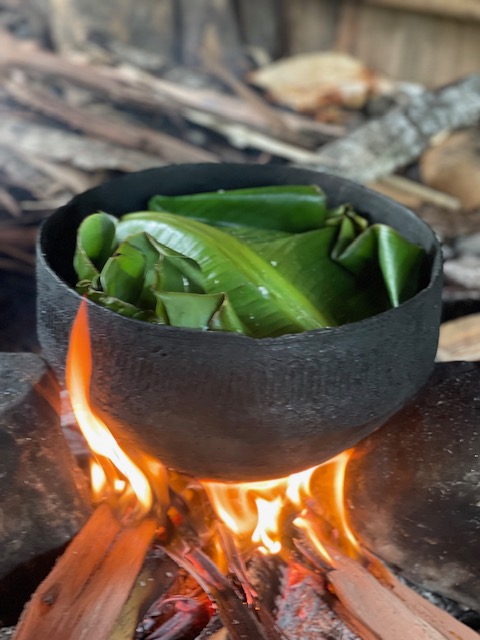
If this sounds like a very long and arduous process, that is because it is. But sometimes people are not so patient, especially if they are hungry. The villagers have attempted to assuage some hungry tummies with “snacks” steaming in banana leaves, heaped into pots set over open fires.
(Photo by Wikki Bhanubandh)
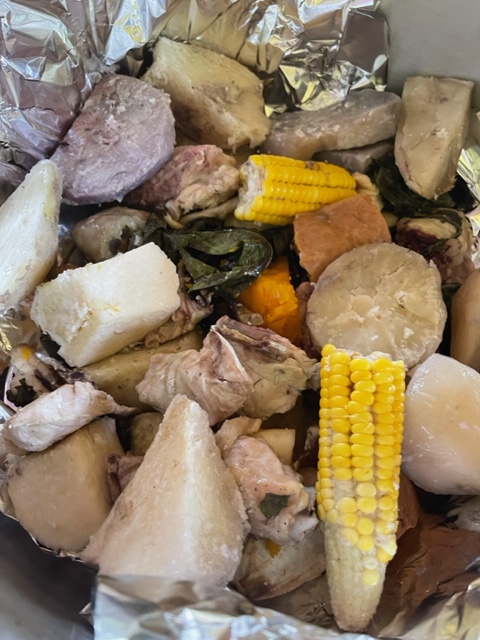
Inside those leaves, there is sweet potato, corn, and some delicious ibika leaves strongly resembling the greens that line the bottom of a Thai “hor mok”. Yellow watermelon, fresh ripe mango, and pineapple are also laid out on plates. But the heat has made some people cranky. “We’re leaving!” bellows one woman, and the first busload leaves, hardly an hour into the cooking process, in a rush for the shipdeck American barbecue buffet.
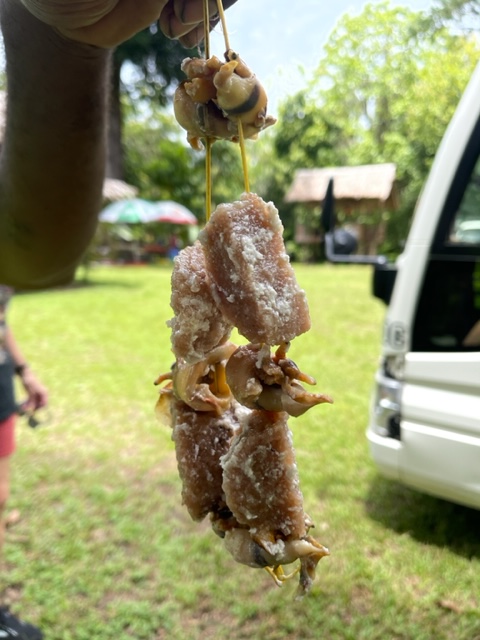
Perhaps feeling the pressure to feed these visitors who seem so hungry, we are offered some alternate snacks. My nephew Weka is offered a snack of snails on skewers, steamed with taro root.
(Photo by Wikki Bhanubandh)
Elsewhere, at the site of where the chief says was the village’s last feast featuring human flesh, Wikki and I are offered the meat of the betel nuts that grow on high trees throughout the village. A young boy, a band connecting his feet, scrambles up to the very top of a particularly towering tree, collecting a sheaf of green nuts and bringing them down just for our enjoyment. Once down, a woman cracks open a nut with her own teeth, revealing the white flesh inside. “Here,” she offers, and of course, the polite thing to do is to accept. The meat is almost aggressively bitter, and tannic like the most inaccessible pea eggplant on your chili dip platter. But like an artichoke, it sweetens the water you drink afterwards.
The woman offers us her own slaked lime, homemade from burning coral and then mashing it into a powder in a mortar and pestle. She uses the stalk of a mustard leaf to put the lime into her mouth with the betel nut, and it is the chemical reaction between all three that turns the teeth red. “You don’t need to brush your teeth because this is calcium,” she says of the slaked lime, and I believe her, because her teeth seemed extremely strong when she was breaking open that betel nut. The effect of all three on your brain, we are told, is increased energy and excitement.
But our betel nut explorations are interrupted by news that the mu mu might be ready. One of the chief’s sisters tests the meat with a small paring knife, and then the hot smoking rocks that cover the pan are removed, again painstakingly, with the same modest utensils. The pan is lifted out of its hole and brought to what the chief calls “the business arena”, the main building where the pots have been steaming snacks all day.
Alas, when the banana leaves and foil are uncovered, the meat isn’t cooked. It’s still pink. In the villagers’ eagerness to feed everyone, they have piled on too much chicken for only an hour’s cook. We will have to wait another 30 minutes. Unfortunately, the second busload decides that they, too, will say goodbye. “They tried,” one of them says as they board their bus, but really, what I am thinking is that they meant “We tried.”
There is no way the rest of us left are leaving. We will be getting fed at this village even if it means we’re staying until the next cruise ship excursion tour finds its way here. We know where all the food is, where the bathroom is, even how to chew our own betel leaf. We can pluck mangoes from the trees and pry snails from the leaves. We might even teach the villagers to collect the red ants from the bark and to throw them into a vat of heating coconut milk for a bright hit of acidity.
But the villagers are saved from our continued presence after 15 minutes, when the chief’s sister decides that the edges of the pan are ready for consumption. Those items are scooped from the pan and placed into bowls, set up into a sort of impromptu buffet in the business arena. We the guests have already broken two of their wooden benches, so we sit perched on the mezzanine made of bamboo, which thankfully still takes our weight. Some children play peek-a-boo with us from open windows, while a group of girls plays with another guest’s long blond hair, braiding it into elaborate plaits.

Sitting with my bowl made of woven banana leaves, eating my food with a bamboo skewer, and drinking from my own little coconut, I am struck by how the villagers have given me a new appreciation for what hospitality really is. In the midst of all of their challenges — weird demanding foreigners, tourists wandering into random homes to snap photos, the constant demand for food, drink and entertainment — they set out an enormous meal, sans electricity and running water, in the broiling midday heat. They put on a dance show, made chitchat with all the guests, and even hosted a walking tour, showing various points of interest like the pool of water that former chiefs used as a “mirror” to fix their hair. Really, the generosity seemed the epitome of luxury, to me: in the midst of what would appear to us to be very little, the abundance of so much sincerity.
 Bangkok Glutton