An Update on this Blog

Our offerings to the water dragon gods

I am sadly unable to write everything I had meant to write before my departure for the US, so if you’re hoping to get some awesome info on epic Thai culinary bangers, you’ve come to the wrong place. Apologies! Instead, I will be giving my reader(s?) a service announcement. Breaking News (or is it now Important Update, as per CNN? I’ve lost track): I am going away for 6 months.

But that doesn’t mean that I am going to be posting less. In fact, I will be posting more! Starting on January 7, I will be leaving Miami and embarking on what is expected to be a cruise around the world. I will be hoping to post (WiFi willing) from each port of call, starting with Grand Cayman or Colombia (plans keep changing, necessarily I suppose, because of various regulations. I have not been to either country so I do not have an opinion, but my sister pointed out that I would be able to hang out with Armie Hammer if I ended up in Grand Cayman. This is ludicrous, of course. I am not Armie Hammer’s type).

The fluidity of our plans, then, points to various other factors which will be out of our control. As you and more importantly, I, well know, cruises are well known for being incubators for disease. And although I have been told repeatedly by various people that Covid is over, some ignorant people who have not gotten that memo are still catching it! Why hasn’t anyone told them?

That’s not to mention norovirus, which, quite frankly, might be even worse to experience on a cruise ship than Covid (which one would you choose if you had to? It’s like choosing between Hitler and Pol Pot). And that’s not all! Cruise ships are also prime locations for disappearances, either on purpose, or not so much so. Throw in the fact that I’m cruising with my in-laws, and all sorts of shenanigans could ensue.

Obviously, it would make sense to make sure that none of these things ever happens to us. What better plan, then, than to make offerings to the temple of the water dragons in Nakhon Nayok? So on a sunny Saturday afternoon, we drove two hours to this temple, in time to make our offerings and say our prayers at the auspiciously selected time of 3:09pm. What I assumed would be a quick jaunt with incense and some chanting ended up being a 1.5 hour marathon of merit-making, replete with not one, not two, but three performances by a couple of very talented Thai dancers. It was the most rigorous Buddhist merit-making that this particular Presbyterian has ever been to, but then again, it is a six-month cruise.

Now all we have is the uncertainty of what will face us. Will it be fun? Will it be exciting? Will we make it all the way to Barcelona in June? Will I be dead? Only the water dragons know. Until then, here’s (hopefully) a clip of the very talented dancers at work.

12 Comments

Filed under Uncategorized

Soft Rock Classics

A bowl of guay jab at Oun Pochana

I find that I am frequently starting my posts with the announcement that I had intended to write something else and was suddenly diverted from my brilliant plans. That is once again the case today, after learning of the death of Christine McVie at 79. Like Christine McVie herself, her manner of death was not strange or out of the blue — she had lived to a decently ripe old age. Classy to the end, her departure was met quietly with little news on her side; her bandmates weren’t even informed of her illness. The outpouring of grief came afterwards, after she was gone. It’s the way I would have liked to go, if I had left behind a body of great songs and a long history of performing for millions of fans.

Christine McVie wrote well-crafted, catchy, and understated pop songs that erred on the side of classy. Obviously, it is strange that I would be a fan. But it’s not just her songs that I enjoy (I’ll admit it now that I’m old, my favorite composition of hers is “Got a Hold on Me”) but her whole persona. It takes a very interesting and secure woman to allow Stevie Nicks the creative (and literal) space to twirl around in her scarves and skirts, singing about witches and gypsies, as she stays at her station, behind the keyboard, off to the side of the stage, doing her job. It takes a smart woman to last, period, among all the drama queens that Stevie, Lindsay and Mick surely were (especially during their cocaine — I mean “Tusk” — era). And of course there were the mutual heartbreaks over the course of recording “Rumours”, and the ways they were used to fuel that incredible spasm of 24-karat creativity; I admire all of it. It’s inspiring for me to see her, on my laptop screen or on TV, exhibiting excellence in her own way. Not everyone has to be Stevie Nicks, you know.

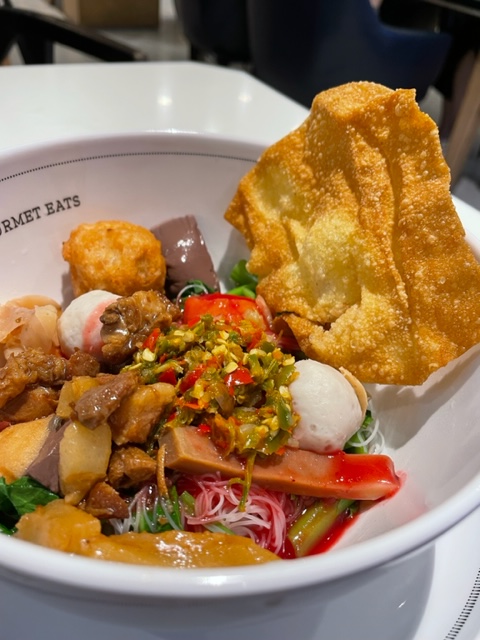
For over half a century, Chanchai Tangsupmanee — aka Nai Oun — toiled away in front of an abandoned movie theater, chopping up pig parts in the sweltering heat by the side of Yaowarat Road. He was no wealthy hitmaker, and few would call him a genius. But, at his street food stall Oun Pochana (MRT Wat Mangkhon), he was an artist in his own way, churning out bowls of pork noodles for the masses. After decades in obscurity, a huge number of loyal customers brought this humble guay jab vendor to the attention of none other than Me Myself (and also later Michelin). The fact that these accolades all came from a simple bowl of rolled Chinese noodles swimming in broth with pig parts and a boiled egg is fairly remarkable. It’s even more remarkable that it’s for guay jab nam sai (clear broth), arguably less popular than its nam khon (thick broth) counterpart due to the impression that clear broth hosts less flavor.

Now, guay jab is no Stevie Nicks. It doesn’t compare, glamor-wise, to other dishes like the noodles on the sizzling hot plate and the morning glory in the wok with the flames reaching up into the heavens. It doesn’t even compare to other soup noodles: egg noodles in tom yum broth leaves it in the dust when it comes to Instagram, and even a bowl of lowly fish meatball noodles with a spray of deep-fried garlic manages to outshine it. Let’s not get started on braised beef noodles. Face it, guay jab is not a pretty dish.

What set Nai Oun’s bowls apart from the rest is the broth, which is clear, yes, but also peppery and full of pork flavor, yet still also clean-tasting. There really isn’t anything else like it on that street, and that is saying a lot. Even after Nai Oun passed away from Covid, and his son Adulwitch took over, the bowls remained the same. If anything, the crowds have gotten larger and more insistent. My last visit there, I was seated so far back I was reminded of the time I visited Oun Pochana’s bathroom (don’t ever do this). Oun Pochana’s popularity has only grown over the years, turning this vendor into one of the road’s few real must-trys, even among native Bangkokians. A bowl of hand-rolled noodles with pork did that, a sign of real craftsmanship with staying power.

3 Comments

Filed under Uncategorized

Nostalgia, sort of

Spaghetti Naporitan at Kelly’s Another, my fave so far

To my dismay, I have not been able to return to Japan, making it almost three whole years since I last set foot on the Land of the Rising Sun. To make up for this, I have been experiencing Japan vicariously through — what else — the TV, even going so far as to overcome my distaste for Ansel Elgort’s face to watch the entire first season of “Tokyo Vice” (which is very good).

But my favorite of the “vicariously living in Tokyo” programs are, of course, the food ones. There is “Midnight Diner”, where each episode features a dish that becomes the theme that day; unfortunately, it’s marred by the fact that the customers are forced to order the same thing every time they pull up to the bar, a sort of culinary “Groundhog Day”. There’s “Gourmet Samurai”, where the protagonist overcomes dining-related embarrassments (the horror!) by conjuring up a more handsome, younger alter-ego who is so macho that he is willing to try new ingredients in his oden! There is also the Road to Red Restaurants List, where a salaryman avoids hanging out with his family on the weekends in order to ferret out restaurants serving “endangered” (read: unusual) foods, and “The Way of the Hot and Spicy”, where another salaryman gets hazed by his coworkers into eating progressively spicier dishes as the series goes on. There’s even “Curry Songs”, which is not really about curry, and made me cry. I have been watching a lot of television.

But none is as dear to my heart as “Izakaya Bottakuri”, where a pair of sisters take over their deceased parents’ restaurant. You not only learn a lot about how the dishes are made, but also about what drinks pair best with them. Through this show, I have learned that carrot tops can be stir-fried and seasoned with sesame oil and seeds; that the broth from stewing chicken wings can be made into a jelly and served as a drinking snack; that tororo (mountain yam) can be grated and cooked on top of a hot plate as a “steak”, topped with dancing bonito flakes. But the most eye-opening dish for me, personally, was the “spaghetti naporitan” (S1, E8), a Japanese-Western fusion (yoshoku) featuring pasta, hot dogs, bell peppers, and a sauce made primarily of ketchup.

Now, I am no newbie to ketchup pasta. Indeed, for years, Bangkok restaurants served only that kind of pasta, at places with “Western” food choices like 13 Coins. I remember my 13-year-old self turning her nose up at these dishes, forcing family members to eat my own “more authentic” spaghetti sauces made from tomato paste and canned tomatoes. Little did I realize then that I was passing on an interesting sliver of food history. I would not remake that mistake.

“Spaghetti naporitan” (spelled that way because it’s the usual way to spell it, not because I’m making fun of Japanese people) is, of course, derived from the southern Italian dish spaghetti alla Napoletana, which is basically pasta al pomodoro. It’s not that way in Japan, though. Said to have been created by a chef at the New Grand Hotel in Yokohama and inspired by the food served to American soldiers, this dish uses ingredients common to Japan at the time to create something Western — a real example of culinary ingenuity, like kai kata. The sauce is a melange of ketchup, milk and Worcestershire sauce; the proper “hot dogs” used are smoked Vienna sausages; the pasta is supposed to be overcooked and soggy. Best of all, it’s served on an iron hot plate, over a bed of beaten egg that can be wrapped around the pasta like a blanket as you eat. Seriously, what’s not to like?

Because I live in a city where the Japanese food is almost as good as in Japan (except for the sushi, which still suffers from the rice), I sought to seek out all of the spaghetti naporitans I could find in an effort to find the closest version to the one at “Izakaya Bottakuri.” My quest started at My Porch , which by night is a karaoke bar but by day is a hotbed of lunch activity for Japanese housewives. I thought of this restaurant first because I used to go often, when I was going through an uni pasta phase (sadly, definitively ended after trying Zac Posen’s uni pasta recipe during lockdown).

As you can see, it’s a fancy plate of pasta, as full of good taste as the other offerings on the menu at this super-classy joint. The pasta is al dente, the protein is bacon instead of hot dogs, and the sauce is made from tomatoes. In other words, not really naporitan. But tasty!

On a rare night out drinking with my sister and her friends, I suggested Kelly’s Another as a post-bar possibility after we discovered that the Teppen on Sukhumvit 61 (sadly, still the only good one) was fully booked. An offshoot of the hugely popular Teriyaki Bar Kelly’s , Kelly’s Another (I can’t with the sequence of words in both names) has a more salaryman-in-Shinjuku vibe (as opposed to the idealized 50s vibe at the teriyaki bar) and a more subdued crowd. Here, I got a tiny plate of naporitan (the servings are small here) that, to me, tasted the most like the one that the customers at Izakaya Bottakuri would have had.

But there were other places ostensibly serving naporitan to try. My friend Andrew agreed to go with me to Kitchen Niigata, an old-fashioned style “diner” that would not have been out of place in the alleyway in Asakusa. The old-fashioned style extends to the table dividers, which I promptly stubbed my toe on. As we took our seats (right as it was opening at 11:30), the room was already filling up. Andrew got what you’re expected to get, the Hamburgu steak teishoku. I of course got the naporitan.

I have to say, it was pretty close. There were hot dogs in there, and the pasta was definitely overcooked. I did taste the ketchup in the sauce. But points docked for no “shakey shakey” (the grated processed Parmesan cheese) or even Tabasco, which seems to be an obligatory addition to every naporitan served in Bangkok.

I did not draft Andrew for my next naporitan at nearby Tonsei , a grubbier version of Kitchen Niigata. As I entered, there was only one other customer there, an older Japanese man reading. Out of all of the places I’d been to, this was the only one where the television was playing NHK. The decor was very much past its prime. This felt like a truly legit place.

I guess this version, of all the ones I’d tried, felt like the most in keeping with the spirit of naporitan (ie. a cheap mishmash of leftover odds and ends). The protein was leftover seafood sausage normally used for the soup noodles. The pasta was overcooked. The sauce was definitely ketchup-y. The cook (Thai) came out to get a look at the person who had ordered naporitan instead of a teishoku. Still no shakey shakey.

So when Andrew and I went to Samurai Diner and they helpfully set down not only the Tabasco but the shakey shakey, I of course went to town when my naporitan arrived.

Alas, it was my least favorite version by far. While the noodles were indeed soggy and the sauce indeed ketchup-based, the sausage (and/or bacon used) emitted an unpleasant smell that no amount of nostalgia could power through. I eyed Andrew’s hamburger steak with envy. Lesson learned: some things are not surefire hits, even when slathered in ketchup.

4 Comments

Filed under Uncategorized