When we line up for food

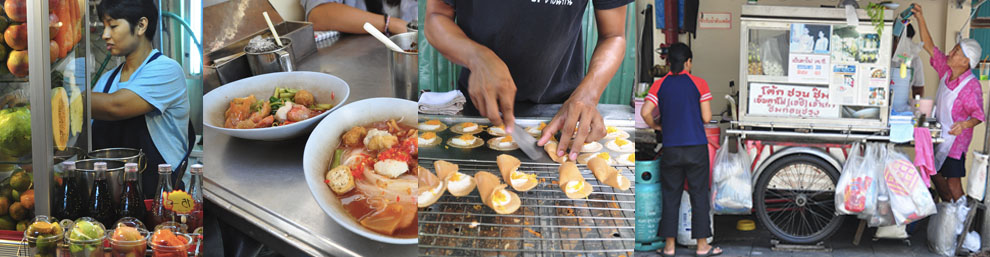
Beef noodles with rice vermicelli in broth at Heng Chun Seng

Some people have asked me about my thoughts on the news about Jay Fai’s recent troubles. To be honest, I don’t like discussing it, because it makes me really annoyed, and I’m trying to cut down on my chances of a heart attack before 60. But what it really makes me think about is how strangely things turn out sometimes. After all, Jay Fai was never meant to be the kind of chef that people waited hours in line for. That was the whole point of her prices.

I first learned about Jay Fai through food writer Bob Halliday, who used to write for the Bangkok Post under the self-deprecating nom de plume “Ung-Ang Talay” (“Sea Toad”). It was the early 2000s and Bob was a treasure trove of information about all the wonderful things waiting to be discovered in Bangkok, a city that until then I had only had surface knowledge about. I suspect he was that kind of repository of information for many people. From him, I learned about homemade streetside samosas in Phahurat alleyways, jade-colored egg noodles on Sukhumvit 38 (now gone), the long-stemmed durians prized most highly by discerning Thais. Thanks to his tireless championing of Jay Fai, my friend Noy had her farewell celebration there, in an open-air dining room lined with hospital-green tiles to eat dishes I rarely ate: “dry” congee, “dry” tom yum, stir-fried crab in curry sauce, drunken noodles, and lard na with prawns the size of my fist.

Needless to say, I was hooked. Anytime someone from out of town, close friend or stranger, wanted to take a bite of “street food”, I took them to Jay Fai first. Some people got it, and some people didn’t (I remember one Chinese news crew who ignored the food completely and decided to focus on the activated charcoal tablets you buy at 7-11). One thing you could count on: there was never a line. The prices acted as an immediate filter; after all, not everyone wanted to pay 350 baht for a plate of fried noodles or 800 baht (early 2000s prices) for a tureen of tom yum soup. If you didn’t think it was worth it, you didn’t have to go.

I remember the night that Michelin gave Jay Fai a star very clearly, because I was there that night. It was 5:30 in the afternoon and empty, and I was waiting for my friend Robert to show up. Jay Fai suggested I get the “suki hang” and I did, and of course it was good. She asked me if I also wanted the poached fish with dipping sauce (she was always asking if I wanted something else, because that’s what she did with all her customers) and I thought no, I’d get it some other night, not realizing that I’d never see that dish on her menu ever again. The next day, my friend Winner sent me a photo of an enormous line in front of her shophouse, looking like a line for sushi at Tsukiji Market. I was happy for her, but I knew that my time there was effectively over.

Some days, I think that maybe the Michelin star was more of a curse than a blessing. The moment that news was announced, the tax authorities were on her back, tallying up all of the dishes she sold and comparing them to the taxes she paid. Now they are back, because an influencer came with a regular customer who always ordered the crabmeat omelet (why) “VVIP style”. He never complained about the prices, but she didn’t know he wasn’t picking up the tab. So now the trusty Bangkok authorities are back: the tax people tallying up her sales, the Commerce Ministry fining her 2000 baht, and the government threatening jail time after the fine was seen as laughably small. What this tells me is that I need an influencer who can make a social media post about the huge pothole in front of my house.

We know why the government is up Jay Fai’s ass, but we can spell it out all the same. The fact is, her success is galling to these people. If there was a person who could stand as an ambassador for Thai food, why should it be her — a former seamstress from a working class background, no high-society connections, no blue-blood pedigree, not married to anyone’s cousin, not even a cooking show on channel 3? Specializing in a food that is eaten by everyone — fried noodles, Thai omelets, nary a curry or obscure chili dip unearthed from a cookbook from the 1800s in sight? How is it that this woman — who is elderly, mind you, and not even a fashion model — would capture the international imagination so thoroughly that the mere photo of a wok over a charcoal brazier is seen as a reference to her? Good Thai people don’t understand this. It seems unfair.

The lesson I am getting is that there are places (and people) that people line up for, and that there are places (and people, I am one) that are a more acquired taste, and that this is okay. “Crossing over” may sometimes be more trouble than it’s worth. The flip side of this coin, of course, is when a shophouse draws people from all corners of the city to a ramshackle old storefront on the fringes of Khlong Toey market — no fanfare, no hype, and definitely no Michelin star. That place is Heng Chun Seng.

My friend Andrew took me here when I was trying to map out a walking tour of Khlong Toey market. It turns out that this place has been a favorite for decades, from back when Andrew’s father was young. Today, it seems more known for its hot pot (it was on every table), but Andrew recommended the soup noodles, which are ordered with your choice of cut: shank, meatball, sliced, stewed, tendon, tongue, heart, liver, stomach, intestine, even spleen. There’s even a pork option for people who don’t eat beef.

There’s a long line. As with all long lines, there’s a hard-working and long-suffering man working it with notepad and menu in hand, taking your order so that when you do sit down, your food will come as soon as it can (there’s also a hard-working and long-suffering woman who works the kitchen, mostly alone). And yes, as with all long lines, there’s a lot of waiting, both before and after you get seated.

Is it worth it? Well, I was happy to eat at Jay Fai pre-Michelin star, so maybe you don’t want to take my word for it. Try it out for yourself. What I can say: don’t order the “fresh” sliced beef, which gets tough before your eyes, and order the hotpot only if you have native Thai levels of heat tolerance (and I’m talking about the temperature outside when I’m saying this). What you don’t have to worry about is this place being a fad and disappearing into nothingness, Bangkok-style; it’s been here for decades and is likely to be here for many more … as long as they don’t become too famous.

Leave a comment

Filed under Uncategorized

Getting Real (aka What’s Cooking: Sukhothai Noodles)

I apologize to the person who reads these posts, because I haven’t been writing them lately. I have been busy on a project that is exceedingly difficult, mainly because the system they make us load our content into makes me want to shoot myself in the face. So I thought I would take a break from painstakingly inputting the latitude and longitude of every place I’ve ever mentioned to write a little ditty after reading a street food proposal paper that my friend sent me.

It rubbed me the wrong way, probably because, once again, it proposes to turn Bangkok into Singapore without making Bangkok as rich as Singapore. According to a quick Google search, the average monthly salary of a Singaporean is around US$5000. The average salary of a Bangkokian is between US$770-1,500. Now, I am one of those trash Asians™ that cannot do math, but I do know that those numbers are not the same (I am Asian so I can make this joke.)

The mention of authenticity in cuisine is also jarring to me. When people start to talk about “authenticity” in a policy paper about street food, it always puts me on alert that they may use it as a cudgel to portray other (cheaper, “lower-class”) food as “inauthentic”. Chef Num of Samuay & Sons (a chef I personally admire) once told me that authenticity was a Western concept, and I totally agree with him. I’d go one step further and say that it is a trap. Authenticity was born when Western people started eating other countries’ food and then wanted to gatekeep other Western people from pretending that they knew about said food. Because Thais are good at adopting everything, they adopted this idea, and now have started using it on themselves. Unfortunately, authenticity as performed on a cuisine like Thailand’s promotes a hegemonic ideal of what Thai food is supposed to be — an ideal that is typically Central Thai and upper-middle-class to upper-class. Because Thai food was invented in royal kitchens, “authentic” Thai food becomes whatever is associated with the aristocracy or people adjacent to the aristocracy. The mere fact that an “authentic” recipe can be looked up in an ancient cookbook means that it’s an aristocratic recipe, because those were the only people who could read and write. Guess what kind of food that leaves out?

The idea of Thai food as something learned at the knees of Thai grandmothers is sweet — it’s true lots of Thais passed on their recipes orally — but ultimately it’s not a shared experience for everyone. To suggest that (inadvertently?) cuts out all sorts of people’s experiences with Thai food. As for me, my one grandmother never cooked for me. and my other only knew how to cook French food. I am clearly a trash Thai™.

When considering the merits of street food — how many times can I say this — IT’S NOT REALLY ABOUT THE FOOD. It’s about granting access to cheap food for everyone, and for everyone to get a chance to make money. It’s not about “glorifying it at the expense of everything else.” If I were to eat pad Thai made by Chef Bo at bo.lan (another chef I personally admire), she would no doubt make it with the best-quality Chanthaburi noodles, with artisanal fish sauce, hand-squeezed tamarind pulp and the best possible prawns Thailand has to offer. It would be way better than what I can get on the street. But it would also be way more expensive. The fact that price and accessibility is constantly left out of these debates is disingenuous at best. Vendors use what they can afford, and the fact that so many of them come up with good food on a daily basis is a freaking miracle.

All of which is to say … I may sound like I’m wearing a tin foil hat and raving about a secret push to impose Central Thai ideas of Thai-ness over the rest of the country. That the Thai grandmother thing is a way to gauge other people’s class, and to dismiss them accordingly. I could be turning full Mel Gibson in a couple of years, jumping out at people in parking garages, screaming “Your grandmother sucks at cooking!” (something that my friend Dylan prints on his tote bags).

Another conspiracy? That a popular street food dish, Sukhothai noodles, didn’t come from Sukhothai, and were either created at Sukhothai Palace (in Bangkok) or invented as a way to draw tourists to the city. Alas, when I emailed Chef McDang about this, he wrote me back:  “Chow, I doubt that it is true.  [My aunt at Sukhothai Palace] raised me and we never had Sukhothai noodles any time during tea time or anything.  I am so tired that everyone wants Thai food to be Royal Thai cuisine.  Normal regular Thai food which is so varied, interesting and delicious is so much better.”

Regardless of how Sukhothai noodles were created, the last time I went there, they were everywhere. And they are delicious. Alas, I don’t have them in Bangkok as often as I used to, after Somsong Pochana moved (I still haven’t gone to the new — like 10 years ago — location). So my friend Andrew adapted a recipe that I sent him to help me with my cookbook (yes, even Trash Thais™ are writing cookbooks. The state of the world today!). It’s really good, so here it is:

Andy’s Sukhothai Noodles

This is for 2 bowls.

  • 150g ground pork (75g / bowl)
  • for meat: 2 tsp fish sauce
  • for meat:1/2 tsp sugar
  • for meat:1/2 tsp white pepper
  • 400ml water
  • 400ml chicken stock
  • 200g noodles (100g / bowl) 
  • 15g green beans / long beans – blanched
  • 1/2 lime
  • 15g chopped peanuts
  • 1 green onion stalk
  • 3g cilantro leaves

GARNISHES – AMOUNTS PER SINGLE SERVE BOWL

  • 2-4 tsp chili paste to taste – i did 3 tsp
  • 1/2-1 tsp fish sauce to taste (didn’t use)
  • 1/2-1 tsp sugar to taste (didn’t use)
  • 1-3 tsp crispy fried garlic to taste – i did 2
  • 1/2-2 tsp chili flakes to taste – i did 1 (but threw on a couple dried chilies for looks)

First, cook your noodles (rice noodles preferably but egg noodles also work) in accordance with package instructions. Season the meat with the above ingredients. Put water/chicken stock to boil and add meat. Boil until cooked through, skimming scum off the surface. Once the noodles and pork are done, you’re ready to assemble your bowls: noodles, broth, squeeze of lime, peanuts, beans, green onions and cilantro. Because this is Thai-style, you customize the bowl to your own flavor preferences: sugar, chili flakes, fish sauce, crispy garlic, chili paste. As an aside, another conspiracy theory I have is that the Thai attitude to noodles (I season my own way) is their attitude to everything, including driving laws.

Andy’s notes:

  1. I seasoned the pork out of habit – so it doesn’t dry out and better slightly bouncy texture. Also for fun I shaped some of the pork into coins. 
  2. I used half chicken stock but actually if you want this to be super simple it can just be water but will definitely need seasoning for each bowl before serving (which is what they do in the OR some salt for the broth.
  3. Probably can cut the amount of pork – maybe people get bored eating 75g of ground pork (though stock won’t taste as good)
  4. I used sticky (wet) pad thai noodles so if people use dry (more likely) the weight should come down to maybe 75g per bowl. 
  5. The namprik pao I have in my fridge doesn’t have much oil (like most of the more commercial ones). But actually I think oily ones are nicer for this because it’s easier to mix into the soup and also droplets of oil look nice.
  6. I used big seedless lime (which probably is similar to what people outside of thailand wll use)
  7. Becuse I seasoned the meat & used chicken stock I didn’t need fish sauce or sugar at the end

(Photo by Andrew Hiransomboon)

12 Comments

Filed under Uncategorized

Return of the Thai Hobbit: There and back again

A full English breakfast at St. Bees

Someone had the idea to do a coast-to-coast walk across northern England, from the tiny town of St. Bees on the west coast to the tiny town of Robin Hood’s Bay on the east. Along the way, there would be other tiny towns, comprising a total of 190-or-so miles over 12 days. The original person to undertake this walk was Alfred Wainwright, an illustrator who also wrote a series of guidebooks, presumably all about walking. I didn’t know who Alfred Wainwright was. I only knew that it sounded like I’d be traveling from pub to pub, eating lots of English food along the way and magically shedding pounds like I had nearly 15 years ago on the Camino.

It turns out, English food is not like Spanish food, and 15-years-ago-me is not the menopausal me of today: coarsened, stumpy, and prone to weight gain at the whiff of a carb. I did not lose weight, but gained it. But at least I also possibly permanently messed up my ankle! At the very beginning of the walk, full of hope, my friends would sing a song I presume came from the “Hobbit” trilogy, because they thought I looked like one from the back (and probably the front). “Chawadee Baggins,” they would call me, and I was fine with it. Later, with all of my injuries, the Hobbit became “the Hobblit”, my walk more of a hesitant lurch. I did not like to be called “Chawadee Baggins” after that.

The food didn’t help. This is something I didn’t know but kind of wish I knew at the time: pub menus are all pretty much the same. There will be a lasagne, for some reason, and a curry of the week, because of course. There will be a steak and ale pie, and fish and chips. There will be a soup, and if it is “fancy”, a chicken caesar salad. And then, if you are east of the Pennines, there will be fried chicken “parmo” in a sandwich or not, with garlic mayonnaise on the side, obviously. Everything comes with fries, including the fries.

More beans for breakfast in Reeth

I tired of this menu by the third day. This, coupled with a fall I took on a rainy day (because of course) on top of a hill leading down to an abandoned slate mine in the Lake District, made me despair of my choices. I admit to taking to drink, finishing and leaving empty mini bottles of whisky from a trip to Scotland the week before in a string of B&B rooms across the country. Yet my friends and family soldiered on, even as I took my “break days”, no matter how tired or angry it made them. I couldn’t understand why they would do this; had they made some sort of vow to the tour company? Was there a magical dwarf who would spirit away their firstborn if they rested?

Sitting in Bullshit Corner at the King’s Head in Gunnerside

Some B&Bs were kind, even if the surroundings were humble. Some places were not. I remember nearing the very end of the trip and staying in an inn that reminded me of the “Master of the House” inn in “Les Miserables”. By the time we reached Robin Hood’s Bay, I had done half of the walk, presumably to keep my pregnant friend Trude company (but really she was keeping me company). I saw the jubilation on other people’s faces who had finished and thought to myself, “So that’s why.”

By the time I returned to Thailand. I was ready to rest for good. Unfortunately, there was a thing called “work” that I had to do. So a day after I arrived from Manchester, I flew to Champion to do some research for a guidebook. There were hikes in my future, but, in typical fashion, I was hoping my friend Andrew would do them without me.

It turned out that neither of us did much hiking. But we did drink a lot of beer, and ate a lot of food (I am noticing a pattern). One of our favorite discoveries was a recommendation from the owner of Chumphon Cabana Resort, Khun Varisorn, who said the kitchen at this other resort had really fresh seafood and very few people. This seemed like a wonderful and unlikely combination to me.

It was called Lung Rom Resort, and it was the sort of place that we would never have found on our own. While approaching the restaurant, I’ll admit we felt some trepidation, and it made me think of the sinking feeling you get after 8 hours of hiking across rolling English hills to a dilapidated inn on a hillside smelling of cat pee. But Khun Varisorn did not steer us wrong.

Our garrulous host, Lung Rom himself, recommended the hoy waan (sea snails), muk dat diew (sun-dried squid), and a grilled fresh mullet. We didn’t feel very hungry, so we agreed and sat down to what we thought would be a quick lunch. The snails were meaty and fresh, and the plastic bits at the end thoughtfully plucked. The seafood dipping sauce was obviously handmade and full of flavor. This was not pureed leek soup made from water and a can of beans upended on bread. It was something else.

The “muk dat diew” was not the dish that I knew of, anywhere else in the country. There, the squid is dried to concentrate the flavor, and it’s accompanied by a Sriracha sauce. Here, this may possibly be what has happened, but the chef has then dipped the squid in a rice flour, fried it to make it crispy, and plopped it on a plate amongst similarly crispy basil leaves, chilies and garlic. Think “calamari”, but way way better. It is a revelation, and a dish I’ve never eaten anywhere else.

The fish, a whole mullet which took 20 minutes because it had to be grilled over charcoal, was as fresh as anyone could make it, and while most places would make do with the using seafood dipping sauce again, Lung Rom brought us a thick tamarind sauce with chilies and fresh shallots. “Put lots of it on the meat,” he advised, and we did.

If we had regrets after our meal, it was that we did not have enough space to sample the whole menu. But if you were to find yourself in Chumphon with an empty stomach and a hankering for seafood, you could do much worse than going to Lung Rom for lunch. Take it from the Hobblit.

5 Comments

Filed under Uncategorized