Food Rant no. 23951

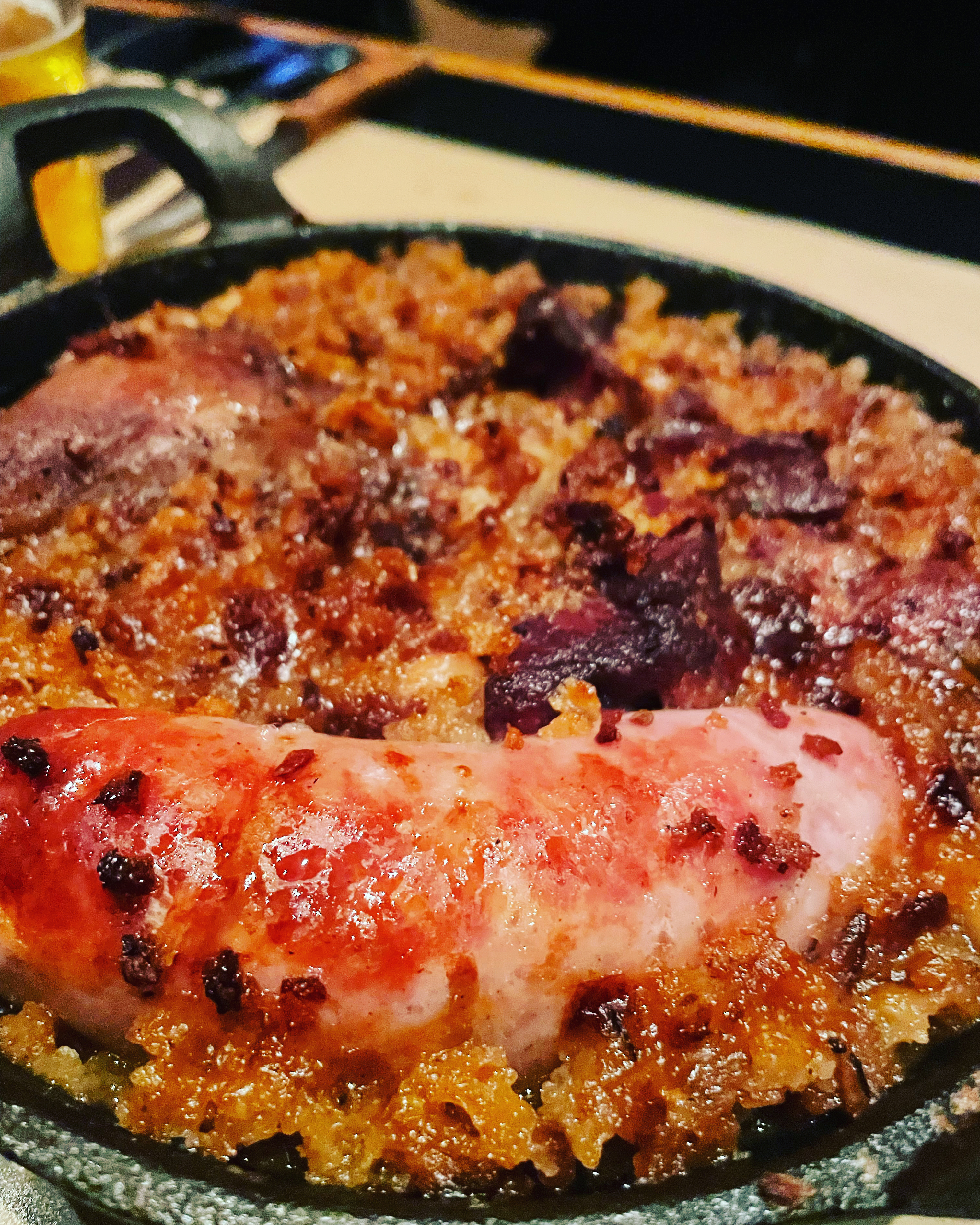
Cassoulet in Portland, not France

I dislike Facebook. I would go so far as to say that I hate it. Yet I remain on Facebook, because it seems no one in Thailand can communicate with another person in Thailand without it. Also, I like being reminded of people’s birthdays. 

But every day that I remain on Facebook also reminds me of how much of a hellhole this social media landscape can be. (Twitter, everyone knows, is also bad, but can also be funny, as shown by this thread that I love). Unlike Twitter, every new development the infernal engineers over in Palo Alto come up with only adds to the soul-sucking lameness of Facebook. Like, no, leave me alone about Kid’s Facebook. I do not want my kids to be on social media all day long. We all know how well that has worked out for our parents. And JFC, stop nagging me about this weekend’s yoga class — everyone knows I’m going already! You are not the boss of me, Facebook!

So it should have been no surprise when I caught a conversation about a Thai restaurant in the US, started by a man I do not know personally (of course), bemoaning the exorbitant prices of said restaurant with the statement, the shit cherry on top of a turd sundae, that “this is peasant food”. The comment somehow so incensed me (ed: the whole point of Facebook), a person who reads a lot of shit opinions on everything, that I actually considered wading into the cesspool of this conversation to say something. But why make comments so publicly on Facebook when I can rant and rave on my blog, which no one reads? Take that, Mark Zuckerberg!

I then thought about writing my retort to this in a very straightforward way, pointing out the provenance of dishes like massaman curry, the sheer labor involved in cooking a real Thai meal, the price of importing Thai ingredients to the US at a time when everyone in the world is feeling the heat, and a host of other extremely boring things. But then I realized the folly of my thinking. The fact is, this guy who knows everything about Thailand is right. We should not pay so much money for peasant food. After all, they are peasants! They don’t need our money. They are busy farming and drinking and hanging out with their elephants. What would they do with all of this extra money we are giving them? They are above all this money-grubbing.

We should reexamine other peasant food as well. Like, WTF is up with the prices at Giglio? Are you seriously telling me I have to spend 250 baht (5 whole bowls of noodles in peasant terms!) for an order of panzanella? Don’t even get me started on the pappardelle. Or Appia! A whopping 400 baht (read: 8 bowls of noodles) for trippa alla Romana, part of a menu inspired by the countryside of Lazio, which has never seen the likes of peasants darkening its cobblestones, ever. 

There have also never been peasants in France, a very sophisticated country whose restaurants in Bangkok feel free to charge 690 baht (or 13.8 bowls of noodles) for a serving of cassoulet aka sausages and beans, or 340 baht (6.8 bowls of noodles) for onion soup. And let’s not leave out the center for the very apex of the culinary arts, Great Britain, whose ambassadors of cuisine in Bangkok charge 410 baht (8.2 bowls of noodles) for a shepherd’s pie, a veritable steal for the undisputed pinnacle of fine dining artistry anywhere in the world.

All the same, I have yet to see loudmouthed, know-it-all gourmands posting the receipts for their French, Italian, Spanish etc. meals in a huff on social media. I wonder why that is? No matter, we will surely rectify this situation here in Bangkok (the capital of a third-world country, but still). We shall scour every restaurant, posting the receipts of our meals only after we have eaten every bite and drunken every drop, accompanied by a strongly-worded complaint of how our food was inspired by peasants. We can even do it on Facebook!

TLDR: Keep an eye out for the third edition of my book, “Thailand’s Best Street Food”, out in bookstores next month! The cover will look different from this:
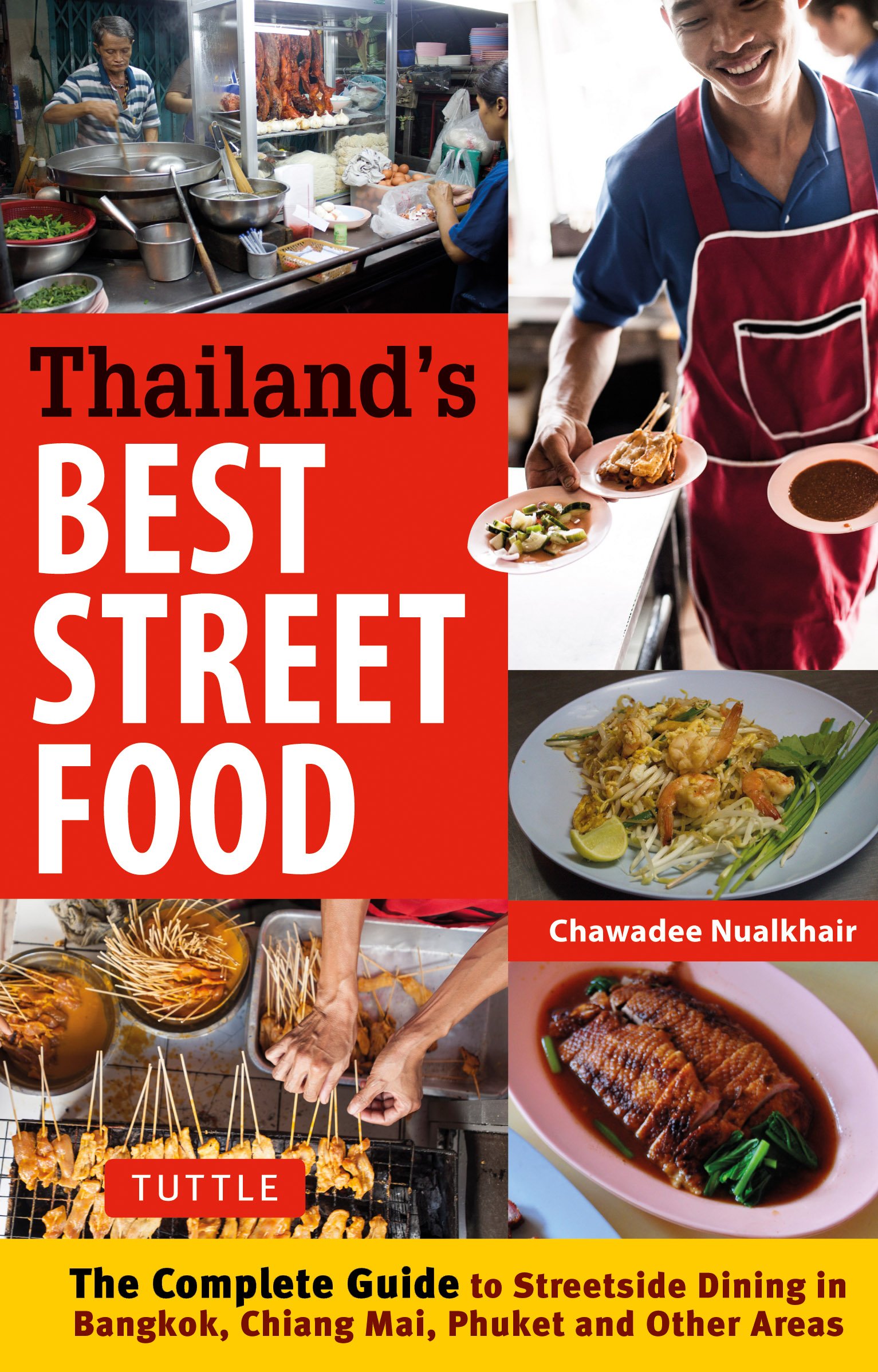
This is not the third edition’s cover

This has been my TED talk.

6 Comments

Filed under Uncategorized

The Slap

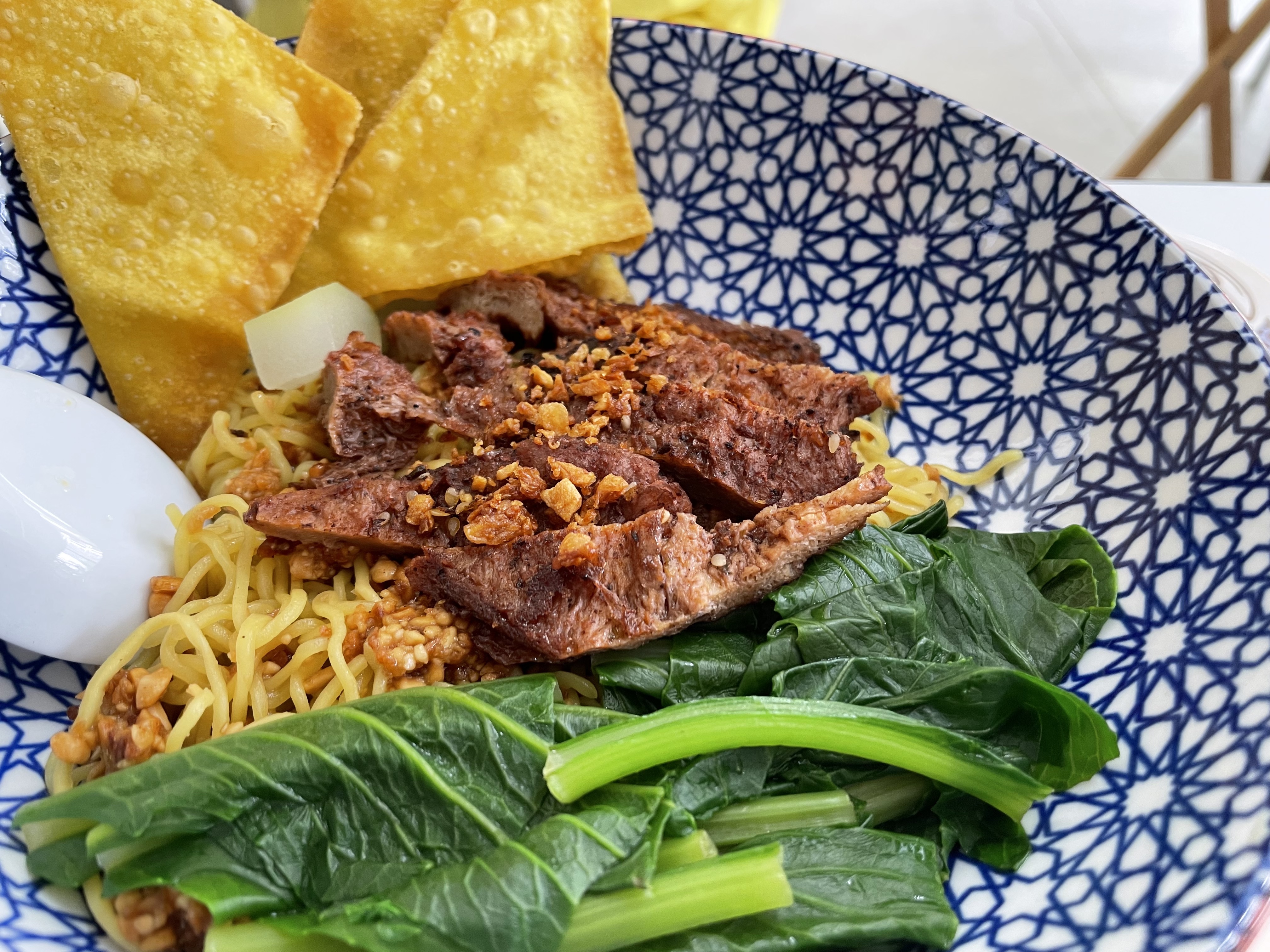
Vegan “egg noodles with red pork”

At the risk of being as disappointing as Will Smith and as unfunny as Chris Rock, I am going to bare all right now (metaphorically, don’t run away) and admit that the title to this blog post is just clickbait. I am not going to add to the literal mountains of hot takes and analyses that have erupted after the slap that shook the Twitterverse. But since I am all about service-y journalism, I will helpfully link to them instead (I must admit the funniest take, to me, might have been the one about Will Smith’s tailoring).

But, no. Alas, I am only here to talk about my diet. I am trying, as best as I can without estranging myself from my family and friends, to stick to a plant-based or at least pescatarian diet with I am not “working” (in parentheses, because I rarely get paid for said “work”). It is a challenge because, in Bangkok at least, it holds you to a particular type of food: heavy on the salads, stews and “bowls”, and light on the junky, deep-fried stuff that made me love Thai food in the first place. Not to mention the fact that plant-based diets are usually something you can pursue when you are privileged enough to do so. I got you. No need to go all Goop-y on me.

So when my friend Jon told me about a vegan street food spot, I was extremely psyched. Like, Kate-Middleton-playing-the-bongos level of psyched. I am as fond of “habibi bowls” and “zoodles” as the next person, don’t get me wrong, but I missed the soul-soothing satisfaction of a good slurped noodle, a light scattering of deep-fried garlic, the crunch of a fried wonton garnish, and the simple pleasures of adding your own chili powder and pickled pepper splashes to the mix.

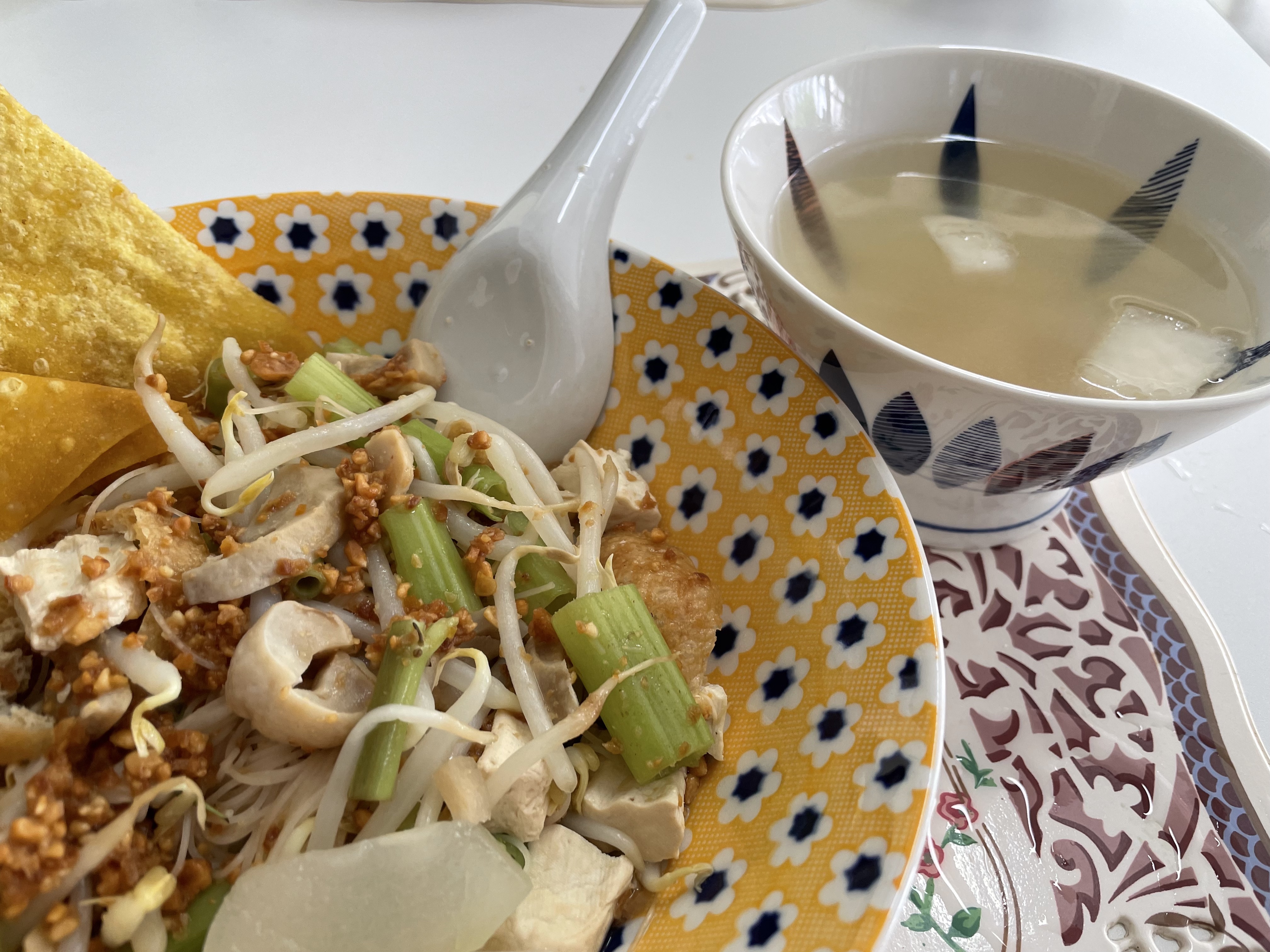
“OG noodles” at Kaek Kao Kua

Which is what I got at Kaek Kao Kua (12 Sukhumvit Soi 27, 096-220-6587), a short-ish walk that’s long if you’re really hot down the road between the Radisson Blu Plaza and Carlton Hotels. There is a sign in the front that marks the restaurant/home that tells you to ring the bell and warns you off petting the dog (there is no need to ring the bell). If you miss the sign, don’t despair: there are usually Grab or Food Panda drivers waiting outside to show you the way.

When you make your way to the outdoor terrace that serves as the restaurant, you might need to poke your head into the front door to announce your arrival. There will likely be no one else there, unless Jon is hungry (say hi to Jon). I know it’s annoying and deeply lazy and cliched to say that this place is a “hidden gem”, but I have no other way to say it: this place is the very definition of a hidden gem. It reminds of the days when Jay Fai was empty because no one wanted to pay 350 baht for a bowl of guaythiew kua gai.

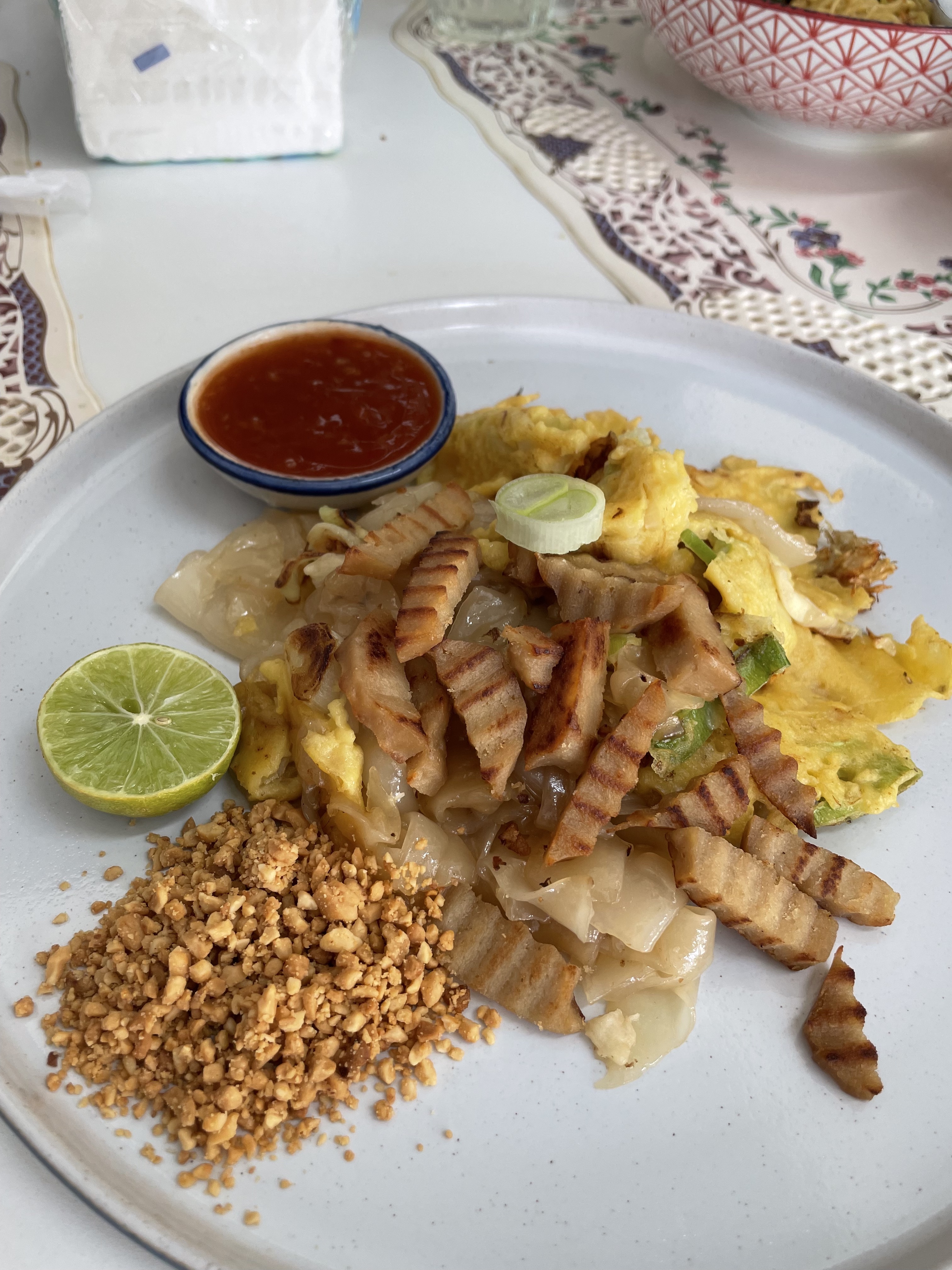
Which reminds me, this place also has vegan guaythiew kua gai:

It’s off the menu, you’ll have to request it or go with Jon

Unlike a lot of “street” vegan places in Thailand (read: not Broccoli Revolution-priced), the food here is truly thoughtful, made with a lot of care. Which surprises me, since the menu is quite large. Besides the “OG soup noodles” (mushroom, morning glory, bean sprouts, and tofu at 79 baht), bamee moo dang (marinated soy protein with egg-free name at 89 baht), and guaythiew kua gai (I unfortunately have no idea of the price, I went with Jon who is a VVIP there), there’s a “kaki kee kui” (noodles with peanut butter, 79 baht) and “shabobo” (spicy-sour noodles at 79 baht). They also serve vegan takes on Sukhothai noodles, tom yum noodles, moo ping, and khao soy. I suspect they have more stuff, but I haven’t gone enough times to check. It’s a substantial menu.

It doesn’t end there. You can also customize your own noodles with extras like morning glory, bean sprouts, long beans, snow fungus, Chinese kale, various types of tofu, and various iterations of meat replacements. I cannot emphasize how big the menu really is. Which is why I felt a bit conflicted about writing about it; I really do enjoy having the pick of the table with the fan in my face. But at the risk of ceding my seat to someone else, take my advice: go here if you like plant-based street food. And don’t slap anyone in the face.

8 Comments

Filed under Uncategorized

The Coffee Lady

Grandma Nang, who sold Thai coffee and tea on Soi Methi Nivet

One of the great things about living on my street was seeing Yai Nang, or “Grandma Nang”, on the corner every morning as I left the house. For as long as I could remember, she was there, offering enormous plastic cups of her super-sweet Thai coffee or tea concoctions, filled to the brim with life-saving ice on hot afternoons. My husband was partial to her orange-hued Thai tea and would ask her to fill up an entire 1 L glass measuring cup with it at lunch; my son would order one of her glasses of nom yen, iced milk with a drop of nam dang, or red sugar syrup, every day after school. As for me, it was simply a “sawasdee ka” to her every morning as I left the house, and, because I knew little else of what to say, a “sawasdee ka” every time I returned home. She was good-natured enough to humor me both times, raising her hands to rup (receive) my clumsy wais.

When people talk of someone who has become a fixture in their community, they mean someone like Yai Nang, who sold cold beverages on the corner since even before the soi was a real soi. Yai Nang was a person who could bear testament to the breezy, quiet canal that existed before the road, when the neighborhood was made up of people from one family and shopping malls and chain restaurants were but a gleam in a property developer’s eye. Houses lined the canal, with simple bridges set up to allow for easy navigating between households. Later, when the canal was filled in to make a road, the same family hired a guard to police the entrance to the soi. Yai Nang also saw that change, and continued to sell her drinks. And when family members started running out of money and began selling their plots of land to developers, and condos sprouted up from where the houses once stood, Yai Nang still was there in their shadows, selling her drinks to the security guards and tenants of those buildings.

All in all, Yai Nang was a fixture on our street for over 50 years, witness to a lot of Bangkok history: the quiet prosperity of the post-WWII years, the heady boom of the ’80s, the thom yum goong financial meltdown of 1997, and then the string of political crises to hit Thailand after. In the last few years, she quit selling her Thai tea and coffee, saying no one really had a taste for it anymore. Instead, she sold simple soft drinks, packets of instant noodles, eggs, and the occasional bunch of morning glory. Her daughter set up shop next to her, selling a tasty bowl of pork noodles; on the other side, an aharn tham sung (made to order) stall started operating. The pungent aroma of kaprao (holy basil stir-fry) became my wake-up call, sending me into sneezing fits; it seemed a small price to pay for the lunchtime embarrassment of riches that the busy corner provided. My favorite orders were the pork noodles, dry, or the stir-fried suki with seafood, or sometimes a pad se ew (soy sauce stir-fried noodles) with rice vermicelli and the bracingly bitter stalks of Chinese kale. I only had to take about 5 steps to get good street food.

I went away to the U.S. for a few months, and when I got back, the corner was quiet. I found out that Yai Nang had passed away from Covid only the week before I had returned. I asked about her funeral and when and where it would be; in the Thai way, her people said they would get back to me but then never did. It probably was more fitting that way, since no one wants a strange interloper at their relative’s funeral, gawking like a tourist. All I can do is say that my Bangkok shines less brightly without her.

10 Comments

Filed under Uncategorized