Hello from the Third Wave

It’s been a tough third COVID wave for us in Thailand, and it doesn’t look like it’s improving anytime soon. My son has taken to running to his computer every day at noon to check on the latest numbers; they are always grim. The effect on the local economy — and by extension, the dining scene — has been predictably grave. A few weeks ago, Bo.lan announced they were shuttering their doors, hopefully in order to morph into another iteration at the end of this particular tunnel.

But there were also some small glimmers of light during this time, for me at least (and isn’t that what’s really important?) I got to go up North and traipse around a farm, taking photos of the literal fruits of other people’s hard labor.

The rice research center in Samoeng, which actually grows wheat *shrug emoji*
View from the top at nearby Mollisol, also in Samoeng

The lovely Aarya made us a gorgeous spread that included a whole roasted seabass “acqua pazza”-style and a faithful rendition of a Veronese duck stew enriched with chestnuts and an entire bottle of red wine. It inspired me to attempt my own duck stew (whole Barbary duck ordered via Paleo Robbie), which was then discovered in a freezer while marinating due to some communication issues (my Thai is truly terrible), and ended up becoming a pretty good duck fried rice and jab chai (Chinese-style veggie stew) with duck broth.

I am also sort-of celebrating the imminent arrival of one book, originally slated for release in 2020. The COVID-delayed third edition of my Thai street food guide is … hopefully? … coming out at the end of this year. This book *may* join its sister on the shelves — tentatively titled “Real Thai Cooking”, it’s my very first cookbook with co-author, photographer and genius recipe doctor Lauren Taylor in New Zealand. We have just finished the first draft of our manuscript and are ready to send it to our long-suffering editor Doug (insert fingers crossed emojis here!)

When I originally sent out my book proposal (written during our first COVID wave with help and guidance from Jarrett Wrisley and Paolo Vitaletti, who generously allowed me to see their proposal for “The Roads to Rome”), I envisioned a book in which all the focus would be on my essays, which would place the recipes in context and make them less of a consideration. What I ended up doing — with generous assistance from both my mother’s and mother-in-law’s kitchens and a treasure trove of funeral cookbooks from my husband’s family — was literally stumble into a bunch of recipes that have deepened my own understanding of Thai food and how it has evolved. TLDR: a lot of these recipes are the bomb tbh. This is coming straight from the horse’s mouth.

There are a bunch of recipes that I really love in this book so there’s some competition, but I think my favorite recipe of all is the one gifted to me by my friend Tawn C., who is a designer in his normal life. While we were in Phuket he made a nam prik out of store-bought peanut brittle that was a flavor explosion; when paired when grilled salt-encrusted fish and all of the accoutrements for a mieng pla meal, it ended up blowing everybody away.

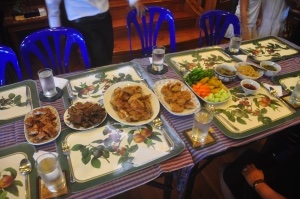
Tawn arranged this spread for mieng pla

The main ingredients, I kid you not, are a good-quality fish sauce and local peanut brittle (tua thad, or “cut peanuts”, made out of peanuts, sesame seeds and palm sugar) from the candy aisle.

Needless to say, it’s a fine tightrope walk between super-sweet, salty, spicy and tart, all the while making sure not to overshadow the main star of the show (What’s that? Oh yeah, the fish).

So here it is, Tawn’s chili dip recipe, and don’t ever say I don’t give you anything!

“Nam prik tua thad”

Ingredients: 

  • 6 pieces of tua thad, or peanut brittle
  • 4 goat chilies or bird’s eye chilies
  • 2 cilantro roots, cleaned
  • 7 garlic cloves
  • the juice of 2 limes
  • 3 Tbsps fish sauce
  • 1 tsp golden syrup

Method:

  1. In a mortar and pestle, pound chilies, roots and cloves together into a paste. Scrape out of mortar and set aside.
  2. Pound your peanut brittle until it is pulverized, then add your paste to it. Mix well.
  3. Season with lime juice and fish sauce. Taste. It should be a balance between salty, acidic, spicy and sweet.
  4. Add golden syrup if not sweet enough. Surprisingly, the sweetness will amplify all the other flavors.

7 Comments

Filed under Uncategorized

More adventures in larb

Isaan style chicken larb

Out of all the cuisines that my family likes to eat, Isaan food is probably the most popular. It is definitely the food of choice for my husband — so much so, that whenever we get back home from abroad (a distant memory for now), he is on the phone ordering delivery from Polo Fried Chicken (usual order: one whole fried chicken, extra garlic; one som tum Thai; one bamboo shoot salad; one pork liver salad; lots of sticky rice).

But if we are really lucky, our housekeeper Somporn will be around to cook for us. While Polo Fried Chicken (aka Jae Gi) is good, Somporn’s food is really excellent. I used to think that one day if I ever moved to New Zealand I would take Somporn with me and open New Zealand’s best Isaan restaurant. Alas, we are no longer doing that and I will have to find new dreams amidst the rubble of my old ones, but at least I can still occasionally enjoy Somporn’s cooking at home.

Luckily, my in-progress cookbook gives me plenty of excuses to plumb her brain for more recipes. This one is for larb, but the Isaan kind. And I have to say (like with almost every other recipe in my book), I learned something new about Isaan larb while working on this recipe. Yes, it has roasted rice kernels and mint in it, and obviously, plenty of chilies, but I also learned that the little flourish of lime is a Bangkok thing and not part of the Isaan salad flavor profile. Instead, larb is supposed to be salty and spicy, and when Somporn cooks it for herself, she doesn’t add lime.

That’s not to say Somporn isn’t above adding some flourishes of her own. She is partial to kaffir lime leaves, so you’ll find plenty of that in the salad. I have to say, both Lauren and I have made this larb, and the lime leaf really makes it sing.

Somporn mixing her larb salad

Here’s the recipe.

Ingredients

  • 250 g minced chicken
  • 3 Tbsps water
  • 1 tsp salt
  • 1 Tbsp fish sauce
  • 1-2 Tbsps dried chili powder
  • 1-2 Tbsps roasted rice powder
  • 3 fresh cilantro leaves and stems, chopped
  • 3 small shallots, sliced thinly (you can use red onion instead if you like)
  • 3 sawtooth coriander leaves (if you have them), chopped
  • 3-4 kaffir lime leaves (if you have them), sliced thinly
  • juice of 1 lime to squeeze at the end (optional)

Method

  1. Heat saucepan until a drop of water sizzles on it, then add 3 Tbsps water. Add minced chicken immediately after. After juices come out of the meat, the bits of chicken will stop sticking to the pan. Cook through until the pink is all gone. 
  2. Transfer chicken (and pan juices) to a mixing bowl and add your shallots and herbs — the cilantro, sawtooth coriander and kaffir lime leaves. Add the ground rice powder and mix everything together well with a spoon. 
  3. Add salt and fish sauce. Taste for seasoning.
  4. Add chili powder. Taste for seasoning.
  5. If you wish, add your lime juice, mix well and taste.
  6. Garnish with mint leaves and enjoy with sticky rice, young savoy cabbage leaves, fresh cucumber, and some cut up long beans!

Leave a comment

Filed under Uncategorized

Mea Culpa

Larb kua at Raan Larb Pa Tan

Back when it was safe to wander around town, maybe a month ago, I was in the Pratu Pii (Ghost Gate) area, taking my daughter, sister and son on a little walking tour around the Old Town. We had had a lovely kai kata (egg in a pan) breakfast at the second branch of the beloved cafe Kopi Hya Tai Gi and had just half-heartedly wandered around the entrance to the Golden Mount without walking up (note: you should walk up if you haven’t before, it’s a beautiful view at the top). It was very, very hot, which is why we were in a hurry to get away to our next spot, slurping up cold drinks on Dinsor Road.

But to get there, we had to double-back to Mahachai Road from the Golden Mount exit. Right at the exit was an aharn tham sung (made to order) stall set up with a few tables, all packed with customers (those were the days). So color me confused when I saw my son, in his all-navy get-up, leaning over a table and talking to a tableful of ladies of a certain age. Convinced he was flirting (again), I slapped him on the butt as I passed.

So I was surprised to see my son up ahead of me on the road, walking with his aunt. I had not tapped my son on the butt as I passed. I had slapped the ass of a stranger, dressed in all navy, with the same short haircut and slim build. I presume they were a waiter, taking an order. However, I did not linger to check. I did as all people of strong moral fiber do and ran far, far away.

Here I am today, saying “I’m sorry” to the poor waiter. Mea culpa. Honestly they looked very much alike from the back. But still, my mistake. My sincere apologies.

Of course, it’s not the first time I’ve made a mistake. Years ago, I posted a recipe for “Northern Thai-style beef larb” that was actually an Isaan recipe, replete with toasted rice kernels and mint leaves. That is the Northeastern larb, which, while delicious and certainly very popular, is not the larb muang or larb that you get in the North. That is larb kua, and it is a more complicated dish with complex, heavy flavors, not for the faint of heart. The meat is mixed with blood to lend it a dark mahogany color and the spices — a mix of cinnamon, star anise and Northern Thai peppercorns called makwaen — recall something out of Western China.

So to make up for this, and in the spirit of making amends to the hapless waiter next to the Golden Mount, I am posting our recipe for larb kua, the one that will appear in our upcoming book (yes that’s still happening). I sincerely hope you enjoy!

Larb Kua (Northern Thai-style larb) (for 4-6)

— 2 kg pork or beef, minced

— 10 dried chilies, chopped

— 3 red shallots

— 2 lemongrass bulbs

— 10 garlic cloves

— 1 tsp coriander seeds

— 1 tsp fennel seeds

— 2 bay leaves

— 2 star anise 

— 1/2 stick cinnamon

— 4 cardamom pods

— 1 tsp makwaen (a type of Northern Thai peppercorn)

— 10 slices galangal, peeled

— 1/2 tsp shrimp paste

— 2 Tbsp cleaned and boiled pig intestine (if using pork) or beef tripe (if using beef)

— 100 g pork liver (if using pork) or calf liver (if using beef)

— 1-2 Tbsp vegetable oil

— 1-2 tsp fish sauce

— 1-2 Tbsp pork blood (if using pork, optional)

Garnish: chopped mint and cilantro leaves, whole sprigs of mint

Lettuce leaves, savoy cabbage leaves, sliced cucumbers

Dry roast spices (coriander seeds, fennel seeds, bay leaves, star anise, cinnamon, cardamom pods and peppercorns) in wok.

Roast garlic, shallots, chilies, shrimp paste, galangal and lemongrass and pound in mortar and pestle into a paste. Set aside.

Add roasted spice mixture to mortar and pound into a paste. Set aside.

Further mince pork or beef on chopping block with butcher’s knife. If using pork blood, sprinkle 1-2 Tbsps of the blood onto the pork as your are mincing it, adding to the deep red color of the meat. This helps to develop both the flavor and the color of the pork.

Add spices and paste to wok and mix over medium heat. Add 1 Tbsp vegetable oil and meat and mix everything together, cooking until meat is brown. Add 1 Tbsp water to wok midway through cooking.

Add liver and intestines or tripe to the wok. Add more oil if needed. Add fish sauce to taste. If too dry (the juices should collect at the bottom of the wok like the dressing for a very juicy salad), add more water. The flavor should be salty, spicy and intense.

When the taste is to your satisfaction, add fresh chopped mint and cilantro leaves and mix. Serve at room temperature with sticky rice and fresh lettuce, cabbage and cucumbers.

Leave a comment

Filed under Uncategorized