Business, Thai-style

Mee krob at Panlom

(Note: Written before the season 3 finale of “White Lotus”)

Like many of you, I have been watching “White Lotus” season 3, which is set in Thailand, every time it appears on Mondays. I have enjoyed the memes around Parker Posey’s character, relived some ghastly three-woman travel trips of my own, and waited with bated breath for something to finally happen to both Gun Dad and Gary. But whenever poor old Gaitok and Mook appeared on my screen, I admit to feeling exasperation and maybe a little boredom. Why were they so one-note? In what way was “Lisa so pretty” *moon eyes moon eyes* a compelling plot line? Was Mike White afraid of pissing off Thai people with a more nuanced portrayal of two real-life people (a real consideration)? They — like many of the “locals” in travel shows featuring dashing Western types like Anthony Bourdain — threatened to be cardboard cutouts in their own story, once again, like many Thais in similar situations before them.

It wasn’t until I ended up scrolling Twitter (AGAIN) and came upon a discussion of the “White Lotus” season so far that I finally came close to understanding what the characters were all about. It was a general discussion about what was working and not working for various viewers, at varying levels of dumbness (yes to incest and feuding three-way friendships, meh on the Darth Vader dad killer plot line, always no to the boring old locals), when journalist Heidi N. Moore (I always like to give credit) started a thread with her own analysis of Gaitok and Mook. Like all of the other characters — Belinda with the payoff, Tim with jail, Rick with killing someone — Gaitok was in a moral dilemma. Would he advance in his career (and life) by subjugating his Buddhist non-harm beliefs and gain a “killer instinct”, quite literally, in order to become a bodyguard? He would get more money that way, and in Mook’s eyes, be more of a marriage prospect.

Let’s ignore the ridiculousness of this in real life (no one aspires to marry someone’s hired muscle, and if you really wanted to move up in Gaitok’s world, you’d work in hospitality) because the plot line is literally about using violence (physical or mental) to move up the capitalist ladder. And the more Western the boss, presumably the more money and stability you get. It’s colonization in another name. Tourism runs along similar lines, even if the bosses change from day to day.

I, as a person who occasionally gives overpriced food tours to foreign tourists and writes cookbooks aimed primarily at people who eat rice with a fork, finally understand this story. Apparently I, like many of my other fellow viewers, can spot and understand class struggle (season 1) and sexual and gender politics (season 2) but not life-altering moral dilemmas. That’s funny, but also kind of sad.

Many of us are familiar with the elusive vendor who shuts up shop when his goods run out, or the chef-owner of a small restaurant who desperately wants to keep her clientele small and select. American-style capitalism would dictate that these people expand, making more goods to feed increased demand, and hiring more people to help you when more customers stress you out. Eventually, you could buy out all of your competitors, make enough money to influence elections, and become Elon Musk. But alas, this doesn’t seem to be the Thai way. Thais traditionally don’t have that “killer instinct”. Instead, you would know what your limit is, and stick with that limit, at the expense of your wallet but to the benefit of the rest of your life. It’s what keeps vendors in their market stalls and their shophouses, selling enough chestnuts on the street to send their kids to university. There is no chestnut empire awaiting them. There is only retiring somewhere with a nice plot of land and a garden, occasionally meeting up for coffee with friends to trade amulets.

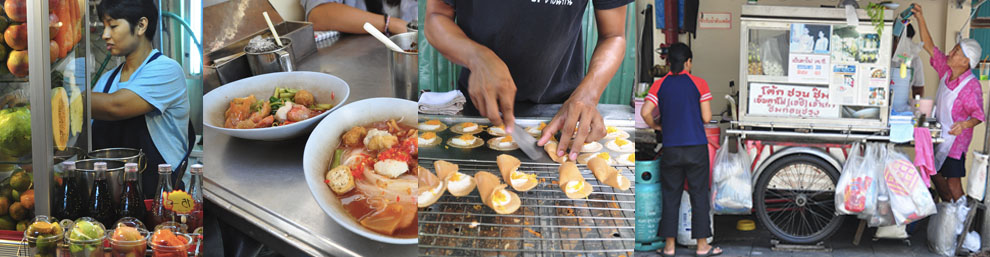
The elderly woman proprietor at Panlom (“Passing Breeze”) is one such retiree. She has opened up a tiny restaurant in an old Thai-style house that is attached to her son’s pie shop in a picturesque corner of Bangkok Noi, close to Bang Khan Non MRT stop. Reservations are essential, since there’s only one or two tables. You order your food beforehand, and the choices are dishes that she makes herself, from her own family recipes. In spite of the “hidden” nature of the restaurant, it’s neither “cool” nor exclusive. It’s not trendy, but at the same time it doesn’t aspire to serve “Royal Thai cuisine”. It’s just a lady sharing the recipes she grew up with.

So of course you would expect the kind of old-fashioned Central Thai food served on the tables of “good” families — the kind of food you’d find at Aksorn. There is mor hor and mangkorn karb kaew (a sticky paste of shrimp and pork atop a slice of fruit, in this case pineapple and orange, respectively). There’s also ready-made miang of pomelo with wild betel leaves and more of that sweet sticky paste.

As the food is presented course-style (normally a pet peeve, but there’s little space on the table for much else), you also get a “salad” of yum kamoy, which translates to “robber’s spicy salad” and is made of a mix of shrimp, chicken, surimi, and ground dried fish.

Then there’s of course, mee krob, an under-the-radar tricky dish to make, with citrusy hints of orange, comforting kai pullo, and khao kluk kapi, or rice mixed with shrimp paste and all of the usual accompaniments: green mango, chilies, shallots, egg, tiny shrimp, and sweet pork.

Then there’s the green curry, served with homemade roti and kanom jeen, cooked in a style described as “Indian”, but which I would describe as “good” (Bangkok curries have been getting too creamy, and, paradoxically, too green. I do not trust pistachio green curry. The color is also bad luck for me, born on a Friday, in accordance with Thai superstition).

The evening ended with som chun, accompanied by the correct and old-fashioned accompaniment of deep-fried shallot powder. I did not take a photo, because I was in the middle of a frankly disturbing work Zoom in which I ended up ranting about authenticity being a Western concept to a group of bewildered Thai people (sort of like the reception Fabian’s singing gets in this week’s episode!)

There were dishes that I didn’t get to order because, come on, no one has that kind of appetite. But Panlom also offers massaman curry (of course), khao tung na tang chao suan (rice crackers with a mild pork dip) and pla hang tang mo (watermelon dusted with dried fish powder, which here serves as dessert). If you are interested in trying any of these, I’d suggest making a reservation, since you’re unlikely to find any of these dishes in a subway station or food court near you anytime soon. There is real life to attend to, after all.

Kai pullo

3 Comments

Filed under Uncategorized

Hot to Trot

Duck gaprao in Chiang Khan

A chef friend of mine once told me some of his customers pick off every bit of coriander and chili that they can find in their food before eating it. These people were not Westerners, or even Japanese; they were Thai. It turns out that, for a certain type of Thai, eating spicy won’t do — either their tastebuds are too delicate, softened by years of studying abroad, or they want to look like they’ve spent years abroad, stuffing their faces with Nobu and spaghetti aglio olio (Italian-style, without chilies). In a way, it’s like Thais and farangs have switched places, “Freaky Friday”-style: the Thais eschewing chilies, and every Mark Wiens-wannabe from the West diving into a plateful of them, head-first.

Spiciness has long had a political side to it. After all, it’s very well-associated with the food of the South and Northeast, Thailand’s poorest region. One theory about why those regions’ dishes are so spicy is that the spiciness of the side dishes necessitates eating more rice, which gets you fuller faster for less money. And if there’s one thing a true Bangkokian hates, it’s to look like you don’t have money. After all, these are the people who would rather drive to the end of the road, spending 1 hour in traffic, than to take a motorcycle or (horror of horrors!) walk.

To bring it all back to me (of course), I fit no one’s definition of a real Thai person. But after spending most of my life here, I can say that my spice tolerance has gotten quite high. This is not something that I’m trumpeting from every corner of my house, like a first-time v-logger to Bangkok; it’s just a fact of life. After decades in street-side eateries from Ubon Ratchathani to Phattalung, that’s just the way it goes. You would have this spice tolerance too, if you’ve eaten as much as I have.

Like dealing with annoying friends of friends, part of handling chilies is knowing how to tolerate them. I’ve watched “Hot Ones” and find that their efforts to mitigate spice are sophomoric at best. I’m lactose-intolerant, so the idea of chasing spicy hot sauce with milk is enough to make me want to barf. Water is almost as bad, spreading spice everywhere before softening it. I’ve found it’s best to simply use tannic, saliva-sapping herbs like cashew leaves, or fresh vegetables like cucumbers, white turmeric, Thai eggplants or even just fresh lettuce; in a pinch, a spoonful of sugar really does help it all go down (a waitress in Petchburi once saw me struggling with a plate of jungle curry and gave me kanom tako, or Thai coconut-and-pandan jelly, to “fight the heat”). Finally, there’s simply rice. Thai chilies tend to be sneaky, and their effects can sometimes be felt long after you thought it was over. This means that all of your efforts to mitigate them might come to naught in the end.

To put my newly acquired powers to “good”, I decided to try out the spiciest pad gapraos (holy basil stir-fries) in Bangkok. I enlisted the help of well-known noodle guru @adambeechinor, whom I stalk on Instagram for tips on where to eat ramen, Chinese noodles, and Thai guaythiew. However, it seems he has been expanding his expertise to all lunch food items, and that includes pad gaprao, Thailand’s unofficial national dish, available everywhere, eaten by everyone.

So besides the obvious, Phed Mark, there’s also the suddenly-trendy Gapao Tapae, and Adam’s suggestion, Little Chef in Udomsuk. Happily, all are available via various food delivery apps (Grab, Lineman, and Food Panda, respectively). Here’s how well I did with them:

  1. Phed Mark
Wagyu beef shin gaprao, level 5

I spend a lot of time making fun of wagyu burgers and wagyu bolognese, but when it came to ordering a pad gaprao for myself from Phed Mark’s extensive protein menu, I was not immune to wagyu’s charms. At least I chose beef shin. And it was nice and tender.

The order comes with your choice of fish sauce with chilies and garlic, which seems ludicrous given that you’ve already got plenty of chilies and garlic in your gaprao. However, it’s helpful for seasoning the best part of this gaprao, which is the specially fried egg with lacy edges and jammy yolk intact.

As for the spice, well, yes, I did cry. My sinuses were completely cleared out by the time I finished my bowl. Did I stop eating? Of course not! And although I did spend the rest of the day with ron tong (the Thai word for “hot stomach”), it didn’t translate into the typical Thai ailment after overestimating one’s spice tolerance, otherwise known as “diarrhea” (the Thai term for this is tong duen, literally “walking stomach”, or “the trots”).

Would I try the level 10 as advertised on Tiktok? No way! I’m not Mark Wiens!

2. Gapao Tapae

Beef gaprao with duck egg

This spot, which Adam says has developed into a kind of “hipster magnet”, has an item it calls “the spiciest gaprao in the world”, which is made with ghost pepper. It’s also listed as an “off-menu” item, even though it shows up on the menu on Lineman. In any case, this is how it looks in the packaging:

“The spiciest gaprao in the world”, in case you’d forgotten

It comes with fish sauce with chilies and garlic, as well as your choice of soup with pickled plum and pork meatballs (for extra). The soup is absolutely delicious. And yes, it does help with the ghost pepper.

As for the gaprao itself, yes, its first “presentation”, shall we say, it unpleasant. It announces itself as something sharp and bitter, somewhat like a bully that enters the room with a loud voice and disagreeable demeanor. But once you plow through, the effect itself gets more and more muted, helped along by that wonderful soup. Once you finish, you’ll find that there’s very little that lingers; like a bully, the spice completely disappears once you’ve mastered the whole plate.

3. Little Chef (Sathu Pradit)

Crispy pork gaprao with fried egg

I had never heard of this place, but Adam assured me it was good, and that it offered a plethora of toppings. I assumed the toppings were the proteins for the stir-fry. Boy was I wrong. There are also actually “topping” toppings, like pickled bamboo shoots and other sliced proteins to go on top of your already existing proteins. Then there are the many choices for eggs, including preserved eggs and salted egg yolks, as well as an extra option for extra chili dips. That’s not even mentioning all the soup choices. I shit you not. The options are close to overwhelming, so I ended up ordering two different kapraos, much to the confusion of my housekeeper. I got the recommended crispy pork (moo grob) and pork liver, both at the “spitting fire” spice level, as well as the “recommended” gang jued.

If I thought I was going to end up being Drogon, spitting fire upon all my enemies, I was sorely mistaken. I finished both (of course) with little trouble and just a mild tingling sensation on my lips. I went about the rest of my day, went to bed, and woke up the next morning. I went to yoga class and sat down to get ready for practice. And that’s when my stomach said, “Ta da!” like a cheap birthday party magician. I was in pain. The waves came and went, so that I would be fooled into thinking it was over before it started up all over again. Would I get diarrhea, right there in yoga class? Would I have to use the bathroom downstairs and risk alienating everyone in the yoga studio? What to do? I had perhaps committed the gravest mistake of all: I did not realize that “spitting fire” referred to the other end.

What I can say is, Minh at Yogatique is an excellent teacher. We did box breathing and a bunch of moves aimed at cleansing out the liver and kidneys. I did not end up having to demolish their bathroom. And my stomach is fully back in commission. That said, would I repeat this exercise anytime in the near future? Maybe if I had plenty of time to myself, with no particular place to go. Thai chilies can be sneaky, after all.

2 Comments

Filed under Uncategorized

Saying good-bye to Sukhumvit 24

A great stuffed omelet at Thong Li on Sukhumvit 20

After 25 years of living off of Sukhumvit 24, I am moving. To Samut Prakan. And, while I have nothing against Samut Prakan, I have been bummed about it. I suppose everyone in Bangkok believes that they live in the middle of everything, in the best neighborhood in the city; I am one of those people. I loved my neighborhood. Villa (the real one, on Soi 33/1) was close by if I needed American ingredients (Vlasic baby dills!), as was Emporium; Klong Toey was a short motorcycle ride away for Thai ingredients. I had my hair salon, my eyebrow lady, my pedicurist and my massage place, all within walking distance. My Skytrain stop was a 5-minute walk away, partly air-conditioned if I wanted to access it through Emporium. Movies, bars, good Japanese food: it was all there. And if it wasn’t close by, I had my favorite motorcycle taxi gang waiting for me, to the left of the entrance to the park.

I have to find all new places in my new neighborhood. After 25 years, the thought of it is daunting. But I wanted to say good-bye to all of my favorite places near my old house first. So that’s what I’ve spent the last few days doing. They are, in no particular order:

The chicken and bitter melon noodle guy next to Benjasiri Park

I’ve written about this place before. Everyone in Bangkok thinks the noodle person next to them is the best, and I am no exception. So say whatever you like, but I really believe the guaythiew gai mara here is superior to most other renditions I’ve tasted. The broth is flavorful and sweet, the chicken is well-seasoned, and you can put your own toppings on. What’s not to like? I might miss this place the most of all of my places.

Guaythiew Pik Gai Sainampung

This place between Sukhumvit Sois 20 and 18 is famous for its stewed chicken wing noodles. Because of the shop’s name, people think the vendor, Khun Saowarot, puts honey on the chicken, but the name is really because of the old name of Sukhumvit 20, Sai Nam Pung. In any case, the chicken noodles aren’t the reason I go here, though they are good. They make my favorite bowl of yen ta fo, a slight favorite over another close-by noodle shop, Tang Meng Noodle.

Thong Li

Tuna nung boie

My friend Andrew, who lives on Sukhumvit 20, introduced me to this cookshop-style eatery, which is nearby. It’s become one of my favorite places since then. They specialize in pork liver, but there are tons of great dishes here, and if it’s possible, they keep getting better and better. My favorites here are the kai yad sai (omelet stuffed with minced pork); tom kloang ruammitr (clear soup with tamarind); and pla tuna hung boie (canned tuna steamed with pickled plums).

Kitchen Niigata

Hamburg steak set A

One of the great things about my old neighborhood is that there are tons of under-the-radar Japanese eateries nearby: an okonomiyaki place in the plaza next to the entrance to Sukhumvit 39, for instance, or Isshin, the soba place a few steps away from Emporium. But my favorite has long been this place, where I go for lunch about once a month. They used to serve “spaghetti naporitan“, but don’t anymore; the last time I was there, they offered a “yum shiokara”, which is as good of an example of Thai-Japanese fusion as I can think of.

Anyway, it’s a place I go to when I want a relaxed, quiet lunch alone, a sentiment likely shared by all the other solo diners around me there.

OnigirI Lab

The “OMG” egg onigiri

This is a relatively new entrant compared to every other place on this list. It opened in a spot I once thought was cursed, across the street from my husband’s cousin’s house. A handful of eateries set up shop there and eventually closed down, and I thought this place would only continue that streak, but something happened and now, it’s quite comfortably full in the mornings and afternoons. Even though I walked by this place almost everyday on my way to the Skytrain, I rarely ate there; I did, however, order on Grab. My go-to orders were Basic Bitch Lite™: the mentaiko with cream cheese, and the natto with wasabi leaves. Sometimes I branched out into the miso egg yolk one or the soy sauce oyster. I never got to try everything on the menu, though, unfortunately. Maybe that can be my next project, after I move a half-hour Skytrain ride away.

Leave a comment

Filed under Uncategorized