Little Portugal

place1

Plates of kanom jeen gai kua at Yai Thi

I noticed that I haven’t been complaining about the heat lately, so I thought it was time to get back to my regularly scheduled programming. It’s really hot, guys. Even when it’s supposed to be rainy season, it’s still hot. The rain doesn’t really help very much. This heat sucks. The end.

But even with this heat, I still managed to corral a few of my friends into taking me to the Portuguese neighborhood of Kudichin, centered on the Thonburi side of the Chao Phraya River around the Santa Cruz church. This patch of land was awarded to the Portuguese by King Taksin for their help in fighting the Burmese in Ayutthaya, and they have retained a cultural hold on the neighborhood ever since. I’m sure you already know about the impact the Portuguese have had on Thai culture, but to fill up this post with more words, I will say that the seafaring adventure-lovers that were the Portuguese spread their culture all over the world. This includes Asia, where they introduced us to heretofore unheard-of ingredients like chilies and created desserts like the egg-and-sugar extravaganza tong yod (a stand in for ovos moles) and kanom mor gang (a coconut custard, inspired by tigelada). Some other stuff the Portuguese brought to us: foy tong or “gold threads”, a stand-in for fios de ovos; look choop, mini fruits inspired by massapa’es but filled with mung bean instead of marzipan; corn; potatoes; guava (!); pineapple (!); papaya (!); cashew nuts (!); pumpkin (!). And of course tomatoes, which they brought to everyone, including the Italians. This is new stuff we all learned at the Baan Kudichin Museum.

Kudichin has something for everyone here, really: history buffs, architecture and design geeks, or people who really like walking around in hot places. For me, of course, it was the promise of food that I would not be able to find anywhere else, the Portuguese-Sino-Thai dish of kanom jeen gai kua, or fermented rice noodles in a mild chicken curry.

What makes this chicken curry and noodle dish different from, say, a standard Thai kanom jeen gang gai are the spices used to season the coconutty curry, which are mixed quite happily in a food processor instead of pounded in a mortar and pestle to release the oils (a shameful practice to Thais, who like to pretend that the food processor or blender don’t exist). The chicken is minced like in a bolognese and flavored with fish sauce, coconut milk, and a hint of chili. The garnish is always slivered green onion. The result is milder and lighter than something you would find elsewhere in Thailand, the flavors fewer and more focused. It is, not surprisingly, utterly delicious. I ended doing this thing where I tried to stuff it down my throat like I was a foie gras goose, but I was doing it to myself. This is not healthy behavior.

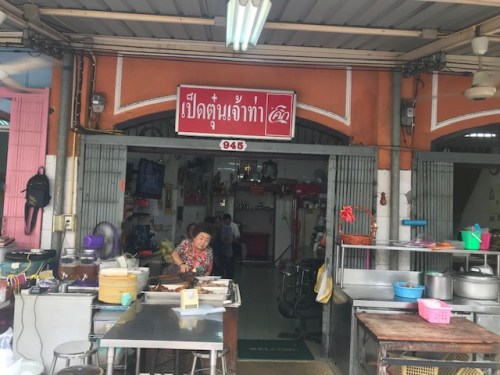
The first place where we had this is said to be the jao gow, or original vendor of the dish. Directly across from the Santa Cruz church next to the river, Yai Thi (02-472-5231) offers their most famous dish — prominently advertised in front of the restaurant — alongside more Portuguese-inflected fare like grilled pork chops with fries and a succession of thick toast with various toppings, including spinach with cheese and butter with caramel. There are chicken nuggets and waffled mashed potatoes, onion rings and garlic bread. It is essentially your picky 4-year-old’s dream restaurant.

Our favorite creation, though, was the banana “crepe”, which is actually a deep-fried samosa stuffed with mashed ripe banana. We thought it would be everywhere on our walk from the church to the Kudichin Museum, but it ended up being a unique thing to this restaurant.

samosa

You will have to remove your shoes to enter the “dining room”, which in this case, appears to be the family living room. The kitchen is located right next to the river, so that the chef can enjoy a pleasant view while preparing your order. In our (in)expert opinion, it appears that various households in the neighborhood are supplementing their income this way, by welcoming strangers into their homes for meals. This is what we surmised, anyway, after heading next door to the next place serving kanom jeen, called Pa Jae (080-305-2448). Unlike Yai Thi, the menu is more Chinese-focused, offering stir-fried pork in oyster sauce on rice, fried shrimp on rice, and macaroni in tomato sauce besides the requisite rice noodles with chicken curry.

place2

Unlike Yai Thi, you are expected to add your own nam prik of coconut milk and blended chilies, which looks like this:

namprik

A plus for Pa Jae is the karaoke, which is performed at your table, while eating your noodles. We blitzed our way through John Denver’s “Country Roads” (a Thai karaoke bar staple), what I believe was “Don’t Leave Me This Way” (I can’t be expected to remember things anymore) and “Top of the World” by the Carpenters before we took pity on the proprietors and showed ourselves out. The karaoke was free, something that maybe the owners should rectify in the future if they value their own mental health.

The third place we were aiming for was the most famous restaurant in the neighborhood, Baan Sakul Thong (213 Soi Kudichin 3, 062-605-5665), where we are told the dishes come from the recipes of great-grandmother Chawee Sakulthong. A set here is slightly more expensive than the other restaurants we visited, at 250 baht per person for a plate of the chicken noodles with two appetizers, a dessert and a soft drink.  Appetizers include Royal Thai-type stuff like chor muang (steamed dumplings stuffed with minced pork and dyed purple with butterfly pea extract) and jeeb tua nok (bird-shaped steamed dumplings stuffed with chicken). When we got there, we were confused by which door was the entrance and ended up busting in on a private family meal. Apparently, reservations must be made 2-3 days in advance. It took all of my willpower to not snap a photo of the family’s food from over their shoulders. I am not yet a savage.

So Baan Sakul Thong was a wash, but it wouldn’t do to not have something to look forward to on our next visit to Kudichin. Wasn’t it Kierkegaard who said that true despair was having all of your wishes fulfilled? Maybe not. I was never that good of a student.


1 Comment

Filed under Uncategorized

Kindred spirits

screenshot

If you want to know what I was ranting about before, of course it is about Game of Thrones and Kit Harrington’s reaction to the script, which was terrible /endrant

My sister Chissa has been on my case for a while for not mentioning her in my blog. This is not true, but it is true that I have not mentioned her by name. So here I am, doing that. My sister is Chissa, and she is one of my best friends.

chissa2

I was wondering (briefly, because there is Netflix to be watched) about why I rarely mention Chissa, and I think it is because we never eat street food together. Sometimes we talk about going to a street food place, but it’s with the same kind of enthusiasm where you tell someone “we have to have dinner sometime” and then the both of you immediately regret it because they will have to think of an excuse not to go and you have to pretend to be senile and forget about it. So we don’t end up going for street food, because 1.) it is hot, 2.) a lot of it is far and 3.) Chissa is kind of a gourmet person, as opposed to a person like me, who loves MK and Hooters. This means any old street food won’t do, and do we want to wait 7 hours for dinner, really? It has to be 100 percent for real guaranteed, and, oh yeah, 4.) it has to allow for copious amounts of booze. This is too much pressure for me, which is why I always end up suggesting El Mercado.

But I went somewhere last week that I think Chissa would appreciate. That place is Someday Everyday (Next to Warehouse 30 on Charoen Krung Soi 30, open daily 9am-6pm), a khao gang (curry rice) venture spearheaded by culinary kindred spirits David Thompson (arguably the most famous Thai food chef in the world) and Prin Polsuk (one of the best Thai food chefs I know). Now curry rice is not only a type of Thai street food vendor but also an action on the part of the consumer: you are presented with your plate of rice (or kanom jeen, or fermented rice noodles, if you are in the South) and you have your choice of several curries and stir-fries with which to adorn your starch. Someday Everyday presents this hallowed street tradition — popular as a to-go breakfast on the way to the office, or during lunchtime when you are running away from the office — but in dressed-up Greyhound-y surroundings, and with top-notch ingredients that are good enough to warrant the THB90+ price tag. In other words, it’s a good tip of the hat to the tradition of Thai street food while still retaining the feel of a restaurant.


sweets

House-made tong yip, tong yod and foy tong, Portuguese-style sweets made of egg and sugar

Even better, they have Rama V-era dishes that would be difficult to find on the street where prices have to be kept as low as they go — I mean, nam prik kapi is a stretch — so you find stuff alongside mainstays like green curry and pullo (Chinese 5-spice) eggs, like pork with madan leaves, nam prik (chili paste dip) and a gang gai (chicken curry) which is simply explained to me in English (several times) as “red curry” even though in my husband’s family, gang gai is always green WTF people are different!

lunch

Lunch

There is a specials menu as well as a roster of regulars, so that the kitchen can feature great produce in season and you don’t get bored and blasé about the whole thing. Perhaps best of all, there is dessert, so you are spared from rushing to After You or, God forbid, Starbucks to satisfy your sweet tooth after the meal.

blackrice

Black sticky rice with coconut and longan

Awesome food? Check. Air-conditioning? Check. Cool neighborhood? Check. Booze? I don’t think they care. This has it all when you’re hot from the boat and don’t want to risk getting even hotter eating soup noodles on the main road.

Now all I have to do is convince Chissa to trek all the way there.


2 Comments

Filed under Uncategorized

Subverted expectations

meekrob

Mee krob at Meng Lee

People who have been reading my blog for a while know that I occasionally enjoy writing about “Game of Thrones”. This is in spite of the fact that no one has ever asked me my opinion on “Game of Thrones”. You’re welcome, world.

But saying anything now seems like a pile-on to basically everyone else on the planet who watched the finale. Can I add to what Aaron Rodgers, Kirsten Gillibrand, Elizabeth Warren and Alexandria Ocasio-Cortez have already said? No, I can’t. I can only subvert expectations by saying that I hope to kinda forget about the last few episodes as thoroughly as Dany kinda forgot about the Iron Fleet.

angus

I AM DISAPPOINT

(Photo by Karen Blumberg)

Luckily, there is food to channel all my rage into. I have been trying my share of great food, without bothering to take many photos, because I am realizing that the constant documentation takes me out of the moment too much. It is no longer enjoyable for me to imagine what other people will think of what I’m eating. Also, I think Instagram is ruining food, more than even Michelin, San Pellegrino and the celebrity chef culture (btw, follow me at @bangkokglutton)!

It’s hard to get your food, though, when your server is running away from you like Dave B. and Dan W. running away from enraged GOT fans. Also, when the restaurant is turning away foreign customers when they threaten to give the restaurant their money. This is what happened at Meng Lee (Na Phra Lan Road next to Silpakorn University, open daily 11am-7pm), and I’m thinking it’s pretty lucky that I managed to slip through the door like a Faceless Man without having to unleash my crappy Thai.

You’d be right to think that it’s crazy for a Thai restaurant across the street from the Grand Palace to turn away foreigners, almost as crazy as sending out warriors to fight dead things in the dark. But then again, you’re not Meng Lee. This Thai-Chinese restaurant is a longstanding “cookshop”, a type of Bangkok-specific eatery that serves Thai-Chinese versions of Western favorites. These are the dishes that the courts of Rama IV and Rama V served to Western dignitaries to show that they were “sivalai” (the Thai term for “civilized”). As yucky as this whole enterprise might seem upon deeper examination, this “sivalai” cooking could be credited with helping the kingdom in the long run, aiding in the effort to keep Siam (all together now) the only uncolonized country in the region.

sign

Meng Lee is — alongside fellow golden oldies Silom Pattakan, Florida Hotel Restaurant and Chairoj  — part of a Dothraki-like tribe of cookshops, which serve a distinctly Bangkokian form of cuisine. It basically comes from a smattering of recipes handed down from the chefs who helmed the palaces, embassies and wealthy households offering this type of food. Because Western chefs were difficult to import into Asia, most of the chefs hired were Hainanese, who, like the “water dancers” of Essos with their swords, were blessed with sterling reputations for great cooking. As a result, the ensuing dishes ended up being a hybrid of Thai, Chinese and Western influences.

Every restaurant specializes in something different, but every cookshop serves a “steak salad”, or salat nuea san. Here the meat comes unsliced and simply panfried to an innocuous beige, set next to a green salad with a tart-sweet clear dressing that is canonically accurate (unlike GOT seasons 7 and 8).

steaksalad

There is also always mee krob, the crispy tart-sweet fried rice noodles dressed in tamarind and citrus that have become a Varys-ish caricature of themselves in recent years, lacquered to a cloying caramel crisp. Here, it is a soft jumble of mild crunch and tang, pleasant and comforting and not at all aggressive. Now, like the reason behind maintaining a Night’s Watch, no one knows why mee krob is always served at a cookshop. It is not particularly Western, Western-seeming or Chinese. We can only assume that, like Podrick Payne’s supposed hunkiness, it is something that simply caught on.

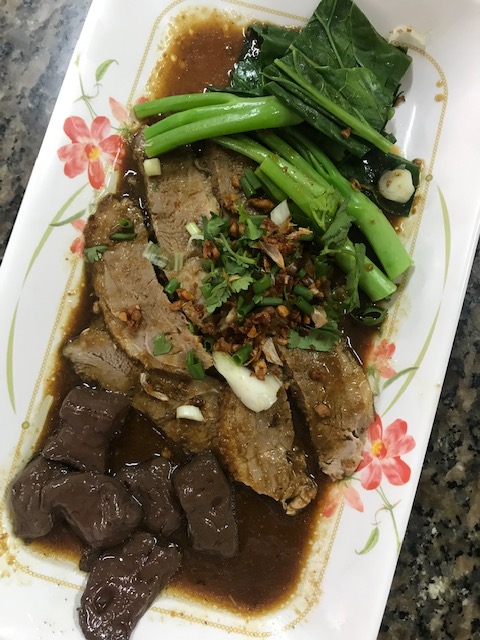
Not to say there isn’t anything else very Asian, because of course there is. Meng Lee is known for its beef-kale stir-fry, which, like Davos the Onion Knight, comes as you would expect, with no nasty surprises.

beef

And then there’s the omelet. Maybe Jay Fai has spoiled us all. But this is a latter-stage Tyrion Lannister version of a crab omelet, something I might slap together hung over and resentful over the intrusion of friends I’d invited over to the house the night before.

omelet

At the end of the day, it might not be the food itself that lures you — if you make it past the Unsullied at the door — to this quiet corner shophouse oasis in the middle of everything touristy. It’s the nifty time travel that happens once you are seated: the checkered floor, the ceiling fans, and, yes, the elusive, super-shy servers. You are not transported “back” to fantasy medieval times; instead, you find yourself in mid-20th century Bangkok, when things seemed a lot simpler and the heat wasn’t quite so oppressive. Maybe this is enough reward to brave a trip through Meng Lee’s green door (BITTERSWEET).


5 Comments

Filed under Uncategorized