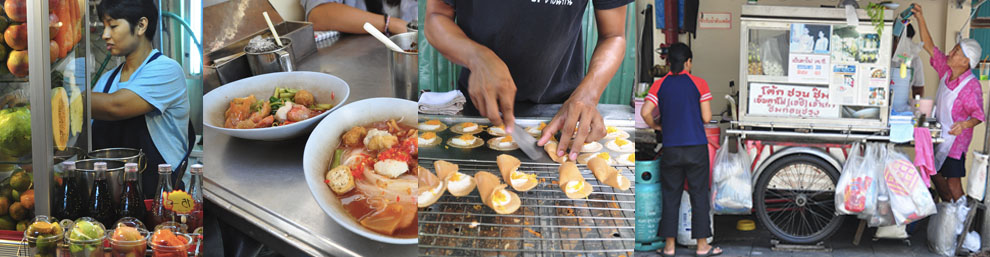
Saying good-bye to Sukhumvit 24

A great stuffed omelet at Thong Li on Sukhumvit 20

After 25 years of living off of Sukhumvit 24, I am moving. To Samut Prakan. And, while I have nothing against Samut Prakan, I have been bummed about it. I suppose everyone in Bangkok believes that they live in the middle of everything, in the best neighborhood in the city; I am one of those people. I loved my neighborhood. Villa (the real one, on Soi 33/1) was close by if I needed American ingredients (Vlasic baby dills!), as was Emporium; Klong Toey was a short motorcycle ride away for Thai ingredients. I had my hair salon, my eyebrow lady, my pedicurist and my massage place, all within walking distance. My Skytrain stop was a 5-minute walk away, partly air-conditioned if I wanted to access it through Emporium. Movies, bars, good Japanese food: it was all there. And if it wasn’t close by, I had my favorite motorcycle taxi gang waiting for me, to the left of the entrance to the park.

I have to find all new places in my new neighborhood. After 25 years, the thought of it is daunting. But I wanted to say good-bye to all of my favorite places near my old house first. So that’s what I’ve spent the last few days doing. They are, in no particular order:

The chicken and bitter melon noodle guy next to Benjasiri Park

I’ve written about this place before. Everyone in Bangkok thinks the noodle person next to them is the best, and I am no exception. So say whatever you like, but I really believe the guaythiew gai mara here is superior to most other renditions I’ve tasted. The broth is flavorful and sweet, the chicken is well-seasoned, and you can put your own toppings on. What’s not to like? I might miss this place the most of all of my places.

Guaythiew Pik Gai Sainampung

This place between Sukhumvit Sois 20 and 18 is famous for its stewed chicken wing noodles. Because of the shop’s name, people think the vendor, Khun Saowarot, puts honey on the chicken, but the name is really because of the old name of Sukhumvit 20, Sai Nam Pung. In any case, the chicken noodles aren’t the reason I go here, though they are good. They make my favorite bowl of yen ta fo, a slight favorite over another close-by noodle shop, Tang Meng Noodle.

Thong Li

Tuna nung boie

My friend Andrew, who lives on Sukhumvit 20, introduced me to this cookshop-style eatery, which is nearby. It’s become one of my favorite places since then. They specialize in pork liver, but there are tons of great dishes here, and if it’s possible, they keep getting better and better. My favorites here are the kai yad sai (omelet stuffed with minced pork); tom kloang ruammitr (clear soup with tamarind); and pla tuna hung boie (canned tuna steamed with pickled plums).

Kitchen Niigata

Hamburg steak set A

One of the great things about my old neighborhood is that there are tons of under-the-radar Japanese eateries nearby: an okonomiyaki place in the plaza next to the entrance to Sukhumvit 39, for instance, or Isshin, the soba place a few steps away from Emporium. But my favorite has long been this place, where I go for lunch about once a month. They used to serve “spaghetti naporitan“, but don’t anymore; the last time I was there, they offered a “yum shiokara”, which is as good of an example of Thai-Japanese fusion as I can think of.

Anyway, it’s a place I go to when I want a relaxed, quiet lunch alone, a sentiment likely shared by all the other solo diners around me there.

OnigirI Lab

The “OMG” egg onigiri

This is a relatively new entrant compared to every other place on this list. It opened in a spot I once thought was cursed, across the street from my husband’s cousin’s house. A handful of eateries set up shop there and eventually closed down, and I thought this place would only continue that streak, but something happened and now, it’s quite comfortably full in the mornings and afternoons. Even though I walked by this place almost everyday on my way to the Skytrain, I rarely ate there; I did, however, order on Grab. My go-to orders were Basic Bitch Lite™: the mentaiko with cream cheese, and the natto with wasabi leaves. Sometimes I branched out into the miso egg yolk one or the soy sauce oyster. I never got to try everything on the menu, though, unfortunately. Maybe that can be my next project, after I move a half-hour Skytrain ride away.

Leave a comment

Filed under Uncategorized

What’s Cooking: Jaw pakkad

Northern Thai Chinese cabbage soup

(Photo by Andrew Hiransomboon)

A few years ago, I got a Facebook message out of the blue from an acquaintance that I didn’t know very well. I don’t get angry that often (or didn’t at the time, pre-menopause) but his message really annoyed me. I mean, not only have you reached out to me for no reason (no food involved, just aimless conversation), but you do it to say such stupid stuff.

Him: Let’s talk Thai food.

Me: OK.

Him: Those Thai soups that have all that gunk in them. Why do Thai chefs not take it out before they serve it? My personal theory is that they are lazy.

Me: I don’t agree with those Western rules for plating Asian dishes.

Him: OK, thanks for playing!

Me: Bye

I mean, seriously? Don’t bother me with your “poor-benighted-savages-who-need-a-finger-wagging-foreigner-to-tell-them-what-to-do” bullshit and then have the temerity to expect me to agree with you? Does this man not read anything I write? (of course not) Do I complain when I get a big-ass steak that the chef hasn’t cut for me into bite-sized pieces? No. Do I think the chef is maybe a little bit lazy? Possibly. I mean, why do I have to do all that labor, at the table, myself? An Asian food chef would know to pre-slice that steak. What am I paying this jackass for?

Maybe I’m still a bit annoyed at that exchange. In any case, I never talked to this man again. But I do continue to enjoy “soups with the gunk still in them” like tom yum, tom som, tom saap, basically all the toms. I enjoy them like many other Thai people do, because they know to just ignore the stuff that they don’t want to eat, while still enjoying the smells from the aromatics. We do this because we have eyes. I understand that this is a privilege.

My personal theory is that this chef is lazy

But here’s a soup for people who get confused about what you should eat and what you should leave in the bowl. It’s called jaw pakkad, and it’s a Northern Thai staple, available at any restaurant that calls itself a “huen” anywhere in the region. It’s a soup (“jaw”) made with Chinese flowering cabbage (“pakkad”) and tua nao (fermented bean discs). Because this ingredient (I’m talking the bean discs) is so hard to find outside of Northern Thailand, I despaired of ever trying this dish out for myself. But I found some beautiful “pakkad” (also known as pak Guangdong in Thai) in Klong Toei market and couldn’t help but try.

So I subbed out the bean discs for thao jiew, or Chinese-style fermented brown bean sauce, and went to work. The result was something that I personally love: super-umami with shrimp paste and brown beans but also salty and sour from tamarind. If you like these types of flavors, I feel like you’ll love this soup. Added bonus: no gunk.

Now, if only we could find a good replacement for Chinese flowering cabbage …

Jaw Pakkad

Serves 4

Prep time: 10 minutes                            Cooking time: 2 hours

  • 300 g pork ribs, cut into individual riblets
  • Enough water to cover pork in a pot (around 3-4 cups)
  • 1 small bunch of flowering Chinese cabbage (pakkad in Northern Thai or pak Guangdong in Thai), thick stems and yellow leaves removed but blossoms kept
  • 2 Tablespoons thao jiew (Chinese-style fermented brown bean sauce)
  • 1 Tablespoon fish sauce
  • 6 Tablespoons tamarind juice (for cooking, not drinking)
  • 3-4 dried chilies (for garnish)

For curry paste*:

  • ½ teaspoon salt
  • 4 cloves garlic, peeled
  • 5 small Thai shallots (or 2 Western shallots), peeled and chopped
  • 1 Tablespoon shrimp paste

First, set the pork ribs to cook in water over medium-high heat, about 1-1 ½ hours. Keep skimming impurities from the surface (foamy bits and impurities) all the while, not obsessively but fairly frequently. If the water starts to fall below the level of the ribs, add water to cover and bring back to the boil. Your ribs are done cooking (and your broth is done brothing) when the ribs can be easily pierced by a fork.

While ribs are cooking, pound your paste base, starting with the salt and garlic and adding each ingredient as you go. Once your ribs are soft, add the paste and stir to disperse. Allow to flavor the broth for a few minutes, then add your brown bean sauce (thao jiew). Stir to disperse again, and add fish sauce and tamarind juice. Taste and adjust seasoning if needed. Once you’re satisfied, add your vegetables and allow to cook, about 5-10 minutes. Remove from the heat and serve as part of a great Northern Thai meal.

* Pro tip: If you have nam prik tha dang (red eye chili dip, page x) already made, you can add that paste to the soup instead of making your own.

Leave a comment

Filed under Uncategorized

Markets: Chin Haw Market

A bowl of mohinga at Talat Chin Haw

A lot is made out of the Lanna culture when you’re in Chiang Mai, and how old and distinct it is from Central Thailand. While that is all good and true, it is also oversimplifying what a real patchwork quilt of cultures the “Rose of the North” really is, and how truly awesome that makes the former Lanna capital. So when you stumble upon a place like Chin Haw Market — open only on Friday mornings — you want to cherish it, and go there again and again.

You’d be forgiven for thinking that the Chin Haw market only offers items made by the Chin Haw people: a Muslim-Chinese group whose extensive travels resulted in bringing influences all the way from Persia via to Silk Road to Northern Thailand, resulting in dishes like khao soy. But it’s a mash-mash of all of the “minority” groups in the area, like the Muslim-Thais selling “cha chak” (“shaken tea”, poured from a great height with much ceremony) to beef satay to samosas, available at the entrance to the market.

A little ways into the market, a vendor offering various vats of curry with rice is attracting a long queue, which of course piques our interest. We head over to have a look and are rewarded with possibly the most beautiful biryani we’ve ever seen, peppered liberally with colorful spices that glow like jewels in the sun.

Further on down the way, lined with vendors selling all manner of typical market food like fried tofu and chicken rice, a vendor at the end of the aisle threatens to dominate the whole space. It’s the halal Hamza Goat Farm stall, and its main product is prominently displayed next to the vendor’s head:

But just across from this meaty display, a hill tribe couple roasts local peanuts, marked with the “tiger stripe” pattern that makes them unique.

Just a few steps away, a pair of Chinese men offer their house-cured Yunnanese ham, traditional cured sausages, and sausages liberally seasoned with the flavor of the moment in Thailand, Sichuan-style “mala”.

And next to them, a Yunnanese couple serve up fresh pancakes made from just-shucked corn. We take a bite when they are plucked off the griddle, and they are everything they look like they’d be: warm, sweet, soft and comforting.

We want to taste more, but we’re heading into a section that is not quite Yunnanese, and not quite … well, we don’t know. We ask a vendor in Thai what a tangled root-looking vegetable is called, and he responds, “I don’t know its name in Thai.”

Further on, a vendor is making a dish that we’ve never seen before in Thailand, layering a thin crepe with scrambled egg and scallions on one side, then flipping it over to receive two big lashings of sauce and folding it over crispy rectangles of dough — something similar to what we’ve seen in Taiwan. What is it exactly and where does it come from? Hell if we know.

But now we’re heading to more well-known ground. A scrum of customers surrounds one particular vendor, serving the fish noodle dish known as mohinga (aka “Myanmar’s national dish”) as quickly as she can plate it. We try to order, but she gestures at a table, already waiting for their noodles, and then the line that is waiting to sit at that table next. “We’ll come back later,” we say, thinking later = sometime next year.

Finally, after a bit of maneuvering, more crowds and the sight of stressed faces lead us to a covered tent, where handmade dim sum is being doled out to an anxious crowd of customers. Next to him is the Shan table, serving “khao ganjin” (rice cooked in pork blood and wrapped in banana leaves), their take on “khao soi” — sans coconut milk and with more of a nam ngiew-like ragu — and a dish we’ve never seen before: a tofu porridge made of green peas and a thickening agent, left overnight in plastic bags, drizzled in broth and seasoned with deep-fried garlic oil and fresh chervil leaves.

We want to eat more, but we are full to bursting when we finally make our way out of the market, clutching our purchases to our aching bellies, the sound of Chinese songs blaring in our ears. In a world that seems like it wants to pare itself down to homogeneity and conformity, it’s comforting to have places like the Chin Haw market still around, ready to add more flavor and genuine surprise to our lives.

Black sesame doughnuts

2 Comments

Filed under Uncategorized