The Natural

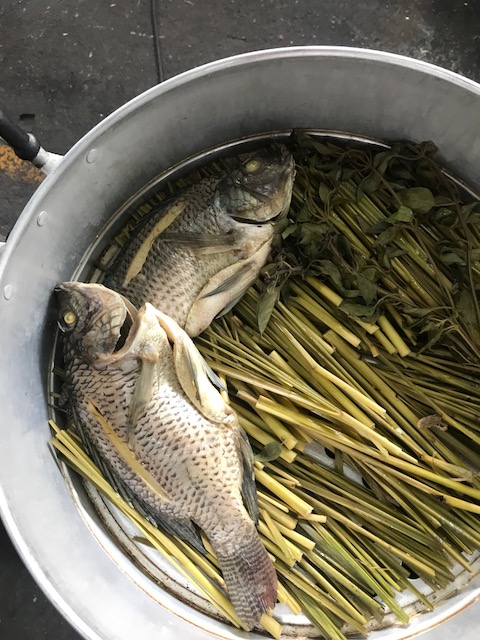
crab

Crab from the Crabman

(Photo by Chatree Duangnet)

I have not posted in a while because my laptop was being held hostage by my son, who used the tail end of his summer holiday to make numerous Google slide presentations for his own amusement. I have to admit I appreciated the excuse to stop writing. Unfortunately, he is back at school so I suppose I will have to start up again.

Also during the summer holiday, I was lucky enough to be tapped to do some research work for a documentary on street food. This led me to various restaurants, not all of them street food, where for some reason or other (such as, they were not street food) they did not make the final cut. One of those non-street food places was “Jok Tho Diew” (“One Table Jok”), also known as Jok Kitchen.

Jok Kitchen has been around for a while, a little over 10 years now. From the very beginning it was a success, winning write-ups from various publications and months-long waiting lists. The funny thing about this (Alanis Morrissette would call it “ironic”) is that Chef Jok came to the success of his one-table restaurant fairly late in life, after decades of kicking around Asia doing anything but cooking.

Born 65 years ago in Chinatown to a Chinese-Thai mother and a father who had immigrated to Thailand from Shantou, Jok spent his earliest years in the hospital, cared for by nurses because of a rare allergy to his mother’s milk. Fed on a mixture of chocolate and rice water, he was given the name “Jing Jok” (Thai for gecko lizard) by the nurses because although he didn’t eat much, he wouldn’t die.

This early ailment may explain why he remained the apple of his parents’ eyes well into adulthood. Gregarious and talkative, Jok was deemed unsuited to the traditional support roles in the family business, which was one of the most prominent suppliers of crab in the country. So instead of following his siblings into management, Jok became a delivery boy.

Watching what the cooks did with the crabs he delivered sparked his interest in food. His first taste of steamed fish in soy sauce, the signature dish of famed Thai-Chinese eatery Hai Tien Lo, sealed it. Determined to make the dish himself, 12-year-old Jok convinced his father to let him apprentice with the chef, Meng Jai, igniting a pattern of incorporating, adapting and improving others’ dishes that he continues to this day.

snowfish

Fried snow fish on lettuce, inspired by a meal at Fuji

 (Photo by Chatree Duangnet)

Never at a loss for friends, Jok honed his kitchen skills by cooking for his friends, starting a “cooking club” where he would attempt to replicate dishes that he and his friends admired at famous restaurants. Even as he took on a more peripatetic lifestyle, embarking on various ventures in Indonesia, Vietnam and mainland China, the cooking club remained a near-monthly occurrence, his interest in food unrelenting. “You should start a restaurant,” was a familiar refrain from friends that he kept touch with, childhood friends who had since grown into positions in the military, banks, police, media, and of course, in neighboring shops in Chinatown.

This would become key later on, when his parents passed away and he was left to fend for himself. After a brief and acrimonious stint maintaining a food outlet at Suvarnabhumi Airport (he quit after one month over rent issues), he decided to essentially monetize his supper club, opening up the table typically reserved for guests to his house to food-loving members of the general public willing to make the trip down the dank, dark alleyway to his door.

alley

By day, a bustling market. By night, the entranceway to Jok Kitchen

The concept was irresistible to Bangkokians: one table, reservation only, serving high-end Thai-Chinese food that was championed by big-name mucky-mucks in all corners of high society. Since then, Jok Kitchen has expanded to a back room next to the kitchen that easily fits two more tables; at maximum capacity, Jok Kitchen can accommodate six. The repertoire has also expanded, including special requests from guests if made far enough in advance (although his signature dish remains the beautifully steamed, fresh crab.) Other dishes are a map to his own experience: “Prosecution Fried Rice”, a delicious mix of perfectly wok-cooked Chinese sausage, egg, and Chinese kale was hatched during a late night session with lawyers working on the prosecution case against Thaksin Shinawatra; his “hangover soup”, a clear seafood soup with pomfret, ginger and pickled plum, was born after an evening spent overindulging on whisky.

The kitchen, however, remains tiny, a condominium-sized cubbyhole with four burners and a shelf full of homemade condiments, including his own version of a famous oyster sauce from a restaurant in Hong Kong. This is used to best effect in his steamed fish dish, inspired by that first bite of steamed fish in soy sauce at that restaurant in Chinatown years ago.


2 Comments

Filed under Uncategorized

This one is about Wuanood

noodles

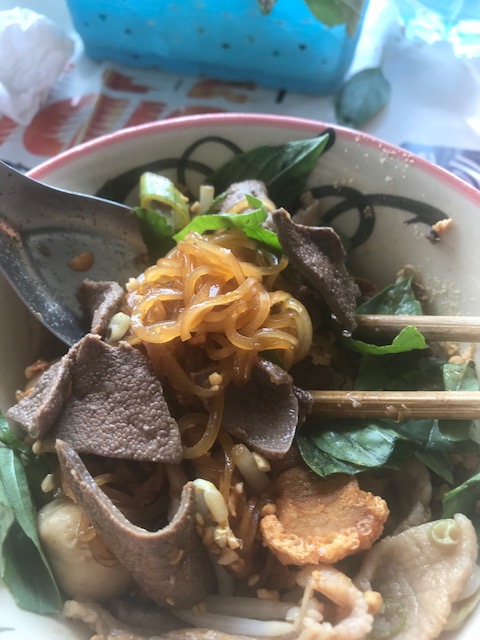
Beef noodles at Wuanood

Note: The owners here are actually Thais who have studied abroad in the US. The basic premise (that we cross-pollinate our culinary influences when we spend any amount of time somewhere else) holds, doncha think? 

I have never been a fan of Khao San Road. The bucket cocktails, the blaring music competing from both sides of the street, the endless parade of pad Thai/fried spring roll carts standing in for Thai street food — it’s all pretty much my nightmare, aside from being in an actual club blaring the Black Eyed Peas’ “Let’s Get It Started” on a never-ending loop as a bunch of fraternity bros high-five each other over my head.

All the same, the decision to clear the street of its street vendors from August 1 onwards is baffling to me in many ways. It’s not just because we always thought Khao San Road would be untouched. It’s because of the reasons behind that assumption: namely, the budget-conscious backpackers who form the backbone of the clientele there, the fact that the Thai economy relies heavily on tourism, and the likelihood of these tourists wanting to see something that doesn’t look like what they left back home. What would end up taking these vendors’ place? If you guessed 7-11, Starbucks, Burger King and some nearby shopping malls in the offing, congratulations, because I guessed that too and we are officially guessing twinsies.

At a time when Thailand is undergoing a gradual strip-mallification, Thai food continues to proliferate and flourish abroad. Sometimes it is not in the form that many Thais recognize … but them’s the breaks. Was Kurt Cobain thrilled to see fraternity bros enthusiastically mouthing the words to his songs in concert? No, he was not. Was Prince thrilled to see various people maul his songs onstage during a tribute performance? No, he was not. Cooks abroad, making food for people who are not necessarily Thai, are doing the very same thing with their interpretations of these classic dishes.

Now, when I sit down to a Thai restaurant in, say, Brooklyn and am confronted with crab rangoon and a watery green curry, do I think to myself, “Gee, I wish someone would swoop in and save me/save this restaurant?” I admit, sometimes I do. But never, ever, do I ever think the answer lies in the Thai tasting robot (I will never stop talking about this forever, because it was a genuinely batshit crazy idea). I guess I am just not as proactive about these things as Thai officials are. Also, I feel like it’s a futile exercise: aside from LA, there are just not enough Thais and Thai palates in this world to ensure that dishes in Thai restaurants from Prague to Pennsylvania taste like they do in Thailand. This is unlike the situation for Chinese food in Auckland or Vancouver, where there are plenty of Chinese people around to reward authenticity. Be happy that someone else knows about green curry and pad Thai. Count your blessings.

And sometimes, something genuinely exciting happens when you grow a cuisine abroad and see it imported back to you. People saw that with Chinese-American food, a once-derided niche that is today genuinely beloved for its chop suey, moo goo gai pan, kung pao, and of course, General Tso’s chicken (all stuff that I never got to try as a kid, because my parents liked the real thing). The things that people do with sushi rolls nowadays (tempura, deep-frying, mayonnaise) are things you are just starting to see in Japan, where now even salmon is everywhere, except at serious places where it is embarrassing for you if you order it (trust me).

In that vein, Thai-American stuff is just beginning to trickle back to the homeland. Wuanood purports to serve the same recipe as longstanding fave “Nuea Grob Noodles Behind Thai Airways” on Vibhavadee Road, but they do it with a decidedly fusion-y flair. Owned by Thai-Americans descended from the original Vibhavadee vendor, Wuanood specializes in, obviously, beef noodles, but allows you — via super-detailed multiple-choice menu — to choose the cut of beef, method of cooking, and even level of spiciness, allowing a level of customization set to please even the most persnickety of diners. Beef-averse customers need not worry: you can also get pork (Kurobuta of course) and/or a plethora of sides that include yum woonsen (spicy glass noodle salad), fried spring rolls and crunchy Korea-like chicken wings. Best of all, it’s indoors and air-conditioned, so you don’t risk heat stroke from going out on your lunch hour. If this is what the coming strip- mallification of Thailand looks like, bring on the corporate overlords.

menu

Self-portrait with noodles


6 Comments

Filed under Uncategorized

Finding the Om in Nom

lunch

You may start with a 30-minute run, or a group barre class. It’s boring and/or excruciating, but after a week, you’re hooked — the pain is nothing when compared to the glow of self-congratulations after the fact. I AM AWESOME, you think, so you do it again. After a while, like a drug, that hour-long class seems like old hat; it’s new heights of boredom and pain that you now seek. Some find that backbreaking solace in Crossfit, or marathons, or iron man competitions. Others take a different route: meditation, a cleanse, or detox.

It’s easy to say “I’m detoxing for 30 days, don’t feed me anything good”, and then eat soup and be mean to your husband all month long. But if you really want to do it, and to be held accountable, you go to something like Samahita Retreat in Samui, where detox, yoga, and, yes, weight-loss programs are available for anywhere between 7 to 14 days.

Samahita’s slogan is “Breathe into a new life”, but my friend Trude would say a more honest one would be “Luxury fat farm”. Open since 2003, Samahita means “centered” and its default setting is its “yoga/core/cycle” program, which every guest automatically gets once they book into the retreat. This basic default mode means that you aren’t required to stay the minimum of 7 days that it takes for the detox or weight loss programs to take effect. So naturally, this is what Trude, Fiona and I chose. It was not until I arrived on the premises that I discovered that “yoga/core/cycle” means yoga, core, and cycling classes because duh (I thought it meant some sort of yoga like “sun cycle”, only “core cycle”. Whatever ok?)

giphy

Gwyneth judges me

The “yoga/core/cycle” program involves up to 5 hours of classes, including morning meditation and breath work, yoga flow, core class in the afternoon, spinning, and then a gentler, “restorative” yoga. In the evening, you get another hour of meditation if you want. There is a morning banana and coffee and tea from 6.45 on, and a “hot” breakfast available from 9.30 while you are already in yoga class, but the bulk of the eating is done from 11am to 8 at night, when the dinner buffet closes down. In the afternoon lull at 3pm, you get a “snack” that is invariably a fruit that skinny girls always seem to eat, like papaya, watermelon or dragonfruit. I am detailing this as clearly as I can because 1. I am a pig and 2. this is ultimately what Samahita is all about.

In other words, besides being “centered” and working the crap out of you with its fitness and yoga classes, Samahita is mainly about (excuse my French) “le poop.” If you have problems in this area, Samahita is there to fix it with its smoothies, its juices, its poop-y fruity snacks, its all-you-can-eat lunch and dinner fiber buffets. I can attest (again TMI) to going to the bathroom twice a day; my companions, three. In any other setting, this would be cause for alarm and a trip to the pharmacist. Here, it was merely a byproduct, evidence of our detox.

And the food? The food. The food is a portal through which any culinary pathology can pass and thrive, uninhibited. Gluten-intolerant? Lactose-free? Vegan? Wary of garlic and onions? Every food phobia you can think of is acknowledged, cosseted, tended to like the weary feet of a tourist at an upscale Thai spa. There is even a handy food index:

index

Note the “Thai food” warning

Not surprisingly for a place that must denote its Thai food dishes, the clientele is overwhelmingly Western, with a smattering of Singaporean and Japanese guests. Many, if not most, of the guests knew Thailand solely through their experience at Samahita. This might explain why the food caters to a crowd that prizes purity first and taste second: the buffet changes daily but always features a salad, steamed veggies, a dip with crudités and a “green power soup” that I strongly suspect are the pureed steamed green vegetables from the night before. The focus is on freedom from meat, from sugar, with the occasional nod to dairy, wheat, eggs and even fish.  Things that hint at “sweet” are simply nods at those things, security blankets that don’t mean anything. This comes into focus most clearly in things like the “chia chocolate pudding”, which Fiona calls “the most anorexic pudding ever” and tasting as if “a chocolate bar had been waved over it during assembly”.

chia

Perhaps this is why much of the Thai staff, when confronted with an actual Thai and a Thai-speaking farang like Trude, did not really take us to heart. Even Fiona noticed, telling us, in case there was any doubt, that “Yeah, they really don’t like you guys.” I think the underlying assumption (because it couldn’t possibly really be us!) was that farang whose only experience of Thailand would be this retreat would be expected to indulge in crazy things like vegan food and 5 hours of fitness classes a day. Why on earth would other people who really know Thailand do it though? To opt for a garlic-free mash of grilled green peppers instead of nam prik num, to content oneself with flat rice noodles in a vegetable-and-arrowroot gravy instead of real guaythiew lard na? In their eyes, what were we thinking?

What we were thinking was that it was nice, for once, to feel so exercised, healthy and self-righteous. All the same, three days was enough. So enough, that we plan to do it again, later this year. I will bring athletic shoes this time, so I can go spinning. It won’t be any longer than three days, of course.

twins

Twinsies

On the way home, I bought a wildly overpriced bag of Doritos (extra Nacho flavor) and ate them outside, in a courtyard of the cray-cray Samui airport built to resemble a suburban US shopping plaza. It was the best Doritos I’d ever had, everything I’d been missing: satisfyingly crunchy, aggressively umami, yo-yo flavors both salty and sharp. That alone seemed worth the trip.

5 Comments

Filed under Uncategorized