Phuket’s sure thing

tabletop

(Photo by @seenyc)

I used to be afraid of watching horror movies. I remember watching “Aliens” (not even the scary Ridley Scott original, but the James Cameron action flick) and having to sleep on the floor of my parents’ room for three nights straight (this was in 1986, and I was 14 years old). At slumber parties, I would cower in the kitchen at crucial parts of “The Exorcist” or “Halloween”. Now, I don’t know whether it’s my advanced age, or my own cray brain, but I love horror movies. I prefer the slasher and home invasion genres to supernatural or demonic possession, simply because they are usually scarier and nothing is worse than a scary movie that isn’t scary. As I write this, I am watching “Texas Chainsaw Massacre” (the remake, because I can’t get the Tobe Hooper original). It helps me concentrate. That said, I won’t go anywhere near the zombie genre or French horror, because that is *still* straight-up terrifying, even in my deadened state.

There are foodie versions of horror movies too. They are the restaurants you go to, lured by a glowing review that grabs at you like the promise of an idyllic summer camp experience (“Friday the 13th”) or a whirlwind marriage to Taylor Swift’s ex-boyfriend (“Crimson Peak”), thereby forcing you into the dodgy situation in which you currently find yourself. There, like Morgan Freeman opening up that box in “Se7en”, you are confronted by the very worst of what you could expect to find in a restaurant — food that is contrary to everything that drew you there in the first place (the horror!!)

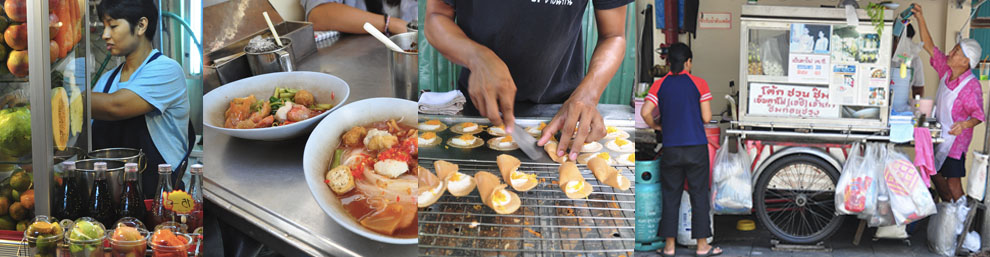
Under these circumstances, it would make sense to head for what is known and proven, culinary security. And in Thai cooking, there are few choices that are safer than the Southern Thai dish of kanom jeen (Mon-style fermented rice noodle) in Phuket. A bowl of this is the Thai equivalent of the slam dunk: rice noodles slathered with nam ya (fish curry, thickened with coconut milk, heady with grachai or wild ginger) and accompanied by a battery of fresh, blanched and pickled vegetables.

kanomjeen

Kanom jeen nam ya at Kanom Jeen Ji Liew in Phuket

(Photo by @seenyc)

Kanom jeen is ubiquitous on the island, and the dish’s identity — like khao soi in Chiang Man — is inextricably linked with its home. Because of that, it seems churlish to single out one of the many fermented rice noodle places that dot the island, but I’m going to do it anyway. Kanom Jeen Ji Liew Phuket (Thep Kasattri, Thalang District, Phuket 83110, 081-256-9615) has the culinary chops to back up that impressive-looking sign:
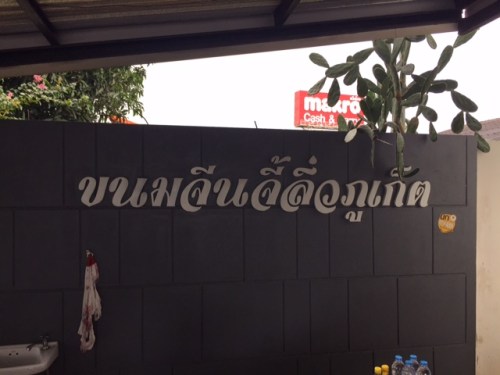
sign

(Photo by @jiminspace)

But perhaps the best reason to visit this place is not even in the name … or even in any photos, for that matter, because it was devoured immediately before anyone could take any photos of it. I’m writing of the fried chicken, crispy nuggets of drool-inducing savor hiding tender morsels of flesh that actually  melt in your mouth, for real. So OK, I love fried chicken anywhere (I just had some fabulous stuff in Malaysia, for instance), but this really was good, I’m not joking, I’m not playing you like Pazuzu in “The Exorcist”.

garlic.JPG

Pickled garlic, one of the many accompaniments to southern kanom jeen

(Photo by @jiminspace)

Bottom line: you can’t lose with kanom jeen when you are down south, especially in Phuket. Don’t take this advice lightly. The sure thing may be just what you need to get you through any crisis, especially at a time when every day brings threats of more horror stories just around the corner.

Leave a comment

Filed under Uncategorized

Northern Exposure

I try to post something every two weeks or so, but with the passing of King Bhumibol Adulyadej last week, it seemed silly to natter on about noodles while the country was still newly mourning. Don’t get me wrong, it is always silly to natter about noodles, but sometimes that is all that we (I) have.

One of the great silver linings about taking taxis in Bangkok is the opportunity to listen to whatever the taxi driver is listening to during a traffic jam. What we were listening to was a very long, involved radio interview with a royal palace cook hailing from Suphanburi, because Thais are fascinated by what royalty like to eat. What I learned was that the King was partial to a nice piece of steamed fish paired with Hollandaise or a lemon sauce, simple Thai culinary standbys like gang som (Southern-style sour curry), and childhood favorites from his time in Switzerland, taught to the cook personally by Princess Srinagarindra, the King’s mother. It was nice to know that the King was fond of dishes from his childhood, too.

If you’ve read this blog for a while, you will probably know that I like to wax poetic on my own childhood favorite, kanom jeen nam ngiew, a Northern Thai noodle dish that my father used to call “Thai spaghetti”. In the North, it is typically made with the fermented Mon-style rice noodles found all over the South called kanom jeen, but you can also find it served with rice noodles, just like they appear to do in Laos (where, to make things more interesting, they call it “kao soi”): a stew of minced pork with tomatoes, chilies, shallots, and garlic over a base of fermented soy beans and topped with bean sprouts and coriander leaves.  In the North, they add well-stewed pork ribs, cubes of congealed pork blood and the requisite dok ngiew, witchy-looking blossoms that resemble broomstick ends and bring a chewy texture and floral taste to the brew. If one is lucky, the ribs have been cooked until the bones have nearly disintegrated into the sauce, the blossoms are thick and plentiful, and the dish comes to you with a generous dusting of deep-fried garlic. And if you are really lucky, the chef has been liberal with the tua nao, the fermented soybean discs that form the basis for flavor in Northern Thai cooking, much like gapi (shrimp paste) in the Central region and pla rah (fermented Thai anchovy) in the Northeast.


kanomjeen2

Eating the namesake dish at roadside vendor Nam Ngiew Nua Sud Sud

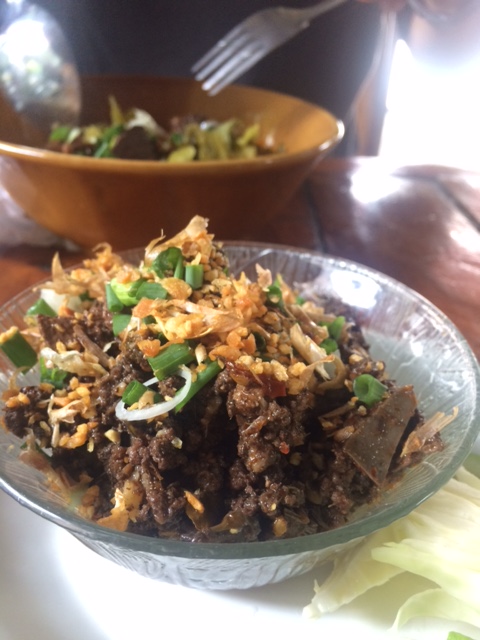
One reason I find a lot of the Northern Thai food lacking in Bangkok (especially with this dish) is that no one wants to bother using tua nao, thinking the Chinese yellow bean sauce (thao jiew) is good enough. I am here to tell you that is not true. And at Raan Nam Ngiew Nua Sud Sud (meaning “Northernmost Nam Ngiew”, Soi On Nut 12, 081-741-8917) … they also do not use tua nao, rendering the sauce just-ok-but-good-enough-because-there-is-nothing-better-in-Bangkok. But their larb kua (a minced beef dish cooked Northern-style with plenty of liver and a heavy chili paste base) is off the hook, the best I’ve had outside of the North: properly ponderous, slightly bitter from the deep-fried garlic, thick with the deep dark flavor you would expect to find in a place like Chiang Rai.

larbkua.JPG

What my dad calls “larb muang”

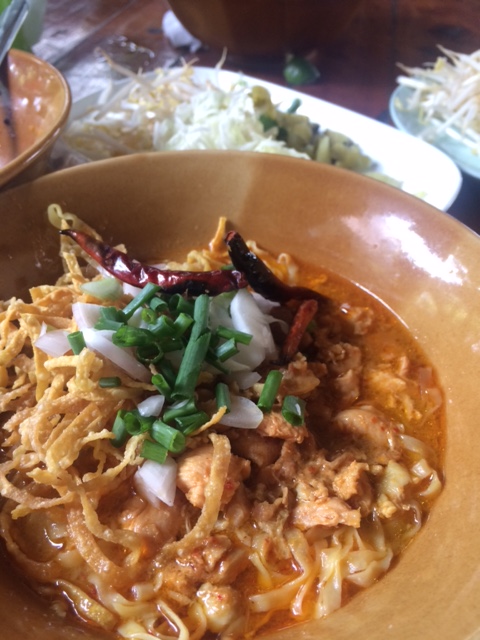
Of course, they also offer khao soy, because what is a nam ngiew stand in Bangkok without the ubiquitous curried noodle dish? Through my Wikipedia research, I have just learned that Northern Thai khao soy most corresponds to the Burmese dish ohh no kao swe. 

khaosoy

Khao soy

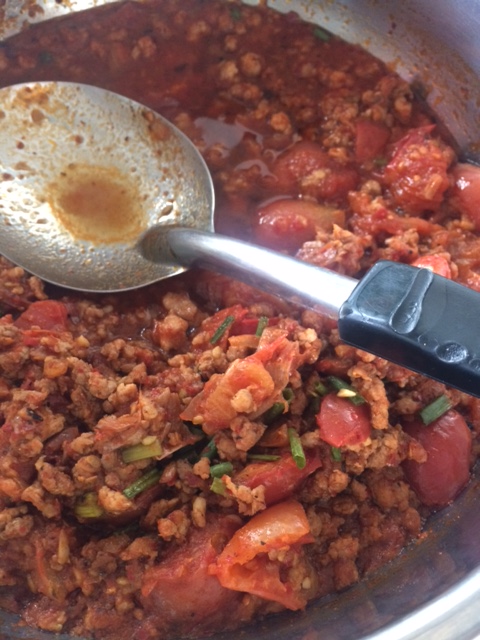
And, in a shoutout to my brother Sutree, the all-important Northern Thai accompaniment of nam prik ong, a chili relish most like Bolognese sauce in the Thai culinary lexicon, except with a fermented soybean base:

namprikong

Nam prik ong

Is this stuff going to change the life of a Northern Thai food lover whose best memories center around eating these dishes? No, of course not. It’s hard to compete with one’s childhood, and to prepare for the change that inevitably lies ahead. It’s good enough for now, though.


2 Comments

Filed under Uncategorized

Glutton Abroad: KL overload

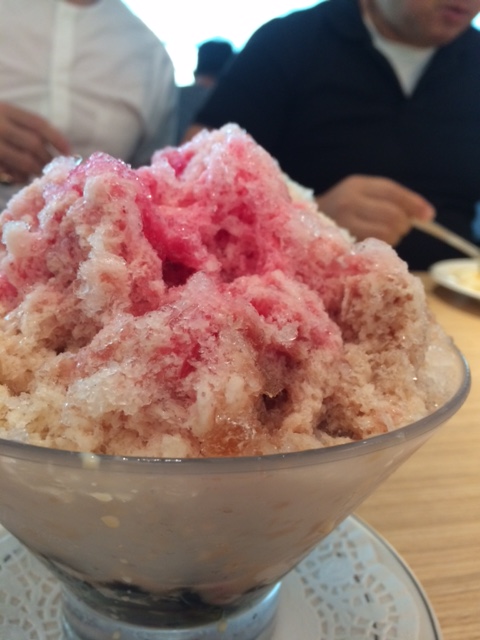
ice

Malaysian ice kacang at Madame Kwan’s

One of the best things to have happened to me this year is learning that I am allergic to almost everything. Instead of the usual old response to “how are you doing?” (which was “I’m okay I guess aslfjasklfnbj;js ……..zzzzzzzzzzzzzzzz”), I can now regale people with fascinating insights on not being able to eat gluten, dairy, asparagus, almonds, mustard, cashew nuts, etc. It gives me a good 10 minutes of cocktail conversation at least. Sometimes people lose track and offer me a sour cream dip or cheese afterwards, but I don’t blame them, because the list is so very long — who can be expected to remember all that? I myself keep a list handy whenever I forget (which is often):

list

#prayforbangkokglutton2016

I am supposed to stay away from these things for six months, and indulge occasionally in some of the others every 3 or 4 days or so. The idea is to gradually reintroduce these offending ingredients into my diet in a controlled manner. In all honesty though, I eat eggs and coconut probably every other day — how else would I be able to eat Thai food otherwise? — and the rest … well, I now know that I’m allergic to them. And when I overindulge? Let’s just say I still bear the traces of my last two indiscretions on my chin, in the form of zits named “4 slices of Domino’s Pizza” and “pecan pie”.

So when I decide to fall off the wagon, it’s a real, conscious decision with pros and cons: pros (I will be happy), cons (I will look like I have leprosy). On my trip to Kuala Lumpur for my friend May’s birthday, I choose to go it whole hog, as it were, for as much as I can.

There are places we never miss while in KL, such as Overseas and their Chinese roast suckling pig, sliced into crispy fat-backed squares, laid atop a mound of sticky rice and served alongside steamed white buns and gravy boats (gravy boats!) of Malay-style curry.  But May always tries to mix it up with dishes we haven’t tried before, and although that list gets smaller every time we visit, there are still, unbelievably, things there.

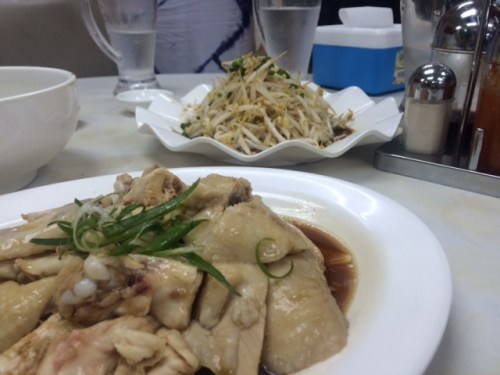
Such as Ipoh-style chicken and noodles. Where we go (creatively named “Ipoh Chicken Rice”), we try all the things we are meant to, even though it is our second lunch of the day after a quick “breakfast” (15 minutes ago) of succulent pork belly char siu with a side of stir-fried thread-like egg noodles and a plate of gossamer cooked lettuce leaves. We eat the stir-fried bean sprouts, Ipoh’s best, awash in a light sour-salty sauce and a platter of chicken with meat so custardy that it barely resembles meat:

IMG_4201.JPG

Ipoh Chicken Rice’s chicken and sprouts

Plus the noodles. As a Thai, I am supposed to say that they were bland and strangely resistant to chewing, but as a Glutton, I can say that their texture was strangely addictive, bouncy and sweet from all the shallots.

noodles

At Kukus (26, Jalan Tun Mohd Fuad 1, Taman Tun Dr., 03-7731-3559), open only three months ago, we go batshit crazy and each order what can only be described as a gigantic circular tray of rice (150 g or 300 g’s worth of 100 percent Basmati rice, take your pick) topped with various types of sambal ranging from sweet vegetarian to a slightly spicy dried fish version and incredible fried chicken (“worthy of a Southern matron,” says my friend Nat).

img_4191

The “Kapitan”, with four types of sambal and two eggs

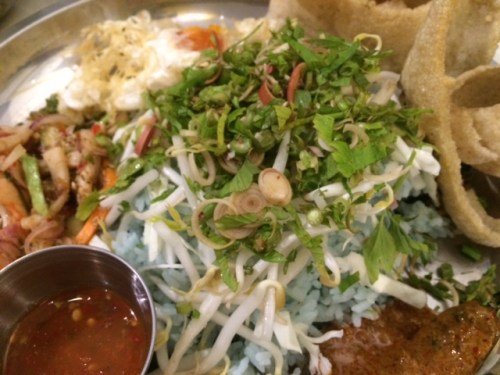
There was also a rice dish hailing from Malaysia’s Northeast, where the Thai influence is strong, and the chilies are more predominant. The rice is colored lavender with butterfly pea extract, a dollop of curry rests alongside it, and the “salad” accompanying it resembles a spicy-tart Thai “yum” in taste, melding the textures, smells and flavors that both Thailand and Malaysia are known for.

rice

My favorite dish of the trip, however, may be the spicy crab at Sweet Inn (18 Jalan SS20/10 Damansara Kim, 03-7732-6623), where freshly cooked crab is stopped with a mixture of deep-fried shallots, garlic, scallions, flour and plenty of salt and sugar to form a dish that is better than anything that Under Bridge Spicy Crab in Hong Kong could ever come up with.

crab

Yet it is with a feeling of something like relief when I get on the plane to get back to Bangkok. Not just because I will have to detox for days before approaching anything like normalcy again, but also because there is something else popping up on my chin that will soon get big enough to develop its own allergies. Time to call it a day.


5 Comments

Filed under Uncategorized