Southern Exposure

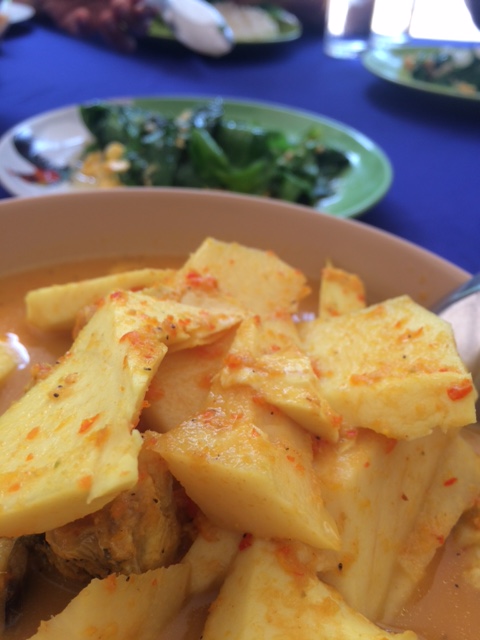
Sour curry with deep-sea pomfret and young coconut

Sour curry with deep-sea pomfret and young coconut

One of the things I love about Thailand is that great food recommendations can come from anywhere. I found out about Luk Than (Sirinat National Park, http://portal.dnp.go.th) from my husband’s lawyer, who, while not a Phuket local, seems at least as well-versed on the island’s culinary scene as he is on the ins and outs of Thai property law. When we went together the first time, sharing a fire-breathing gang som (sour curry), pad sator (stink beans stir-fried in shrimp paste with fresh shrimp) and nam prik goong sod (fresh shrimp chili dip), I stubbornly neglected to document the meal, leaving my phone at home because I had not discovered this restaurant myself. I made sure not to make this mistake a second time.

Luk Than is meant to form part of a “food court” located around 100 m down the road after you enter Sirinat National Park (just turn right and drive along the beach for about 3 minutes). And it is still part of a food court, if “food court” can also mean a bunch of closed and shuttered places that nobody goes to, plus Luk Than. Helping things along, park authorities have added a carved-wood sign for Luk Than in Thai along the main road, in case you need extra help.

The menu is all in Thai, but there might not be any need for it anyway: it’s all Phuket cuisine’s greatest hits. There’s a gang som you can have with your choice of protein and vegetable (this time we chose pomfret and young coconut), a collection of chili dips, and a whole bunch of stir-fried greens. Not wanting to miss out on anything, we ordered everything that caught our eye, and did not find ourselves regretting anything save the size of our pitifully inadequate stomachs.

The sour curry — strong, pungent, devoid of coconut milk — is known as gang som in the south, but is referred to as gang lueng (yellow coconut milk-free curry) in Bangkok, due to its inclusion of turmeric (gang som in Bangkok is actually a central Thai dish, milder and sweeter than the feral southern version and made sour from the inclusion of tamarind juice). Amid the vicious, chili-flecked dregs of the soup lurked two thick tranches of soft pomfret, buried beneath jagged shards of young coconut meat, cut big enough to show off the tenderness of the fruit. One slurp of the sour broth made metallic from the chilies and you knew you were in for it — not a “Nightmare on Elm Street”-type pain, where a malicious Freddy Kruger chases you down the road with chili fingers. No, this level of spice was inexorable and unforgiving, the “Terminator” of Thai food, not stopping until you are weeping and wiping the sweat from your brow. Of course, it was delicious.

There were other things too. There was a nam prik goong sieb (dried shrimp chili dip), the inevitable Phuket favorite, and a creamy lon (coconut milk-rich chili dip) of salted fish and fresh crab, both accompanied by a raft of fresh vegetables like raw stink bean still in the pod, bulbous Thai eggplant, and fresh white turmeric.
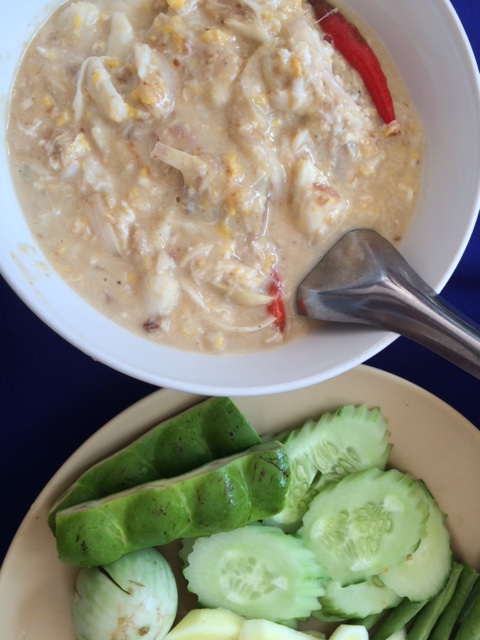
Salted fish and crabmeat lon with veggies

Salted fish and crabmeat lon with veggies

There were also tiny deep-fried fish (pla sai) that had to be plucked like harpstrings from their bones, eaten with the hands to save one’s brow from furrowing. Stir-fried mieng leaves glossy with oil and scrambled egg. Shrimp sauteed in garlic and black pepper. Squid, cooked quickly with salted egg yolk, onion, scallions and big, mild chi-fa chilies. It was, dare I say it, far more tender than the versions I’d had in Malaysia.
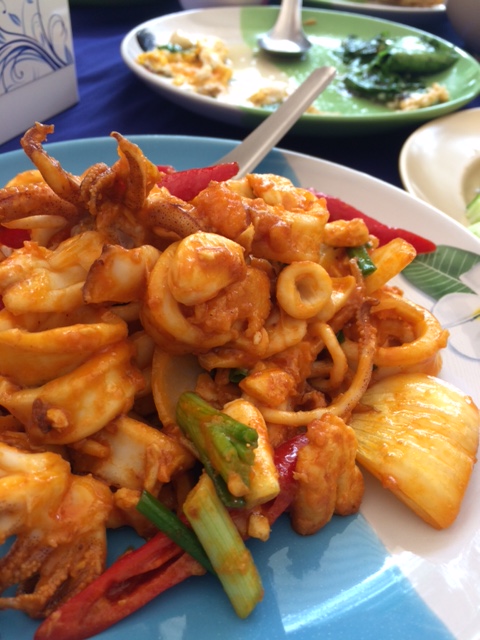
Stir-fried squid in salted egg

Stir-fried squid in salted egg

Of course, no meal is complete without kua kling, the Southern Thai stir-fry of meat cooked in a paste of spices that skirt the line between fiery goodness and abject pain. Here, the meat is sliced instead of minced, coated in a marinade that seems to include hefty doses of turmeric and lime leaves and rendered even more dangerous with an added shot of young galangal, which only serves to amplify the chilies — turning it up to “11”, so to speak.

Pork kua kling

Pork kua kling

Making our way to the parking lot as our ears rang from the food, my husband said it was lucky we had discovered a place that truly seemed to be a “hidden gem” — a term you hear often but, like “icon” or “legendary”, has since lost most of its meaning. It was agreed that mild success, enough to keep you going in a deserted food court, was a good thing, while too much success (the kind that forces you to cater to a legion of nameless faces) could end up being as bad as no success at all. Luk Than managed to toe that line. “Let’s not tell anybody about this place,” his friend agreed.

4 Comments

Filed under Uncategorized

Early Wednesday Morning

Flaky roti and massaman beef curry at Yusup Pochana

Flaky roti and massaman beef curry at Yusup Pochana

While doing research for a story recently, I came across the menu for the Dining Room at the House on Sathorn, the former Russian Embassy that has been turned into a drink-dine-function space by the W Hotel. Chef Fatih likes to emphasize the creative process that spawns his dishes by drawing their names directly from his past experiences. So you can order something like “Early Morning at Tsukiji Market” (bluefin tuna/seaweed/avocado/wasabi) or “Once Upon a Time in Istanbul” (lamb belly/eggplant/hummus) and feel like you’re being told a story and offered a voyeuristic glimpse of someone’s life through a series of “slides” that probably taste delicious too.

Naturally, I thought of the menu that I would create as Chef Fatih, but culled from my very own experiences.  There could be “Sophomore Year of College” (frozen pizza/cocoa nibs/instant noodle powder/hemp seeds) or “Limbo in Palo Alto” (whitefish/tortilla/avocado/artichoke). I could get more ambitious and go for “Junior Year Abroad in Tokyo” (curdled milk/mentaiko/nori/pickled plum) and “Penniless in Culinary School” (torn-up baguette/hard-boiled eggs/grated carrot/black olives). Maybe we could end the evening with a heaping helping of DIE BITCH DIE (herring/monterey jack/triscuit/gherkin) in honor of my high school boyfriend who cheated on me, not that I care that much anyway. Or “Barfing at Gas Panic in front of Agee the hot Japanese-Brazilian bartender” (Budweiser/Jack Daniel’s/Jagermeister/Goldschlager).

If I were to concoct a dish for “Early Wednesday Morning in the Bangkok Rain”, it might be something along the lines of (braised beef/potato/flaky dough/cinnamon/coconut cream/peanuts). It would be delicious, because it would be modeled after the breakfast-lunch I had at Yusup Pochana (531/12 Kaset Nawamin Road, Tawmaw 97, 081-659-6588), considered one of Bangkok’s best Thai-Muslim restaurants but one I had yet to go to because I am lazy. Yusup Pochana has all the Thai-Muslim faves we have come to know and love: biryanis, South Asian-inflected curries, mataba (a sort of crepe stuffed with fish, beef or chicken), a pungent hot-sour soup strong enough to cut through the other dishes’  sweet coconut milk and a respectable array of noodle soups.

Lots of curries

Lots of curries. This one is the massaman.

The online love for Yusup’s curries falls almost squarely on the rich massaman, a dish that is almost entirely Malaysian-influenced but a deeper and more aromatic version than others commonly seen in Bangkok. The even more beloved “kuruma goat” curry is only available on weekends, and the khao mok (biryani) is okay, but it’s really the mataba that drew raves from my friends from KL (excellent meat-to-dough ratio) accompanied by a generously chunky ajad of cucumber, shallot, and chilies in a sugar syrup. I, meanwhile, was enamored of the roti, which was so supremely flaky and light that it reminded me of clouds and made the roti at other places look like baked rubber cement. The roti here versus there is like croissants versus dinner rolls. Don’t miss out on this stuff.

To get here without a car, your best bet is to take the BTS to Mor Chit and then a taxi. The earlier you come, the better.

4 Comments

Filed under Uncategorized

An accidental education

"Dancing shrimp" from Petchburi Soi 5

“Dancing shrimp” from Petchburi Soi 5

A lot of the things I learn about Thailand, I stumble into out of ignorance. You would think I would know more than I do, but there are a lot of things in Bangkok that they don’t think to teach you. One of those things is where to hail a cab.

How to hail a cab is fairly simple: pretend you are pointing at the taxi with your entire hand, and then beckon with your palm to the ground. Why you would do this instead of raising your hand like anywhere else, I’m not sure. I’ve heard it’s because it’s impolite to show your open palm to anyone. The best Thai cab hailers manage to beckon with a mix of insouciance and grace that minimizes effort while maximizing effect. Drivers always stop for these people. I’m still perfecting my technique.

Back in the days when I was still raising my arm for a taxi like Tracy Flick in English class, I had just moved back to Bangkok from Paris and was preparing to move back out again, to Palo Alto. I was living on Wireless Road, and on my way to dinner with my parents at a place called Shintaro near the Ratchaprasong intersection, back when there was still a Regent Hotel. To find a cab more easily, I thought I would cross the street to Lumpini Park and hail a taxi going in the direction towards Ploenchit. It seemed like an easy enough proposition, despite the deepening dusk and the cacophony of bird sounds that erupts from the trees just as the sun goes down, making it more difficult to tell drivers your final destination.

Let me tell you, so many taxis passed me by. So many. It seemed like these cab drivers were even more desperate to give up money and keep from working than they usually were. When a taxi finally did slow down for me, I wasn’t even sure if they were for hire or not, so desperate was I to avoid walking to the Regent Hotel in my hugely impractical high-heeled mules.

The taxi driver seemed deeply nervous. When I told him to take me to Regent Hotel, he actually told me no, that he would take me somewhere behind it (Thai cab drivers are so temperamental, and so particular about where they go). As long as he was taking me somewhere fairly close, it was fine by me. But when he parked in a dark alleyway next to the hotel and lit a cigarette, I started wondering what was up. His hands were shaking. It was different from other taxi rides.

There was no fare due on the meter. So I took 100 baht out of my wallet and threw it at him before leaving the cab. I was willing, at this stage, to walk down the street in my high heels. But even though I knew something was wrong, it wasn’t until much later when I realized he thought I was a prostitute. Because I was hailing a cab from Lumpini Park at twilight.

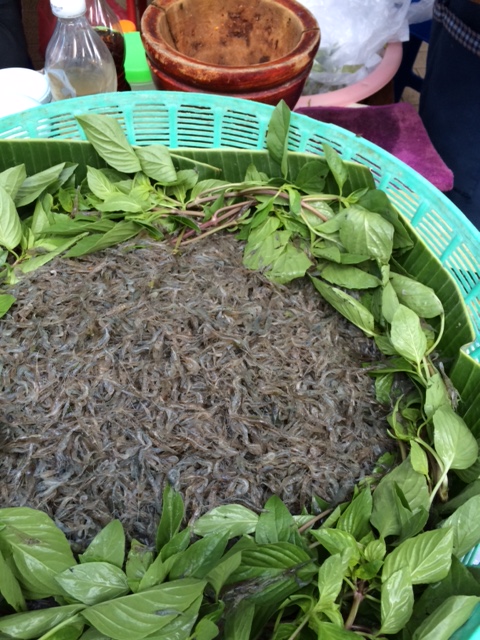
Since I am in the mood to give tips, here’s another one for you: don’t go with your Isaan friend to try his favorite childhood dish unless you are very, very sure you are hungry, or that his favorite dish is something like grilled chicken. Because you could be in for a big surprise. In my case, the surprise came in the form of a dish called “dancing shrimp”, which does not refer to fresh shrimp “dancing” on a grill, or “dancing” in a bubbling soup, or “dancing” in the proximity of any cooking fire whatsoever. No, these shrimp are alive. And they are babies.

The “dancing” probably refers to when the baby shrimp are scooped into a bowl, drizzled with fish sauce and vinegar, mixed with coriander and green onion, and sprinkled with chili powder, ground toasted rice kernels, and a small squirt of fresh lime. To subdue these little suckers, you are meant to cover your bowl with another, empty bowl in order to shake those babies to oblivion without getting any gunk on yourself. You can then eat them with minimal interference. Of course, you can opt instead to watch them “dance” on your table, desperate in their ineffectual gyrations to get away from your gaping maw.

When my friend Maitree took me for “dancing shrimp” (goong then), it was at one of the restaurants along the Isaan strip of Petchburi sois 12-14, and the shrimp were collected from fish tanks that lined the sidewalk. These restaurants no longer serve this delicacy, because the shrimp have become more expensive. But streetside baby shrimp served live in a chili sauce is still a possibility, thanks to this vendor along Petchburi soi 5.

The "dancing shrimp" vendor displaying her wares

The “dancing shrimp” vendor displaying her wares

You are meant to enjoy your baby shrimp at home with some mint and sawtooth coriander, but if you ask nicely, you can eat it right there, in front of the 7-11 with the rest of the vendors on the soi waiting eagerly for you to keel over and die. Just make sure to tell them to go easy on the chili powder. Don’t say I didn’t warn you.

Leave a comment

Filed under Uncategorized