Glutton (sort of) Abroad: Best Laid Plans


Image


I’ve been thinking about this for a while now. Last week, I finally bought the ticket. It’s non-refundable. So I’m doing it. I’m finally going  on my very first barbecue tour in the southern US this July.

Unlike most other things I do, where I just sort of throw things at the wall and see what sticks, I am actually trying to plan this time. It’s not easy for me, because I am a spaz. I will start researching something, only to find myself clicking on the crazy True Detective theory website, or looking up songs from the “Sixteen Candles” soundtrack. I have the attention span of a gnat. So it is really very slow going. But it’s (sort of) set. I’m focusing on what is called “real” barbecue, in the so-called “barbecue belt”. That means Tennessee, Mississippi, Alabama, Georgia, and the Carolinas. That’s it. Really, Texans.

Barbecue means pigs. Pigs are, somehow, intrinsically connected to the Southern identity: a cheap source of protein for centuries, pigs were allowed to run semi-wild in the woods up to the turn of the 20th century, making them easy game for hungry hunters with a halfway decent knowledge of how to start a fire. Although it is back-breaking and time-consuming work manning the pit, it also requires little more than experience: the more you barbecue, the better you get at it. And it is a relatively cheap pastime, breaking the tough or stringy pieces of meat into something that collapses into a velvety ooze. Each region boasts its own sauce, and even, in the case of Texas (beef) and Kentucky (mutton), different protein. But bona fide barbecue deals in pork, and smoke, and fire.

The act of barbecuing is said to have been the glue that kept Southern society together. Any big event — political rallies, church gatherings, etc. — featured one, and all and sundry would show up to socialize and have a little taste of the pig. The word “barbecue” supposedly comes from the West Indian term barbacoa, but Southerners have managed to take this cooking method and knit it securely into their own identities. To provide barbecue, real barbecue, one must be Southern, and understand the tradition of it. And any permutations, variations, iteration must be debated ad nauseum by anyone with even the slightest claim to Southern heritage, because to know about barbecue and its traditions is to be Southern. In this way, barbecue in the South is comparable to street food in Thailand, to me at least. Thais love to debate the merits or demerits of a particular version of any street food dish. They love to cast aspersions on another region’s treatment of the same ingredient. It’s like the social, conversational form of trading cards. This is how you show you are plugged in. Only, in the South, it’s the different ways someone slow-roasts a pig, instead of how someone cooks noodles.

I will start in Nashville, where I’ve never been. I must admit it’s not the barbecue that is drawing me here: it’s something called “hot chicken”, or fried chicken with hot sauce on it, which may be the best thing I have ever heard of. I LOVE FRIED CHICKEN. Next comes St. Louis/Kansas City, where a sweet, tomatoey sauce ladled over slow-cooked ribs is favored. In Memphis, the pig is “pulled” (shredded with a fork) and the sauce has molasses in it. In Alabama … I hear there is something called “white barbecue”, or a mayonnaise-based sauce (YIKES). In Georgia, the barbecue is served alongside “hash” — the Southern version of Scrapple. In South Carolina, the pork is sliced or chopped, and the sauce is piquant and mustardy. And in North Carolina, the “home of barbecue” to many, the sauce is either vinegary and the ‘cue served with hush puppies (on the east coast), or tomatoey and peppery, and served alongside a faintly terrifying dish called “Brunswick stew” in west North Carolina.

Do you know barbecue? Do you, like me, wonder how the different ways people roast pigs reflects the environments they live in? Do you have a favorite barbecue place? This is my tentative itinerary, and my very first attempt at crowdsourcing. If you have any opinions at all — even if you are not a Southerner — please let me know what you think.

TN

 —  Jim Neely’s Interstate (2265 S. 3rd St., Memphis)

—  A&R BBQ (1803 Elvis Presley Blvd., Memphis)

—  Jack’s (416 Broadway, Nashville)

—  Siler’s Old Time BBQ (6060 Hwy 100 E., Henderson)

—  Prince’s Hot Chicken (123 Ewing St., Nashville)

—  Hattie B’s (112 19th Ave. S., Nashville)

MO

—  Arthur Bryant’s (1727 Brooklyn Ave., Kansas City)

—  FIorella’s Jack Stack BBQ (101 W. 22nd St., Kansas City)

—  Pappys Smokehouse (3106 Olive St., St. Louis)

—  C&K BBQ (4390 Jennings Station Rd., St. Louis)


KS

— Oklahoma Joe’s (3002 W. 47th Ave., Kansas City)

— Woodyard (3001 Merriam Lane, Kansas City)


SC

— Scott’s BBQ (2734 Hemingway Hwy, Hwy 261 Brunson Cross Rd., Hemingway)

— Martha Lou’s Kitchen (1068 Morrison Dr., Charleston)

— Home Team BBQ (2209 Middle St., Charleston)


NC

— Allen and Son (6203 Millhouse Rd., Chapel Hill)

— Lexington BBQ (100 Smokehouse Lane, Lexington)

— Stamey’s (4524 N. Carolina 150, Lexington)

— Wilber’s BBQ (4172 Hwy. 70 East, Goldsboro)

— Skylight Inn (4618 S. Lee St., Ayden)

— The Pit (328 W. Davie St., Raleigh)

— Scott’s (1201 N. William St., Goldsboro)

— Bill’s (3007 Downing St., Wilson)

GA

— Gladys and Ron’s Chicken and Waffles (529 Peachtree St., Atlanta)

— Pittypat’s Porch (25 Andrew Young Intl Blvd., Atlanta)

— Fat Matt’s Rib Shack (1811 Piedmont Rd., Atlanta)


17 Comments

Filed under Uncategorized

Touring the Old Town

Image

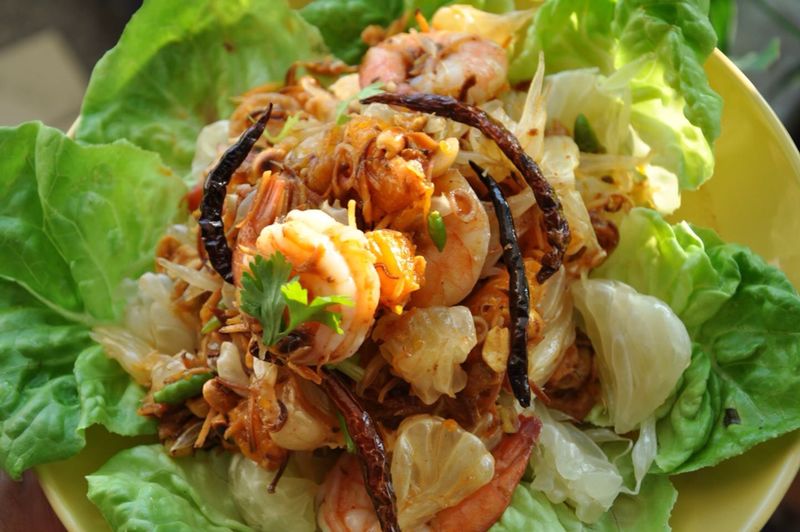
Chin’s pomelo salad

(Photo courtesy of Chili Paste Tours)

I don’t often give street food tours. Don’t get me wrong — I like getting out and about and meeting people — but if I do go with someone, it’s more of a walk-a-long to somewhere I’m trying out anyway, because I’m not sure I’m a very good guide. The thought of charging for an experience that may or may not be useful to someone is very fraught for me. I JUST WANT TO BE LOVED, OKAY?

So when I went on my own Bangkok food tour, it was an interesting change of pace for me. Recommended by the talented Anne Faber, Chili Paste Tour (www.chilipastetour.com) is a name that frequently springs to mind when people ask me for street food tour recommendations. Because I have mentioned them a couple of times, Chin — the tiny powerhouse behind Chili Paste — generously offered to take me to her favorite food stops. This was an incredible windfall for me, since these stops fall in my favorite part of town: the loop from Pra Arthit Road bypassing Rachadamnern Avenue, up through the Chinese Swing, and onto Tanao Road.

Now, I like to think I have fairly delineated tastes, meaning very few things are neutral to me. I like to think that I can be picky, but fair. I also like to think that I’m nice and that if I don’t like something, it doesn’t show, but my husband has just told me that I’m an abject failure at that. In other words, I can be a raging bitch. But Chin, while managing to veer nowhere near Bitchtown, is even more exacting, and really knows her food: she frequently spends entire afternoons sampling the offerings of vendors in nearby towns, trying to find a suitable place to take her charges. A famous som tum place is dismissed for being too “sweet”; a widely lauded Thai lunch spot is “bland”. Almost everyone is guilty of too much MSG. So when Chin likes a place, I feel like it must really be good.

First up: Chin’s favorite restaurant, Krua Sam Hom at Praeng Puthon Square. This road may sound familiar to you because of the perennial tourist favorite, Chote Chitr, which is close to the entrance from Tanao Road. Krua Sam Hom is a little further in, on the right hand side, directly across from the “park” that forms the square.  It is, like most of the places in that neighborhood, surprisingly empty. But that ends up being a blessing, since Chin commandeers the kitchen (she takes a lot of people here), gathering ingredients for a spicy pomelo salad, the recipe for which she has loaned below. She is a whirlwind of instructions and information: the best pomelos come from Samut Songkhram and Nakhon Pathom; good nam prik pao (roasted chili paste) can be bought at Aor Thor Kor; she adds fresh orange segments from a particularly tart type found only in Samut Songkhram. And other stuff: how many modern Thai stir-fry cooks rely on margarine to add color and sheen to their creations, at the expense of aroma; to always have pomegranate juice vendors squeeze their juice in front of you, because many bulk up their bottles with cheaper watermelon juice.

We also get a beautiful plah goong, a prawn salad blanketed in minced lemongrass, mint, shallots and kaffir lime leaves and a stir-fry of morning glory and chilies. There is also a gaeng som (sour soup) with more prawns and squares of acacia leaves battered in egg, its rich red color courtesy of polished red chilies hand-picked by the chef, who keeps the discards in a plastic bag by the stairs.

Image

Krua Sam Hom’s gaeng som

Now, being a Glutton is my thing and all, and I really thought I might end up going home hungry, but that was foolish. After lunch, a stop at what is probably still Bangkok’s most famous ice cream shop, Nuttaporn: mango and coconut were especially recommended. Then, an iced coffee at the corner with the possibility of 12 baht pork noodles on Dinsor Road looming on the horizon and … I was stuffed. Stuffed like an 18-course meal at Eleven Madison Park (where I was convinced they were trying to kill us) stuffed. What can I say? We all have our limits.

Chin’s pomelo salad (for two)

– 5 pomelo segments

– 1/2 som kaew (glass oranges from Samut Songkhram)

– 1 Tbs roasted chili paste

– 1 Tbs peanut powder

– 1 Tbs dried coconut

– 3 Tbs palm sugar mixed with tamarind juice

– 1 Tb fish sauce (more to taste)

– 1/2 lime (more to taste)

– 5-6 dried chilies

– 1 Tbs roasted peanuts

– 1 Tbs fried shallots

– 4 cooked shrimp

– 3 fresh bird’s eye chilies

– 3 Tbs lemongrass, minced

– 2 tsp granulated sugar (to taste)

1. Mix roasted chili paste, peanut powder, palm sugar/tamarind juice, fish sauce, lime, fresh chilies, lemongrass and granulated sugar to form dressing.

2. Add citrus segments, squeezing them a bit to add juice to the dressing.

3. Garnish with shrimp, coconut, shallots, dried chilies and whole peanuts.

Image

Mango and coconut ice creams at Nuttaporn

9 Comments

Filed under Uncategorized

Isaan foodie haven

Fish grilled in a salt crust at Jay Dang

Fish grilled in a salt crust at Jay Dang

It’s official: I’m in worry for my second book, which threatens to be stillborn in Singapore. It’s hard for me to point fingers, since it is supposedly all my fault. Remember that time when I thought signing a book contract and handing over control meant I could sit back and let other people do the work? Remember that? That was foolish, me. At least there is my non-existent writing career to fall back on. Silver linings!

Let’s look at more silver linings. Such as: a movie like Pompeii 3D exists. My lack of social life means I can finally grow a beard, just like I always dreamed of. And that there are still little pockets of unique, special foodie-dom in Bangkok, existing in spite of jams and disturbances and disorders. Hanging in there until the commotion dies down. In some cases, thriving.

Example: the Isaan neighborhood on Petchburi Road, next to Ratchathewi intersection and across the street from the mosque on Soi 7. Dwight Turner of bkkfatty.com told me about this place first; later, the very talented Isaan artist Maitree Siriboon took me here when I asked him where he ate when he got homesick. By day, it’s a grimy, slightly down-at-heel working class neighborhood where you’d expect to see a lot of hubcaps sold. At night, though, the strip suddenly lights up and the people come out like Isaan food-loving vampires, basking in the dusk and the neon lighting of the restaurant signs as they are switched on: Jay Orn, Jay Goy, Jay Dang. There may be a Loong (or “Uncle”) sandwiched in there somewhere.

But the aunties are the big ones, the favorites of the diners here — either transplanted Isaaners like Khun Maitree, or chili-seeking junkies like me. In that respect, this place doesn’t disappoint: hot, hot grated papaya salads peppered with pickled crab and sprinkled with fermented Thai anchovy juice; steaming vats of soup sporting an abundance of chicken feet, bright orange in its toxicity and nicknamed thom super (“super soup”). There are strips of pork liver and minced pork or chicken meat dressed in a spicy-tart dressing and a shower of mint leaves. And, if spice isn’t really your thing, there are old favorites like grilled chicken, sliced pork collar, and snakehead fish cooked over an open flame, stuffed with lemongrass stalks and kaffir lime leaves and coated in a salt crust so that when the skin is split open, the flesh stays wonderfully fragrant and tender. There is nothing like this dish when it is done right.

A shame about the dancing shrimp: live baby shrimp that are drizzled in a tart-spicy Isaan-style dressing and served to you, as is. It is baab (a sin) to eat them, as you are causing the suffering of untold little animals, but the experience — while horrifying — is unparalleled by anything else in Thai food. When I asked about this dish last week, and the tanks that used to be at every cooking station, they all said the protests had made bringing fresh live shrimp to Petchburi impossible. Good or bad? As with everything else, my feelings are mixed.


8 Comments

Filed under Asia, Bangkok, Isaan