Tag Archives: cooking

What’s Cooking: Moo Jum

Image

Finally, a decent approximation

Isaan food is a celebration of simple things, put forth very directly and forcefully. Your finger-licking renditions of gai yang (grilled chicken) and nuea nam thok (spicy beef salad) aren’t content to sit mutely on your tabletop, requesting your appreciation; slightly smoky and full of heat, they practically shout I AM DELICIOUS as you cram morsel after succulent morsel down your throat. Paired with a hank of sticky rice and the battalion of condiments that Thais cannot resist pairing with everything, they are unstoppable, a food army that cannot be resisted, taking up all the valuable real estate in your gut that you have reserved for something useful, like beer.

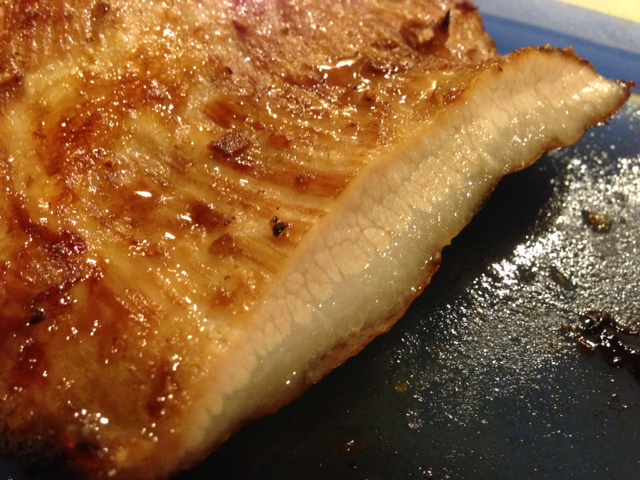
Moo Jum (located at the entrance of Suan Luang Soi 3 after 6pm) specifically traffics in these very dishes, the ones that make you sorry you stuffed yourself silly. Like most great Isaan cooks, they focus on straightforward simplicity. The namesake dish, an Isaan-style sukiyaki, is a spicy-tart broth in which unwitting vegetables, sawtooth coriander, Thai basil, pork and an egg are dunked, creating an aromatic melange good enough to eat even on sweltering hot nights. A simple spicy squid salad, rings of flesh barely blanched, dressed in sharp shards of Thai celery stalk and chili. And of course, their famed kor moo yang (grilled pork collar): sweeter than up north to be sure, charred at the edges from the grill, lacquered like a freshly-baked pie, as brown as the skin of a dedicated bodybuilder.

For all its supposed simplicity, I have struggled with this recipe. The basic recipe (as outlined in Chef McDang’s “The Principles of Thai Cookery”) uses a basic marinade of mashed garlic cloves, pounded coriander root, 1/4 cup of soy sauce, and 10 white peppercorns that is then slathered onto the meat. Very traditional, but nothing to set hearts aflutter. I tried to build on that recipe by going back to the marinade’s roots, substituting fish sauce for soy and adding some palm sugar. The result: ho-hum. I then tried to add molasses paired with fish sauce: NO DO NOT DO THIS EVER. It appears that where modern versions of kor moo yang are concerned, it is best to stick to soy sauce and build on that.

So last night, alongside an odd pairing of roasted cauliflower and soba noodles, I made some more pork collar for unsuspecting victims-slash-guests who had come over expecting dinner. The result was not awful! This is the best iteration of Moo Jum’s kor moo yang so far.

Kor Moo Yang (serves 4, just barely)

– 400 g pork collar (or shoulder)

– 4 garlic cloves

– 2-3 coriander roots, washed

– 1/2 tsp white peppercorns

– 1/4 cup soy sauce

– 1 Tb brown sugar

– 1 Tb sweet soy sauce

To make:

1. As in Chef McDang’s recipe, mash garlic, peppercorns and coriander root into a paste with mortar and pestle. Add soy sauce and sweet soy sauce and mash that all together to form marinade. Add brown sugar.

2. In a large mixing bowl, pour marinade over pork and allow to infuse meat, ideally overnight, or at least four hours.

3. When ready, grill meat until brown and charred a bit at the edges. If you, like me, don’t own a grill (why are American males so into grilling?), heat up a nice heavy pan (I use a cast-iron one) that has been oiled beforehand, and brown the pork until it’s a nice caramel-ish color. Then stick this into the oven that’s been set at 180 degrees Celsius for about 15 minutes, or until the edges gain the same charred edges and sticky-looking exterior that you would have gotten via grilling.

4. Slice and serve with a tamarind or sweet chili sauce, along with some sticky rice.
6 Comments

Filed under Asia, Bangkok, food, food stalls, pork, Thailand

What’s Cooking: Jay Gai

Image

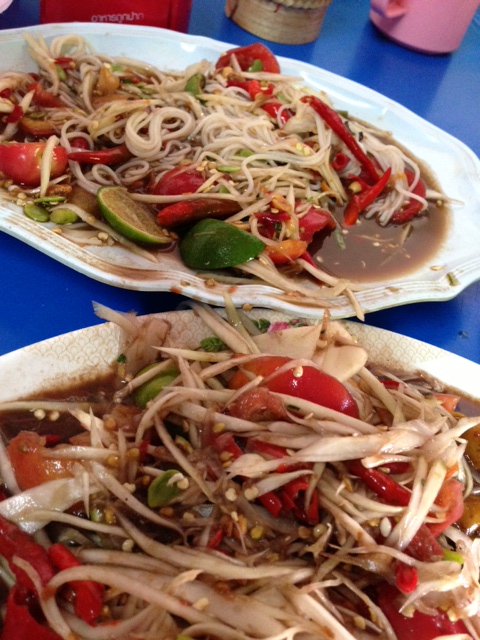
Two kinds of Isaan-style grated salads at Jay Gai

It is almost impossible to live anywhere in Bangkok that is not within walking distance of a som tum (grated fruit or vegetable salad) vendor. While street food lovers frequently rhapsodize over the best bowl of noodles or grilled hunk of meat, it’s som tum that most often finds itself at Thai tables.

And what som tum it is. Although the grated green papaya is the variety that is most popular in (and out of) Thailand, vendors display a wide range of fruits and vegetables with which to make this salad, from cucumbers and long green beans to tart gooseberries and green bananas. The truth is, anything with any sort of crunch is a good base for a grated spicy salad. It’s the dressing that usually stays constant.


Som tum Thai — the type most commonly eaten in Bangkok and abroad — is the kind we are exploring here, with a dressing made of lime juice, fish sauce, and a healthy dose of sugar (be it palm or granulated). A light dusting of roasted peanuts and dried shrimp and you’re done. But if you are the adventurous sort who does not shy away from fishiness (really, the essence of Thai food), there is som tum Lao, tinged with that extra oomph afforded by pla rah, or fermented Thai anchovies, or even som tum nuea (the northern Thai variety), flavored with a bit of nam poo doo (the juice of pulverized and fermented field crabs). I am not a fan of som tum Thai, which I find to be too sweet throughout much of the capital nowadays, but I do have plenty of time for the Isaan version, made with either crunchy fruits or vegetables, or mua (confused), which includes kanom jeen (fermented rice noodles).

The som tum Lao and som tum mua shown above hail from Jay Gai, also known as “som tum yib bat” (som tum where you must pick a number), such is the popularity of this stand on Naresuan Road in Udon Thani. Their som tum Lao is rich in anchovy flavor, with a nearly rancid tinge; the som tum mua includes green papaya, bamboo shoot, cherry tomatoes, long beans and snails alongside the kanom jeen. Both are what you expect Isaan-style som tums to be: thick, heady, uncompromising.

That’s not what we’re doing here. Chris and I are starting with the basics, by trying to emulate Jay Gai’s “Thai-style” som tum. With Western cooks in mind, we are using shredded carrot and daikon radish in place of green papaya. The only thing we may be copying from Jay Gai is its propensity (and everyone else’s propensity) for MSG (pong chu rot).

Som tum Thai, inspired by Jay Gai (makes 4 servings)

In the bowl of a mortar with a pestle, pound 3 cloves of garlic with 1-3 Thai chilies (vendors call each chili a “met” and ask customers how many “met” they want in their som tum. Answers usually range from none (“mai sai prik“) to five (“ha“). Mash into a paste.

Add 3 Tablespoons fish sauce, the juice of 2-3 limes, and a Tablespoon of palm sugar or granulated sugar.  Taste to correct seasoning. This is your last chance to fix the dressing before all the other ingredients are added to the mortar. 

Add a cup of granted carrot, half a cup of grated daikon radish, 3 inches of long beans cut into 5 cm pieces, and 3-5 cherry tomatoes. Mash gently with your pestle to ensure the strands get bruised (nothing is worse than too-crunchy pieces) while scraping the bowl with a large spoon with your other hand. 

It’s your decision to add Ajinomoto (to taste) or not, but every Thai I have spoken to insists that it is an essential ingredient, so there it is. We used a light sprinkling on our finished salad before garnishing with crushed roasted peanuts and dried shrimp (both to taste). A platter of fresh veggies — sliced green beans, a wedge of cabbage and some cucumber spears — accompanies the salad. If you want to be really traditional, serve alongside sticky rice and grilled chicken or pork shoulder or, if you want to be like Jay Gai, a bowl of boiled snails.

4 Comments

Filed under Uncategorized

What’s cooking: Aim Och

Image

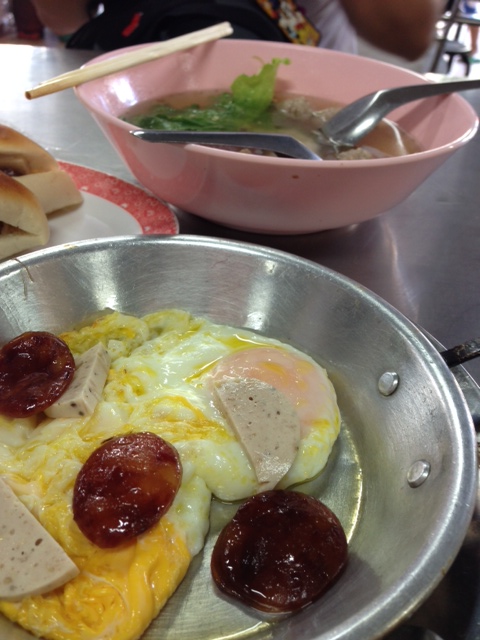
“Egg in a pan” at Aim Och in Khon Kaen

There is nothing easier to make in all of Thai street food than kai kata, or “egg in a pan”. Still stinging from our inability to decode Jay Fai’s Byzantine fusion of herbs and spices masquerading as tom yum goong, Chris and I decided to give ourselves a break and do something that is, quite literally, fool-proof.

Kai kata is the Thai version of the Vietnamese version of the American breakfast, said to have been inspired by homesick American GIs during the Vietnam War. In an attempt to replicate the American breakfast standby “ham and eggs”, Vietnamese cooks cracked eggs into “personal-sized” pans, garnished them with Chinese sausages and Vietnamese steamed pork pate (moo yaw) in place of sausages and ham, and cooked them quickly on a stovetop until the whites set. Garnished with a splash of red chili sauce like Sriracha and fish sauce and accompanied by a toasted, buttered bun stuffed with more “sausage and ham”, this no-fuss breakfast combo is quick, easy — and unbelievably satisfying. Best of all, you can let your imagination run riot: anything, anything at all, will work with these eggs. Have a sweet tooth and want to drizzle some maple syrup on it, maybe with a garnish of crispy

bacon? A handful of peas? Maybe some pancetta and sliced fresh chilies? Or maybe a

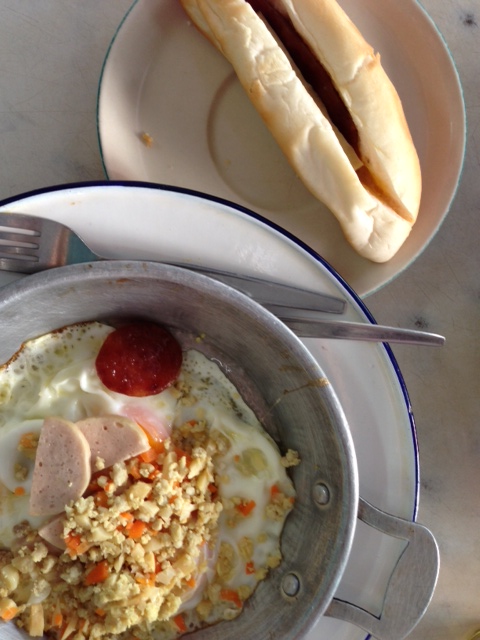
splash of minced chicken and diced carrots, just like at King Ocha in Udon Thani:

Image

Kai kata and buttered bun at King Ocha in Udon Thani

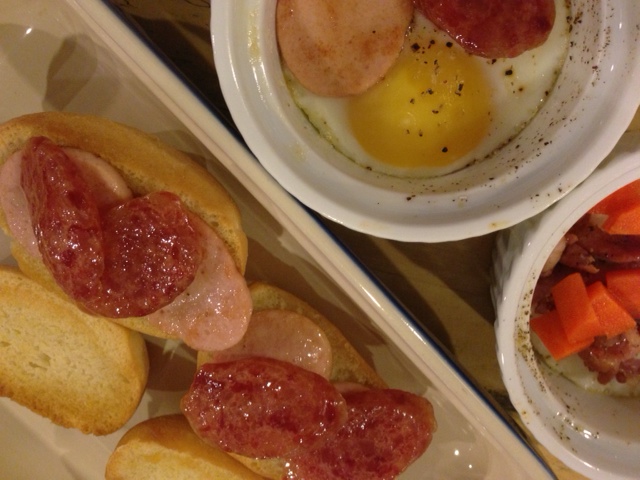
There are no rules for this fusion-y adaptation of a Western favorite. Ironically, if you are in the West, you may need to make some substitutions for some hard-to-find ingredients, so you may have to re-substitute those substitutions. Hence our choice to use buttered ceramic ramekins instead of tiny pans, because we aren’t sure how many of those are available back West. If you don’t have an oven, you can make a bain-marie by putting your ramekins in a pan, filling with water up to the middle of the ramekin, and cooking your eggs on the stovetop. However you decide to make it, we have tried to cleave as closely to the “authentic” (circa 2013) basic Isaan-style kai kata as possible.

Kai kata a la Aim Och (makes 2 servings)

What you’ll need:

– 2 ramekins, well-buttered

– 2-4 eggs, depending on size of ramekins

– 1 link Chinese sausage (gunchieng), sliced

– 6 slices moo yaw (Vietnamese steamed pork pate) — baloney works in a pinch

– Two mini-baguettes or soft rolls (for real Thai street food flavor, they should be as sweet as possible)

– Butter (for toasting buns)

– Fish sauce with sliced chilies, Maggi, or Golden Mountain sauce (to taste)

– Sriracha sauce (to taste)

– Salt and pepper (to taste)

To make:

1. Preheat oven to 325 degrees Fahrenheit/180 degrees Celsius.

2. Place buns, slightly open and their insides buttered, into a casserole and toast in the oven until warm, edges are light brown and butter is melted. 

3. In a pan, warm slices of Chinese sausage and/or moo yaw until hot to the touch.

4. Crack 1-2 eggs into each buttered ramekin, depending on size. Cook in oven for 5-10 minutes (depending on how well your oven works), until whites are set when you jiggle them and start to pull away slightly from the sides of the ramekin. If you like your eggs more well done (I love runny yolks), wait at least 10 minutes.

5. Take eggs out of oven and garnish with sausages and “ham”. If you have cooked minced meat and/or vegetables, scatter those onto your eggs as well. Season with salt and pepper.

6. Fill toasted buns with slices of “ham” and “sausages”. Serve alongside eggs, and make sure to pass the fish sauce/Maggi and sweet chili sauce. Easy AND delicious.

Image

Our versions


Leave a comment

Filed under Uncategorized