Tag Archives: Isaan

Living to Eat

Image

The mieng pla at RBSC

It should come as a surprise to absolutely no one that I love food, or that I am drawn to other people who love food. My friend Gwen is one such person. A constant whirlwind of activity, she touches place here or there long enough to, inevitably, pick up a friend or two and eat at this or that fabulous place. She is also invariably kind, which is probably why the most damning thing she can say about someone is that he or she “eats to live”. 

Look, everybody has to eat to live. But it’s a very particular type of person who lives to eat. This is the person who plans his or her travel itinerary around restaurants; who would rather go hungry than eat something that tastes bad; who considers life a series of meals, and every sub-par meal a missed opportunity. I am this type of person, which explains why I have no friends and no one will travel with me. I have also met other people like this, and it’s like meeting other people with strange obsessions or second lives — the guy who dresses up like Boba Fett at the occasional Star Wars-themed convention, or Bruce Wayne in his off-time. 

A person who eats to live might not find much to trumpet about when it comes to the Isaan dish mieng pla: there’s fish, and vegetables, sometimes noodles, and a dipping sauce. There is no interesting technique, no volcanically hot wok, no smoke, no fire to speak of. No welcoming waft of steam when you lift the lid off the bamboo steamer, no doughy dabs wrapped like tiny birthday presents, no glistening jewel-toned slabs of flesh arranged artfully on a platter like pieces of jewelry. This is all DIY work — it’s all up to you. All you need are the fish and the seasonings. Anybody can do it.

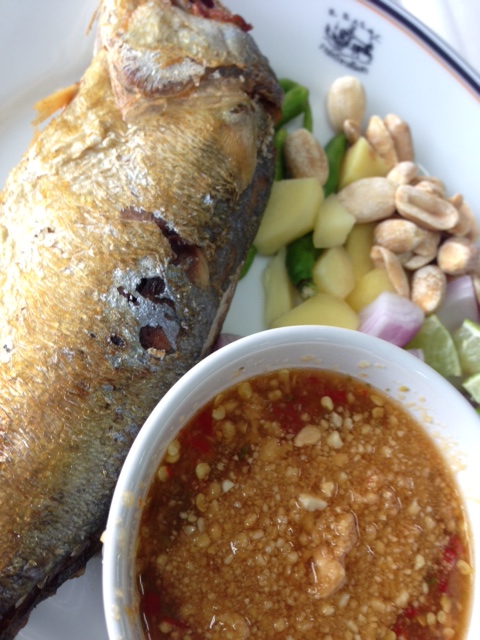
Except that not all mieng pla is made the same. It’s hard to screw up, that is true, but it’s also hard to make great. And that’s what Khun Sakol Boon-ek, the proprietor at the mieng pla tu stand at the Prajane Lumpini market, is able to do. Plump, fat (and deboned!) pieces of Thai mackerel; fat, juicy greens, and fresh, unblemished condiments (lime, shallot, peanuts, ginger, green mango, chilies, and, in her case, blanched thin rice vermicelli, or sen mee), this is everything you need for an afternoon snack, a light lunch, or, if you are a Hobbit like me, elevenses.
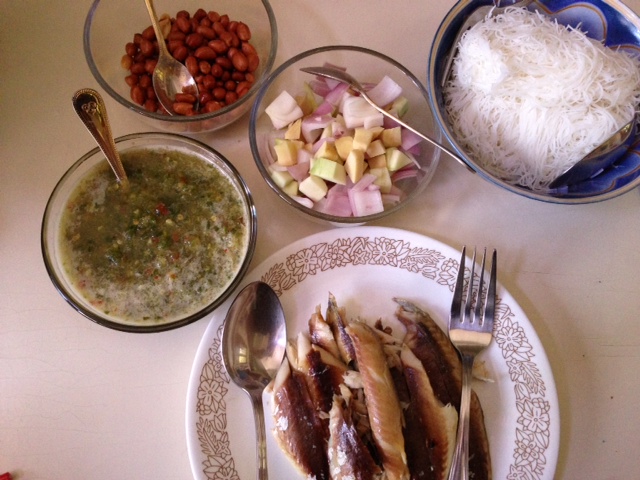
Image

K. Sakol’s mieng pla

Image

K. Sakol’s accompanying greens

Khun Sakol’s secret is ultimately her dipping sauce: a mixture of lime juice, fish sauce, garlic, sugar and a bountiful harvest of chilies, yes, but somehow the sum is greater than the parts. Obviously she won’t tell me her secret.

To contact her (they deliver!) call 084-944-6732. Or, if you are very lucky, she might be at the Prajane Lumpini market situated along the right-hand side of Polo Road (Soi Sanam Klee) if you are coming from Wireless, but I’m not sure how much longer she’ll be there. Sadly, some big changes appear to be planned for that road: Khao Thom Polo (they of the fire-and-brimstone jungle curry) are being asked to move, and even the mighty Polo Fried Chicken might have to follow suit. 
12 Comments

Filed under Uncategorized

What’s cooking: Aim Och

Image

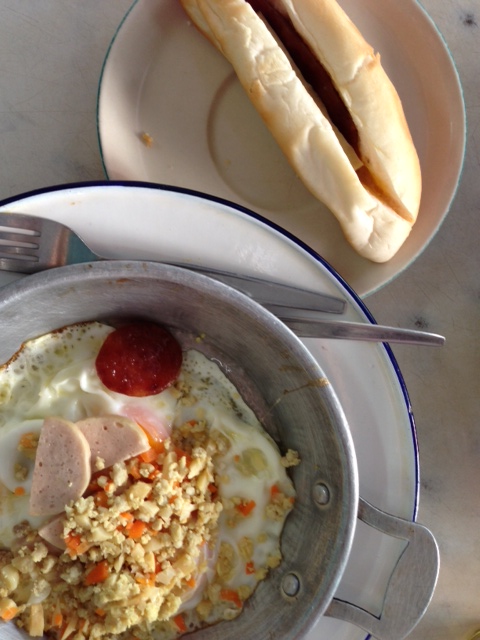
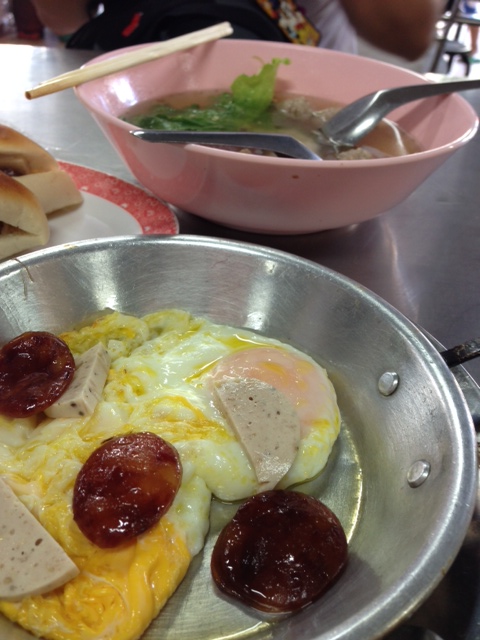
“Egg in a pan” at Aim Och in Khon Kaen

There is nothing easier to make in all of Thai street food than kai kata, or “egg in a pan”. Still stinging from our inability to decode Jay Fai’s Byzantine fusion of herbs and spices masquerading as tom yum goong, Chris and I decided to give ourselves a break and do something that is, quite literally, fool-proof.

Kai kata is the Thai version of the Vietnamese version of the American breakfast, said to have been inspired by homesick American GIs during the Vietnam War. In an attempt to replicate the American breakfast standby “ham and eggs”, Vietnamese cooks cracked eggs into “personal-sized” pans, garnished them with Chinese sausages and Vietnamese steamed pork pate (moo yaw) in place of sausages and ham, and cooked them quickly on a stovetop until the whites set. Garnished with a splash of red chili sauce like Sriracha and fish sauce and accompanied by a toasted, buttered bun stuffed with more “sausage and ham”, this no-fuss breakfast combo is quick, easy — and unbelievably satisfying. Best of all, you can let your imagination run riot: anything, anything at all, will work with these eggs. Have a sweet tooth and want to drizzle some maple syrup on it, maybe with a garnish of crispy

bacon? A handful of peas? Maybe some pancetta and sliced fresh chilies? Or maybe a

splash of minced chicken and diced carrots, just like at King Ocha in Udon Thani:

Image

Kai kata and buttered bun at King Ocha in Udon Thani

There are no rules for this fusion-y adaptation of a Western favorite. Ironically, if you are in the West, you may need to make some substitutions for some hard-to-find ingredients, so you may have to re-substitute those substitutions. Hence our choice to use buttered ceramic ramekins instead of tiny pans, because we aren’t sure how many of those are available back West. If you don’t have an oven, you can make a bain-marie by putting your ramekins in a pan, filling with water up to the middle of the ramekin, and cooking your eggs on the stovetop. However you decide to make it, we have tried to cleave as closely to the “authentic” (circa 2013) basic Isaan-style kai kata as possible.

Kai kata a la Aim Och (makes 2 servings)

What you’ll need:

– 2 ramekins, well-buttered

– 2-4 eggs, depending on size of ramekins

– 1 link Chinese sausage (gunchieng), sliced

– 6 slices moo yaw (Vietnamese steamed pork pate) — baloney works in a pinch

– Two mini-baguettes or soft rolls (for real Thai street food flavor, they should be as sweet as possible)

– Butter (for toasting buns)

– Fish sauce with sliced chilies, Maggi, or Golden Mountain sauce (to taste)

– Sriracha sauce (to taste)

– Salt and pepper (to taste)

To make:

1. Preheat oven to 325 degrees Fahrenheit/180 degrees Celsius.

2. Place buns, slightly open and their insides buttered, into a casserole and toast in the oven until warm, edges are light brown and butter is melted. 

3. In a pan, warm slices of Chinese sausage and/or moo yaw until hot to the touch.

4. Crack 1-2 eggs into each buttered ramekin, depending on size. Cook in oven for 5-10 minutes (depending on how well your oven works), until whites are set when you jiggle them and start to pull away slightly from the sides of the ramekin. If you like your eggs more well done (I love runny yolks), wait at least 10 minutes.

5. Take eggs out of oven and garnish with sausages and “ham”. If you have cooked minced meat and/or vegetables, scatter those onto your eggs as well. Season with salt and pepper.

6. Fill toasted buns with slices of “ham” and “sausages”. Serve alongside eggs, and make sure to pass the fish sauce/Maggi and sweet chili sauce. Easy AND delicious.

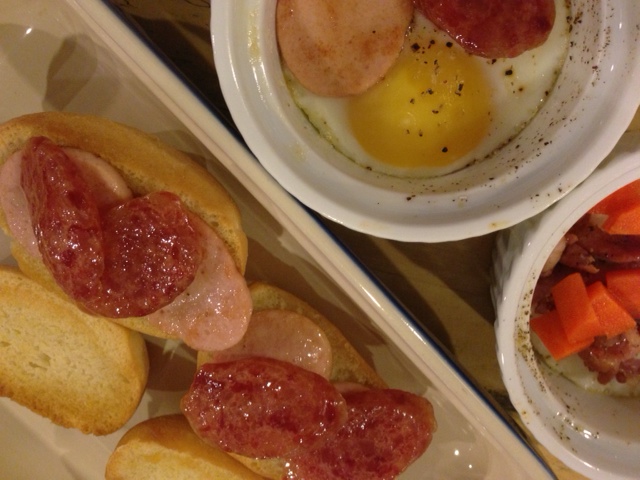
Image

Our versions


Leave a comment

Filed under Uncategorized