Tag Archives: street food

What’s Cooking: Jay Gai

Image

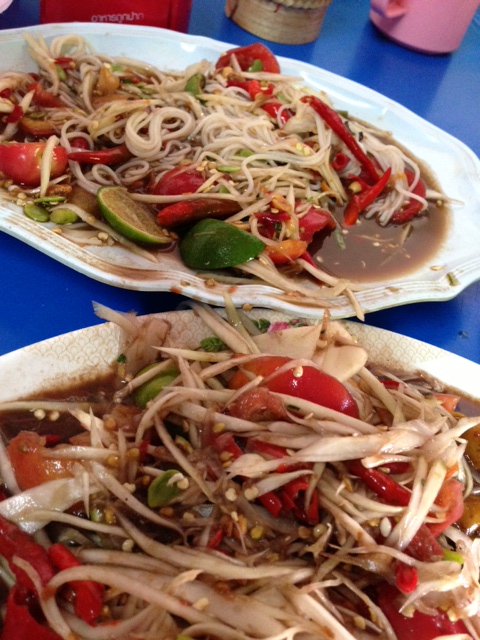
Two kinds of Isaan-style grated salads at Jay Gai

It is almost impossible to live anywhere in Bangkok that is not within walking distance of a som tum (grated fruit or vegetable salad) vendor. While street food lovers frequently rhapsodize over the best bowl of noodles or grilled hunk of meat, it’s som tum that most often finds itself at Thai tables.

And what som tum it is. Although the grated green papaya is the variety that is most popular in (and out of) Thailand, vendors display a wide range of fruits and vegetables with which to make this salad, from cucumbers and long green beans to tart gooseberries and green bananas. The truth is, anything with any sort of crunch is a good base for a grated spicy salad. It’s the dressing that usually stays constant.


Som tum Thai — the type most commonly eaten in Bangkok and abroad — is the kind we are exploring here, with a dressing made of lime juice, fish sauce, and a healthy dose of sugar (be it palm or granulated). A light dusting of roasted peanuts and dried shrimp and you’re done. But if you are the adventurous sort who does not shy away from fishiness (really, the essence of Thai food), there is som tum Lao, tinged with that extra oomph afforded by pla rah, or fermented Thai anchovies, or even som tum nuea (the northern Thai variety), flavored with a bit of nam poo doo (the juice of pulverized and fermented field crabs). I am not a fan of som tum Thai, which I find to be too sweet throughout much of the capital nowadays, but I do have plenty of time for the Isaan version, made with either crunchy fruits or vegetables, or mua (confused), which includes kanom jeen (fermented rice noodles).

The som tum Lao and som tum mua shown above hail from Jay Gai, also known as “som tum yib bat” (som tum where you must pick a number), such is the popularity of this stand on Naresuan Road in Udon Thani. Their som tum Lao is rich in anchovy flavor, with a nearly rancid tinge; the som tum mua includes green papaya, bamboo shoot, cherry tomatoes, long beans and snails alongside the kanom jeen. Both are what you expect Isaan-style som tums to be: thick, heady, uncompromising.

That’s not what we’re doing here. Chris and I are starting with the basics, by trying to emulate Jay Gai’s “Thai-style” som tum. With Western cooks in mind, we are using shredded carrot and daikon radish in place of green papaya. The only thing we may be copying from Jay Gai is its propensity (and everyone else’s propensity) for MSG (pong chu rot).

Som tum Thai, inspired by Jay Gai (makes 4 servings)

In the bowl of a mortar with a pestle, pound 3 cloves of garlic with 1-3 Thai chilies (vendors call each chili a “met” and ask customers how many “met” they want in their som tum. Answers usually range from none (“mai sai prik“) to five (“ha“). Mash into a paste.

Add 3 Tablespoons fish sauce, the juice of 2-3 limes, and a Tablespoon of palm sugar or granulated sugar.  Taste to correct seasoning. This is your last chance to fix the dressing before all the other ingredients are added to the mortar. 

Add a cup of granted carrot, half a cup of grated daikon radish, 3 inches of long beans cut into 5 cm pieces, and 3-5 cherry tomatoes. Mash gently with your pestle to ensure the strands get bruised (nothing is worse than too-crunchy pieces) while scraping the bowl with a large spoon with your other hand. 

It’s your decision to add Ajinomoto (to taste) or not, but every Thai I have spoken to insists that it is an essential ingredient, so there it is. We used a light sprinkling on our finished salad before garnishing with crushed roasted peanuts and dried shrimp (both to taste). A platter of fresh veggies — sliced green beans, a wedge of cabbage and some cucumber spears — accompanies the salad. If you want to be really traditional, serve alongside sticky rice and grilled chicken or pork shoulder or, if you want to be like Jay Gai, a bowl of boiled snails.
4 Comments

Filed under Uncategorized

Rediscovering the familiar

Image

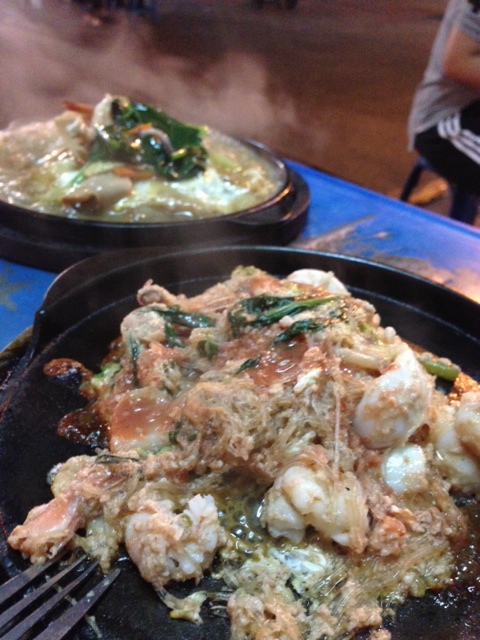
Suki and seafood gravy noodles, courtesy of Krua Porn Lamai

I find it amusing when I hear someone say they don’t want to end up like the old married couple in the restaurant, eating their dinner in silence. I find this amusing because, in my opinion, THAT IS THE BESTEST THING EVER. Why do I have to talk all the time? The well-worn song-and-dance, the incessant thrum of pleaselikemepleaselikeme — all of this singing for our suppers … it’s just not my normal state. My normal state is that of a big old grump who thinks occasionally eating a restaurant dinner in silence IS THE BESTEST THING EVER. That’s because sometimes, I don’t want to talk. And sometimes I don’t want to listen. Sometimes these two desires meet up over the dinner table in front of my spouse. Whenever this happens, I call it RELAXING.

Of course, this doesn’t take into account the feelings of my long-suffering spouse. Maybe he wants to bare his soul over his salad caprese and dish over the little details of his day as we work our way through our oxtail stew. Something tells me I probably wouldn’t be married to this person, but once in a while my husband does want to talk, and it’s not the old refrain “When are you going to take care of the kids/clean the house/take a shower” that I usually hear coming out of his mouth.

So, in the interests of compromise, and against all my better instincts (I AM SO MUCH FUN), we talk, we discuss, we communicate. And in doing this, we find out more about each other, even as we soldier on through our 157th year of marriage. As many eons and eons (and eons) that we have been together, we discover that much more every day.

As many times as I’ve been down the main drag of Yaowaraj Road and explored its many offshoots (YES I AM EQUATING MY MARRIAGE TO A PART OF TOWN), I still find new vendors to get excited about — not every day, but often enough to make an hour-long Skytrain-then-subway-then-tuk tuk trek to Chinatown from my house worthwhile (I CANNOT WAIT for the subway extension into Chinatown to be finished. My life will BE CHANGED FOR THE BETTER. THEN I CAN STOP WRITING IN ALL CAPS).  

Enter Krua Porn Lamai (081-823-0397). Despite the suspicious likeness of its name to a made-up massage parlor in a future installment of “The Hangover Part 34”, this outdoor vendor specializes in kata ron, or “hot pan” — fried noodle dishes given the special oomph afforded by the sizzle and smoke of a heated plate. Part of a “cooperative” of vendors that share tables and help service each other’s customers (something I’m seeing more and more of nowadays), Porn Lamai is set right at the entrance to Soi Plang Nam, just as you turn right from Yaowaraj Road. All those tables with hot plates on them? That queue of excited-looking customers staring at other people’s food? That’s them.

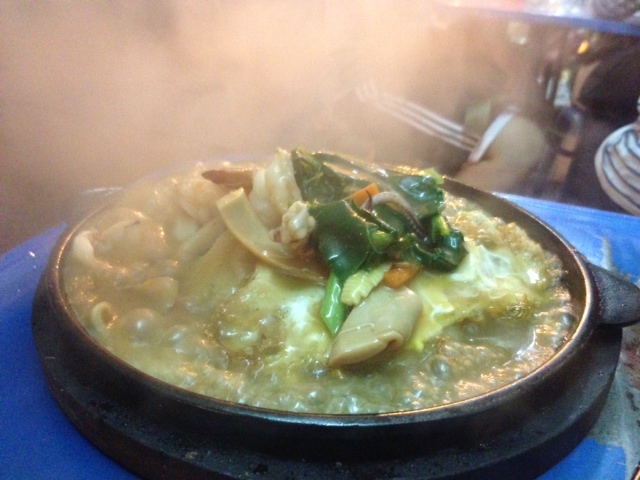
The reason for all the excitement — despite the wait elicited by having to wash all those hot plates for new customers — is obvious. Take, for example, the guaythiew lard na talay (seafood gravy noodles), charred to a crisp on the bottom, just like the bottom layer of rice in a good paella. It arrives at the table still seething, emitting a slight hiss, but when the server upends a pitcher of gravy over the liquid, a giant plume of smoke and sound erupts:

Image

Krua Porn Lamai’s lard na noodles

This is food that fights back (seriously, watch you don’t burn the roof of your mouth off). This is food that you will remember (as you’re doing your laundry). This is food that will not go gently into that good night. Enjoy.


6 Comments

Filed under Uncategorized

What’s cooking: Aim Och

Image

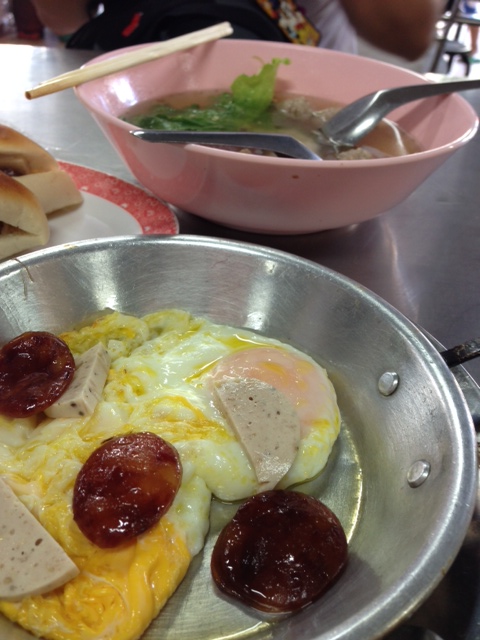
“Egg in a pan” at Aim Och in Khon Kaen

There is nothing easier to make in all of Thai street food than kai kata, or “egg in a pan”. Still stinging from our inability to decode Jay Fai’s Byzantine fusion of herbs and spices masquerading as tom yum goong, Chris and I decided to give ourselves a break and do something that is, quite literally, fool-proof.

Kai kata is the Thai version of the Vietnamese version of the American breakfast, said to have been inspired by homesick American GIs during the Vietnam War. In an attempt to replicate the American breakfast standby “ham and eggs”, Vietnamese cooks cracked eggs into “personal-sized” pans, garnished them with Chinese sausages and Vietnamese steamed pork pate (moo yaw) in place of sausages and ham, and cooked them quickly on a stovetop until the whites set. Garnished with a splash of red chili sauce like Sriracha and fish sauce and accompanied by a toasted, buttered bun stuffed with more “sausage and ham”, this no-fuss breakfast combo is quick, easy — and unbelievably satisfying. Best of all, you can let your imagination run riot: anything, anything at all, will work with these eggs. Have a sweet tooth and want to drizzle some maple syrup on it, maybe with a garnish of crispy

bacon? A handful of peas? Maybe some pancetta and sliced fresh chilies? Or maybe a

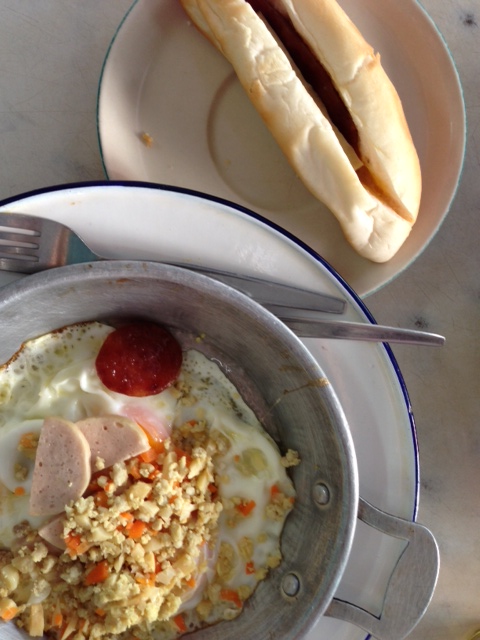
splash of minced chicken and diced carrots, just like at King Ocha in Udon Thani:

Image

Kai kata and buttered bun at King Ocha in Udon Thani

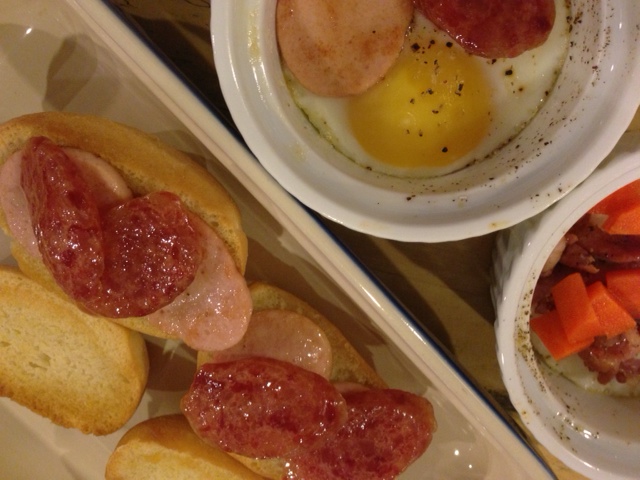
There are no rules for this fusion-y adaptation of a Western favorite. Ironically, if you are in the West, you may need to make some substitutions for some hard-to-find ingredients, so you may have to re-substitute those substitutions. Hence our choice to use buttered ceramic ramekins instead of tiny pans, because we aren’t sure how many of those are available back West. If you don’t have an oven, you can make a bain-marie by putting your ramekins in a pan, filling with water up to the middle of the ramekin, and cooking your eggs on the stovetop. However you decide to make it, we have tried to cleave as closely to the “authentic” (circa 2013) basic Isaan-style kai kata as possible.

Kai kata a la Aim Och (makes 2 servings)

What you’ll need:

– 2 ramekins, well-buttered

– 2-4 eggs, depending on size of ramekins

– 1 link Chinese sausage (gunchieng), sliced

– 6 slices moo yaw (Vietnamese steamed pork pate) — baloney works in a pinch

– Two mini-baguettes or soft rolls (for real Thai street food flavor, they should be as sweet as possible)

– Butter (for toasting buns)

– Fish sauce with sliced chilies, Maggi, or Golden Mountain sauce (to taste)

– Sriracha sauce (to taste)

– Salt and pepper (to taste)

To make:

1. Preheat oven to 325 degrees Fahrenheit/180 degrees Celsius.

2. Place buns, slightly open and their insides buttered, into a casserole and toast in the oven until warm, edges are light brown and butter is melted. 

3. In a pan, warm slices of Chinese sausage and/or moo yaw until hot to the touch.

4. Crack 1-2 eggs into each buttered ramekin, depending on size. Cook in oven for 5-10 minutes (depending on how well your oven works), until whites are set when you jiggle them and start to pull away slightly from the sides of the ramekin. If you like your eggs more well done (I love runny yolks), wait at least 10 minutes.

5. Take eggs out of oven and garnish with sausages and “ham”. If you have cooked minced meat and/or vegetables, scatter those onto your eggs as well. Season with salt and pepper.

6. Fill toasted buns with slices of “ham” and “sausages”. Serve alongside eggs, and make sure to pass the fish sauce/Maggi and sweet chili sauce. Easy AND delicious.

Image

Our versions


Leave a comment

Filed under Uncategorized