Tag Archives: Thailand

What’s Cooking: Bamee Slow

My stab at "bamee kai", or egg egg noodles

My stab at “bamee kai”, or egg egg noodles

It’s on. Stress has taken hold, and I am feeling overwhelmed. As deadlines loom and previously-unforeseen hitches suddenly rear their little heads, I find myself reacting in strange ways. Please don’t be alarmed. If you see me staring at you, I am not contemplating you for dinner. I don’t see you at all. If you are foolish enough to say something to me, do not be startled if I spout even more rubbish than usual. I am trying to work something out.

In my present state, I have discovered some people enjoy my company more than usual. These are twisted and strange people. They are also food lovers. Because, in an attempt to keep from creeping as many people out as I usually do, I have retreated to the kitchen, where I can be as weird as I want and as brave as I like. It’s all OK, you see. My inevitable failures here won’t be as heartbreaking. And the results, as pitiful as they are, can be shared by everyone.

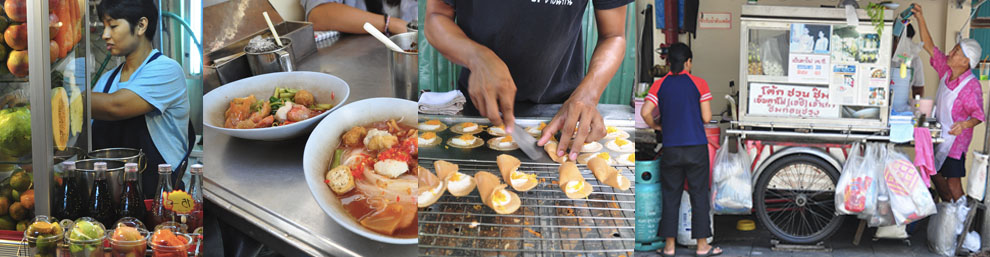
Today, I am attempting to replicate one of my favorite comfort foods, the bamee kai (egg noodles with, um, egg) from Bamee Slow, officially referred to as  “Bamee Giew Moo Song Krueang” (open after 8pm at the entrance to Ekamai soi 19). Diners who like these noodles enough to queue up for them — and Thais have a hard time lining up for anything — affectionately call this place “Bamee Slow” because the khun lung (old “uncle”) manning the stall makes every bowl one by one, and it can take up to half an hour to get your order (for the record, the longest I have waited is 22 minutes). He has since stepped back from the soup vat and his daughter has taken over, and I am told she is a bit faster. But their noodles are as popular as ever.

What I love are the al dente, silky noodles, coated with the unctuous yellow yolk that eventually spills out of every unlucky egg plonked into each bowl. Slices of red pork, sturdy bits of Chinese kale, crumbled minced pork bits: none are immune from the reach of the yolk. This is what I am trying to capture, in my own small way.

Before starting, you need to make sure you have a big enough strainer that will hold all your noodles while ensuring that all the starch washes away, so that your egg noodles are not a smooshed-up Jack Sparrow-like bird’s nest, rendering your entire bowl a sad mess like the remnants of my career. Also, like the people at Bamee Slow, you should make up each bowl one-by-one: it really does make for better noodles.

I boiled a handful of pork soup bones in water with some garlic and white peppercorns for an hour, skimming periodically, and then flavored the broth with soy sauce and roasted chili paste (the ingredient that I think lends the toxic orange color to Bamee Slow’s broth). However, if you don’t have the time or inclination for this, pan-fry some minced pork with or without pork soup bones first, then cover with water and boil for a few minutes before starting. Or, simply get a couple of pork bouillon cubes into some hot water and proceed without delay. It’s all up to you.

Bamee Slow’s egg noodles (makes 2 servings)

– 200 g pork soup bones

– 500 ml water

-2 garlic cloves

– 5-10 white peppercorns, depending on how peppery you like it

– 1 tsp nam prik pow (roasted chili paste)

– 1 tsp salt

– 3 Tbs soy sauce

– 200 g minced pork

– 200 g fresh egg noodles

– 4 stalks Chinese broccoli or kale

– 2 eggs, soft-boiled (boiled for 3-4 minutes), cooled in an ice bath, and peeled

– Sugar, chili powder, fish sauce, white vinegar (for garnish)

To make:

1. Boil first four ingredients for an hour, skimming periodically.

2. Season with soy sauce, salt, roasted chili paste and more white pepper. Adjust to your taste.

3. Add minced pork and allow to boil for a few minutes until pork is cooked, skimming scum off of surface.

4. Add your greens.

5. Place half of your noodles in a strainer and immerse in the broth, skimming more off the surface if needed. Wait 2-3 minutes for noodles to “cook” and lose their starch.

6. Place in a bowl and ladle broth with minced pork (but without pork bones) over the noodles. Garnish with egg and greens and, if you have it, a few slices of Chinese-style barbecued red pork.

7. Serve alongside sugar, chili powder, fish sauce, white vinegar (with or without sliced or smashed chilies) and ground peanuts, if you like.
 

6 Comments

Filed under Asia, Bangkok, food, food stalls, noodles, pork, Thailand

For simplicity’s sake

There is a lot to be said for doing as little as possible. As an officially Lazy Person, I am all for doing the absolute minimum necessary to get by, or, if that is not possible, getting someone else to do it. That philosophy is, in essence, what lies behind my house motto (THIS IS ALL YOU GET). So the concept of doing very little is something close to my own heart.

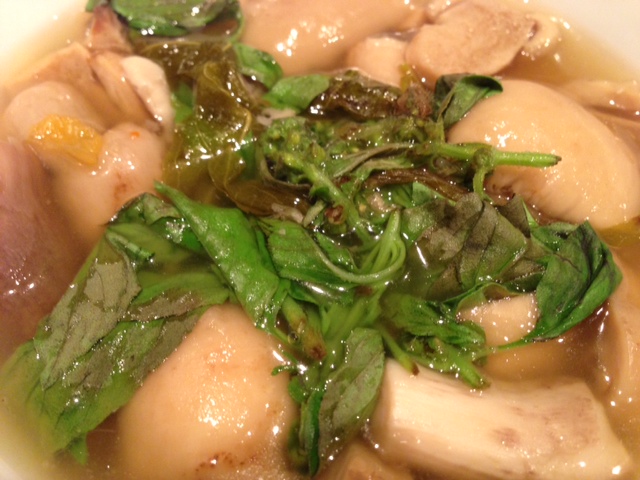
Although Isaan-ers (Thais living in the northeastern part of the country) work very hard and are known for doing so, they do very little with their food — perhaps because they are busy working. A little water, a few bits of meat, a barrage of chilies and a handful of crumpled herbs and you’ve got dinner on the table after maybe half an hour. Very easy and very simple, yet the results of this hurried labor remain delicious. Exhibit 1: an Isaan-style “mushroom soup” whipped up with water, fish sauce, lime juice, a tangle of Thai basil, and very little chili, resulting in something sharp, salty, slightly squidgy and utterly addictive:

Isaan-style mushroom soup

Isaan-style mushroom soup

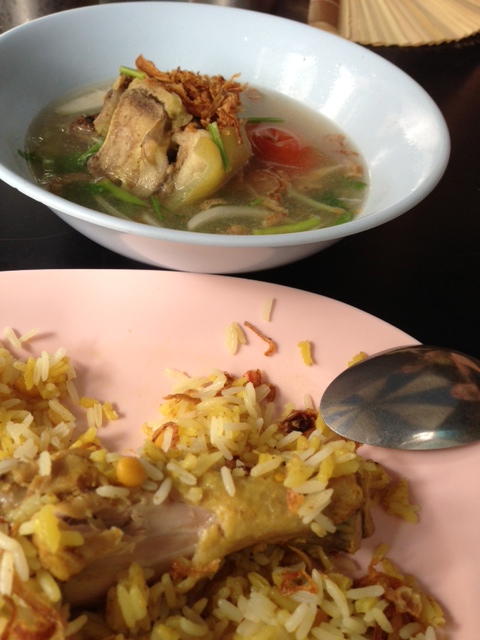
But the Isaan region is not the only part of Thailand known for its tart, spicy soups. The soup hang wua (oxtail soup) of the deep South is another gem — meaty of course, but also sour with lime and toughened by a mini-explosion of spice. It’s the perfect complement to the khao mok gai (Thai-Muslim chicken biryani)  that it almost always accompanies, sweetened as it is with raisins and deep-fried shallots. It also makes for a hearty, substantial breakfast or lunch, when a slice of toast or a smidgen of rice porridge just won’t do. A good place to get this combo is at Amat Rot Dee, about 100 meters from the entrance to Thong Lor Road on the left hand side (02-319-6576, open weekdays from 8.30 am-noon), where the biryani is reliably fluffy and the soup a fragrant melange of oxtail, onion, tomato, coriander and, of course, chilies.

Amat Rot Dee's oxtail soup

Amat Rot Dee’s oxtail soup and chicken biryani

Simple, yes, but devoid of flavor, no.

Speaking of simplicity, nothing is simpler than the humble potato. But the myriad ways different people prepare this thing can prove surprisingly fascinating. For those curious about just how many ways that could be, please check out my friend Poh Sun Goh’s new blog “The Traveling Spud” (http://www.thetravellingspud.blogspot.com), detailing potato dishes everywhere from Bangkok and Singapore to Norway and Spain.

4 Comments

Filed under Asia, Bangkok, food, food stalls, Thailand

What’s Cooking: Jay Fai Take 2

Image

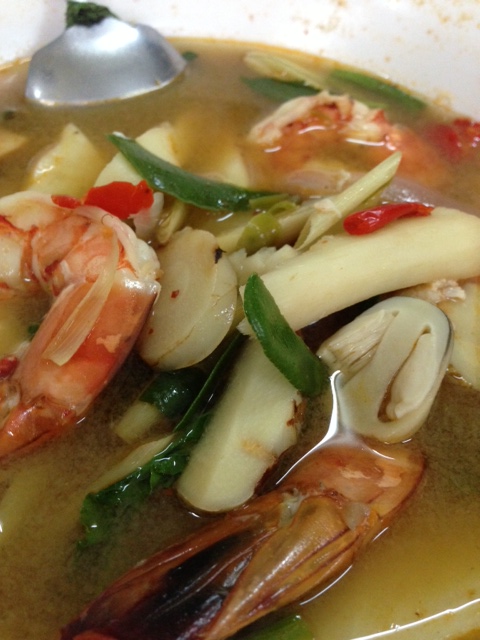
Jay Fai’s spicy lemongrass soup

(Note: spoilers for “Game of Thrones” viewers and A Storm of Swords readers, published in 2000)

(Note take 2: I already tried making this soup. What gives? Unhappy with the first version, I tried it again. I am happy to report that, like “A Song of Ice and Fire”, this soup gets better!)

There are rules to things. Although I’m all for culinary experimentation, and switching things up for almost everything, some rules are set in stone(heart), and the breaking of them renders you cursed in the eyes of gods and men. One such rule: the guest right. Once you have partaken of your host’s bread and salt, you are supposed to rest assured that your host won’t start taking his brand-new set of Wusthof knives to your internal organs.

Yes, the “Red Wedding” was tragic, the King in the North was killed through black treachery instead of on the battlefield, Robb is dreamy, yada yada yada. But what angered me most was the hosts’ callous violation of the guest right, this most important of all rules governing Westeros, more so than even kinslaying or having sex with your sister. THASS JUST PLAIN RUDE. What’s next? Forgetting to wipe your blade before moving on to your next hapless wedding guest-slash-victim? Allowing stray blood spatters to sully the mashed neeps and jellied calves’ brains? Starting the slaughter before anyone’s had even a bite of wedding cake? WHAT IS UP WITH THAT. One lesson learned: never, ever go to Argus Filch’s house for dinner.

Immutable rule no. 2: tom yum, the spicy lemongrass soup served at almost every Thai restaurant you know, is an infusion. That’s what makes it the most Thai of soups, unlike dishes like gaeng jued (clear broth soup), which is adopted from the Chinese and hence based on a broth. The base of tom yum is water. You add all your aromatics and seasonings to it after it comes to a boil.  

That’s probably part of the reason why it’s so easy to mess around with, and why modern-day cooks have started to play fast and loose with this poor soup, adding everything from nam prik pow (roasted chili paste) to milk and even sweetened condensed milk (I AM SHOCKED). The fact is, as great an invention as tom yum goong is, the contemporary tongue wants MORE. They want the drama, they want the spectacle, they want the gore. They want to be surprised. 

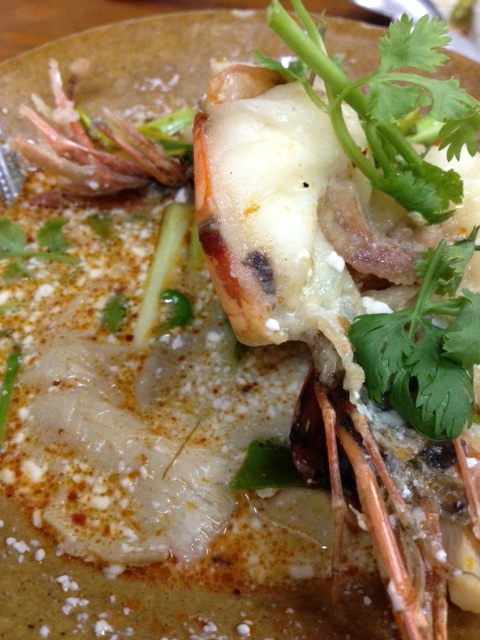
So it’s no wonder, then, that even “old-style” eateries like Chote Chitr are dressing their tom yums up to better fit in with the times. Here, Chote Chitr includes fat tiger prawns, yes, and a healthy dash of milk:

Image

Chote Chitr’s tom yum goong

The result is sweeter and fattier than the bracing, astringent herbal brew you (I) might have expected. It’s not really tom yum. It’s something else. How to make a proper rendition of this dish, but make sure it has enough flavor?

Well, you could take a cue from Jay Fai’s (1,500 baht) version, which caters to modern tastes while staying true to the spirit of the soup. In Jay Fai’s case, the difference is most certainly roasted chili paste. Although it is not strictly traditional, it adds the heat and flavor to an infusion without murking up all the flavors. Another thing: scraping the shrimp heads into the water, and allowing the heads to “infuse” alongside the kaffir lime leaf, lemongrass and galangal. This one hopes that — unlike breaking the guest right — these relatively newfangled additions will not curse you in the eyes of god and men.

Jay Fai’s tom yum goong (serves 4)

– 5 cups water

– 6 jumbo prawns with heads, deveined

– 6 large slices galangal

– 5-7 kaffir lime leaves (it’s a lot, but if you are cooking in the spirit of Jay Fai, you will want this soup to “go up to 11” — her personal motto.)

– 4 lemongrass bulbs (purple part), bruised

– 1 shallot, sliced

– 4-8 red chilies, bruised (this depends on your heat tolerance)

– 1 heaping tsp roasted chili paste

– 1 cup mushrooms (I used oyster, but straw or button mushrooms also fine)

– 1 cup young coconut shoots (if you can’t find these, you might want to use something else that is tender yet crunchy, like peeled white asparagus)

– 5 Tbs fish sauce

– juice of 2 limes

To make:

1. Bring water to a boil. Stir in roasted chili paste.

2. Add galangal, kaffir lime leaves, lemongrass and chilies. Allow to infuse for about 5 minutes, then bring to a simmer.

3. Add shrimp heads, first scraping their contents into the soup. Wait 5 minutes, then season with fish sauce. Add mushrooms and coconut shoots.

4. Wait half an hour, or until shoots are tender. Skim gunk off of surface and discard shrimp heads.

5. Turn off heat, then add cleaned shrimp, and stir to turn the shrimp “pink”.  Season with lime juice. Taste and adjust seasoning accordingly.

6. Serve immediately, paired with rice and a Thai-style omelet, or in individual small bowls.

Image

My improved tom yum

7 Comments

Filed under Asia, Bangkok, food, food stalls, seafood, Thailand