When I was a kid living in Pennsyltucky, I used to daydream about a place with soaring green mountains, rice paddies, and snaking rivers that I could move to someday, far away from teachers who gave lectures about how not speaking English in the United States was “rude”. It turns out, the place I was dreaming about was Luang Prabang.
Lo and behold, I actually have family in Luang Prabang. They are second cousins (or maybe third?), relatives of my Grandma Jeanette’s whom we finally got to meet for the first time last year in November. So when I got a commission to research and write about Luang Prabang for a guidebook this year, I jumped at the chance to contact them again, if only to stuff my face with more of their food.
My relatives own a restaurant, and an ice cream parlor. Could I get any luckier? Madame Noy is owned by the eldest of three sisters, who has been cooking for her family all her life. Her restaurant is known for serving Thai-style chicken rice, crispy pork on rice, and red BBQ pork on rice (it would appear, even in places as proudly Laotian as Luang Prabang, that Thai-style dishes are better known than pure Laotian ones.) That said, her expertise isn’t limited to Thai street food; she makes a mean spread of Laotian food — and not just Laotian, but dishes that are hard to find anywhere outside of Luang Prabang.
One dish that I’ve had a hard time finding anywhere else is “khao poon nam jaew”. While “khao poon” is roughly equivalent to Thailand’s “kanom jeen” (Mon-style fermented rice noodles), “nam jaew” seems confusing because everyone associates “jaew” with “spicy chili dip”.
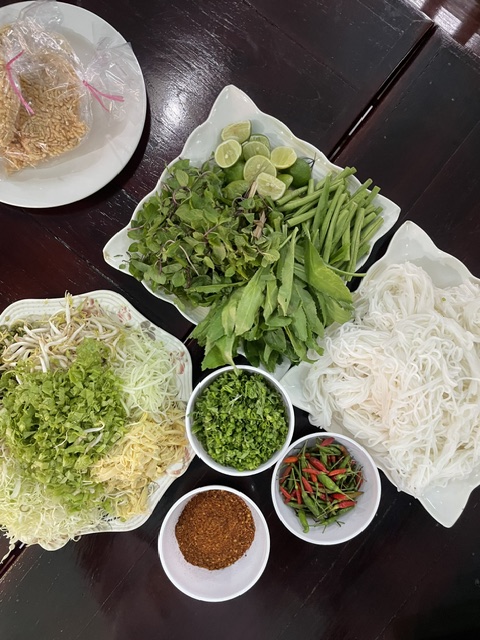
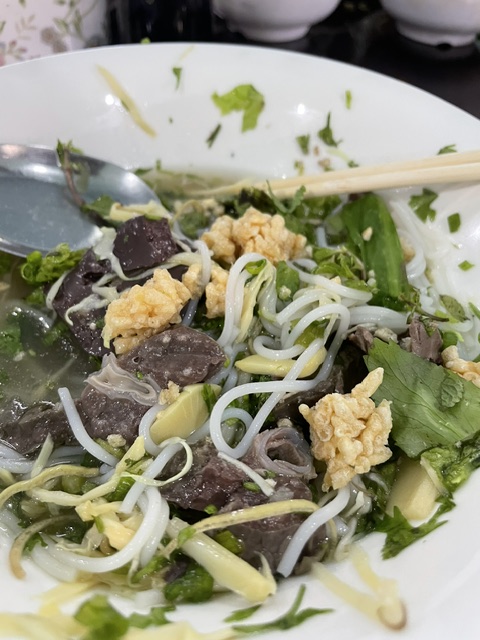
But this nam jaew has less to do with spicy red chilies, and a lot more to do with pork: pork offal, primarily. It’s what highfalutin chefs today would call “poverty cuisine” — all the off-cuts of the pig that no one else would want — but which is quite sensibly about making sure that nothing goes to waste. To maybe hide the fact that there are so many pig parts in there, a veritable mountain of toppings are included, like chopped banana blossom, cabbage, bean sprouts, the requisite green onion and fresh coriander leaves, green beans, basil leaves, fresh lime, raw chilies, and French watercress, ubiquitous in Luang Prabang. You pile your noodles with the toppings, ladle the stew on top, and give them a good mix while flinging the whole thing with lashings of chili powder. The final flourish involves smooshing rice crackers in your hands and tipping them over the noodles like croutons. The result is milder than expected, natural and somehow refreshing, like most Laotian food is.
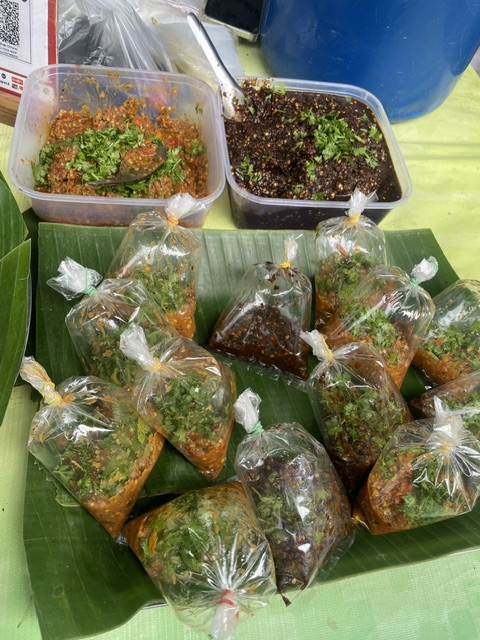
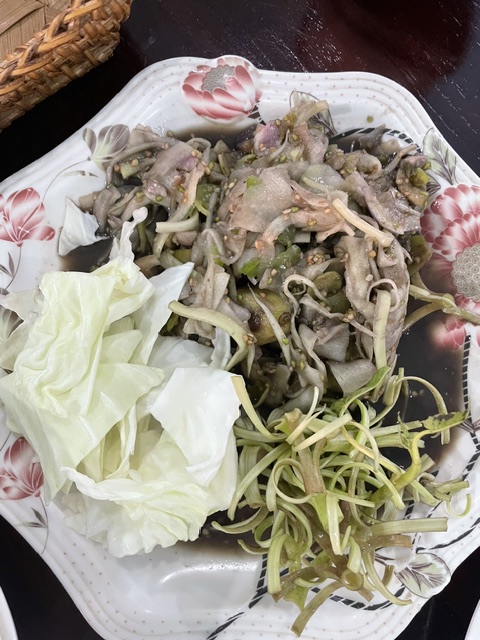
Like Thais, Laotians are also fond of buying their favorite dishes from valued street vendors for special meals with family. This includes the only Luang Prabang dish that Thais are familiar with, “tum Luang Prabang“, made with slivers of cucumber (not necessarily big flat noodle-like slices, but often) and seasoned with shrimp paste, water olive and lots and lots of fermented field crab juice. My cousins’ favorite vendor is in the alleyway next to the former Dara Market (it’s since been closed to make way for something, likely another high-end hotel).
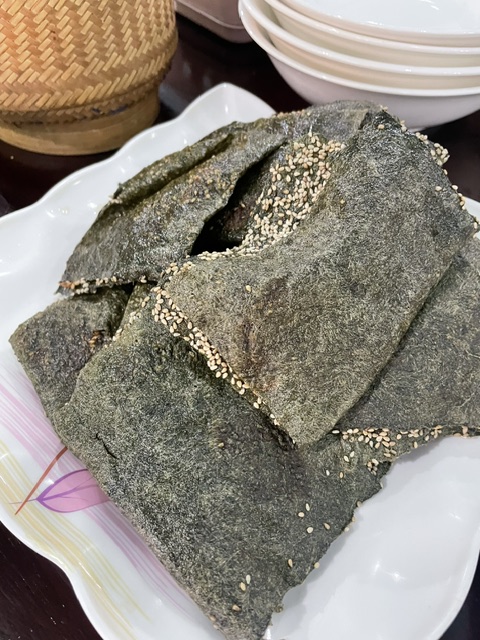
Another snack that’s everywhere in Luang Prabang is “khaiphaen”, which is Mekong river weed that’s been seasoned with sesame seeds and dried in the sun. You’ll see racks of it drying along the river banks in November, when the water is as its clearest, I’m told; the rainy season muddies the water too much for collection (not to mention, it’s fairly dangerous). The river weed is supposed to melt in your mouth like a communion wafer; if it’s sticky or chewy, it’s too old — meaning I’ve been chewing on old river weed all my life. The khaiphaen I’m served is a melt-in-the-mouth revelation, but when I ask where it’s from, I get hemming and hawing about how they are friends who process the river weed themselves. Needless to say, it’s not from the Morning Market.
Finally, Madame Noy served us a dish I’ve never seen before, looking like two big logs of black, sticky matter. No, reader, it was not photogenic, as you can imagine. Or don’t have to imagine:
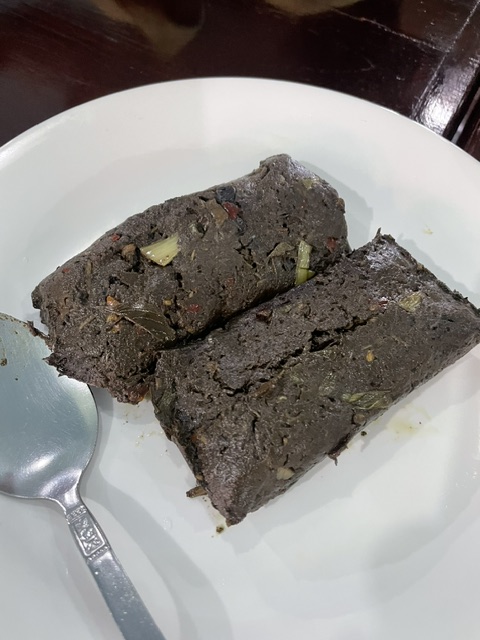
It was called “oat bon”, though I’ve also seen it referred to as “or bon” or “aw bon” online (though that’s not what it sounds like when people refer to it.) Oat bon is not a dish you’ll find on many menus, and if it is there, it’s probably listed in Laotian. It’s made of taro or “elephant ear” leaves, which grow in profusion around the banks of the Mekong and Nam Khan rivers that surround Luang Prabang’s historical district. The leaves are poisonous when raw, so they are marinated and then steamed, thickened with pounded sticky rice, and mixed with seasonings like chilies, galangal, lemongrass, fermented fish sauce (pla daek), ground pork or water buffalo, and pork skin. The result is a stew, or as I saw it, a chili dip that my cousins said must be eaten by hand with a rolled-up ball of sticky rice. Only then would I become Lao, they said, so I did it, after getting a bit on my white shirt (of course). The taste was salty yet somehow light, better than the sum of its parts, and improved with each mouthful. But upon asking where they got this delicacy, they said the vendor made only a few a day: “They don’t really like to work too hard,” they said, and it was the most Thai thing I’d ever heard.
Online research tells me that I can find this dish at Little Lao Culture Bar, which is something I will check out when I return (yes, return!) to Luang Prabang in October for more research. It turns out, unlike what many people would have you believe about Laos, that Luang Prabang is roiling with things to do, and I have only scratched the surface of “sights & activities” (and “food & drink” too, for that matter). I’ll get my fill of everything else that I’ve missed, and make a return trip to Madame Noy (and U-Like Ice Cream next door for their sticky rice parfait, too).
 Bangkok Glutton