Monthly Archives: August 2017

Korat state of mind

somtum

Somtum Korat at Kanom Jeen Kru Yod

Korat is known as the “gateway to Isaan”, but there’s nothing entry-level about the Northeastern Thai food you get here. Green papaya salad, grilled meat, sticky rice, fermented Thai anchovies — it’s all there, graced with a decidedly “Korat” stamp like an edible Isaan-style “LV” with extra chilies on top, if you please.

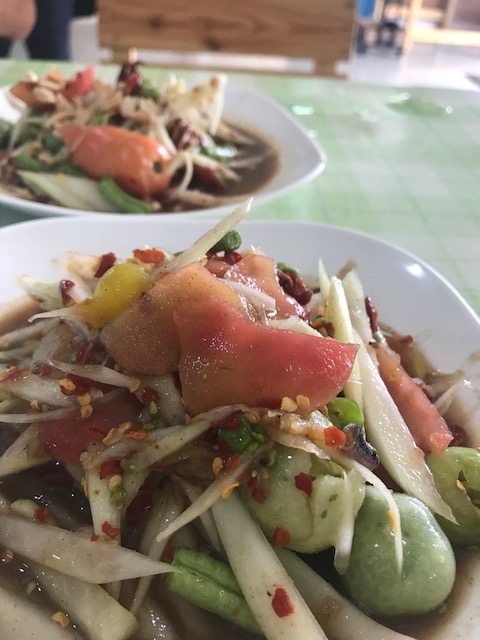
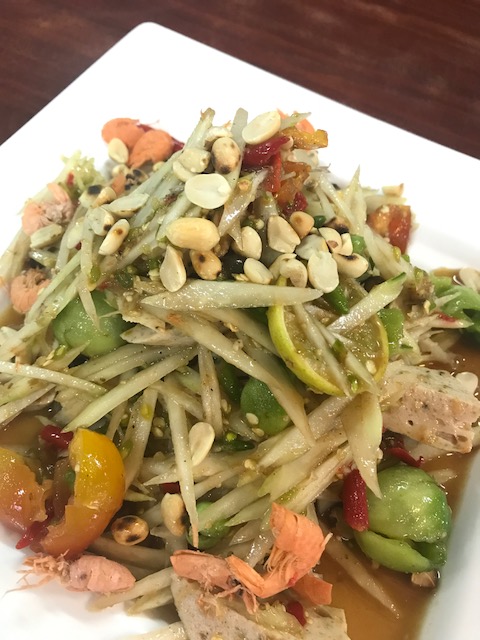
There are as many types of som tum, or what’s commonly known as “green papaya salad”, as there are fruits and vegetables. That’s because, while the green papaya variety is the most well-known, you can make som tum out of just about anything: corn, green banana, sweet santol (known as gratawn). “Som tum Korat”, ostensibly named after the town in which it was created, veers from the usual with the addition of pickled field crab, dried shrimp and fermented Thai anchovy juice alongside all that green papaya and pounded long beans, garnished with a shower of roasted peanuts. The result is spicy and salty with a touch of sweet, in a region where sweet flavors are usually anathema.
somtum2

Som tum Korat with plenty of moo yaw at Som Tum Pan Lan

Of course, the flavors vary depending on the chef. Despite its deceptively simple appearance and quick assembly time, som tum is surprisingly hard to get right, a tightrope walk between salt, spice and tart, with an additional hit of sweet or bitter when the recipe demands it.

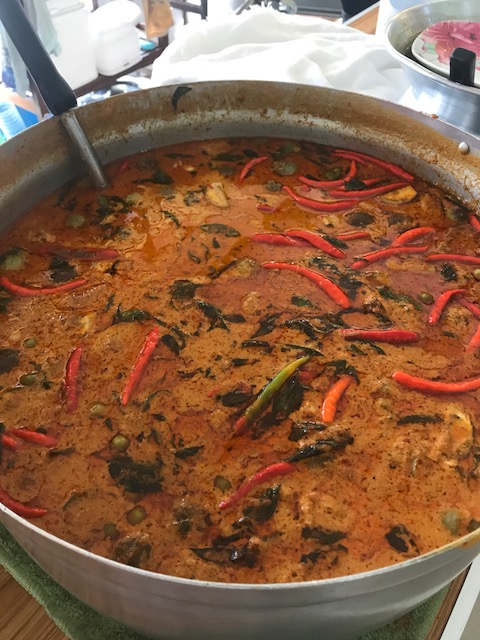
At Kanom Jeen Kru Yod (200 moo 9, Moo Ban Kokpai 2, Thanon Siriratchathani, 081-548-4097), the restaurant is named after the fermented rice noodles that locals flock to for lunch to eat slathered in the gang gai, or chicken curry.  But as delicious as those noodles are, the som tum salads are just as toothsome, big, bright flavors in a jumble of fresh, crisp textures and colors. This is also the big draw at Som Tum Pan Lan (Ratchasima-Pakthongchai Road, 081-966-1497), where we waited out a torrential downpour while hunched over a plate of som tum, bulked up and chilled out with a generous handful of moo yaw, or steamed Vietnamese-style pork sausage.
ganggai

A vat of Kru Yod’s ubiquitous chicken curry

Sometimes people want a little drama with their som tum. Or something to properly Instagram. I hate to say it, as I am a big Instagram user too (follow me @bangkokglutton guys!), but Instagram is ruining food. To win more interest, restaurants are creating dishes with an eye toward how spectacular they will look in photos, instead of how these dishes actually taste. The birth of som tum tad (literally “som tum on a tray”, surrounded by a solar system of items meant to go with the som tum “star” in the middle) falls into this category, but some versions are more palatable than others. Enter Thum Saeb Gaen Khon (11/2 Suebsiri Road, Soi Suebsiri 3, 084-605-9120), which, alongside a very tasty selection of regular som tums, thom saeb (spicy Isaan-style soups) and grilled meats, offers an enormous som tum tad centered around their very own “som tum gaen khon” and less manicured than the scary specimens haunting your local food court.

Here, the som tum is surrounded by fried pork rinds, fermented rice noodles, soy sauce-fried rice vermicelli, sprouts, pickled mustard greens, blanched cabbage, dried sweet pork, katin seeds, boiled shrimp, steamed cuttlefish, steamed mussels, blanched surimi, dried shrimp, sour fermented pork sausage, and three types of egg: hard-boiled, salted, and century. It’s a meal fit for 3-4 kings.

somtumtad

Som tum tad at Thum Saeb Gaen Khon

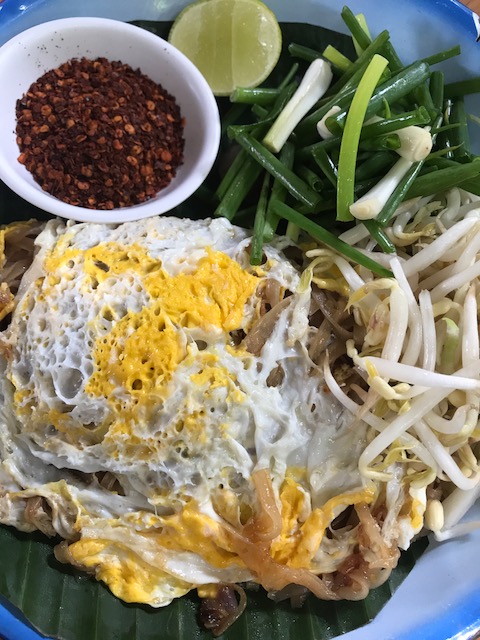
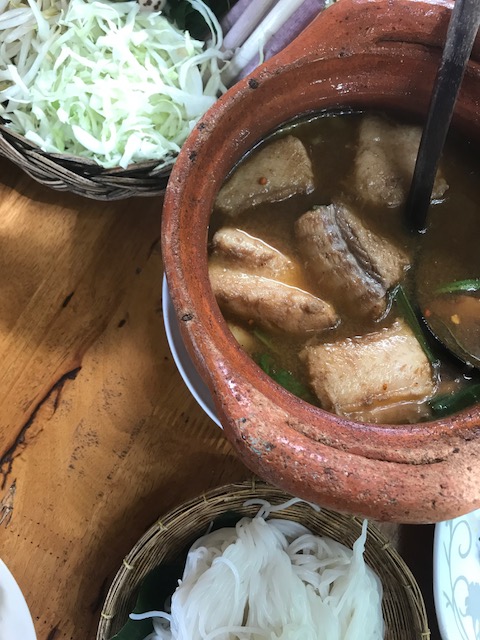
When/if you get som tummed out, there are still some Korat-based culinary alternatives. Krua Khun Ton (Jomsuranyat Road) is as hidden as a hidden gem gets anywhere: tucked into an outskirts-lying development that calls to mind images of basement meth labs and Episode 4 of “True Detective” Season 1. Somehow, amidst all of this, a restaurant terrace sits behind a tranquil pool of carp and artful display of old furniture arranged around an ancient television set. Everything is good here, if the enormous crowd of people (everyone awake in Korat on a Sunday morning) is anything to go by. We settle in with a mee Korat (fried rice vermicelli with dark soy sauce, fish sauce, palm sugar, chilies and pork) and the restaurant’s signature, kanom jeen nam ya pla rah (fermented rice noodles with fermented anchovy curry).
meekorat

Khun Ton’s mee Korat

The soup — deep, salty, slightly funky and somehow sweet — is studded with thick, meaty chunks of fish and accompanied by a plethora of garnishes including shredded cabbage, pickled greens, and green foliage that I sadly didn’t catch the name of but tasted both tannic and tart, gorgeous next to the murky curry.
plarah

Kanom jeen nam ya pla rah

It’s hard to leave Korat without feeling like you have swallowed a submarine whole. But like all physically taxing experiences, like childbirth, you forget about the pain afterwards in favor of the good and fuzzy feelings. Over the course of two days, I ate enough for a week’s worth of meals. This was only a little bit of it. But damn it if I didn’t end up wishing I could stand to eat a little more.
Leave a comment

Filed under Uncategorized

BKKian of a certain type

IMG_4991

Pork meatball congee at … Joke Samyan?

There used to be a certain type of person you would always bump into in Bangkok. This type was a real Bangkokian, the same way you expect to only find a certain type of person (black-clad, highly strung) in New York, one in L.A. (glossy, tanned, a believer in detox cleanses and crystals), or in Paris (grumpy). The Bangkokian is the person who will gauge your street food knowledge upon first meeting you, gently probing whether you have been to hotpot in Sutthisan (yes) or Nai Ho near Mahachai Market (no) and slot you into the food knowledge hierarchy accordingly. Like rival dungeon masters comparing arcane Dungeons & Dragons lore, these Bangkokians equated more knowledge with more power, and treated you accordingly. It was a rivalry, but it was also a shared language. A person who knew their street food spots was a cultured person.

That type of Bangkokian is disappearing, the food knowledge now pushed aside in favor of K-pop bands, handbag designs and where to find the best Korean dessert cafes. Fewer people care about where to eat street food, making it easier for that street food to disappear. Already, rumor has it that plans are afoot to clear up Suan Plu and Convent, adding to the grim list of places (Asoke, Sukhumvit, Thonglor/Ekamai) that are deleting older spots from their landscape in the name of progress. Unfortunately, it happens everywhere.

Win (not my husband) is one of this dying breed, even though he is young. It’s a rare combo, this youth and knowledge. Win is good for a quick spin around the boat noodle area canal-side, good for sussing out the best spots for beef noodles (his favorite), good even for making confident foodie suggestions in cities abroad. He is also good for correcting me, like when he tells me that the Joke Samyan at the actual Samyan is not really Joke Samyan, but an imposter like the Black Swan who comes in at the third act and steals the prince’s attentions away (I am the prince in this scenario okay). It’s an example of what happens when intermittent attempts to “clean up the streets” are carried out, vendors are chased away, and others take their place. It’s a cycle as old as Bangkok street food.

This spot, helpfully also named “Joke Samyan” and all the way in upper Sukhumit (Udom Suk Soi 9, 081-350-6671), features the silky texture and highly seasoned meatballs that congee aficionados prize. The atmosphere is pure old-school shophouse, replete with a loud soundtrack of ’80’s power ballads (Air Supply and Richard Marx figure prominently), sung along to by one accommodating shoplady as the other critiques your congee-slurping technique in between stabs at her knitting. Who would want their joke any other way?

IMG_4992


1 Comment

Filed under Uncategorized

Glutton Abroad: I’ve got Seoul

kimchi

I made this kimchi

While traveling, it is occasionally fun to hear remarks that you may have made to a visitor to your own country — call it “conversational karma”. In my case, it came from being warned repeatedly that this dish or that morsel might be “too spicy”, and to beware. This has never made me not think of the kid glove treatment I give people who come to Thailand, which no one has ever associated with chilies or spicy food before, no siree.

hotdogs

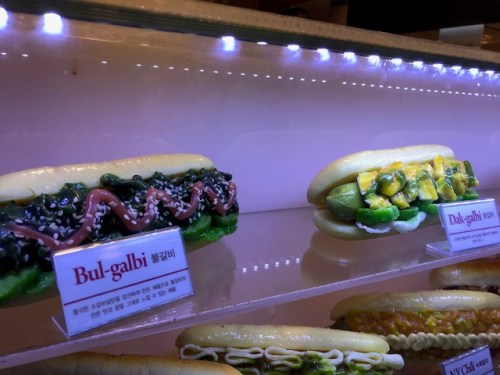
Ogling Korean-style hot dogs at Lotte World

Like the Thais, Koreans came into contact with chilies in the 1600s, courtesy of the seafaring Portuguese. And like the Thais, Koreans have taken to chilies with a vengeance. There is rarely something adorning the dinner table that is not slathered in some kind of chili sauce, ready to be cooked and wrapped in greenery of some kind, a handy food delivery system in lieu of those sadistic metal chopsticks that Koreans like to use. If it’s never come into contact with chili before, no worries, they have it covered. I learned this the hard way when I went to Krispy Kreme for the first of what would be many times (I have a 7-year-old) and ordered the “hot original”. No, the “hot original” is not a glazed doughnut hot from the oven. It is a doughnut flavored with kimchi spices and then glazed. This would explain its bright orange color and the bits of scallion that appear to float on the surface of the dough. For once, it was indeed “too spicy”. My son was not a fan.

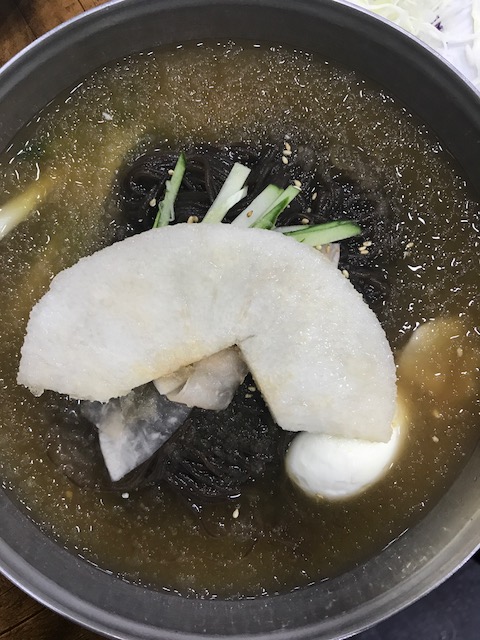
But it was summer, and many other delights awaited us. For example, the chilled buckwheat (and sometimes corn!) noodles, a great relief to this particular Glutton allergic to most other types of flour:

noodles

Chilled buckwheat noodles with shaved ice, hard-boiled egg and cold nashi pear

This was a great relief at mealtimes because the weather was so stultifyingly hot, it made me actually miss Bangkok. It felt like walking around inside of a microwave. Needless to say, it was murder on everyone around me, as I had chosen the occasion of this trip to start experimenting with natural deodorants. I spent the week oscillating between “orange alert” (smelling like ketchup) and “red alert” (lamb souvlaki).

The Korean antidote to hot weather is (quite characteristically for people who believe that eating ginseng is good for you) consuming even more hot food. This is why we ended up at Gobong Samgyetang in the mall (it has a Michelin star don’t you know) ingesting hot chicken-ginseng soup at midday. The samgyetang features a whole chicken — not post-steroid Ben Affleck-sized, but juvenile-sized — stuffed with rice and ginseng, boiled and served in its own broth with dates and a smattering of sliced leeks and black sesame seeds. Served with a side of pickles, kimchi, and a “bone bucket” into which to throw your discards, it is both delicious and sweat-inducing. On weekends, Gobong only serves either sanghwang or hanbang samgyetang (with added medicinal herbs). This one-pot meal is considered a summertime go-to.

summerchicken

Hanbang samgyetang at Gobong

If chicken stew is meant to improve your stamina, I guess even more stew could turn you into Wonder Woman. With this in mind, our friends took us to get kimchi jjigae (kimchi hotpot) at a convivial, buzzy restaurant where everything was in Korean, including the name. Everyone was thoughtfully given bibs to wear, but the cooler, in-the-know Koreans simply draped these bibs over their laps, because unlike me, they wouldn’t be sloshing their grody kimchi juices everywhere. This stew was served with sides of cold soup and dried seaweed, as well as chilled guava juice, all meant to lessen the sting of the spice. Koreans seem more thoughtful about this than the Thais, whose anti-spice remedies amount to laughing at you, cucumbers, and rice.

kimchistew

Kimchi stew with a side of cold soup to alleviate the spice

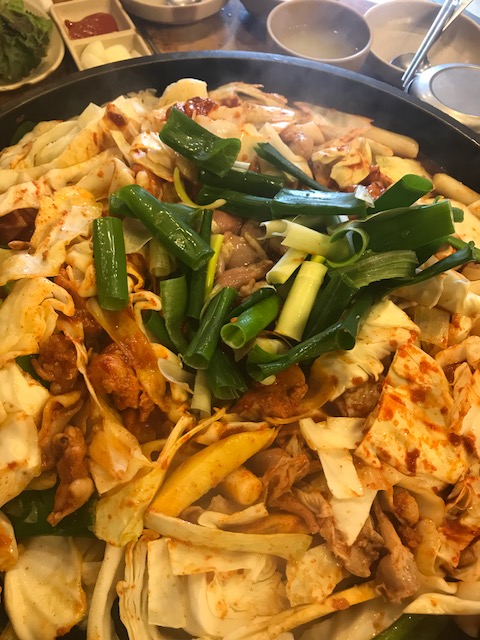
Such is our love for chicken that we even made time to trek two hours out of town (on three different trains) to Chuncheon, where a street crowned with a giant golden rooster is lined with myriad restaurants all serving the same dish: dak galbi, or chicken stir-fried on a hot plate.


chicken

Dak galbi, at the most popular place on the strip

Our friend Michelle tells us that dak galbi was a dish favored by poor students who dreamed of dining on real galbi made from red meat, but could only afford chicken. So the dish was rebranded as galbi, although it in no way involves “ribs”. Our host Jay ordered two servings of intestine to go with the chicken, probably because he was punking us. Not surprisingly, this stirfry — chicken, intestines, cabbage, scallions, onions et al — are wrapped in lettuce leaves and eaten with your choice of sauce, kimchi and raw garlic, if you like.

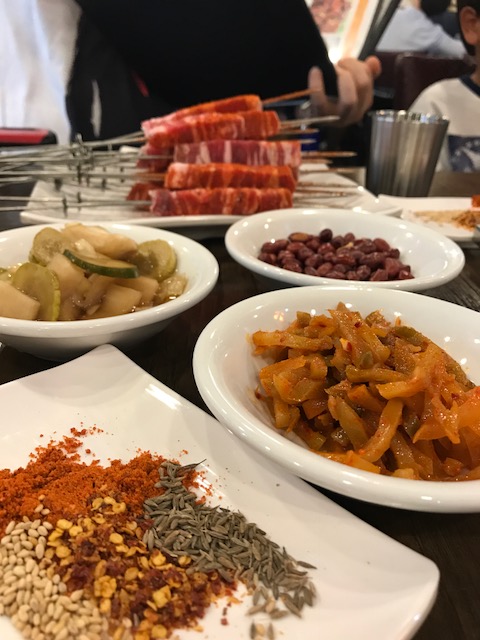
Incidentally, that is also the way we ate our Northern Chinese-style lamb kebabs, skewered and cooked in front of us at the table and later dipped into spices like dried chili and fennel seed while still dripping with fat:

lamb

Lamb kebab, with spices

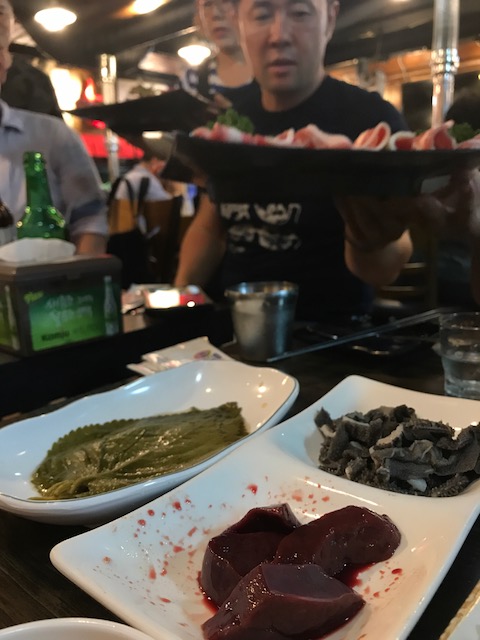
Of course, no trip to Seoul would be complete (for a Thai, at least) without some Korean “barbecue”. Our hosts ordered us both pork and chicken, plus copious amounts of soju (distilled rice liquor) and enough kimchi to sink a dinghy, but before embarking on dinner we had to pass the test of the complimentary appetizers: a mound of Jay’s fave, black beef tripe, accompanied by pickled perilla leaves and several cubes of raw liver.

bbq

There is not much I can tell you about this except that it tastes exactly like it looks. I preferred the liver cubes seared, wrapped in fresh perilla leaves with a nice big dab of ssamjang (brown dipping sauce). The soju didn’t hurt either.


3 Comments

Filed under Uncategorized