
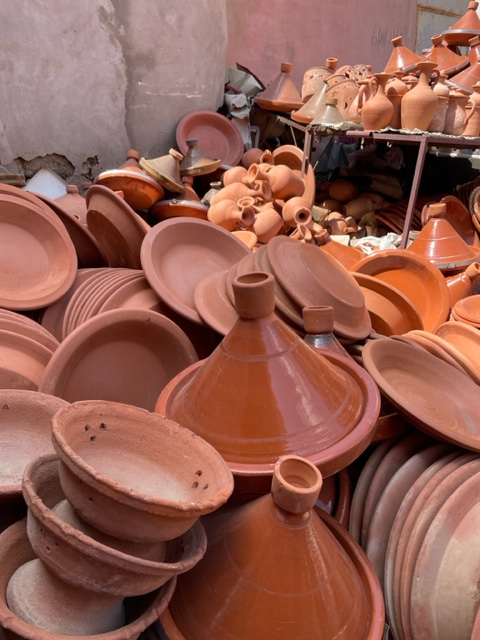
In Morocco, it’s impolite to eat with your own little plate. Everyone must eat together from one large platter, typically a tagine, where the food is cooked over charcoal. These tagines are typically made of clay, because Moroccans feel that is healthier than glass or steel. All of their kitchenware, including the double-handed long-necked containers they use to keep olive oil, are made of it.
Because meat is valuable, it is nestled in among the vegetables — the potatoes, the carrots, any green and leafies — and eaten only after the patriarch breaks it apart himself, dividing it into equal pieces for every member of the family. Everyone eats with their hands, in a circle. Moroccans believe it is a way to strengthen bonds between family members and friends.
I’m thinking of this because Thais eat in a similar way, from common plates set in the middle. No one has their “own” tom yum soup, for example, and absolutely no one orders the same curry, eating it from a platter set in front of them like the biggest Cheesecake Factory entree ever. I’m also thinking about this because in Spain, there are a lot of plates. Small plates, even. You might have heard of them? They are called tapas.

Yet tapas also serve as a social glue, probably because they are more often than not accompanied by a lot of wine. You can’t go anywhere in Spain without a tapas bar or two on every block, featuring at least one table of boisterous guests laughing over glasses of beer or, if they’re a tourist like me, red wine sangria. All the same, our tour guide warns us that bars with large photos of the dishes out in front, accompanied by large signs, are places to avoid. I think eateries back in Thailand that look like that should similarly be left alone.
Granada, in southern Spain, is an interesting mix between the Moroccan and Spanish philosophies, having spent a long time under Muslim rule. Its last Muslim rulers, the Nasrids, commanded the last Muslim state on the Iberian peninsula before being taken over by the Catholics in 1492 — but not before leaving Spain with The Alhambra, a gorgeous testament to 16th century Moorish architecture and alternately (with the Sagrada Familia in Barcelona) the most-visited site in the country.

Like in Morocco, the beauty of a place is hidden behind a mostly plain exterior. I’ve been told many times that it is to keep neighbors from feeling jealous, but I liked our Alhambra tour guides explanation of Muslims being introverted better. I also liked that the complex was made of mostly humble materials: local stone, local wood, even stucco, which through sheer skill was made into a thing of beauty. It must have been a beautiful place to live in at its height in the 16th century, and I understood why the Nasrids would spend so much money to bribe the Christians into staying away. Unfortunately, they did not stay away forever; our guide said that when the Nasrids started planting orange trees, everything started going wrong for the kingdom. The orange trees are still there, but no one eats the fruit.
At least they left behind their food. At Jardines Alberto, you can order their entire roster of Nasrid dishes, as well as a whole other list of what they call “local cuisine”, which is apparently different from Spanish food in general. One of these “local dishes” was an unusual salad of steamed codfish with potatoes, black olives and slices of the aforementioned cursed oranges, harbingers of the Nasrids’ fall. This being Spain, it was all topped with a hard-boiled egg.

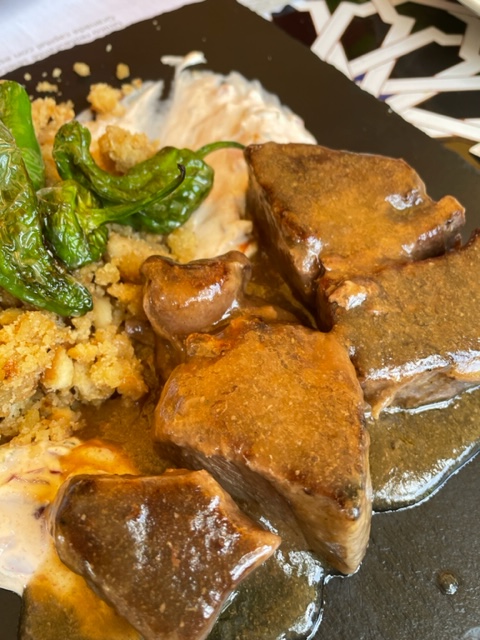
But back to the Nasrids. We ordered a fresh spinach salad scattered with cubed cheese and raisins, and a dish called “vizier’s lamb”, a slow-cooked boneless lamb leg paired with a mountain of breadcrumbs for texture and a mild yogurt sauce. If you just pictured Jafar from “Aladdin” eating this lamb dish, you aren’t alone.
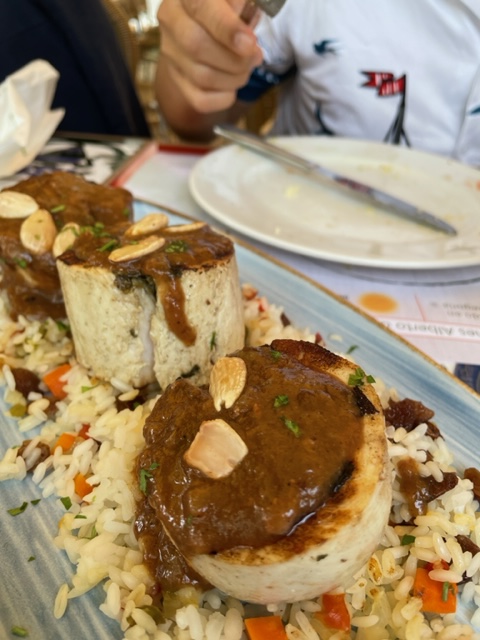
But the specialty of the house is the “Nasrin-style chicken”, tender ballotines made of the breast and stuffed with spinach and garnished with almonds and a honey sauce.
Was it something I’d go back for? Well … no. It looks like I prefer the Christian Spanish food. But it was the perfect punctuation mark to a day full of history, the remnants of a fallen kingdom, left behind for people to share over a common plate.
 Bangkok Glutton
That’s you in the picture? Suai!
that’s my daughter!
Haha. Unforced error. I stand before you naked.
Sent from my iPhone