It’s been a little over a week since my knee surgery, and since then I’ve mostly been relegated to hanging out at my house, Jimmy Stewart-in-“Rear-Window”-style. Like Jimmy Stewart, I have been left to my own devices, entertainment-wise. Unlike Jimmy Stewart, Grace Kelly is not visiting me and a look out my window mostly yields …………………………………………… um …. ok.
So nothing much entertaining on that front. Instead, I have been left to my device, literally: of course I’m talking about my iPhone. I’m on it now like it’s my job, and politely-worded requests from my nice new editor to trim 30 pages from my manuscript are the distraction from the very important work of matching all the Chinese barbecue skewers onto the correct grills for the pretend customers in my new video game.
And when I’m not playing this game, I’m lurking on Twitter. Yes, I know about Elon Musk. But I can’t shake the feeling that I find out things more quickly from Twitter than I do from Threads, which I was shamed into joining by my sister on my way to the hospital last week (and haven’t checked out since). There are great conversations and funny comments that make me glad I’m there, as well as incredible discoveries. That includes the band Angine De Poitrine (which you’ve probably heard of already), which I’ve linked to on Youtube and not to Twitter, to make my sister happy.
But there are times when Twitter makes me angry, which is not surprising, since that is the entire point of Twitter. There are several “discourses” that pop up for people, depending on their algorithm, which can either fade away in the span of a few hours or linger on for three or four days (a Twitterer’s lifetime). Not surprisingly, a lot of my algorithm has a lot of food stuff, when it isn’t occasionally mistaking me for 1. an Indian man or 2. Indonesian, for some reason (which is why I’m getting a lot of anti-Korea stuff right now — a new “discourse”, don’t ask). I’m also getting a lot of post-Thai election outrage, and all I’m going to say about that is that it’s a case of Thailand following in the footsteps of the US, but not in the way you might think.
The one “food discourse” that took off recently involved a woman who wanted to give advice on easy cooking for people with “executive function issues”(I don’t want to get into specific handles anymore because the last time I mentioned someone, they ended up responding to *gestures wildly* the current political dumpster fire by calling for defunding the Democratic party, but if you’re on Twitter a lot, you probably already know who I’m talking about).
Now, I don’t really know what “executive function issues” means, but I (as well as my sister) do have untreated ADHD. I also imagine that if one person has executive function issues, other people probably do too, and that includes Asians. So it rubbed me the wrong way, just a little, when someone wrote “Love Asian cuisines, but they absolutely are the worst to cook at home. You have to buy 44 ingredients to make one dish and it’s not something you’ll want to have more than once a week.”
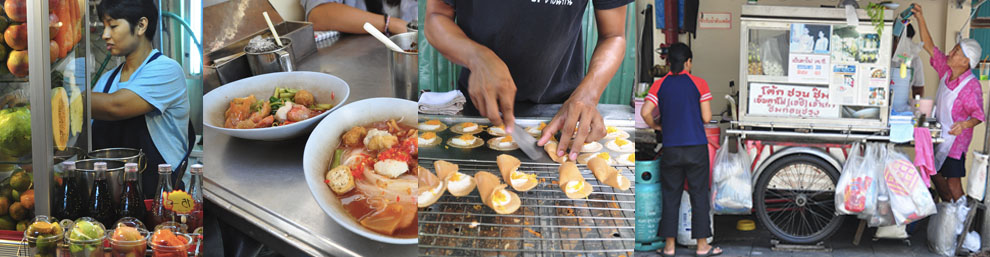
There are a few things to unpack here, which is what I’m here for. 1. Asians manage to cook things at home. Even with street food just a few steps away for many of them. 2. You really don’t need 44 ingredients to make a dish. I know it’s an exaggeration but come on. Very few people are making curries from scratch, much less using more than 10 ingredients for them. 3. Why wouldn’t you use those ingredients ever again? A lot of them — soy sauce, chili powder, rice vinegar — last a long time in the pantry.
But then when people chimed in with the obvious “What about stir-fries?” it ruffled even more feathers. “Sounds good but respectfully, sautéing veggies or meat in garlic and oil isn’t reading as Asian to me. It’s a very regular way to cook anything.”
And then, when incredulous people said, pushing stuff around in garlic in oil absolutely is stir-frying unless you’re a wok hei master, she (it’s a she) pointed out that she had sautéed green beans with garlic at home; did that mean she had cooked Asian food *smirk emoji*?
So it’s not enough to say something maybe a little obtuse, like the Twitter equivalent of Jennifer Aniston greeting Ross at the airport with his new Chinese girlfriend. It’s now important to double down by equating stir-frying with being a wannabe “Cobra Kai” extra practicing kata in the grocery store checkout line. And then I got mad.
To a commenter who may or may not have been trolling when he said she could fall back on French cuisine, which relies on high-end ingredients and culinary school, she said, “Strong agree. This is why I frankly prefer French food for home cooking. It’s [sic] requires less of what stresses me out from a prep perspective, and relies more on technique and ingredients, which I’m happy to learn and am lucky enough to afford.”
So for people with “executive function issues”, the cuisine you choose is FRENCH? An ingredients list for sesame noodles is deemed too long, but boeuf bourguignon is par for the course? A recipe that involves a sauce is too time-consuming, but FRENCH food (with 5 official mother sauces) is not? No prep is required for the cuisine that invented the “mise en place”? Chopping vegetables and taking olives(?) out of their container to put in a bowl for “white people tacos” (yes it’s this person) are too hard but the suggested recipes — mostly tray bakes with chicken and rice or roast potatoes — require no prep for those ingredients? Marinating meat for a stir-fry is terrible but marinating steak is ok? It’s too hard to use a food processor to chop vegetables but a grill is “executive function”-friendly? It’s the contradictions that vex, not the inability to think of something else to do with soy sauce and sesame oil. Don’t even get me started on the intimation that Western cuisine is superior in terms of technique and ingredients. Just say you’re uncomfortable with Asian cooking! And to bat away well-meaning suggestions and even recipes with iterations on “Weren’t you listening?” or straw man arguments about virtue signaling via a pantry full of exotic ingredients takes a special, JK Rowling-level commitment to virtual self-immolation. Have you ever been confused about the Asian concept of “face?” This is it, illustrated for you. Just gargantuan levels of stubbornness (and anti-Asian snobbery, besides).
Smartly (finally) the discourse ended with the OP saying basically “OK you win, you made the world a better place lol.” And then it ended. But I continued to think about it. Because it’s not just OP who feels this way. Asian recipes are scary for a lot of people. I remember after publishing my first cookbook, my son told me that his friends’ parents complained that the ingredients were too exotic (this was a cookbook explicitly tested in Western kitchens). A lot of people balk at buying things like makrut lime leaves, lemongrass and galangal (none of which you can substitute), especially if you don’t know that you can stick them in the freezer when you aren’t using them. We aren’t made of money, after all.
With that in mind, it’s not surprising to retreat to the refuge of the oven, where you can throw anything into it and it usually turns out OK, because I’ve done it too. I always roast a chicken and make a lasagna (with the cheater’s mix of ricotta and mascarpone instead of béchamel) whenever I invite people over but am definitely not feeling it on the day of. I’m sure people who have been to my house recognize this particular combo. People don’t always have the time, money or temperament to “fail” at a dish (though I have failed at roast chicken before). It’s easier to retreat to what you know, like baked chicken, no sauce, Lawry’s seasoning, salt and pepper.
The truth is, I’ve only just begun to hit my Asian cooking mojo, simply because I’ve written (now two) cookbooks on Thai food. I’ll do anything, but I have to be in the mood for it. There are the daunting “44 ingredient” recipes like Chef Dylan of Haawm‘s white curry, which he very generously gave me the recipe for and which I only recently screwed up the courage to try (there are 22 ingredients including the masala powder, not including the garnishes). I didn’t have everything and it was OK. Was it as good as Dylan’s? No way! But my husband really liked it.
I’ve also discovered that if you invest in a handful of sauces — soy sauce, mirin, sake, and dashi powder or packets — you have the foundational ingredients for most Japanese recipes. That includes noodles and even stir-fries sautéing things in a pan with oil and garlic! Is it the same as you’d get in a Japanese restaurant? No way! Is it fun to make? Absolutely yes.
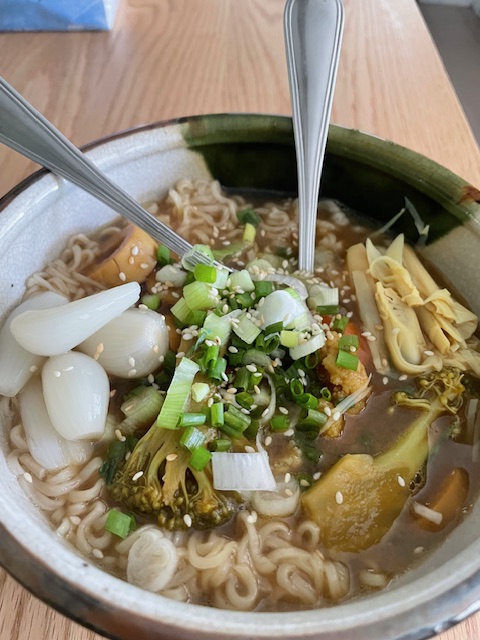
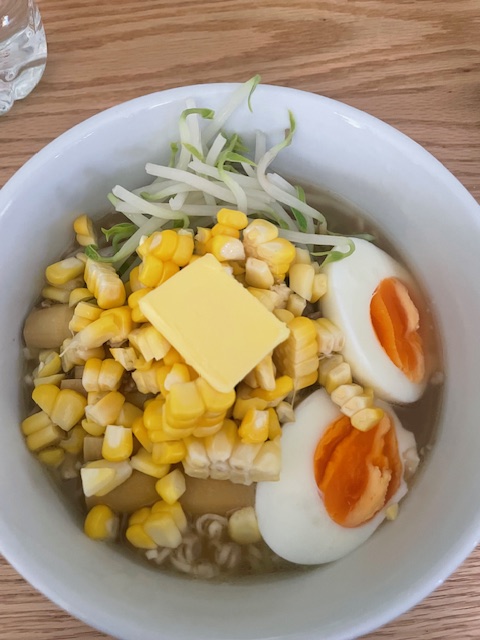
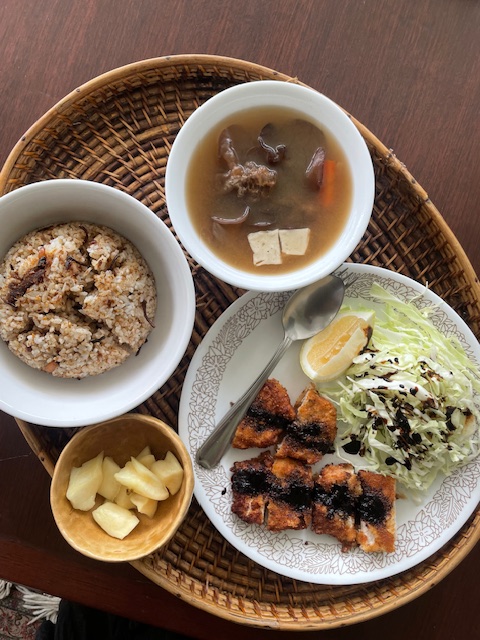
And have I had failures? Totally! My tonkatsu was sliced too thinly, so it was tough (the sauce is an easy mix of Worcestershire sauce, oyster sauce, ketchup and sugar though).
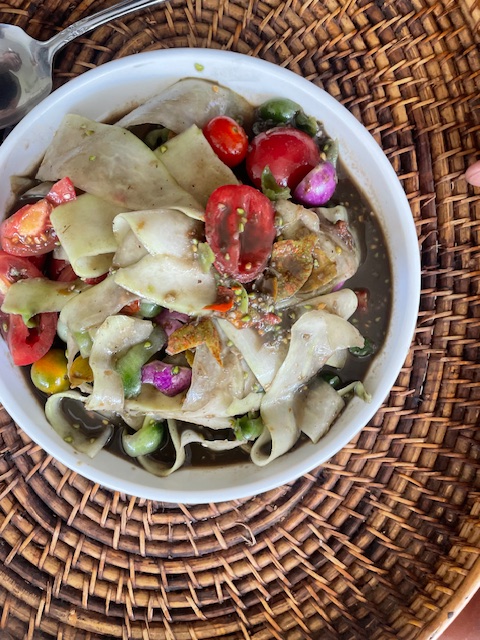
And whatever special alchemy happens in Laos that results in ultra-delicious “som tum Luang Prabang”, it was not happening in my kitchen, even with the Laotian tomatoes and nam poo (pulverized field crab sauce) smuggled back home in my suitcase.
What I’m trying to accomplish by posting my amateurish attempts at Asian cooking is to say that it’s OK to fail. It’s OK to not do things perfectly the first time. It means that you’ll inevitably get better at it. The point is to reach that place where you’re ready to try. And that place can be reached. Trust me.
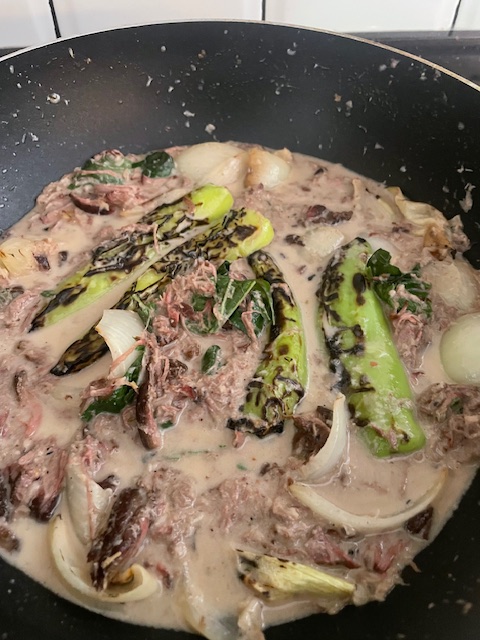
So here’s an Asian recipe that I think satisfies just about every possible obstacle for people with executive function issues, or for people who just want something easy to deal with (although you do have to chop some cabbage, onion and a carrot). And I found out about it from Twitter! It’s the “no-water” chicken soup, which is cooked over very low heat in little to no water so that the vegetables and chicken can exude their own juices. I used regular cabbage, omitted the goji berries and added turmeric, as well as a roasted Sichuan-pepper-and-salt mix left over from another failed Sichuan eggplant stir-fry (Karen said it was too salty).
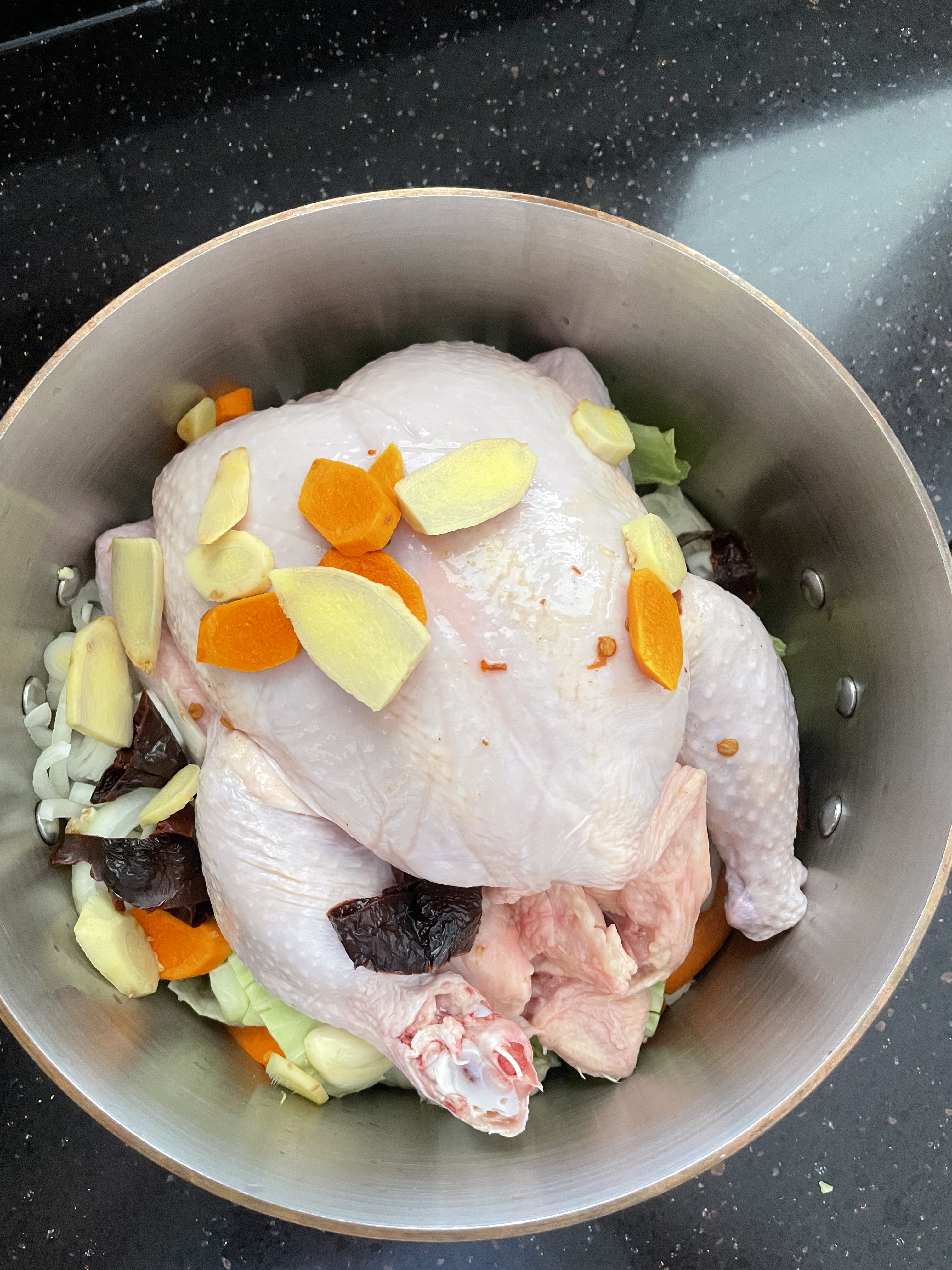
Did I almost cut off the toe from my injured leg by dropping a knife onto the floor? Yes! Did the mixture burn at the bottom because my heat was too strong (“medium low” should actually be “low” in the recipe)? Yes! I ended up adding dried Ancho chilies gifted to me by my friend Jon and their soaking liquid, and the end result was quite nice and smelled amazing. Do I have a picture? No! It’s not like I can run up and down the stairs willy-nilly right now, especially after the previous burning incident. You’ll just have to trust me.
Oh OK, fine.
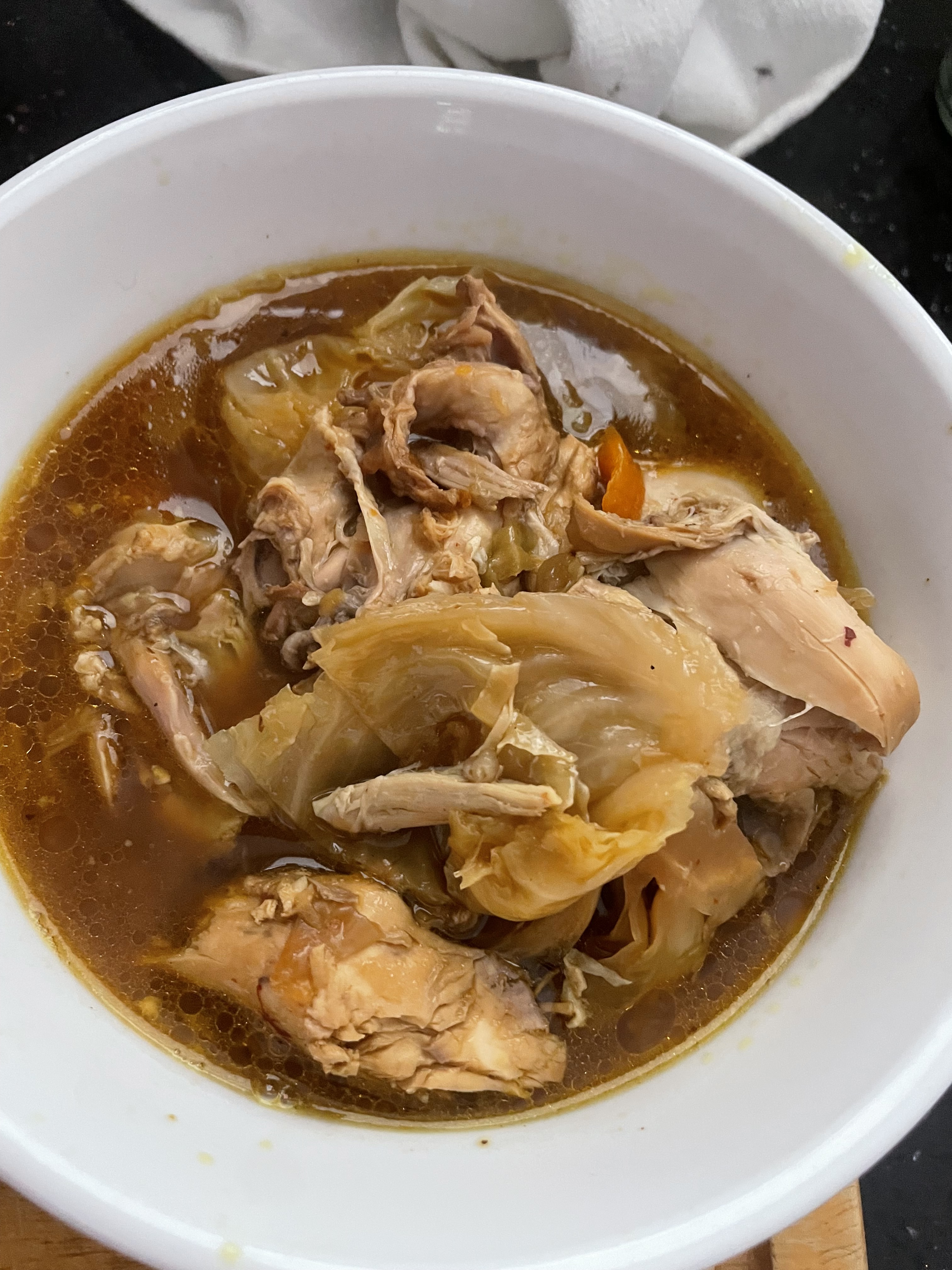
It doesn’t actually produce as much water as I’ve been led to believe on Twitter, or maybe Thai cabbages and chickens are simply not that watery. What does result is full of chicken flavor, however. It’s one of those recipes that can go on forever (a la Wattanapanich beef noodles), as long as you keep putting in a little water. All it requires is, like many things, a little patience, and a willingness to try.
 Bangkok Glutton
Just because I thought it was salty doesn’t mean it was salty. Next stop, porridge for dinner after taking out my teeth.
Haha
Surgery makes you feisty! Thanks for the shout out about
Angine de Poitrine– I’m obsessed!
Yes, they are very cool
Good Rant 🙌 It’s OK to not do things perfectly at any time. Perfection is over rated
Agreed! Case in point: my warrior 3
On the point diatribe! Thanks again for your thoughts and recipes.
Thanks for reading!