Author Archives: Bangkok Glutton

Bangkok Glutton's avatar

About Bangkok Glutton

Eating and writing in Bangkok.

What’s Cooking: Jay Fai Take 2

Image

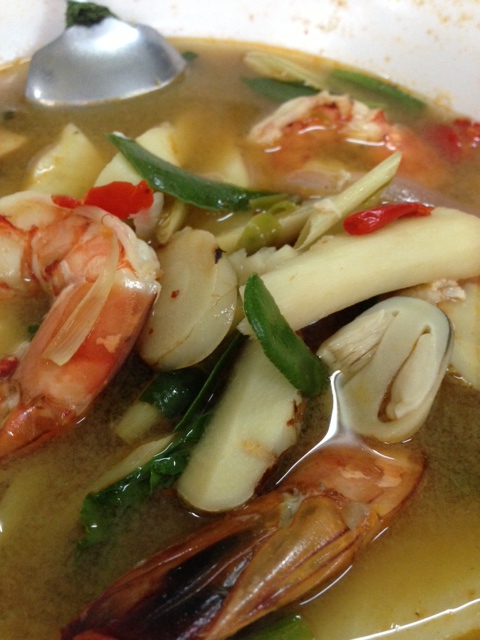
Jay Fai’s spicy lemongrass soup

(Note: spoilers for “Game of Thrones” viewers and A Storm of Swords readers, published in 2000)

(Note take 2: I already tried making this soup. What gives? Unhappy with the first version, I tried it again. I am happy to report that, like “A Song of Ice and Fire”, this soup gets better!)

There are rules to things. Although I’m all for culinary experimentation, and switching things up for almost everything, some rules are set in stone(heart), and the breaking of them renders you cursed in the eyes of gods and men. One such rule: the guest right. Once you have partaken of your host’s bread and salt, you are supposed to rest assured that your host won’t start taking his brand-new set of Wusthof knives to your internal organs.

Yes, the “Red Wedding” was tragic, the King in the North was killed through black treachery instead of on the battlefield, Robb is dreamy, yada yada yada. But what angered me most was the hosts’ callous violation of the guest right, this most important of all rules governing Westeros, more so than even kinslaying or having sex with your sister. THASS JUST PLAIN RUDE. What’s next? Forgetting to wipe your blade before moving on to your next hapless wedding guest-slash-victim? Allowing stray blood spatters to sully the mashed neeps and jellied calves’ brains? Starting the slaughter before anyone’s had even a bite of wedding cake? WHAT IS UP WITH THAT. One lesson learned: never, ever go to Argus Filch’s house for dinner.

Immutable rule no. 2: tom yum, the spicy lemongrass soup served at almost every Thai restaurant you know, is an infusion. That’s what makes it the most Thai of soups, unlike dishes like gaeng jued (clear broth soup), which is adopted from the Chinese and hence based on a broth. The base of tom yum is water. You add all your aromatics and seasonings to it after it comes to a boil.  

That’s probably part of the reason why it’s so easy to mess around with, and why modern-day cooks have started to play fast and loose with this poor soup, adding everything from nam prik pow (roasted chili paste) to milk and even sweetened condensed milk (I AM SHOCKED). The fact is, as great an invention as tom yum goong is, the contemporary tongue wants MORE. They want the drama, they want the spectacle, they want the gore. They want to be surprised. 

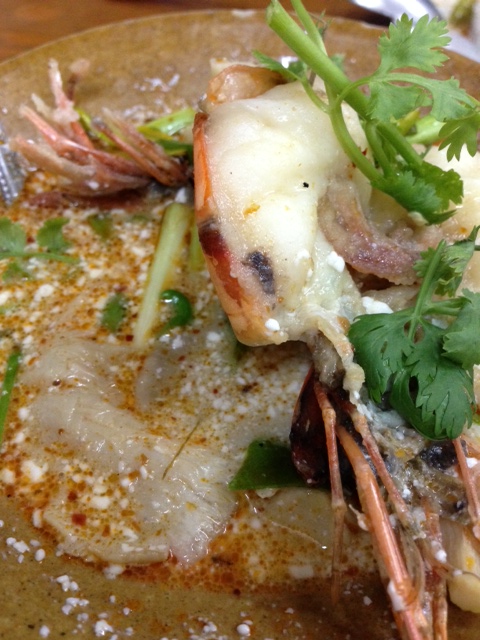
So it’s no wonder, then, that even “old-style” eateries like Chote Chitr are dressing their tom yums up to better fit in with the times. Here, Chote Chitr includes fat tiger prawns, yes, and a healthy dash of milk:
Image

Chote Chitr’s tom yum goong

The result is sweeter and fattier than the bracing, astringent herbal brew you (I) might have expected. It’s not really tom yum. It’s something else. How to make a proper rendition of this dish, but make sure it has enough flavor?

Well, you could take a cue from Jay Fai’s (1,500 baht) version, which caters to modern tastes while staying true to the spirit of the soup. In Jay Fai’s case, the difference is most certainly roasted chili paste. Although it is not strictly traditional, it adds the heat and flavor to an infusion without murking up all the flavors. Another thing: scraping the shrimp heads into the water, and allowing the heads to “infuse” alongside the kaffir lime leaf, lemongrass and galangal. This one hopes that — unlike breaking the guest right — these relatively newfangled additions will not curse you in the eyes of god and men.

Jay Fai’s tom yum goong (serves 4)

– 5 cups water

– 6 jumbo prawns with heads, deveined

– 6 large slices galangal

– 5-7 kaffir lime leaves (it’s a lot, but if you are cooking in the spirit of Jay Fai, you will want this soup to “go up to 11” — her personal motto.)

– 4 lemongrass bulbs (purple part), bruised

– 1 shallot, sliced

– 4-8 red chilies, bruised (this depends on your heat tolerance)

– 1 heaping tsp roasted chili paste

– 1 cup mushrooms (I used oyster, but straw or button mushrooms also fine)

– 1 cup young coconut shoots (if you can’t find these, you might want to use something else that is tender yet crunchy, like peeled white asparagus)

– 5 Tbs fish sauce

– juice of 2 limes

To make:

1. Bring water to a boil. Stir in roasted chili paste.

2. Add galangal, kaffir lime leaves, lemongrass and chilies. Allow to infuse for about 5 minutes, then bring to a simmer.

3. Add shrimp heads, first scraping their contents into the soup. Wait 5 minutes, then season with fish sauce. Add mushrooms and coconut shoots.

4. Wait half an hour, or until shoots are tender. Skim gunk off of surface and discard shrimp heads.

5. Turn off heat, then add cleaned shrimp, and stir to turn the shrimp “pink”.  Season with lime juice. Taste and adjust seasoning accordingly.

6. Serve immediately, paired with rice and a Thai-style omelet, or in individual small bowls.

Image

My improved tom yum

7 Comments

Filed under Asia, Bangkok, food, food stalls, seafood, Thailand

Living to Eat

Image

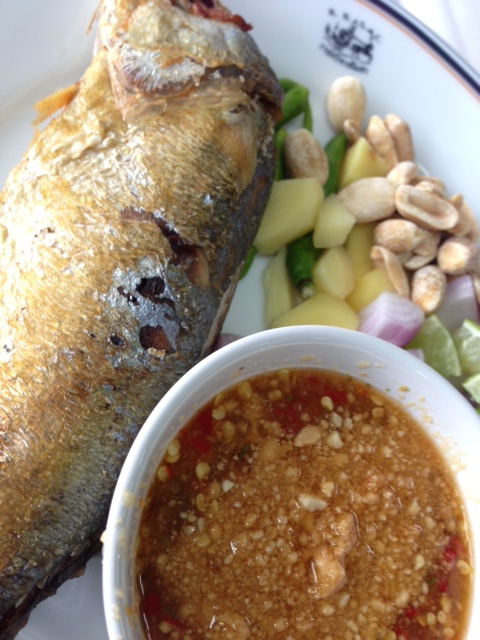
The mieng pla at RBSC

It should come as a surprise to absolutely no one that I love food, or that I am drawn to other people who love food. My friend Gwen is one such person. A constant whirlwind of activity, she touches place here or there long enough to, inevitably, pick up a friend or two and eat at this or that fabulous place. She is also invariably kind, which is probably why the most damning thing she can say about someone is that he or she “eats to live”. 

Look, everybody has to eat to live. But it’s a very particular type of person who lives to eat. This is the person who plans his or her travel itinerary around restaurants; who would rather go hungry than eat something that tastes bad; who considers life a series of meals, and every sub-par meal a missed opportunity. I am this type of person, which explains why I have no friends and no one will travel with me. I have also met other people like this, and it’s like meeting other people with strange obsessions or second lives — the guy who dresses up like Boba Fett at the occasional Star Wars-themed convention, or Bruce Wayne in his off-time. 

A person who eats to live might not find much to trumpet about when it comes to the Isaan dish mieng pla: there’s fish, and vegetables, sometimes noodles, and a dipping sauce. There is no interesting technique, no volcanically hot wok, no smoke, no fire to speak of. No welcoming waft of steam when you lift the lid off the bamboo steamer, no doughy dabs wrapped like tiny birthday presents, no glistening jewel-toned slabs of flesh arranged artfully on a platter like pieces of jewelry. This is all DIY work — it’s all up to you. All you need are the fish and the seasonings. Anybody can do it.

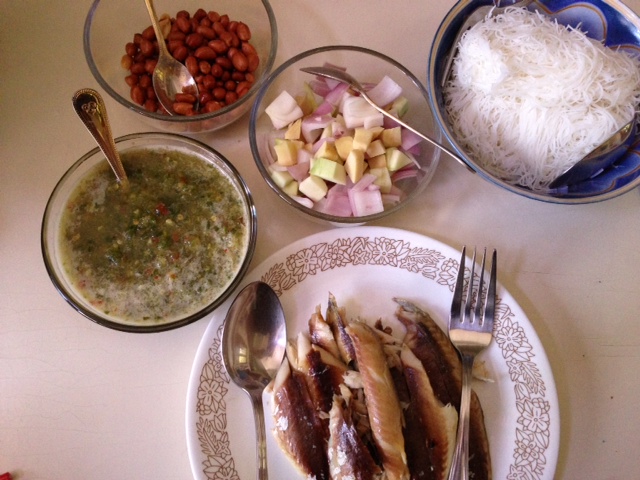
Except that not all mieng pla is made the same. It’s hard to screw up, that is true, but it’s also hard to make great. And that’s what Khun Sakol Boon-ek, the proprietor at the mieng pla tu stand at the Prajane Lumpini market, is able to do. Plump, fat (and deboned!) pieces of Thai mackerel; fat, juicy greens, and fresh, unblemished condiments (lime, shallot, peanuts, ginger, green mango, chilies, and, in her case, blanched thin rice vermicelli, or sen mee), this is everything you need for an afternoon snack, a light lunch, or, if you are a Hobbit like me, elevenses.

Image

K. Sakol’s mieng pla

Image

K. Sakol’s accompanying greens

Khun Sakol’s secret is ultimately her dipping sauce: a mixture of lime juice, fish sauce, garlic, sugar and a bountiful harvest of chilies, yes, but somehow the sum is greater than the parts. Obviously she won’t tell me her secret.

To contact her (they deliver!) call 084-944-6732. Or, if you are very lucky, she might be at the Prajane Lumpini market situated along the right-hand side of Polo Road (Soi Sanam Klee) if you are coming from Wireless, but I’m not sure how much longer she’ll be there. Sadly, some big changes appear to be planned for that road: Khao Thom Polo (they of the fire-and-brimstone jungle curry) are being asked to move, and even the mighty Polo Fried Chicken might have to follow suit. 

12 Comments

Filed under Uncategorized

What’s cooking: Khao Soy Islam

Our pork and chicken satay

Our pork and chicken satay

(Photo by Christopher Schultz)

Real friends always, somehow, prove themselves to you. My friend Dwight is able to go an entire lunch watching me try to shove morning glory into my mouth and talk at the same time. My friend Karen is able to listen to me blather for hours on end about my aching foot, or the last conversation I had with my mother. And my friend Chris is able to stomach all manner of Thai “dishes” I manage to throw at him, no matter how repugnant.

(NOTE: Real friends also tell you when your entire post is wrong. Karen has gently reminded me that Khao Soi Islam is run by a Muslim family, so they don’t serve pork! Me no remember. I will either 1. Have to rejig this recipe to do beef and chicken satays, like they REALLY do it at Khao Soi Islam, or 2. try to emulate the satay at Samerjai or Lamduan Faham. Accuracy is so tiresome.  This is what happens when I write a post in half an hour before picking up my daughter from school. The sauce recipe for the pork satay below is still pretty good though).  

It is hard to make pork satay repugnant. While pork satay is a fine street food dish all on its own, served by vendors up and down and across the land, it is also, inexplicably, the go-to accompaniment for the Northern Thai curried noodles known as khao soy — indeed, no northern Thai vendor worth his or her salt would sell without it.

While the satays at Lamduan Faham and Samerjai in Chiang Mai are rightly praised, it’s the one at Khao Soy Islam in Lampang (Prasanuk Rd., 054-227-826, open 9-14.30 daily) that sticks with me most. Run by a husband and wife team who have served up this dish for the past several decades, Khao Soy Islam also serves a particularly “curry-like” bowl of noodles where they gradually add the coconut milk to the chili paste base bit by bit, over a period of time, instead of all at once at the end like Lamduan. The result is more intense and silkier, and possibly my favorite of all the exemplary bowls available up North.

Like most vendors, Khao Soy Islam is a family affair. The son grills up both chicken and pork satays, with freshly-made peanut dipping sauce and a slightly sweet-sour ajad of cucumber, shallot and chilies. It was this satay that Chris and I tasked ourselves with trying to replicate.

A brief note: We used kebab-style cubes of pork tenderloin here, because I am really lazy and just bought stuff from the grocer’s pre-cut. It’s fine, but doesn’t absorb the marinade as well as a thinly-sliced piece of meat would. We also made this in the oven, but if you have a grill, please use it by all means. Grill 5-7 minutes, or until meat bears a slight, delicious char.

Pork and chicken Satay (makes 4 servings)

– 300 g pork shoulder, sliced thinly

– 300 g chicken thigh, sliced

– 1 Tablespoon curry powder

– 1/2 cup coconut milk

– 1 Tablespoon honey

– 2 Tablespoons fish sauce

– 2 Tablespoons soy sauce

– 3 garlic cloves, smashed

– 2 shallots, smashed

– 1-3 red chilies, crushed

– Satay sticks

To make:

1. Soak satay sticks in water.

2. Setting meat aside, combine all other ingredients to make marinade. Pour half of marinade over pork and other half over chicken and set in refrigerator for at least an hour.

3. When ready to cook, turn oven on to full whack and thread meat onto sticks. Place sticks onto oiled baking sheet (or, ideally, a cooling rack set on top of a baking sheet) and set in position closest to heat. “Grill” for 5-7 minutes, or until meat is browned and even slightly charred at edges.

For Chris’s peanut sauce:

– 1 1/2 cup dry roasted peanuts (unsalted), or 3/4 cup smooth peanut butter

– 1/2 cup coconut milk

– 3 garlic cloves, minced

– 1 tsp soy sauce

– 1 1/2 tsp sesame oil

– 1 Tablespoon brown sugar (omit if using peanut butter)

– 1 Tablespoon fish sauce (or to taste)

– 2 tsp tamarind paste (or lime juice)

– 1 tsp Sriracha sauce or Thai chili sauce

– 1/4 cup water (if needed to thin mixture)

Process until smooth. Taste and adjust seasonings until balance between tangy, spicy, sweet and salty is achieved.

For cucumber-shallot relish:

– 1 small cucumber, washed and sliced

– 3 red chilies, sliced

– 3 shallots, sliced

– 1/2 cup rice vinegar

– 1 Tablespoon white sugar

Combine all ingredients, making sure sugar dissolves in vinegar. Serve with satay, peanut sauce, and toasted white bread if you are so inclined.

6 Comments

Filed under Asia, food, food stalls, pork, Thailand