Category Archives: Bangkok

What’s Cooking: Gaeng liang

I don’t think I would be exaggerating to say I was a total mess after giving birth the second time. Dazed, depressed and demoralized, I struggled with things I thought were so easy as a new mother a decade earlier — changing diapers, giving baths, getting up in the morning.

This spicy vegetable soup was one of the few constants in a maze of uncertainty (“Why is he crying? Is he sick? What does he want?”) Full of nutrients and flavor, it is real Thai health food: one of the things Thai people say new mothers must eat to bring their milk in and keep their strength up. So for me, gaeng liang is the soup of retreat and renewal. It is also one of the few things that can make me sound like a spa brochure.

I based this recipe on Chef McDang’s gaeng liang in his “Principles of Thai Cookery”, which calls for pumpkin, buab (sponge gourd), bai tum lung (ivy gourd leaves) and lemon basil leaves. I swapped water out for chicken stock, grilled serpenthead fish in favor of shrimp, and added nam thao, a sort of watery green gourd. Because this soup is so rich in vegetables, you can omit the seafood altogether, but the shrimp paste is essential.

Gaeng Liang (for 4)
-300 g chicken stock
-16 shallots
-7 small green chilies
-1 Tbsp kapi (shrimp paste)*
-1/2 Tbsp white peppercorns
-2 Tbsp fish sauce
-1 tsp sugar
-2 g pumpkin, peeled and cut
-2 g straw mushrooms
-1 buab (sponge gourd), peeled and cut**
-1/2 nam thao (green gourd), peeled and cut**
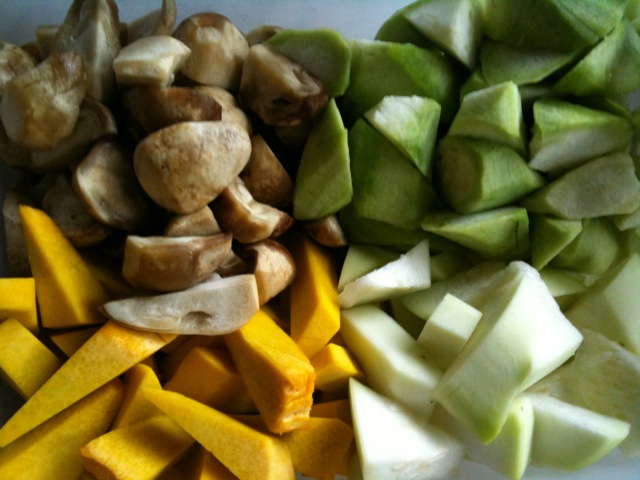
Mushrooms, pumpkin and gourds


-handful of lemon basil and ivy gourd leaves
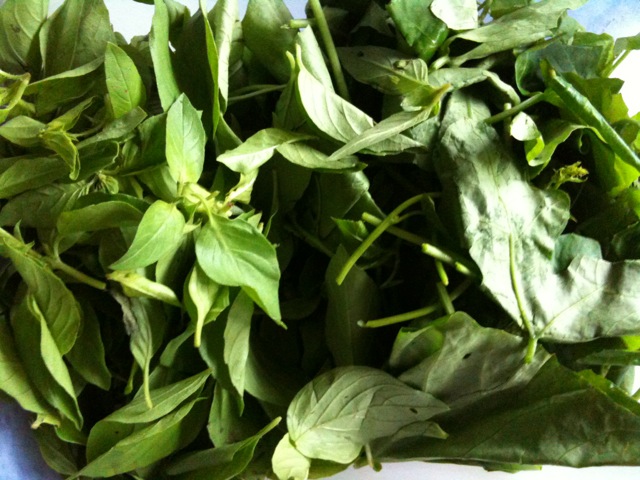
Bai maeng rak and bai thum lung


-300 g white shrimp, cleaned

1. Set chicken stock to boil over high heat.
2. While chicken stock is heating, make your soup base. Pound shallots, chilies, shrimp paste and peppercorns with mortar and pestle until semi-smooth consistency is achieved. Your chili paste should look like this:

3. Once boil is reached, add chili paste. Brace yourself; the smell can go up your nose and set off a cascade of sneezes.
4. Once boil returns, add fish sauce, sugar and veggies except for pumpkin, which gets mushy if overcooked.
5. Once boil returns, add pumpkin. Your gaeng should now look like this:

Skim foam off surface periodically as veggies boil to cut down on shrimpy smell. Leave for about 5 minutes.
6. Add shrimp but do not overstir. Add herbs and, without stirring, cover. Lower heat to medium. Leave for another 3-5 minutes.
7. Taste and, if necessary, correct seasoning. Shut off flame and leave to “marinate”. Your gaeng should look like this:
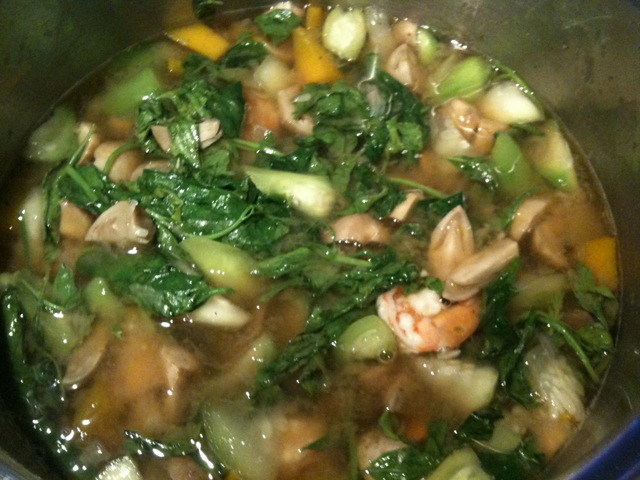
You can leave this for a day (refrigerated overnight) before eating. The kapi-heavy nam prik you so painstakingly pounded will turn the broth into a mahogany-colored, shrimpy ambrosia. Lunch the next day:

Next up: we delve deeper into the wonderful world of nam prik (chili paste) — the foundation for all Thai dishes.

*You need good-quality kapi for this to work. Chef McDang says you can roast store-bought shrimp paste until fragrant, but you can also buy the type made from small shrimp (referred to as kuey in the southern Thai dialect), which needs no pre-roasting at all.

**You may not be able to secure sponge gourd or green gourd where you live. Just in case you come across them, they look like this in their natural state:
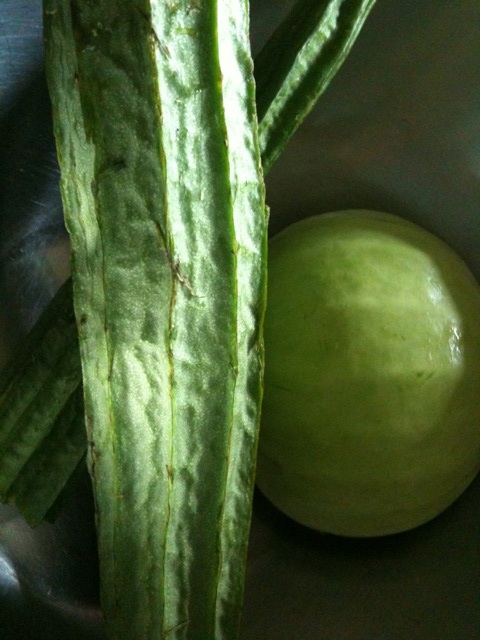
If you can’t find these, substitute zucchini and yellow squash for the gourds, and baby spinach for the ivy gourd leaves.
6 Comments

Filed under Asia, Bangkok, food, seafood, Thailand

What’s Cooking: Gaeng om

If there’s a good place to start for a Thai food cooking virgin, it’s with this tasty Northeastern Thai “soup”. It’s full of good-for-you greens, bright and light with fresh, herbal flavor, and crazy easy to make. Felt like I robbed a bank with this one.

Gaeng Om (for four)
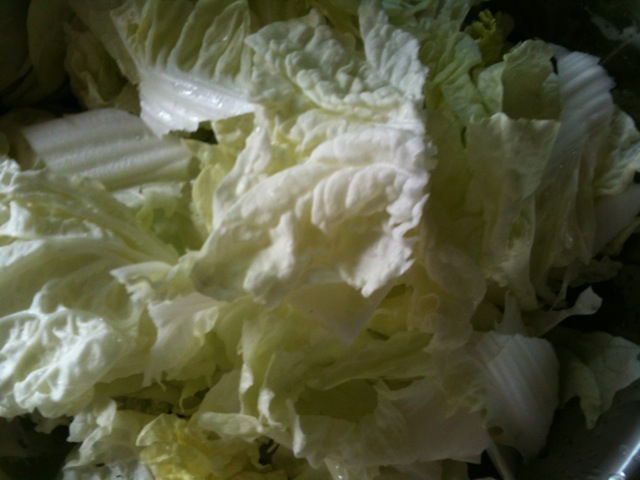
-1 head white cabbage, chopped

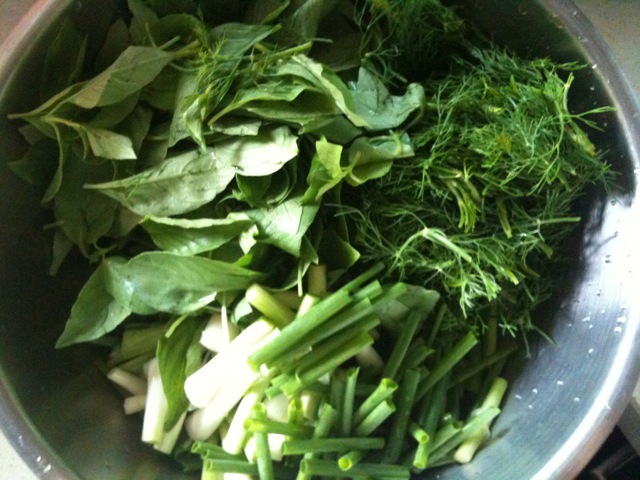
-2 g Thai lemon basil (bai maeng rak)
-2 g dill, chopped
-2 g scallions, cut into 1-in pieces

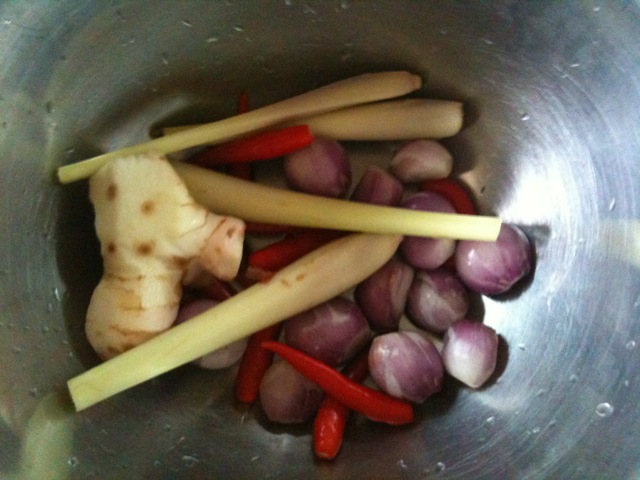
-2 stalks lemongrass, cut in half
-1 large piece galangal, sliced
-12 shallots
-12 small red chilies

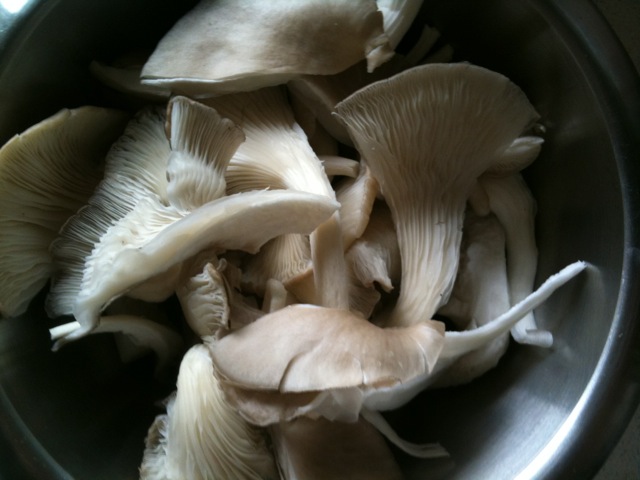
-3 g oyster mushrooms (het nang rong)

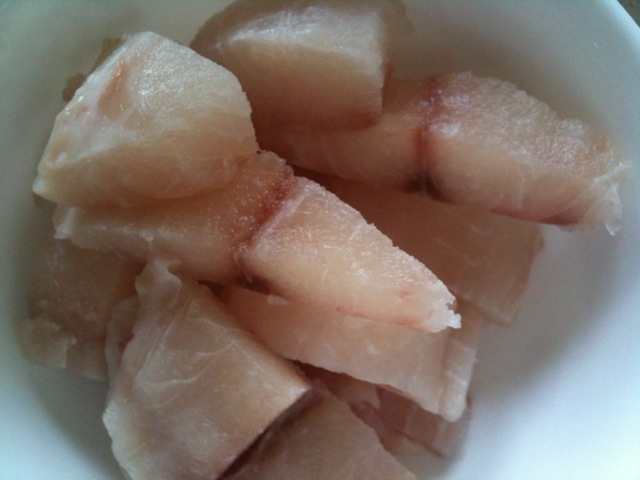
-300 g white fish filets, skin-on, cut into pieces*

-2 Tbsp fermented Thai anchovy juice (nam pla rah)**

-200 g chicken stock

-200-300 g water

-1 Tbsp fish sauce (plus more to taste)***

1. Set water and chicken stock to simmering boil in pot. Meanwhile, mix lemongrass, galangal, shallots and chilies in blender or food processor until finely diced.
2. Once simmering boil is achieved, add chili mixture to stock.
3. Add pla rah juice, 1 Tbsp fish sauce and fish pieces. Do not overstir, or fish will get mushy. Cover.
4. Increase heat to rolling boil. Add mushrooms and white part of scallions.
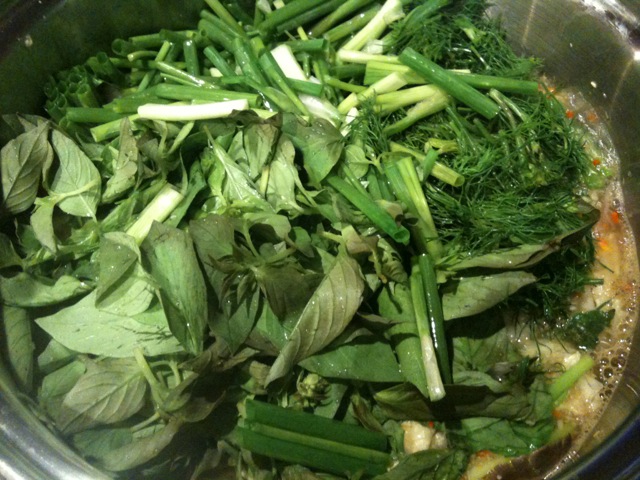
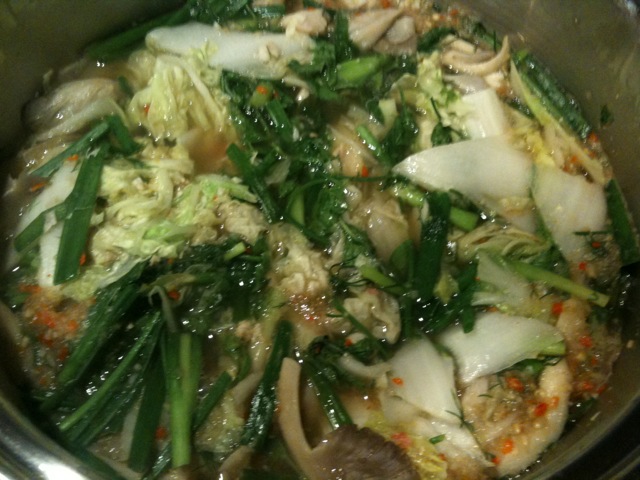
5. When water returns to the boil, add cabbage and the rest of greens. The pot should look like this:

Cover.
6. When vegetables lose some volume, carefully “fold” into broth. Taste and add more fish sauce if needed.
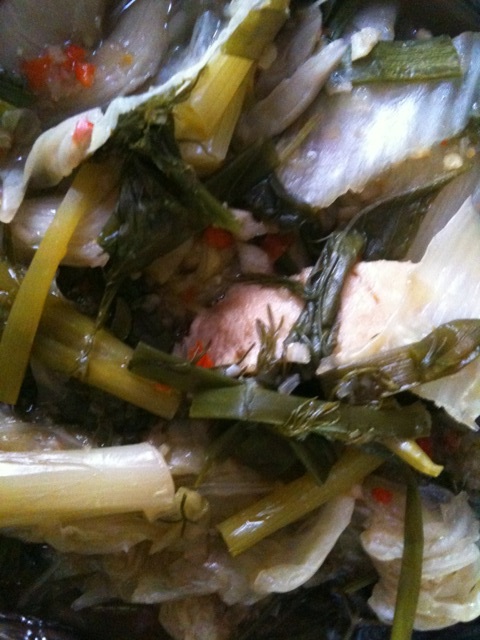
7. Shut off flame. Pot should look like this:

Cover and let “marinate” for a few hours (cool and place in fridge if leaving overnight).

*If you’re a meat person, use sauteed chicken wings or pork ribs instead.
**You can buy Thai anchovies in any supermarket here in Thailand, but Khum Gon, my Thai food tutor, claims homemade is best (obviously). Fermented Thai anchovies look like this:

If this isn’t available to you, try mashing regular good-quality anchovies instead.
***Khum Gon believes that fish sauce from shellfish (such as razor clams) is best because it smells less fishy than other types. Frankly, I am not that sensitive to the smell, but if that is an issue, then take Khum Gon’s advice.

What we ended up with:

Lunch

In the end, it was … pretty good. I’d use all chicken broth next time. And more Thai anchovy juice. But it was everything I expected and wanted from my first Thai cooking experiment. Next up: a veggie-rich gaeng liang.

12 Comments

Filed under Asia, Bangkok, fish, food, Isaan, seafood, Thailand

Will it cut the mustard?

This is not to be confused with cutting the cheese — because of course I will cut the cheese. No, “cutting the mustard” is an old saying that implies something has passed muster, is deemed acceptable. The question here, as always on this blog, refers to food — the future children of my pots and pans.

I am going to be embarking on a cooking challenge, aided by inner voices supplied by Chef McDang and my aunt and Win’s grandmother and whomever else has written a Thai food recipe. I do this because, while I am a competent cook of English roasts and Italian pastas and French, uh, fries, frozen from the bag, I have never put my hand to a real Thai food recipe, not even once. And that bothers me.

That also places me in the realm of the “average-mediocre” in terms of cookery skill here; it won’t be as alienating as reading a cookbook by, say, Thomas Keller, but (hopefully) I won’t be a complete doodoohead either — I do know the difference between a beurre manie and a roux. Which won’t help me much in this case. Yet however.

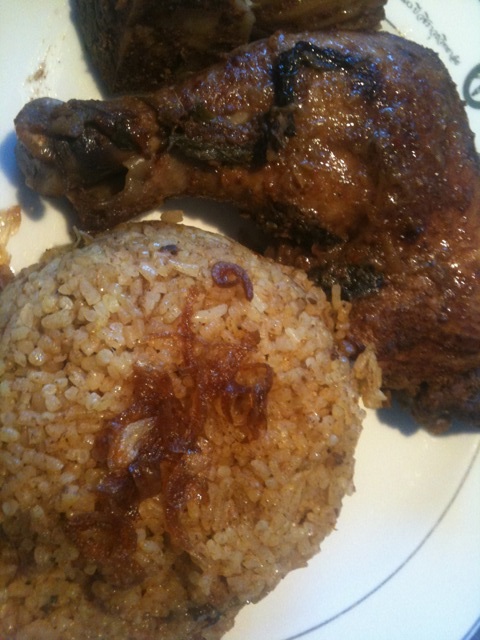
There is also a post-Songkran bounty of recipes in my house, right at this moment. Win’s grandmother has two restaurant menus-full of them, laced with the Persian-Chinese-Thai influences that run though my husband’s family, who gather in Hua Hin every Thai new year to gorge on khao na gai (rice topped with chicken gravy) and khao buri, or “cigarette rice”, similar to the Thai-Muslim standard khao mok gai except more herbal.

Khao buri

I won’t start with that stuff though. That stuff is too hard.

So why not? It’s not like there is furious demand for my writing services. Somehow editors aren’t peeing themselves in ecstasy over my story ideas about exploring the little-known cuisine of the super-secret community of western Pennsylvanians in Bangkok (cheesy fries on cheese toast, with cheese) or an expose on noodle stalls helmed by cooks born to Cordon Bleu-trained pastry chefs moonlighting as doctors/lawyers/prime ministers on Thonglor. Somehow this gig isn’t working out for me right now. I have plenty of time.

But do I have the mustard? (For the record, I know I don’t need mustard to cook Thai food. At least I know that. I need ketchup).

Wish me luck!

7 Comments

Filed under Asia, Bangkok, food, rice, Thai-Chinese, Thai-Muslim, Thailand