Category Archives: food

Where the beef is

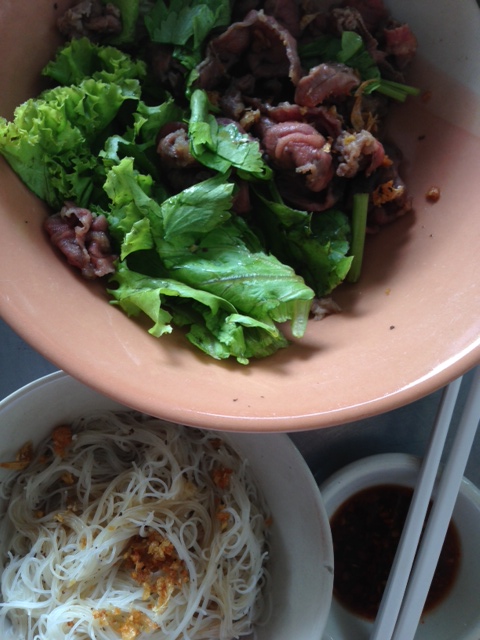
"Crunchy" wagyu beef with rice vermicelli at Pu Raithiemthan

“Crunchy” wagyu beef with rice vermicelli at Pu Raithiemthan

Noodle soups are a pillar of Thai street food; in fact, Thai street food probably wouldn’t exist without it. It was probably the first type of street food to appear in Bangkok, brought to our shores from the Chinese immigrants to sold this dish alongside the canals that criss-crossed the city at the time.

Noodle soups are still everywhere to be found in Bangkok, in hundreds of different iterations. The easiest way to categorize them, though, is through the protein used: chicken, fish, pork, and of course, beef. Although many Thais don’t eat beef for religious reasons, beef is still a popular option — and getting more popular as time goes by, if the number of vendors offering Japanese beef options are anything to go by.


Time was, you had to traipse all the way into Chinatown to get a chance at some super-expensive obsessively massaged, sake-fed beef, sold in an alleyway in the shadow of a temple. Now, there are a handful of brave beef noodle vendors who offer your choice of Wagyu, Kobe or even Matsuzaka Japanese beef varieties, and not just in the confines of an air-conditioned luxury mall. Now you, too, can sweat in an open-air dining room, just like any other common prole with his or her bowl of yen ta fo. 
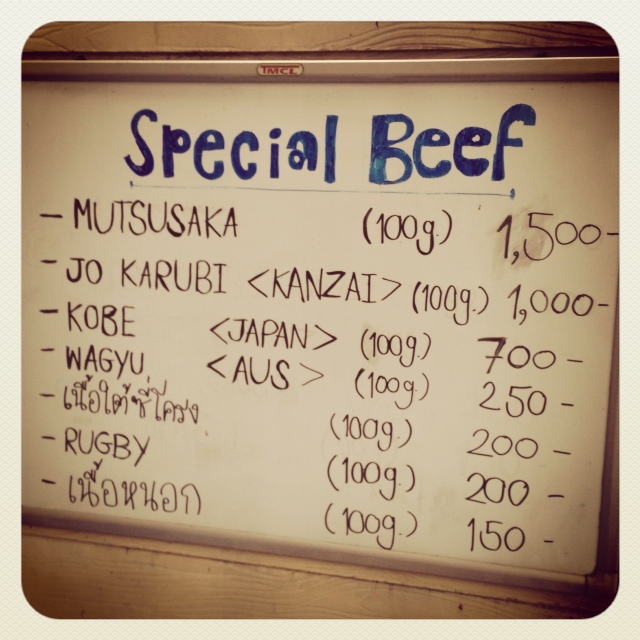
The menu at Pu Raitiemtan

The menu at Pu Raitiemthan

Introducing Pu Raitiemthan, set out on Pracha Uthit Road across from Kesinee KIS School. Their beef — which you can order either krob (“crunchy”, usually a cut of beef shank that’s been simmered in beef broth), thun (stewed) or sod (“fresh”, or blanched slices of beef to order) — is sourced from Japan, Australia and Thailand (although the owner tells us he may stop ordering some cuts of Thai beef such as the “rugby” cut, due to inconsistent quality). You can have any of these preparations (or any kind of combination) with noodles (gub guaythiew), or with just broth or “dry” (gowlow nam or hang), accompanied by a small bowl of noodles or rice on the side that has been sprinkled with bits of deep-fried garlic. Here at Pu (and I’m sorry, since it’s a common Thai nickname meaning “crab”, but I do refuse to use the more popular spelling “Poo”), if they are not using the Thai varieties, they like to use Wagyu for their krob beef, Kobe for their stewed beef, and either Matsuzaka or Kobe for their freshly blanched beef.

Some beef vendors are known for their broth, and some are known for their meatballs, but the folks at Pu are known for their way with their cuts of beef: using exactly those cuts that are suited for their particular treatments. That goes for Thai beef too — never tough,  always fresh, with a nice meaty heft to the broth that ensures you clean your bowl even after the beef is all gone.

Pu Raitiemthan

Pracha Uthit Road across from Kesinee Ville compound

Open: 10am-8pm (or until they are sold out)

081-134-8348, 089-055-4847
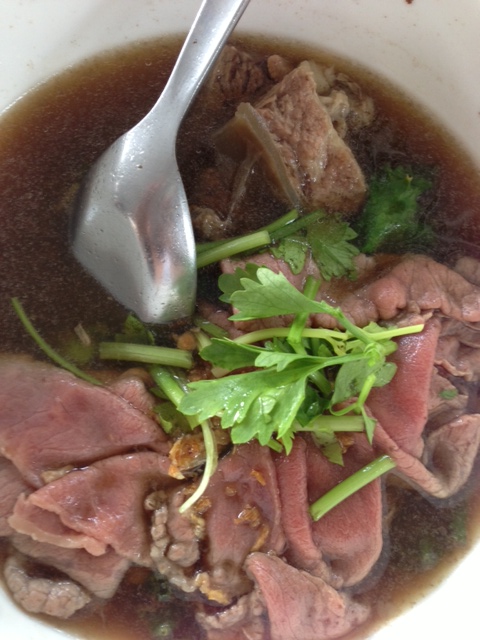
Fresh Kobe beef and stewed beef in broth "gowlow"

Fresh Kobe beef and stewed beef in broth “gowlow”

7 Comments

Filed under Asia, Bangkok, food, food stalls, Thailand

Hamburger heaven

The Thaiger burger with bacon

The Thaiger burger with bacon

When I just moved to Bangkok, a guy called me up. I was still new to the whys and hows of life here and was still bewildered by things like who wais who if you look the same age. So this guy called me up, and after what seemed like hours of talking about his hair, when he casually said I should “come over to his house and make him a sandwich”, I thought WOW GUYS IN BANGKOK DON’T MESS AROUND.

It turns out this fool probably really did want me to come over to his house and smoosh two slices of Wonder bread around a piece of baloney. Because since then I’ve learned that there is this weird thing about guys and their sandwiches. Let me put it another way: What is it about guys and sandwiches? I don’t get it. It’s not like it’s hard to do. Any idiot with two hands should be able to figure it out. Yet the fetishization of sandwiches not only lingers, but has grown, to zit-on-picture-day-like proportions. Case in point: the lady who was challenged by her boyfriend to make him 300 sandwiches before he proposed. You know what I’m talking about. Just in case you don’t, you can check out this link here: http://300sandwiches.com. Smart. So smart. This woman will get a cookbook deal and will be played by someone like Amy Adams in the upcoming movie. And all because her boyfriend is a doofus who can’t make his own sandwiches.

So I don’t get sandwiches in general, but I do understand hamburgers. This is a big thing for me. I can maybe say that, besides Buffalo wings, this is possibly THE thing. It’s because I live in Bangkok, where correctly-rendered versions of either of these dishes are about as rare as a talking unicorn made of ice cream. Too often, “Buffalo” wings mean deep-fried chicken wings slathered in a honey-barbecue sauce. Once, I ordered Buffalo wings at a hamburger place (these two dishes often go together under the rubric of “American shit no one else will eat”), only to be presented with a dry tangle of limbs that resembled an evil vulture’s nest. They told me the Buffalo wings were “spicy Thai wings”. WHY DON’T YOU CALL THEM SPICY THAI WINGS?

Hamburgers are similarly mistreated here. I think it is because Thais — and possibly Asians in general — misunderstand what the point of a hamburger is. A hamburger is about the meat — the beef, to be specific. It’s about having a great big slab of beef, fully grained, charred and juicy, subtly mitigated by a fluffy bun and maybe some crunchy green crap on top. A hamburger is supposed to taste like MEAT. But Thais, possibly because there aren’t as many beef eaters as in other countries, don’t really believe this. They want a patty that has everything but the kitchen sink in it — onions, garlic, carrots, whatever — in a round of something that has been minced and pounded until it resembles a fine meat frisbee. It’s the Mosburger approach to hamburgers, and it is ruining all the burgers in this town. I don’t care how many Japanese people you get to eat it.

It comes as no surprise, then, that Daniel Thaiger draws a line of hungry hamburger-lovers even before they open at around 6pm. Recent LA transplants Mark and Honey run their hamburger business out of a white food truck parked at the far end of Sukhumvit Soi 38, on the right side of the road on even-numbered days, and on the left side on odd. Like all good street food, the menu is simple and straight to the point: burgers, tasting of meat and smoke fresh from the grill, with bacon and/or cheese, wrapped in a soft bun and a wax paper sleeve that doesn’t quite keep you from looking like a big slob as you’re eating. And yes, there are pork versions too. But come quickly, because these folks often sell out by 8.30pm.

18 Comments

Filed under Asia, Bangkok, food, food stalls, Thailand

What’s Cooking: Yum

A "three-way" yum of shrimp, pork and dried fish at Polo

A “three-way” yum of shrimp, pork and dried fish at Polo

I’ve been away, so I haven’t had as much Thai food as I’d like. Although the world is full of what I’m sure are great Thai restaurants that venture beyond the sour-sweet stir-fries and chicken with cashew nuts that we all know and will perversely miss some day, I have a general rule about not eating Thai food when I’m out of the country. It is usually — not always, but a lot of the time — a pale shadow of what I’d get at home. Since I live at home, why don’t I just get it there?

But I find that the thing I miss most when I’m away is the spicy-sour-sweet melange of what-have-you called, fittingly, “yum”. It’s room temperature and chopped, perfectly made to eat in greedy mouthfuls with a spoon — the bigger, the better, hopefully alone so that you don’t have to share. It’s made up of things that might not tantalize on their own, like tiny dried fish or julienned banana blossoms or blanched Chinese kale stems or even chopped lemongrass bulbs. Its variations are infinite, but the overall effect of the dish is the same: a bit of spice, a lot of tart, some fish sauce, some sugar. Some heft in the form of a smoky grilled eggplant, or lightly cooked shrimp. Something light and refreshing, like lettuce. And always some texture, some crunch. It’s the very definition of something that is better than the sum of its parts.

The sky is the limit when it comes to thinking up yum salads of your own, so it’s probably not surprising that many families have their own favorite yum recipes. My husband’s family is no different. When they get together, you can be sure to find a big vat of beef green curry (gaeng kiew waan nuea), some fermented rice noodles (kanom keen), a bit of roti, and, in a nod to the Japanophile tendencies of modern-day Bangkok, some pickled ginger. Also on the table is a big brimming bowl of yum soon sen, a “salad” of glass vermicelli that is a far cry from the anemic glass vermicelli salads I have had anywhere else. With its mix of palm sugar and coconut milk and tamarind juice, this salad recalls more of the luxurious sweetness of a good mee Siam you’d find on the southern Thai border, and less of the cartoonish “hot ‘n spicy” of a package of Mama tom yum noodles. It’s sort of like eating garlic bread for the first time again.

Obviously, I lack the self-discipline to stop and take a photo of this dish, so you will have to be content with a photo from Karen, taken at the beginning of a family banquet when everyone was being too polite to be the first to tuck in:

_DSC8021

Yum woon sen in the earthenware bowl in the middle, surrounded by everything else anyone could think of on that day

 (Photo by Karen Blumberg)

I have to admit, I had a bit of trouble securing this recipe from my husband’s aunt. These things aren’t easy to come by. So if there’s something that might be missing, or some cooking step that someone may have forgotten to mention, well … don’t look at me. I’m just the messenger.

Yum Woon Sen

Ingredients:

–       500 g woon sen (glass vermicelli)

–       1 kg shrimp, cleaned

–       shredded kaffir lime leaves (for garnish)

–       1 L coconut milk

–       1 kg shallots

–       25 g dried chilies

–       150 g tamarind juice

–       5 Tbs fish sauce

–       150 g palm sugar

–       unscented cooking oil (for stir-frying)


To make:


  1. Soak glass vermicelli in water for half an hour.
  2. Mince and then stir-fry shrimp until pink, let rest.
  3. Slice and fry shallots until opaque.
  4. Split coconut milk into two portions, the add palm sugar, fish sauce, and tamarind juice (juice only). Mix, and heat until boiling, stirring occasionally. Set aside.
  5. With the remaining coconut milk, “stir-fry” glass vermicelli that has been drained. Add other coconut milk. Add shallots, leaving some for garnish. Add chilies, sliced roughly. Stir-fry until dry. Scatter julienned kaffir lime leaves and remaining shallots over the top as garnish.


11 Comments

Filed under Asia, Bangkok, food, noodles, Thailand