Category Archives: Isaan

Infatuation with Isaan

"Thum pa" in Udon Thani

There are certain ways people are supposed to talk about things. Like, unless you are a commie weirdo freakazoid, you have to say Tim Tebow is “inspiring”, or “great”, or at least “intriguing”. Or, as long as you aren’t one of those strange people who hates freedom and puppies and all things wonderful, you obviously think the “Game of Thrones” HBO series is the best thing EVAH and don’t feel any need whatsoever to read the books, instead harping on and on about how you can’t wait until the next installment airs so you can find out what happens next instead of picking up a book and, uh, actually reading it (no, it doesn’t bother me that much, why do you ask? I’m just plucking an example out of thin air, I say!)

There are also ways, it seems, to talk about whole groups of people. For example, when someone is Asian, they are invariably described as “technical” or “proficient” or, if you are really good at describing, “technically proficient” (read: good at violins and math). Asian food gets similar treatment.  If you write about Asian food, you have to make sure you are as reverent as possible. References to old recipes from the 17th century get you extra points (and more if, like, you can go back to the Bronze Age. Everyone wants to know what those guys were eating!) You should consider it a monolithic “whole” that never, ever changes in order to ensure as much “authenticity” as possible. And, for God’s sake, make sure to use a poncey know-it-all tone so that people who don’t know what you are talking about feel ashamed and bad about themselves. If you cook, everything has to come out properly; if you eat, everything has to be difficult to find and hard to consume.

I try as hard as I can to adhere to these rules. Sometimes it works out splendidly. But today, it might not work out so well, because, to tell you the truth, I don’t know all that much about Isaan food. Yes, you’d think I would, since I know a bit about Northern Thai food and, since Northerners also use sticky rice, then Northern Thai and Isaan foods are OBVIOUSLY ONE AND THE SAME CUISINE. But those uppity Northerners and Isaan-ers insist that their cuisines are completely different. What do they know, right? I just can’t wait for that next “Game of Thrones” episode.

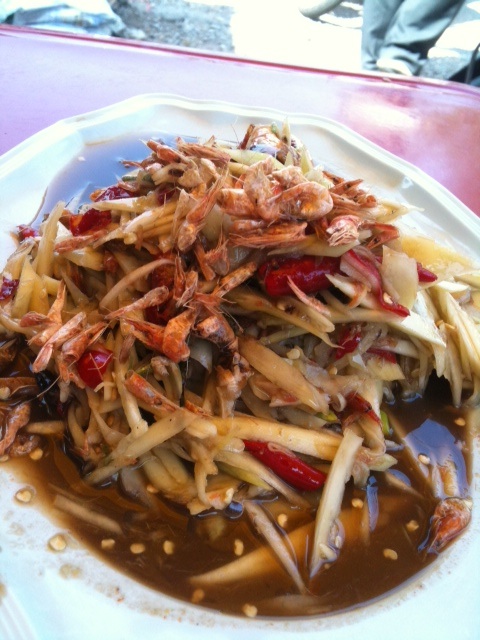
So when I trekked up to the Northeast and had my first bite of thum pa (jungle som thum), I was blown away. Rice noodles instead of grated fruit or veggies? A fishy, earthy dressing, heavy on the fermented Thai anchovy? The inclusion of everything but the kitchen sink: some shards of bamboo shoot, a few stray strands of acacia, a handful of unripe tomatoes, a few lost snails, the occasional bashed-in green bean. Thum pa (also referred to as thum sua or thum mua, “confused thum“) incorporates what Isaan is all about — fire, earth, and even water (if you include those fermented fish) — with the relatively newfangled addition of kanom jeen “noodles”. I had to find some in Bangkok!

It was harder than I expected. Bangkokians really love their som thum Thai, what can I say? But finally, on Rachadapisek Road across from the Esplanade shopping center, Saab Wan (or “Yummy Day”, 081-751-3181, parking at the gas station next door), where thum sua (40 baht) is on the menu.

Saab Wan's thum sua

This is a nice melange of crispy bean sprouts and tiny deep-fried fish with the smooth slithery silk of noodles, papaya and bamboo shoots, spiked liberally with chili and pla rah (fermented anchovy). But even more startling is the so-called gai yang (80-150 baht), which turned out like this and, at a glance, explains the rampant popularity of this street food stall:
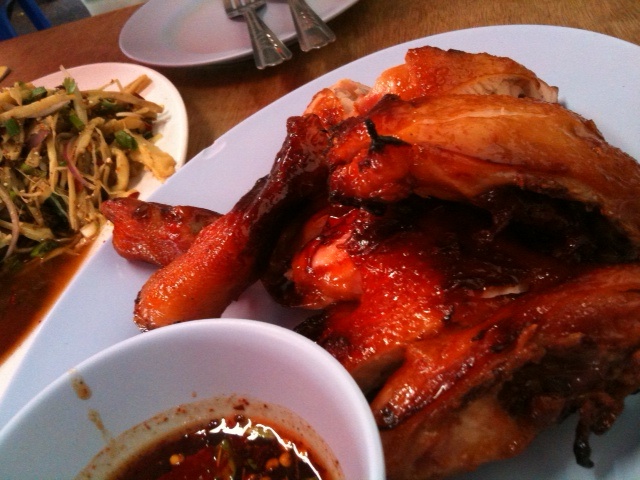
Saab Wan's gai yang and bamboo shoot salad

You and I know this is not Isaan-style grilled chicken. This is a lacquered Kim Kardashian of a chicken dish, a bastard child of American barbecue and Chinese sweet pork. This is sugary, sugary stuff — in spite of the fact that Isaan food is not supposed to have any sugar in it. No wonder this stand is packed at all hours of the day! Bangkokians are stuffing their pie holes with the saccharine-sweet oblivion that only sugar can provide.

Of course, this has inspired me to open my own Isaan food stall, using beer-butt chicken instead of gai yang, a grilled corn thum on the side, and maybe a white barbecue sauce alongside the jeao (Isaan-style spicy dipping sauce). Think I’m kidding? Watch this space.

4 Comments

Filed under Asia, Bangkok, chicken, food, food stalls, Isaan, som tum, Thailand

Stories we tell ourselves

Kai gata in Udon Thani

We all have our own little stories that we choose to believe, and this one is mine: We have Vietnam War-era American GIs to thank for two of the more beloved dishes in our culinary lexicon. One is a hastily-stirfried hodge-podge of sliced processed hotdog, ham, raisins, peas, and rice, lubricated with a generous dollop of ketchup and topped with a fried egg, sunnyside-up. This dish, a big ol’ smile on a plate, is generally known as “American fried rice” and can be found just about anywhere you can find a wok and a cook, and sometimes not even the cook. Just bring your two hands and a bottle of oil.

The other, because of its Vietnamese roots, is more prevalent in the Isaan region and known as “kai gata” (or “kai kata” or “kai gataa” or “kai kataa” … sometimes, you just have to close your eyes and point a finger and hope that it’s darn near close enough). Eggs are broken into a small metal pan and baked or cooked gently atop a grill, accompanied by sliced gun chieng (sweet Chinese sausage), veggies and  moo yaw (which, according to Chef McDang, was born as a Chinese cook’s approximation of European pate at the court of King Rama IV). And don’t forget the “bread” — usually a disarmingly sweet white bun, cleaved into two, buttered thickly and stuffed with ham, moo yaw and/or sausage. The story is that this dish was the closest an American GI could get to an American breakfast. What I see it as is 1960s-70s Asian-American fusion (just like me!): hearty and welcoming, pragmatic and resourceful, just what is needed sometimes to start what once threatened to be a deadly dull day.

Happily, you can find this dish in Bangkok. You just need to know where to look or, barring that, know who to pester. In my case, it’s my friend Winner, who knows the culinary ins-and-outs of Banglamphu like no one else. Gopi Hia Gai Gi (37 Siripong Rd., 02-621-0828. There is another one at the Wisut Kasat intersection), alongside stuff like Chinese-style flat stuffed noodles, dim sum and, uh, steak, serves up a mean kai gata, drizzled with minced pork and peas and, of course, accompanied by the mini white bread bun stuffed with moo yaw.  Best of all, it’s open from 7 am to 8:30 at night — a chance at kai gata at any time you think you might need to restart your day.

Banglumphu's version

8 Comments

Filed under Asia, Bangkok, food, food stalls, Isaan, Thai-Chinese, Thailand

Stuffed in Isaan

Lunch at Jay Gai Som Tum in Udon Thani

It’s 10 in the morning, and I am already stuffed. I cannot imagine what lunch holds in store for us.

Yes, I am starting this all over again. The first book, researched while I was pregnant with my second child, gave me … well, the joy of publishing my first solo effort, and 25 extra kilos. This second, well, who knows? I certainly don’t want 25 extra kilos, and I’m not sure if I could do it, even if I wanted to. My digestive system is screaming, What are you thinking?! even as I lurch my way through downtown Udon Thani. And this is only the beginning.

After landing in Udon Thani, our gracious hosts promptly whisk us off to VT Nam Nueng (www.vtnamnueng1997.com), a Vietnamese restaurant that, well into its second generation, is just about as big as any enterprise can get in Udon Thani. Every day, an assembly line churns out thousands of sticks of nam nueng (pork sausage wrapped in a flat rice noodle, lettuce and herbs and drizzled with a sweet-tart dipping sauce) and goong pan aui (shrimp mince wrapped around a sugarcane stick), later to be sold at either the restaurant, replete with air-conditioning and imposing Chinese-style furniture, or at the aggressively efficient take-out counter. There is even a hotline, where a motorcycle awaits your call should any nam nueng emergency arise. Not to mention the branches at the airport, or the various other Vietnamese-Thai restaurant chains in town, helmed by cousins or children of the original VT founder, who made his dipping sauces in a secret room so as to minimize infighting among his children.

The namesake dish at VT Nam Nueng

But Udon Thani isn’t all about Vietnamese food (though it does boast a sizable Vietnamese community, said to have fled the country during the French colonial era). Newcomers to the city jonesing for street food but unsure of where exactly to go should simply get themselves to Naresuan Road, which appears to be Street Food Central for the entire town. Here, you will get anything you could possibly want: toothsome Chinese-style rice porridge (jok) as well as the looser Thai kind (khao thom), boiled with pork cartilage to a porky mellowness; hunks of muu satay, pork slathered in coconut milk and grilled on bamboo skewers; winningly large portions of silky, golden, whisper-soft homemade egg noodles — what it must feel like to eat Jennifer Aniston’s hair, if her hair was delicious.

But the standout, for me, has to be the Isaan food — fiery, acidic, deep with the bass note of the fishy and fermented, without any fancy-fingers gimmickry or sugar. At Jay Gai Som Tum, you have to pick up a number and wait in line for a gander at one of the maestro’s artfully pounded concoctions: thum pa, a jimble-jamble of fermented rice noodles, some slivered green papaya, boiled snails, green pak grachet and bamboo shoots, perhaps? Maybe a thum lao, green papaya mixed with the bewitching brew of fermented Thai anchovies (pla rah) and pickled field crabs, or thum mamuang, julienned mango topped with tiny field shrimp and flavored with the juices of an especially large mashed field crab. Or maybe you’re a traditionalist and want to stick with thum Thai, in which case — why are you here again? The point is, there’s a lot of different kinds of som tum, from the traditional green papaya version to mango, to gratawn (the sweet-tart santol) to the rice noodle, or kanom jeen-based som tums that appear to be the default setting for the som tums here  — Thai fusion in action, a Central Thai ingredient getting the Isaan treatment.

Jay Gai's mango som tum

What perfectly sets off all that fire and acidity? A simply prepared bowl of snails, a mere 10 baht per dish, boiled with kaffir lime leaves.

Udon Thani is a great town that I must visit again, but I had to venture up to Khon Kaen, today one of Thailand’s biggest, fastest-growing cities. So we girded our stomach linings and made a special effort to go to Saeb Nua (Mitraphab Road across from Srinakarin Hospital), which ended up not being street food but special nonetheless, despite its factory cafeteria ambiance. Another long menu of som tums here, as well as delicious larbs (minced meat salads, including larb goy, or raw beef larb) and nam toks (grilled, rare meats in a spicy dressing). But the stars here are the gai yang, or whole chicken, pressed flat within the recesses of a wooden stick and grilled, and pla pow, freshwater fish encrusted in salt, stuffed with an herb parcel and also grilled. There is a lot of grilling in Isaan food.

Saeb Nua's grilled fish

At night, a meal of jaew hon (Isaan-style sukiyaki, with a chili-touched broth and strong, spicy dipping sauce that leaves every other sweet, cloying dipping sauce in the dust) at lakeside stall Tik Jaew Hon and we were done, clutching at our charcoal pills and glasses of water.  A “not spicy” salad of naem (cured pork sausage) arrives looking like a crime scene out of CSI, splattered with a lurid coat of smashed red chilies. If you haven’t noticed, Isaan food also likes its chilies. Alas, I do not. I will have to return to Isaan, later. After my stomach has a nice long rest.

10 Comments

Filed under Asia, chicken, fish, food, food stalls, Isaan, restaurant, som tum, Thailand