Category Archives: Northern Thailand

Chiang Mai Redux

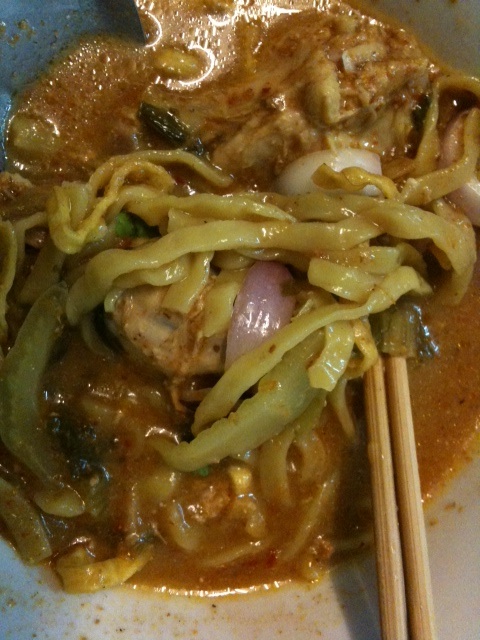
Chicken khao soy at Lamduan Faham

When people go to Chiang Mai, they usually want to eat the local food — aharn muang. Not all Chiang Mai-ers are as infatuated with northern Thai fare, of course, but as a resident of Bangkok — where good northern Thai cuisine is as hard to get as a pair of rubber boots — there was no way I would not hit all the typical places that one goes to for this food. Anything else would be a waste of time.

Now, I am a northerner. Yes, I grew up in Pittsburgh, and yes, my dad would make kanom jeen nam ngiew and call it “Thai spaghetti” in order to get us to eat it. But having grown up with a dad from Chiang Rai and a mom from Chiang Mai, I feel pretty qualified to figure out what is northern Thai food and what is not. What drives me crazy is that a lot of times, people do not know what northern food actually is. I hate this about myself, that this petty little thing drives me crazy. But it does.

So when a guy who is couched as a “northern Thai food expert” calls the central Thai dish yum samun prai (lemongrass spicy salad) northern, it drives me crazy. When some other dude asks me if, while on my trip up north, I ate mieng kum (a DIY central Thai appetizer of betel leaves, sometimes Chinese kale leaves, with dried shrimp, cubed lime, chilies, what have you), that drives me crazy. When yet another person asks me if khao chae (cold rice porridge with deep-fried sides eaten in the hot season) is northern I … you get the point. Many people don’t know what aharn muang is, Thai people included.

I think this is because northern Thai food — with the exception of khao soy — isn’t particularly friendly. It lacks the sweet-tart overtones that make central Thai food so appealing, or the in-your-face sour-fire that Isaan food boasts. It’s salty and heavy; it has weight and gravitas and a bitter backbone, echoed by all the lawn clippings and this-should-be-in-a-compost-pile tree leaves that usually accompany it. It’s flecked with blood and bile, fat and parts — we Northerners do love our pig parts. All this, because we live in the mountains where it is “cold” — the weather dips below 30 degrees C sometimes OMG!  The further north you go, the more “northern” food gets. Chiang Mai is actually aharn muang lite.

Yet I do love Chiang Mai. I have been there twice in the past three weeks: first, with @ChefMcDang, who was filming something I can only describe as an “unnamed chef competition series” (I was designated Shirt Holder); then, with my mother’s family, meeting up for the annual katin, which is essentially  an opportunity to “make merit” at the family temple. Both times were thinly-veiled grabs at eating as much northern Thai food as I could.

Making merit

Yes, I am that person: next to the food table at parties, hiding in the kitchen at big get-togethers, in the self-styled “market” next to the temple during prayers. But would you blame me?

Kanom toei at the "market"

Every year, there is khao soy and kanom jeen nam ngiew. There is pork on skewers grilling over an open flame, hunks of grilled chili dip (nam prik num) wrapped in banana leaves, soft, comforting bowls of fried noodles, garnished with purple orchids. Som tum, muang-style, flavored with nam pu, or the juice from pulverized field crabs. Yum pakkad dong, or a spicy salad made out of pickled cabbage. No, not everything is northern, but it is served with a gracious smile, ravenous cousins poking you from behind with their bamboo baskets, waiting for their turn. And it is FREE … as long as you are willing to wear a pa sin (old-fashioned sarong), and make awkward small talk at various intervals.
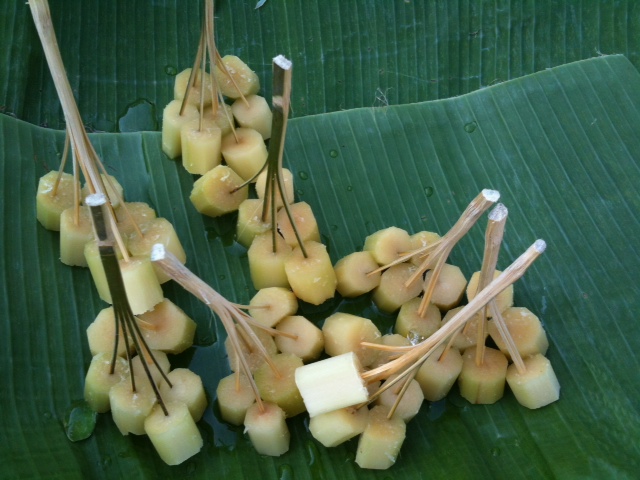
 

Sugarcane on a stick

So that was a place I would call very familiar. But I made a new discovery too, thanks to the New York Times story on “northern Thai food” in Chiang Mai. I am glad I read it (thanks @DwightTurner!), or I would not have found out that Krua Phech Doi Ngam (125/3 Moo 3, Mahidon Road) has some of Chiang Mai’s best northern food, better than (dare I say it?) even Huen Phen.

Not to mean that it’s perfect. There’s that lemongrass salad, which is award-winning, apparently, but, uh … not Northern. Nice recipe though! There is their insistence on calling what is basically a beef version of Northern gaeng om a gaeng jin hoom, which is a different dish entirely, usually made of fatty pork stewed with turmeric and lemongrass until the juices evaporate and all that is left is a salty and (you guessed it) fatty glob. There is the nam prik pla rah (chili dip with Thai “anchovies”), marred by the strange addition of cherry tomatoes.

But there is also everything else, which is pretty pretty good. In fact, it’s great, even the faux gaeng jin hoom, which I wish I had taken home on the airplane — stewed-til-tender slivers of thick, melt-in-the-mouth beef in a deliciously unctuous sauce. The chicken gaeng om (here, with the same base as jin hoom), pepped up with the addition of chicken livers. The fabulous thum kanoon (pounded young jackfruit), which makes Huen Phen’s version an anemic, sad little pretender.

Krua Phech Doi Ngam's jackfruit

So next time I go to Chiang Mai, there may be a new must-go-to in town, alongside Lamduan Faham and Aunt Ton’s house and, yes, Love At First Bite (I hate that I like this place, but what can I say? I love pie). Even better: the hordes snapping up all the food in front of your eyes at Huen Phen are, strangely, absent at Krua Phech Doi Ngam. All the more food for me.
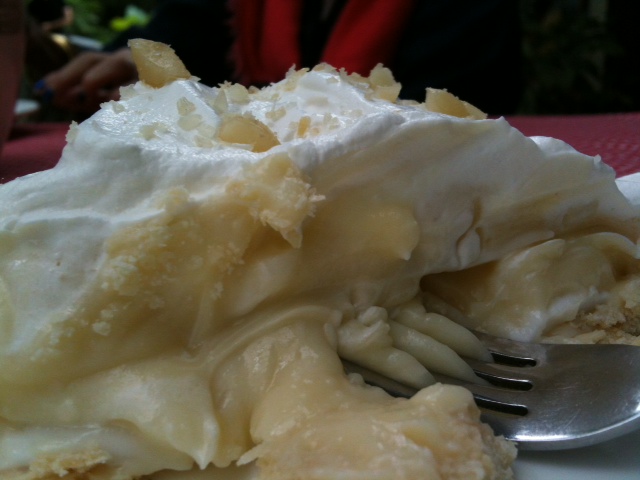
Because I love pie: LAFB's coconut cream

 

11 Comments

Filed under Asia, Chiang Mai, dessert, food, Northern Thailand, pork, restaurant, Thailand

About my grandma, and sausage

For as long as I can remember, I was told to refer to my grandmother as “Jiao Yai” (Lady Grandma). As a kid in Amish country somewhere in western Pennsylvania, I thought all Thais called their mother’s mother this term. Grandpa would be content with being a “khun tha”, but grandmas required something a little better.

I found out my grandma was kind of like a princess when we were getting ready to move back to Thailand. Her grandfather Inthawarorot had been the 8th of his line to “govern” Chiangmai; her father had been slated to be his heir. Her family name was “Na Chiangmai”, which, like “Na Ayutthaya”, “Na Songkhla”, or the like, means “Of [insert town name here]”.

Because I am really shallow, I became interested in my mom’s family history because of my grandma. When there were family gatherings, like a big ol’ buzzard, I was there, devouring scraps of old family gossip, hidden (and not so hidden) resentments, embroidering a new mental narrative of myself. Family dynamics were fascinating to me — there were “greater jiao” and “lesser jiao” (guess which branch yours truly belongs in?) and celebrations featuring dancers with ribbons and peacock feathers where everyone dresses up in old Thai clothing and complains about the heat (that’s just me, actually. I sweat a lot, what can I say?)

Best of all, there is gorgeous, life-changing, extraordinary Thai food. Getting gussied up in diapers and gossiping are all well and good, but after a couple of times, that story about Uncle So-and-so in 1847 gets old. The food never got old. It became the reason I still lurk, an ever-hungry buzzard, on the edges of family conversations, inviting myself to this or that party against the wishes of everyone involved. There is gabong, battered and deep-fried pumpkin, beans and whatnot (northern Thai tempura!) with a sweet chili dipping sauce. A sort of gaeng som in crystal-clear broth with chunks of pomfret, intense and flavorful despite its prettiness. A nam prik pla rah (fermented fish chili paste), tangy and salty but strangely un-fishy. Gluay buat chee, bananas served in a hot coconut milk, soft and comforting and almost buttery in taste.

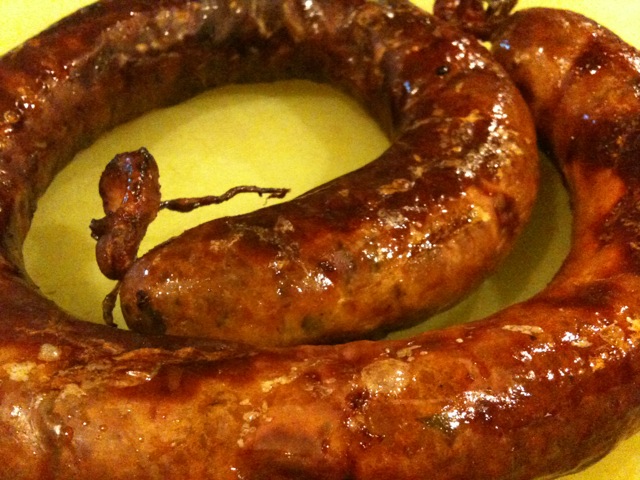
And then there is the sai oua (northern Thai sausage), which I will always associate with my grandma. Obviously, my grandma has never stuffed a sausage link in her long life, but her cook has made exemplary sausage since I was a little girl, and although lots of places make nice sai oua (Soul Food Mahanakorn, the 5th floor of Emporium), I will always associate this particular sausage — fiery, yellow, flecked with fragrant herbs — with her. Nothing compares to my Grammy’s.

Too bad it’s so hard to get the freaking recipe. When I call Porn, my grandma’s cook, it’s a list of vagaries: “Get some shallots — 10 baht worth at the market near Victory Monument … some garlic …” “How much?” “Oh, well … five?” “Five cloves?” “Well, yes.” “What else? What else?” “Kaffir lime leaf, coriander, oh, slice it really thinly.” “Are there seasonings?” “What?” “ARE THERE SEASONINGS?” “Well, salt, and fish sauce, and MSG, and [something unintelligible] and curry base … mix all of that together …” “Anything else? Is there pork?” “Oh yes, pork. Maybe 2 kilos? Soak dried chilies in hot water, and don’t forget the pak chee farang … don’t forget the turmeric! You can’t forget the turmeric.” After guesstimating a handful of shallots as “10 baht worth” and mixing central and southern Thai curry paste to get a nice orange color, I end up with a paste that I think will work. I also get a kilo of minced pork and a kilo of minced pork fat.

Luckily, it was way easier to stuff the sausages than to make up the stuffing. Jarrett Wrisley, the owner of Soul Food, was kind enough to let my friend Chris and me use his sausage casings (100 percent natural!) and his kitchen, as well as his sai oua expertise — we used a mixture of fish sauce, salt and soy sauce, just like Jarrett does for his own, MSG-free sai oua. Chris made a gorgeous Polish sausage, slightly tart and salty, and a nice chicken sausage studded with dried apple.

Getting stuffed

The final product? When I got home, the first thing I did was turn on the oven and cook my very first sai oua. The result: burnished mahogany, soft on the inside, juices running from the pan.

Again, there is lots of great sai oua in the world, but nothing compares to my Grammy’s.

7 Comments

Filed under Asia, Bangkok, cooking, food, Northern Thailand, recipe, Thailand

What’s Cooking: Larb Dib

When I order steak tartare at French restaurants, I am invariably told by a worried waiter that the dish I have just asked for is raw. Do I want to rethink my order a little bit?

Raw is, in fact, what I’m looking for. There is that feeling of being an animal, of tearing into something in its “natural” state, untouched by flame, uncivilized. I don’t think I’m the only one. Thanks to the rise of the Japanese sushi bar, tartare of some form — beef, tuna or salmon — is a fixture of pretty much any Western restaurant across the globe: studded with avocado, dusted with pink peppercorns, or, if you are particularly unlucky, bulked up with ketchup.

Since tartare is pretty much ubiquitous, other types of restaurants have had less trouble serving raw meat to diners previously considered “too skittish” for such savage fare. Nadimo’s features a “raw kibbee” dish that is made up of minced lamb cut with bulgur wheat and accompanied by a garlicky puree. It’s unusual and surprisingly delicious, an example of how good raw meat can be.

Raw kibbee at Nadimo's

Thai food boasts its own raw dishes — in this case, larb dib nuea, or “raw minced beef salad”. Its nature changes depending on the region; in Isaan, it’s tart and fresh, leavened with ground rice grains and lots of pak chee farang, the sawtooth-edged leaf reminiscent of soap. In the North, it’s something brusque and brawny, with lots of dried chili, a hint of pork blood and a shrimp paste-based sauce. The Northern Thai one is the version I’m trying today.

Larb Dip (for 4 people)

– 400 grams good-quality raw beef, hand-chopped (I chose a Thai-French tenderloin from Villa Sukhumvit 33)
– 100 grams thin beef tripe, sliced and boiled

– 8 Tablespoons fried garlic
– 1/2 stem lemongrass, sliced and fried
– 4 Tablespoons thinly sliced shallots
– 4 Tablespoons shredded coriander
– 2 teaspoons vegetable oil
– 1/2 cup pork blood (optional)
– 1 teaspoon pork bile (optional)

For larb muang paste
– 25 pieces grilled dried chilies
– 10 cloves grilled garlic
– 15 cloves grilled shallots
– 1 piece grilled galangal
– 1 Tablespoon shrimp paste, wrapped in foil and grilled
– 1/2 stem lemongrass, finely sliced
– 1 Tablespoon roasted makwaen, or a northern Thai peppercorn (I could not find it on short notice, so I substituted Sichuan peppercorns, roasted and ground)

Directions:
1. After having grilled most larb paste ingredients on an oven on full whack, pound into a paste with mortar and pestle alongside lemongrass and roasted makwaen or other substitute.

2. Mix beef and tripe with larb paste mix. If using pork blood and bile, add now.

3. This is optional, but you can cook your larb dib bleu by adding vegetable oil and giving the meat a few stirs with a wooden spoon. Otherwise, you can leave the lovely deep ruby color by leaving it completely raw.

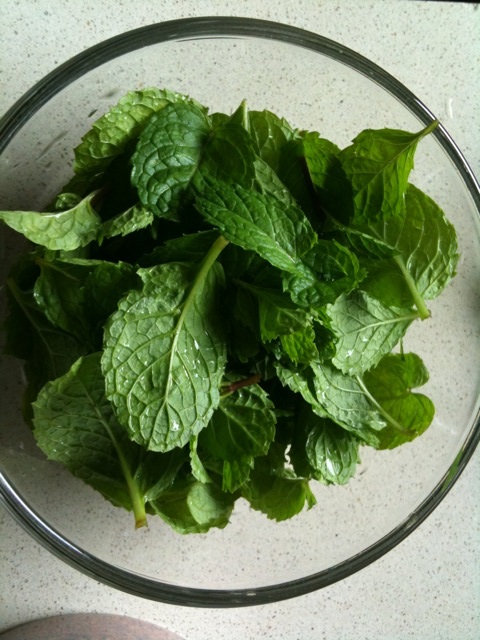
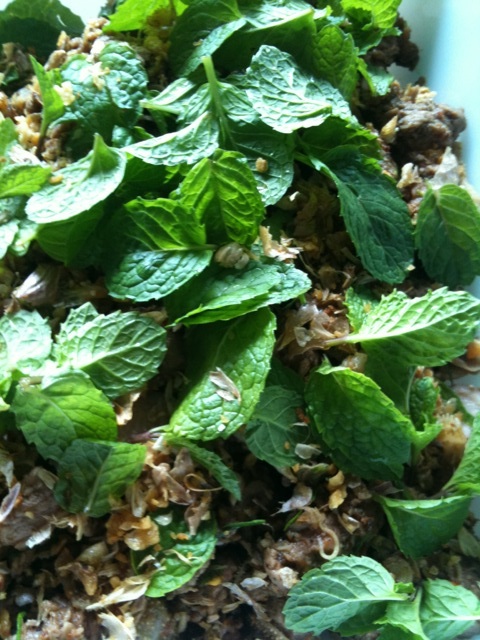
4. Season with salt and fish sauce to your taste. Top with sliced shallots, fried garlic, fried sliced lemongrass and shredded coriander. I also topped mine with lots of mint, even though it’s more Isaan and less muang (Northern), simply because it’s one of the few things we have managed to grow in our garden! Look at these beauties (I know it just looks like regular mint to you):

My finished larb looked like this:

My raw beef larb

5. Serve accompanied by sturdy lettuce leaves, cucumber slices, blanched green beans, boiled pumpkin and any other fresh vegetable you may fancy or have lurking somewhere in your refrigerator. Don’t forget the sticky rice.

13 Comments

Filed under Asia, Bangkok, beef, cooking, food, Northern Thailand, recipe, Thailand