Category Archives: restaurant

Accidental Fusion


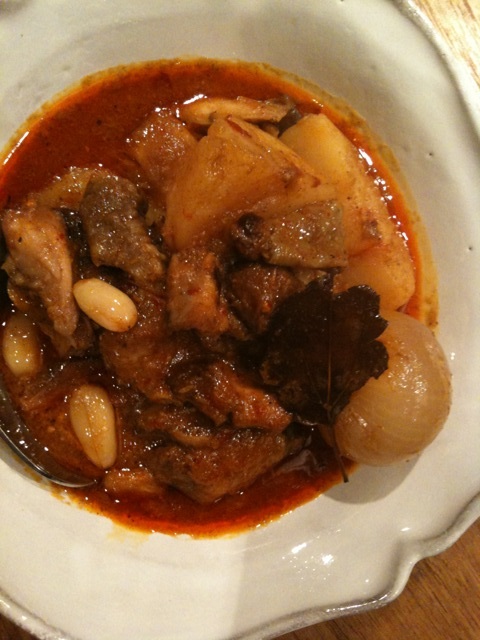
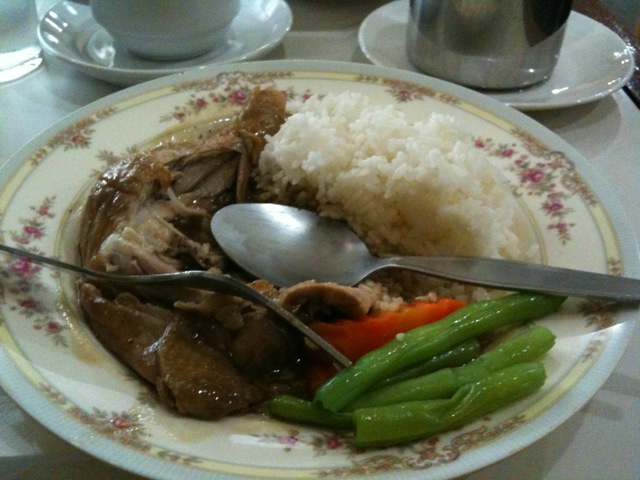
Chicken stew at Lertros


The four of you who read this blog may have noticed I’m not writing as often as I used to. The answer: I’m busy watching television. It’s called “having priorities”. Give me a break, mom, dad, @SpecialKRB and Mrs. Silverman! Haha, just kidding. My mom doesn’t read my blog.

But now that StarWorld is showing a rerun of “Britain’s Next Top Model”, I find I have the time to talk about my new favorite rediscovery. I’ve been rereading David Burton’s “The Raj at Table” and have been struck all over again about how historical events seep, unwittingly, into a country’s culture and cuisine. A silver lining from the British Raj: the ingrained sense of “superiority” that went with England’s colonization of India resulted in “English” food created from Indian ingredients that ended up an entirely new cuisine.

Not surprisingly (sorry Britons, I love Welsh rarebit as much as the next guy, but…), that culinary influence did not really go both ways. The English way of cooking had little impact on the Indians. But the ingredients they managed to transplant to their adopted country had tons: cabbage, lettuce, tomatoes (referred to as “love apples”), green beans, avocados and corn. Without the West’s potatoes, the Indians would not have come up with aloo gobi; without spinach, no saag paneer.

All the same, a lot of English food got more “Indianized”, and an entirely new Anglo-Indian fusion resulted, the most famous dishes of which are probably kedgeree (a rice porridge featuring smoked fish like Finnan haddock, which is why many mistook this dish for Scottish) and mulligatawny soup (what cynics called the “remnants of yesterday’s curry” in liquid form).

But there were other, no less noble, creations: country captain (chili- and turmeric-infused chicken); corned beef bhurta (borne out of the scarcity of beef in Hindu India); sweet potato chapatis; a”Madras Club Pudding” (using mostly dried fruit instead of the more expensive sugar for sweetness); and a “Sandhurst Curry” served in the officers’ mess alongside sliced bananas and shredded coconut. Many of these dishes, in some form or other, trickled their way through English cuisine, lending a touch of the tropical to the stoic roasts and hearty puddings of the north.

But I’m rambling. Again. I love these old-style dishes and have vowed to recreate them for my long-suffering friends and family (who have already had to put up with any number of “retro American” dinners of “perfection salad” and tuna tetrazzini) because they are perfect snapshots of an interesting point in time, irresistible to this girl who majored in Indian history (because I loved the food. Yes, really.)

Which is why I love going to Lertros Alacarte (74 74/1 Silom Soi 4, 02-234-3754). Its old-school diner ambiance — sort of like where the two old guys in “the Muppets” would hang out if they were to live in Thailand — is totally my style, and some of its food specials — a fusion of Thai-Chinese and Western — are becoming increasingly hard to find elsewhere.

Like the Indianized Anglo-cuisine of the British Raj, the story of this food (Chinese-style curries, chicken and tongue “stews”, minces and pork pate, or moo yaw) is primarily a political one. According to Chef McDang (yes, he has basically taught me all I know about non-Northern Thai food), King Rama IV sought to entertain the various Western officials at his court by  serving “Western” food. He used chefs who learned to cook in the employ of British officials; these chefs were almost always Chinese. The result: Western ingredients cooked with Chinese techniques.

So for one of the oldest forms of Thai-Western fusion out there, look no further than Lertros. And if you see Statler and Waldorf, steer clear.

6 Comments

Filed under Asia, Bangkok, chicken, Chinese, food, restaurant, rice, Thai-Chinese, Thailand

Caught in the culture wars


Thai food: a focal point of the culture wars


I vowed never to talk about this again, but Sunday’s “Bangkok Post” opinion piece about the state of Thai cuisine drove me, once again, to the keyboard (I don’t have many interests, and nothing else to talk about). Like a Katherine Heigl movie, it starts out reasonably enough, and then somehow turns crazypants somewhere in the middle.

The basic premise is, modern Thai food has atrophied as a result of the culinary shortcuts commercial cooks take today, resulting in processed dreck that bears little resemblance to the dishes they are supposed to be (while this is very true, it sounds a little to me like running into a McDonald’s and complaining, “Why do they only use cheap ingredients? Why is everything so poorly made? Where is the care and thought put into my hamburger?”)

The media also deserve blame for the commodification of Thai food, concerning themselves only with “tasting this or that dish” and on “atmosphere and decor rather than offering any real knowledge concerning the food” (Because NO ONE cares about that stuff! Silly journos. Tell me once again about how the Indians and/or Portuguese inspired coconut milk-based curries).

Because of these shortcuts, Thais DESERVE to lose their mastery of their own cuisine. Because we’re so stupid! Now David Thompson has blown into town and his place is packed and that sucks, because our lives suck and so his should too! But we’ve done this to ourselves, because we bear witness to culinary crimes like this:

“…pizza with a dry version of gaeng kiew waan luk chin pla or with dry tom yum goong. These combinations are a slap in the face to both the Thai and Italian cooking traditions.”

First of all, what’s with all the slaps in the face? Is there no other way for writers here to convey getting insulted? No tug on the ear, perhaps, or maybe a kick in the pants? Get a new rhetorical device!

Secondly, well, I am no fan of crap-topped pizza either. That said, I’m sure someone probably thought tossing spaghetti with pla kem (salted fish) and dried chilies was once a daft idea, too. Now you wouldn’t bat an eye seeing this dish on a menu. And how did Thais take to the first bowl of khao soy, a “fusion” creation of egg noodles and coconut milk said to be invented by cooks in Chiang Mai from a dish originated by the Chin Haw Chinese-Muslim minority group?


Khao soy at Khao Soy Islam


(photo by @SpecialKRB)

I was lucky enough to get the chance to help work on the first English-language cookbook by Thai TV chef McDang (“The Principles of Thai Cookery”, in case you’re interested — it’s very good! Not that I’m biased or anything …) In it, Chef McDang discusses quite clearly how all the different parts of a Thai meal fit together (a minimum of five elements: a clear soup, a curry, a fried dish, a stir-fried dish, and a kreuang jim, or chili dip with vegetables), why Thais use forks and spoons (in order to kluk, or mix the different elements of the meal together to your liking), and how all the ingredients in a Thai dish are supposed to interact. That’s why traditional Thais get all crazy about substitutions like onions for shallots, or adding spring onions instead of coriander leaves.

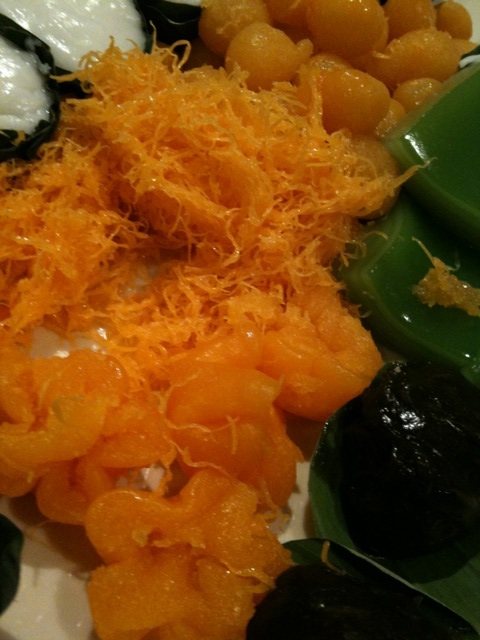
That said, Thai cuisine is also the beneficiary of a number of foreign influences that have seeped in from interaction with the rest of the world over the course of Thailand’s history. In the Sukhothai period (1238-1438), we were scarfing down fish, fruit and wild boar on rice flavored with peppercorns, cilantro roots and palm sugar. And then, in the Ayutthaya period (1351-1767) the Portuguese came along, and gave us this:


"Golden threads" and "golden drops": traditional Thai sweets that are also Portuguese


They also introduced us to eggs, tomatoes, potatoes, eggplants and sugarcane; co-introduced us to savory uses for coconut milk; and showed us a crazy new way to flavor our food with these things called “chilies”. They also found a way to form a curry custard by mixing fish and egg and steaming it; the result was called hor mok:


Steamed seafood curry at Aor Thor Kor


(Photo by @SpecialKRB)

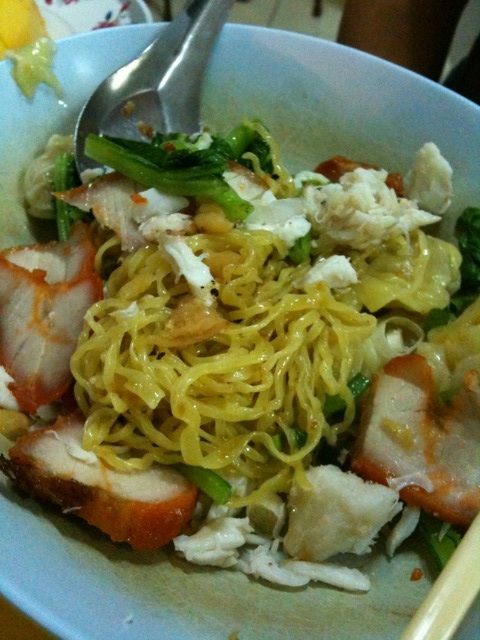
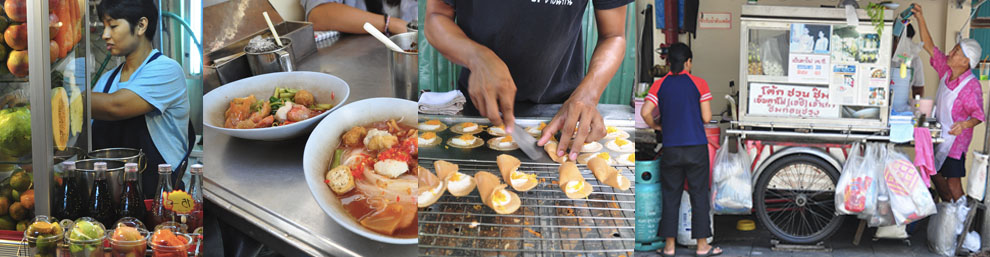
And then there were the Chinese. What to say about the Chinese? Without them, Thai food would not be “Thai food”. From them we got: shrimp paste, fish sauce, the use of duck meat in cooking, pans, stir-frying, and frying. Another innovation: an interesting alternative to rice in the form of long, thin strands of rice flour (and sometimes egg-based flour), which can be served in soup, blanched, fried, or even in desserts. They are popular in Thai street food, so keep your eyes peeled for this rare, strange delicacy:


Bamee at Sukhumvit Soi 38


So sometimes fusion isn’t so bad after…..zzzzzzzzzzzzzzzzzzzzzzzzzzOh, sorry, you’re still here?

Thailand is at a point in its history where its future — like that of the rest of the world — is uncertain. Maybe people are unsure of where they stand and so long to return to a time when things seemed more secure. Food serves as a convenient stage on which to act out this current identity crisis. But that doesn’t mean we should shut out foreign influences, or, for that matter, a foreigner who is doing the exactly same thing as us.


27 Comments

Filed under Asia, bamee, Bangkok, celebrity chefs, Chinese, curries, food, food stalls, Japanese, noodles, Portuguese, restaurant, rice, Thai-Chinese, Thailand, TV chefs

The Taste of Envy, II

Bitter melon stewed with grilled pork and squid at nahm

Many Thais might be accused of feeling envious of famous Australian chef David Thompson, and for good reason. His restaurant nahm (lowercase “n”, somehow) at The Halkin in London was the first Thai place to earn a Michelin star — an indicator of big-time international acclaim, if you are a chef — and he is the author of one of the most well-regarded cookbooks of all time, Thai Food. Calling him an “expert” on Thai cuisine is no big stretch.

Unless, of course, you are Thai. If you are Thai you are supposed to exclaim at the arrogance of a Westerner who has the temerity to come to the motherland with an outpost of the well-regarded Michelin-starred Thai restaurant in London (at The Metropolitan, 02-625-3388). Because cooking Thai food for ignorant foreigners is one thing, but cooking it for Thais is another.

Or that’s what the media would have you believe. A “New York Times” story purporting to chronicle Thais’ feelings about Thompson and his characterization of modern Thai food as “decaying” and less complex than before caused a big splash a few weeks ago and, to me at least, seemed like a load of BS. Who cares? Another restaurateur comes to Thailand. Oh, he cooks Thai food? OMG! More manufactured controversy.

But a few days later, it seemed I was proven wrong. It seemed like people really did care. Or maybe I should just quote the Nation opinion piece, penned by ML Saksiri Kridakorn: “…it makes me hotter than biting into a hot chili hidden in a larb dish. It was a slap in the face to all Thai chefs in Thailand: don’t they know how to cook their own cuisine? It was also a slap in the face to all those who go to Thai restaurants. That makes all of us. What have we been eating?”

I wasn’t sure I understood what ML Saksiri was saying (do you say “khun”? Do you say “mom”? I don’t know!) Was he saying foreigners can’t cook Thai food? Because that makes absolutely no sense to a person who went to cooking school in France and somehow got a CAP in French cuisine (an achievement which really is a slap in the face to the French people). Or is he saying Westerners can’t criticize Thai food? Because I criticize Western food all the time, and if I couldn’t, what would be my reason for living?

I think — and this took a little digging — that he was saying David Thompson couldn’t possibly come to Thailand and purport to save “decaying” Thai cuisine, when it is not decaying, and doesn’t need his help. Well, all that stuff is arguable (the “decaying” part). But it did drum up some pretty publicity for nahm! Naturally, I went there to try it out.

Grilled mussels, satay-style

An amuse-bouche of “candied” pork on a sliver of pineapple (called ma hor) started the meal; then, a succession of canapes including a lovely mieng featuring pomelo, tiny bite-sized mee krob rolls (what is this thing with mee krob? Argh) and skewers of grilled mussels, slathered in peanut sauce and accompanied by cucumber slivers.

Local chicken given the "massaman curry" treatment

After that, a quick succession of dishes (so wise, keeping it family-style!): stir-fried pak waan (sweet greens), fiery nuea kem (sun-dried beef), a bright, buoyant cucumber yum, a pounded tamarind chili dip, a lohn-like pla rah song krueang, and a lovely-looking massaman chicken curry that I got nowhere near to even tasting (one thing that bugged me: it says it’s “bresse” chicken on the menu? Does this mean that “poulet de bresse” is being raised locally? How do I get some? Stop telling me I’m misreading “bresse” for “breast” on the menu!)

However … and I hate saying this, because this means I am a xenophobic, foreigner-hating Thai: there were some misfires. Like a vegetable yum that wasn’t as yum-like as I’d want it to be: my American palate only tasted sweet. The bitter melon, while still delicious, was a little more along the “bitter” end of the taste spectrum than I’d like my maraa to be (read: stewed to oblivion). In general, the food seemed to play more along the upper end of the registers, and I’m a girl who loves the deep, dark bass notes represented by gapi (shrimp paste). In that way, it reminded me a bit of Chote Chitr (where the chef, incidentally, is Thai).

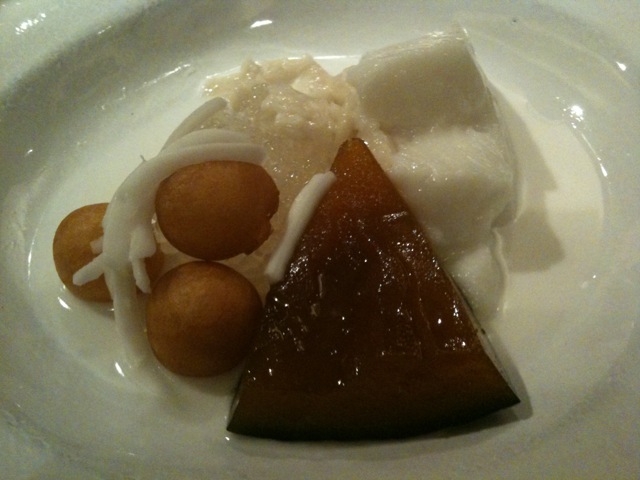
Yummy custard apple with tapioca, coconut cream and mini-"doughnuts" -- genius

And, strangely, I was disappointed to not get to see Chef Thompson himself, although we did get to meet his partner, Tanongsak Yordwai. I think meeting the chef himself would be the one thing that would tip unsure and/or conflicted locals still mentally processing their meal at nahm into “I’m a David Thompson fan” territory.

Or maybe I’m just disappointed I didn’t get to take a picture with the man himself, slapping mah face.

4 Comments

Filed under Asia, Bangkok, celebrity chefs, chicken, curries, dessert, food, restaurant, Thailand