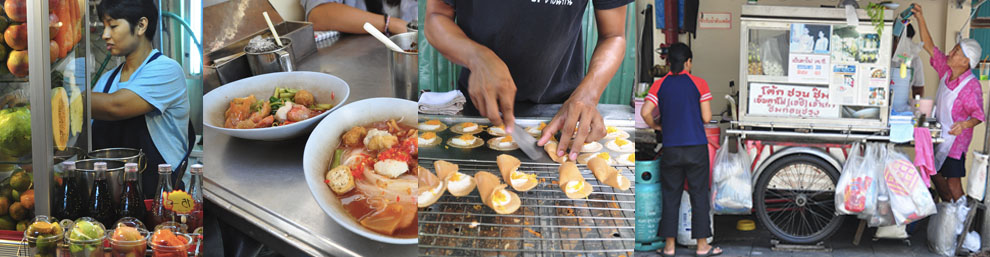

(Photo by Chatree Duangnet)
Ketchikan
Ketchikan was a city that couldn’t seem to get a break. First founded in 1885, Google tells us that this town burst onto the scene, fully-grown as if Athena from Zeus’ head, as a salmon cannery, but our guide Nathan — giving strong Starsky & Hutch vibes — tells us a different story. Ketchikan was born from what most towns in Alaska seemed to be born from: the centuries-old search for gold, and lots of it. Alas, Ketchikan had none.
So then the enterprising inhabitants latched onto selling a resource that was clearly in abundant supply all around them: lumber. Alas, that was also short-lived, as the surrounding temperate rainforest became Tongass National Forest, its 16.7 million acres of largely old-growth forest protected. So then, finally, Ketchikan turned to the scores of fish in its waters: of course I’m talking about salmon.
The town’s fishermen came up with a method of “fishing” that involved huge nets that caught gazillions of fish at a time. This led not only to a drastic decrease in the fish population, but also big caches of fish that were kept frozen in warehouses and parceled out for market days. Somehow, this led to fish pirates, because this is Alaska. The pirates would break into the warehouses, steal the fish, and then sell them before anyone else had had a chance to get to the market. This turned into a full-out turf war that led to people getting killed. So that method of fishing was outlawed in favor of traditional old line-catching. And this is where we find Ketchikan today, as a thriving salmon cannery that has enabled the town to call itself the “Salmon Capital of the World“.
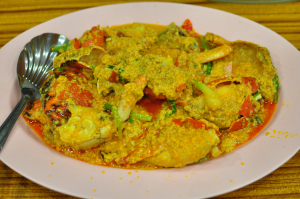
Of course, I do not partake of the salmon. Somehow, I find my way onto a tour that promises a feast of (thankfully in-season) Dungeness crabs. It would be an all-you-can-eat affair. Naturally, I am psyched.

I have had Dungeness crab before, in Seattle, where you are armed with a nice plastic bib and a little wooden hammer and all manner of other instruments to help you pry out every last bit of meat. We have no tools of that kind here, except for our forks. Our “crab lady”, who spends her days plonking cooked Dungeness crabs onto the plates of busloads of people every two hours, shows us how to open the crab legs using the fork like a letter opener. The shells are surprisingly cooperative, revealing large, juicy and sweet sleeves of meat. The only thing missing is (alas again!) some Thai seafood dipping sauce.
We only last two rounds until we are forced to call it quits by our traitorous stomachs, but a few champs last three. No one makes it to round four.
Juneau

Juneau is the capital of Alaska. It is also where the real Alaskan summer begins to kick in for us, meaning torrential cold rain, nonstop. This renders things like a walk around the Mendenhall Glacier park an absolute chore, and the fact that it is a food-free zone makes it even gloomier. I stupidly forego breakfast in the mistaken belief that our tour was an eating tour, and am hungry enough to consider buying the Alaskan kelp salsa in the gift shop and pouring that into my mouth straight from the jar in a secluded corner of the visitor’s center.
I’m just setting the stage for what happens next. We are at a brewery now and there is no food at our tasting. The beer is nice (although strangely no sampling of spruce tip ale) but it’s almost 2 in the afternoon and I haven’t eaten anything. There are two food trucks in the parking lot, and I think I should be able to hide my inner monster until after the tasting, when I can run away to order something while other people are getting more free beers.
There is someone already ordering at the halibut slider truck, so I go to the next-door pizza truck, which has somehow been visited by Guy Fieri. Those precious minutes are key, after all. I am about to place my order when our guide shouts out from the bus, “We are about to go to a restaurant next!”
I know this, but do not know how much food will be offered. If it’s not enough, I will kill everyone in my immediate vicinity. This is a calculation, not only for me, but for everyone: my husband, my sister and brother-in-law, their young son Remy, and I guess whoever else is on this stupid tour.
“I know, it’s just a snack!” I shout back from across the parking lot. “I haven’t eaten all day!”
Nevertheless, she persists. “It’s a lot of food at a really nice restaurant,” she says, and I wonder if I have read the tour notes correctly, because she makes it sound like we are about to have a 10-course meal. Still, in this state, I think I can swing both the pizza and the 10 courses.
She finally relents. “You can’t eat on the bus!” she says, but that is ridiculous, there will be no pizza left, SHE NO KNOW BANGKOK GLUTTON.
I choose an artichoke white pizza and go to town under a little overhang from the rain, and eat one of my brother-in-law Sergio’s halibut sliders as well. It comes with UFO-shaped fries that Sergio offers to our guide after she continues, somehow, to talk about the foolishness of getting food when an enormous repast is waiting in the wings. She agrees the fries are good. She refuses my offer of a slice.
Finally, we pile onto the bus for our last stop, Alaska Fish & Chips Company. I think, are we about to get a repeat of the Dungeness crab fest, but this time with king crab? What we end up with is a cup of salmon chowder and a halibut fish stick with house-made tartare sauce. It’s nice. But LOL FOREVER.
So we get a table outside, and eat the king crab feast I had been dreaming about in the first place. It’s pricey (around $100 for two legs), but in this case, two legs are more food than you’d expect. I’ve had king crab before, presumably from Alaska even, but nothing prepares me for the fat, juicy, not-dry-at-all meat from two gargantuan crab legs that are easily the biggest I’ve ever seen (and that includes Hokkaido snow crab). Less popular are the mini-corndogs made from reindeer sausages (not nice, sorry) and my husband also orders halibut fish and chips for some reason. I eat some chips to be nice.

Skagway

Our tour is not food-related today. Instead, we are going on a “Good Time Girls and Ghosts” tour, because any mention of “ghost” and my sister Chissa and I will come running. Sure enough, we are outed as ghost enthusiasts within the first few minutes of the tour, because a majority of it revolves around “good time gals”, of which there were many in Skagway.
While Ketchikan had no gold, Skagway had much. Or, more accurately, was the gateway to it. So many people flocked to Skagway to find their fortunes, in fact, that a law was put in place to force fortune hunters to bring their own 1 ton of goods to town, enough to subsist on for one year. Out of the millions who came to Skagway, maybe a few hundred found gold; about 100 made their way back to Skagway with it; and a mere 20 or so were able to leave Skagway with their fortunes intact.
Where there are fortune hunters, there are good time girls. There were three classes of these girls in Skagway: the street walkers, self-explanatory, who made about $1 every 15-minute session (overly generous?); the “boudoir girls”, tucked away in rooms off of the street, who made $3; and the ones in brothels, who worked from their rooms (free with board), had madams, and bouncers for protection. These ladies made $5. In contrast, ladies working the more “traditional” jobs — teaching, factories, food service — made maybe $3 a day.
It is during a stop when we finally discuss some ghosts (one with OCD and another genuinely scary one that Chissa thinks she can hear in the wind) when a familiar, non-scary face turns up in the park behind us. It’s @karenblumberg, somehow, entertaining her 4-year-old niece during a two (!)-day stop in town. So long has she been in town, in fact, that we almost immediately start shouting Skagway trivia to each other as we make plans for lunch later (“Do you know they had to transport 1 ton of goods all the way to Carson City on their backs?” “Did you know those goods included a mandated 150 lbs of bacon?” and so on and so forth).
Later, at the Red Onion Saloon — home to a “brothel museum” where items on display range from nighties and combs to old-timey nudes of the saloon’s ladies confiscated from the home of a local judge — we discover its main business is as a pizzeria. We finally get citrusy spruce tip ale (“Do you know spruce tip has medicinal purposes?”) and a couple of pies, as well as the inescapable salmon dip, replete with Saltines (which I believe is the traditional and best way to serve this dish).
Hoonah

Throughout our journey, we have touched on the indigenous community (especially in Ketchikan with its famous totem poles, which I did not visit), but Hoonah is majority Tlingit, giving it a different vibe from the rest of the cities we’ve visited. Deer carouse openly in the grass and brown bears roam the riverside, leading to a closure of the nature trail on that very day. To get to our destination, this time a cooking class, we board a gondola that takes us to a mountaintop crowned with a complex of shops, restaurants and a strangely realistic cannery museum.

We’re here to learn from Crystal, who is partly indigenous and partly from Texas. After demo-ing a salmon dip (of course) and an unexpectedly decent “salmon nori bake”, she expertly fillets a halibut and sockeye salmon and we are left to our own devices, seasoning our pieces and grilling them outdoors ourselves. A guy outside, who informs us he would otherwise be fishing, is able to tell from sight when our pieces need turning and when they are done. All the same, I see some real culinary crimes happening, right in front of my eyes. Naturally, I think my halibut and salmon are top-notch.

Hubbard Glacier
And here, I’ll leave you with a photo that my dad took. This is because I did not see the Hubbard Glacier. Instead, Chissa and I were getting massages, because we thought our mother wanted a massage after she told us she wanted a massage with all three of us. She cancelled, but only for herself. Pre-treatment, I manage to see numerous chunks of blue ice in the water before we get to the glacier, and feel like I can relate to it: falling apart for the entertainment of others. On the massage table, I have several epiphanies about the need to draw stronger boundaries.


 Bangkok Glutton