Glutton Abroad: Goan holiday

Image

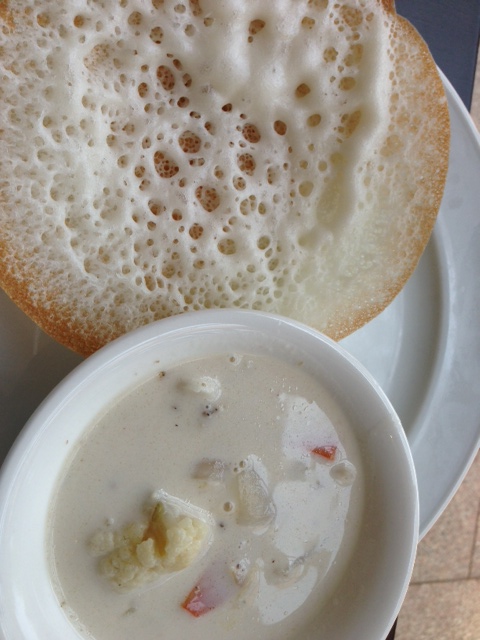
Appam with vegetable-and-coconut milk stew


I’ll admit it. When it comes to food, I am frequently a judgmental jerk. I am one of those people who looks into your grocery store cart while waiting in the check-out line. Yes, dude. I saw your value pack of tom yum-flavored Mama noodles, packet of Skittles and six-pack of Asahi — not even Yebisu, but the Foster’s of Japan. I saw that. And gurl, a plastic container of cut-up watermelon? Is it really that difficult to get a wedge of watermelon and cut it yourself?

But I have no leg to stand on. Because I just spent three days in Goa, doing something I don’t normally want anybody to do — wrote a street food guidebook to help people avoid it as much as possible, really — and that is, eat every meal at the hotel restaurant. Every. Single. Meal. Except for the weird interlude spent wandering in the backwoods of Goa, where we ended up in what looked like someone’s backyard dancing to Indian wedding music and shoveling what was optimistically referred to as “Russian salad” into our gaping maws.

It wasn’t just that the cost of every meal was factored into the cost of our stay (not only am I a lazy hypocrite, I am a cheapskate too). Every morning, I thought to myself, I’ll just check what they have today. Just a peek, and then we’ll walk down the beach to somewhere else. (See also: every afternoon, and every early evening. Goans eat dinner late. Like, Brazilian late). But like a terrible siren call luring us to the shallows of delicious, blissful apathy, a veritable army of cast-iron casseroles, each containing an ever-changing cast of curries, stews and grains, would beckon. Mysterious stuffed parathas and deep-fried papads, light as feathers; murky dals, porky vindaloos and buttery naan, delicious enough to drive the crows hovering close to our table to distraction. 

The best things, though, were those I’d never seen before, like the South Indian appam, rice and lentil flour touched with coconut milk and cooked in specially-made pans. They resemble Thai kanom krok but are big and savory, edible bowls for the stews with which they are inevitably paired.

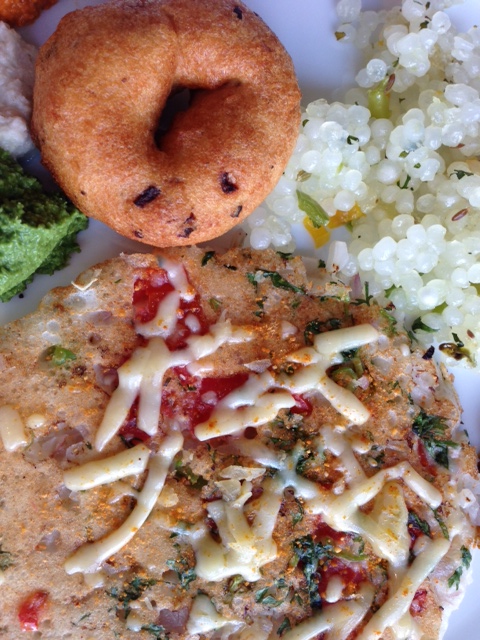
Another day brings wada, deep-fried savory “doughnuts” laced with aromatic spices, thick or thin dosas, comforting discs of steamed rice idli and kachori, deep-fried lentil fritters (this is no food for those who are watching their weight). Alongside vats of local mutton xacutti stew and the popular potato-in-gravy specialty aloo bhaji sit offerings of pongal (mushy coconut-laced rice) and sabudana khichri (savory tapioca), all meant to mop up any stray goodness. That’s not to mention the clever pizza-like uttapam, a mutant form of savory pancake that can be paired with a multitude of chutneys (coconut, onion, coriander), both garlic and lime pickles, and a dried south Indian spice blend aptly named “gunpowder”.
Image

Wada, tapioca and uttapam with a multitude of chutneys

Everything is milder and sweeter than at the Indian restaurants back home in Bangkok, and I feel a pang of remorse for once referring to the Indian restaurant near my house (the generally-good Indus, if you’re curious) as “India lite”. It’s more refined and unassuming than what Thais — gourmet adrenaline junkies, every last one of them — have come to associate with what defines “authentic” or even “good”. And there’s so much more of it, a dizzying variety of pulses, pastes and combinations that will never make it out of the country, because it’s not what non-Indians associate with “Indian food”. Every Thai restaurant in the world is saddled with expectations that tom yum soup, pad thai and green curry will be on the menu; the vast culinary lexicon of India, too, is typecast: butter chicken, chicken tandoori, maybe a vindaloo or biryani.

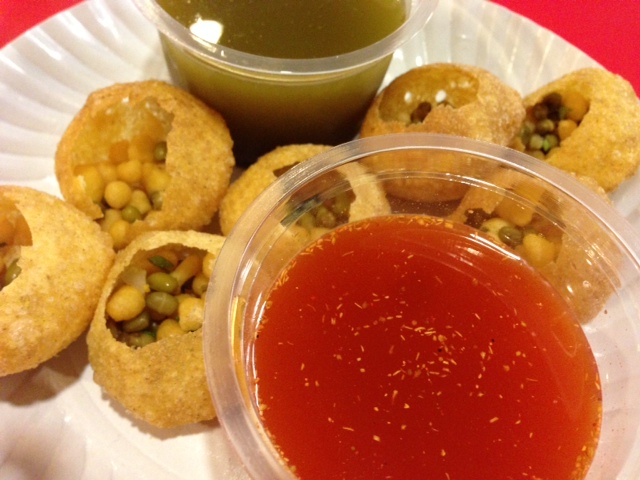
Back at the airport on our way home, I still can’t let go of this desire to try as much as I can. At a place called “Curry Express”, where cooks and servers wear the same disaffected looks one would expect of any Burger King or McDonald’s, I get pani puri: razor-thin dough shaped like eggshells with the tops cut off, filled with legumes and paired with two dipping sauces that taste the same. The dough is stale and my husband thinks I am going to contract some sort of stomach bug. But it, too, is something new, and I likely won’t see another plate until my next trip to India.
Image

Airport pani puri


12 Comments

Filed under Uncategorized

Rediscovering the familiar

Image

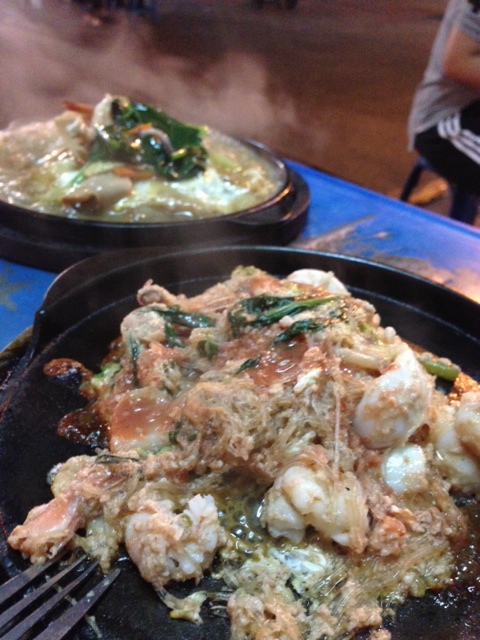
Suki and seafood gravy noodles, courtesy of Krua Porn Lamai

I find it amusing when I hear someone say they don’t want to end up like the old married couple in the restaurant, eating their dinner in silence. I find this amusing because, in my opinion, THAT IS THE BESTEST THING EVER. Why do I have to talk all the time? The well-worn song-and-dance, the incessant thrum of pleaselikemepleaselikeme — all of this singing for our suppers … it’s just not my normal state. My normal state is that of a big old grump who thinks occasionally eating a restaurant dinner in silence IS THE BESTEST THING EVER. That’s because sometimes, I don’t want to talk. And sometimes I don’t want to listen. Sometimes these two desires meet up over the dinner table in front of my spouse. Whenever this happens, I call it RELAXING.

Of course, this doesn’t take into account the feelings of my long-suffering spouse. Maybe he wants to bare his soul over his salad caprese and dish over the little details of his day as we work our way through our oxtail stew. Something tells me I probably wouldn’t be married to this person, but once in a while my husband does want to talk, and it’s not the old refrain “When are you going to take care of the kids/clean the house/take a shower” that I usually hear coming out of his mouth.

So, in the interests of compromise, and against all my better instincts (I AM SO MUCH FUN), we talk, we discuss, we communicate. And in doing this, we find out more about each other, even as we soldier on through our 157th year of marriage. As many eons and eons (and eons) that we have been together, we discover that much more every day.

As many times as I’ve been down the main drag of Yaowaraj Road and explored its many offshoots (YES I AM EQUATING MY MARRIAGE TO A PART OF TOWN), I still find new vendors to get excited about — not every day, but often enough to make an hour-long Skytrain-then-subway-then-tuk tuk trek to Chinatown from my house worthwhile (I CANNOT WAIT for the subway extension into Chinatown to be finished. My life will BE CHANGED FOR THE BETTER. THEN I CAN STOP WRITING IN ALL CAPS).  

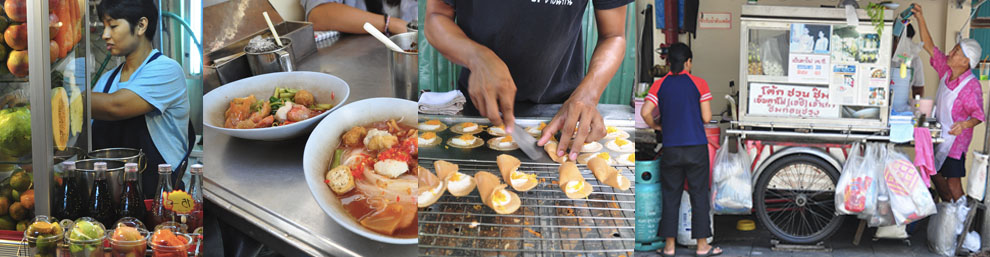
Enter Krua Porn Lamai (081-823-0397). Despite the suspicious likeness of its name to a made-up massage parlor in a future installment of “The Hangover Part 34”, this outdoor vendor specializes in kata ron, or “hot pan” — fried noodle dishes given the special oomph afforded by the sizzle and smoke of a heated plate. Part of a “cooperative” of vendors that share tables and help service each other’s customers (something I’m seeing more and more of nowadays), Porn Lamai is set right at the entrance to Soi Plang Nam, just as you turn right from Yaowaraj Road. All those tables with hot plates on them? That queue of excited-looking customers staring at other people’s food? That’s them.

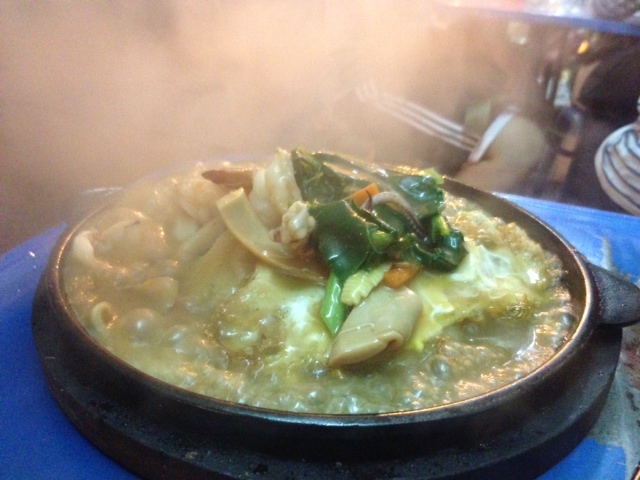
The reason for all the excitement — despite the wait elicited by having to wash all those hot plates for new customers — is obvious. Take, for example, the guaythiew lard na talay (seafood gravy noodles), charred to a crisp on the bottom, just like the bottom layer of rice in a good paella. It arrives at the table still seething, emitting a slight hiss, but when the server upends a pitcher of gravy over the liquid, a giant plume of smoke and sound erupts:

Image

Krua Porn Lamai’s lard na noodles

This is food that fights back (seriously, watch you don’t burn the roof of your mouth off). This is food that you will remember (as you’re doing your laundry). This is food that will not go gently into that good night. Enjoy.


6 Comments

Filed under Uncategorized

What’s cooking: Aim Och

Image

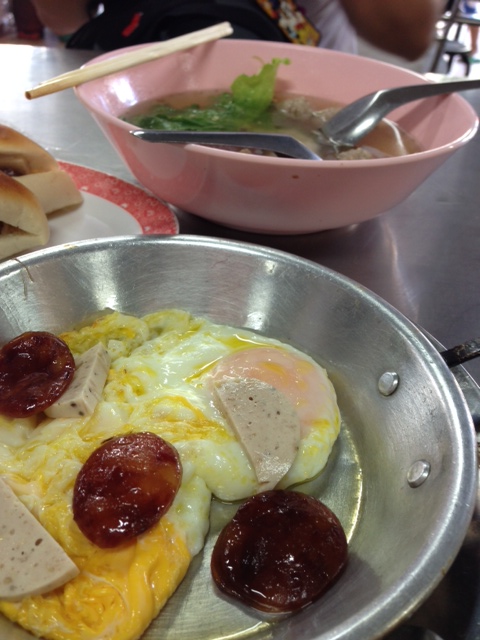
“Egg in a pan” at Aim Och in Khon Kaen

There is nothing easier to make in all of Thai street food than kai kata, or “egg in a pan”. Still stinging from our inability to decode Jay Fai’s Byzantine fusion of herbs and spices masquerading as tom yum goong, Chris and I decided to give ourselves a break and do something that is, quite literally, fool-proof.

Kai kata is the Thai version of the Vietnamese version of the American breakfast, said to have been inspired by homesick American GIs during the Vietnam War. In an attempt to replicate the American breakfast standby “ham and eggs”, Vietnamese cooks cracked eggs into “personal-sized” pans, garnished them with Chinese sausages and Vietnamese steamed pork pate (moo yaw) in place of sausages and ham, and cooked them quickly on a stovetop until the whites set. Garnished with a splash of red chili sauce like Sriracha and fish sauce and accompanied by a toasted, buttered bun stuffed with more “sausage and ham”, this no-fuss breakfast combo is quick, easy — and unbelievably satisfying. Best of all, you can let your imagination run riot: anything, anything at all, will work with these eggs. Have a sweet tooth and want to drizzle some maple syrup on it, maybe with a garnish of crispy

bacon? A handful of peas? Maybe some pancetta and sliced fresh chilies? Or maybe a

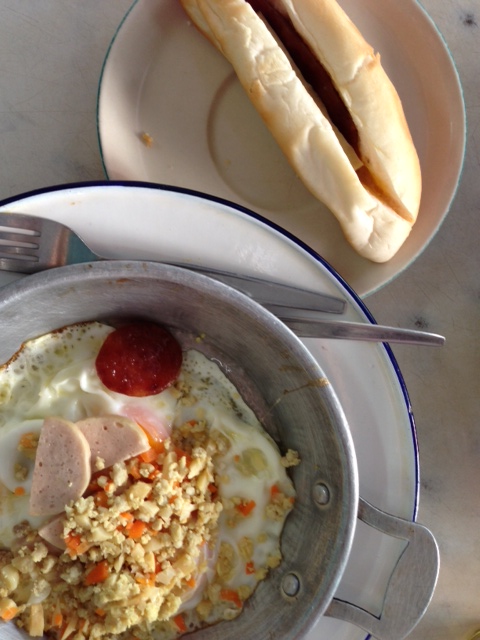
splash of minced chicken and diced carrots, just like at King Ocha in Udon Thani:

Image

Kai kata and buttered bun at King Ocha in Udon Thani

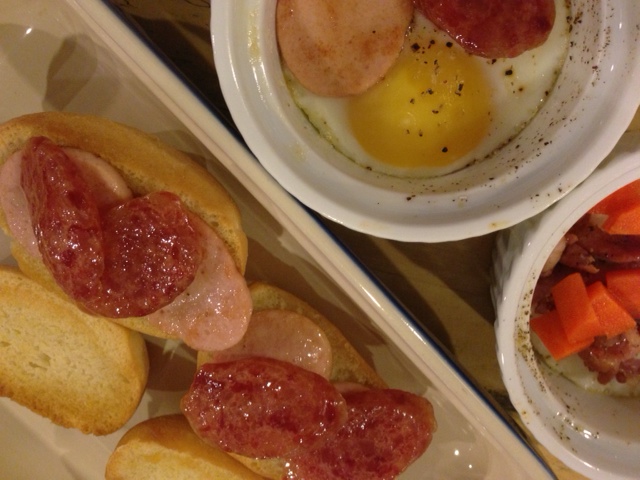
There are no rules for this fusion-y adaptation of a Western favorite. Ironically, if you are in the West, you may need to make some substitutions for some hard-to-find ingredients, so you may have to re-substitute those substitutions. Hence our choice to use buttered ceramic ramekins instead of tiny pans, because we aren’t sure how many of those are available back West. If you don’t have an oven, you can make a bain-marie by putting your ramekins in a pan, filling with water up to the middle of the ramekin, and cooking your eggs on the stovetop. However you decide to make it, we have tried to cleave as closely to the “authentic” (circa 2013) basic Isaan-style kai kata as possible.

Kai kata a la Aim Och (makes 2 servings)

What you’ll need:

– 2 ramekins, well-buttered

– 2-4 eggs, depending on size of ramekins

– 1 link Chinese sausage (gunchieng), sliced

– 6 slices moo yaw (Vietnamese steamed pork pate) — baloney works in a pinch

– Two mini-baguettes or soft rolls (for real Thai street food flavor, they should be as sweet as possible)

– Butter (for toasting buns)

– Fish sauce with sliced chilies, Maggi, or Golden Mountain sauce (to taste)

– Sriracha sauce (to taste)

– Salt and pepper (to taste)

To make:

1. Preheat oven to 325 degrees Fahrenheit/180 degrees Celsius.

2. Place buns, slightly open and their insides buttered, into a casserole and toast in the oven until warm, edges are light brown and butter is melted. 

3. In a pan, warm slices of Chinese sausage and/or moo yaw until hot to the touch.

4. Crack 1-2 eggs into each buttered ramekin, depending on size. Cook in oven for 5-10 minutes (depending on how well your oven works), until whites are set when you jiggle them and start to pull away slightly from the sides of the ramekin. If you like your eggs more well done (I love runny yolks), wait at least 10 minutes.

5. Take eggs out of oven and garnish with sausages and “ham”. If you have cooked minced meat and/or vegetables, scatter those onto your eggs as well. Season with salt and pepper.

6. Fill toasted buns with slices of “ham” and “sausages”. Serve alongside eggs, and make sure to pass the fish sauce/Maggi and sweet chili sauce. Easy AND delicious.

Image

Our versions


Leave a comment

Filed under Uncategorized