Brazilian Days, Vol. 2

Ever feel like you’ve been through some sort of time warp, doomed to a Bill Murray-like existence living the same day over and over again? That is what this interminable trip is starting to feel like, despite the loveliness of the setting and friendliness of the people.

There is plenty of both in Gramado, a Southern Brazilian town famous for its German and Italian communities, Swiss-style buildings and ludicrous number of fondue restaurants for a town of 30,000, a minute fraction of whom are actually Swiss. We are here for Marcelo and Renata’s wedding, joining 298 others in a heavy-duty bash (in case this is news to you, Brazilians like to party) incorporating an all-you-can-drink caipirinha bar, 40 bottles of whisky, 40 bottles of vodka and a whopping 220 bottles of champagne. Win and I, old farts that we are, battle valiantly to stay up past midnight. We make it to 12:30am, failing to outlast Marcelo’s 10-month-old cousin and 80-year-old grandmother, who is still out on the dance floor when we skulk out of the ballroom, pretending to make a call.

When it comes to food, however, we do our part, gorging on bottle after bottle of the local Merlot and sparkling wine and a uniquely Brazilian version of fondue bourguignone that doesn’t actually involve any fondue — a hot plate is coated with salt to keep the beef from sticking, and it is accompanied by a dizzying array of dips ranging from the usual (rose and tartar sauces, garlic-parsley butter and curry mayonnaise) to the, uh, unusual (wasabi, caramelized onion, candied pineapple, strawberry jam). Alas, the 9:30-10:00pm dinnertimes render me a gassy menace to society, snarling my digestive system and making me a deadly weapon in enclosed spaces like cars (sorry, Marcelo’s brother).

So despite the absolute loveliness of Marcelo’s and Renata’s families and promises to visit each other’s respective cities, it is with a certain sense of relief that we are left to our own devices in Sao Paulo, where no one is stuck with me but my husband and I can eat dinner at 7pm like any other tourist. Called the “locomotive of Brazil”, Sao Paulo is nearly everything Rio is not — fast-moving and unwieldy in a way that recalls Bangkok, but way more efficient; where two kisses is a common salutation in Rio (and three in Gramado), in Sao Paulo you get away with only one (time is money, after all). Sao Paulo is also way bigger than Rio: at last count, its population totaled 40 million.

It’s not much of a surprise, then, that Sao Paulo is also home to the biggest Japanese population outside of Japan. After what feels like months of going without Asian food, I insist on trying both ends of the spectrum of Japanese food in the city: slick and high-end vs. “authentic” everyday.

Kinoshita's crispy salmon

At Kinoshita (Rua Jacques Felix, 405, (11)3849-6940) you will get plenty of slick (minimalist, expensive decor, smooth service) and a whole lotta high-end (65 reals for a glass of Hungarian Tokaji). Food — with the exception of a nifty gazpacho with shrimp roe and sea urchin, some nice seared fish eggs with a dollop of wasabi and salmon drenched in ponzu and topped with tempura dribbles and ebiko — stands at the intersection of Mundane Avenue and High-Concept Hotel Dining Street. In other words, it’s the culinary equivalent of an Aman Resort: pretty and well-designed but somehow similar to somewhere else. Of course there is a foie gras course, cubes of it pan-fried and set atop cushions of Kobe that are only seared, so that the marbled fat in the meat isn’t activated. Why bother then?

More satisfying (and easier to do) was the ramen at Lamen Kazu (Rua Thomaz Gonzaga, (11)3277-4286), in the “Japan town” known as Liberdade. The menu is simply a succession of ramen variations: miso, salt, shoyu, with the usual varieties of toppings. All the same, I enjoyed my “Hokkaido” (corn, seaweed, pork, spring onion and a pat of butter) despite getting hangry (hungry+angry) and scaring the waitress and our neighbors at the table next to us.

"Hokkaido" ramen

In the end, we find we’ve explored only the tip of the iceberg that is Brazil. There is still the gorgeous green expanse across the north, and the awe-inspiring forest known as the Amazon. And imagine the food that remains uneaten! It would take weeks and weeks to do the country justice. We’ve only just started.

All the same, I feel like I’ve been on the road for a long time. The memories seem minted long ago: dining on a tableful of oysters at Kaufhaus des Westerns (KaDeWe) and rifling through stacks of scarves and evil-eye jewelry at the Turkish market in Berlin; stumbling through icy streets in Denmark and Finland on a bellyful of schnapps; discovering delicious cream-filled semla buns in Stockholm.

Semla at Vete-Katten in Stockholm

I love exploring the world through my stomach, and I can’t believe I’ve been lucky enough to actually do it for a month. But home beckons, finally. What’s for dinner?

Peppers at the Turkish market in Berlin

Leave a comment

Filed under beef, Brazilian, fish, food, Japanese, noodles, pork, Portuguese, restaurant, seafood

Brazilian Days, Vol. 1

Christ the Redeemer overlooking Rio


(Photo by @SpecialKRB)

Tuesday, Day 1

9:00: It’s taken us a full day, two kilos of oversalted shellfish, and a trough of caipirinhas, but we have finally recovered from the 36-hour trip from Stockholm to Rio (via Berlin, Zurich and Sao Paulo). We are in Rio de Janeiro (‘River of January’), a glittering city of around 6 million which funnily enough does not have a river but a gigantic bay and many beaches. At breakfast, we watch impossibly toned and tanned beautiful people do yoga and practice a form of soccer-volleyball, all apparently without any hint of irony whatsoever. Afterwards, we meet our guide, Leonardo, who promptly learns that we will go anywhere and do anything, as long as we are fed well for our trouble. He pledges to take us to Porcao, one of Rio’s best-known churrascaria rodizios (barbecue houses), as soon as he can.

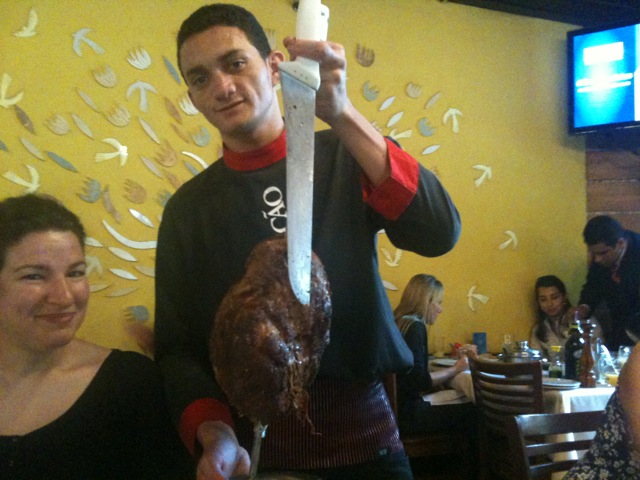
13:00: Thanks to a crowd of especially exuberant Koreans and a traveling samba band (“Now is the time for the samba,” says Leonardo, who cannot stand the samba) the tram trip up to Christ was amusing, but we are now in a post-giggle funk after being confronted with a snarl of traffic that just might rival the best Bangkok has to offer. Although Leonardo claims it is a bit early to stuff our faces, we are famished, and head to the nearest Porcao (Av Infante Dom Henrique, (021) 3461-9020) we can find. At Porcao (which, as @SpecialKRB points out, is pronounced “poor cow”), we find cuts of every part of the animal awaiting us including the rubbery hump (called cupim), plus a generously-proportioned buffet of “sushi”, salads and hot stews that we ignore until we are almost full. Luckily, I am wearing a maternity dress chosen especially for the occasion.
Confronting a skewer of fried chicken hearts
(Photo by @SpecialKRB)

After stuffing ourselves to near-bursting, we promise to never, ever eat ever ever again.

The man of our dreams with @SpecialKRB

Wednesday, Day 2

9:00: We break our promise at breakfast the next day, when I once again inhale an entire plate of cold cuts and cheese with plenty of bread, as I am told is the breakfast of choice for true cariocas (natives of Rio, which loosely translated in the local language actually means “house of the foreigner” or “house of the white man”. Go figure). This is especially interesting since it is very hard to find starches like this for lunch or dinner unless you actively ask for it. Is this the “Rio diet”? Only enough carbs to keep you regular and then not touching them after noon? Eating manioc like a maniac at ridiculous times of the day, like 3pm and 11pm? Will I lose a bunch of weight and write a diet book and become a famous weight-loss guru like Rocco DiSpirito? Only time will tell.

13:01: After spending the morning buffing the floors at the Palacio Rio Negro in Petropolis, the Brazilian royal family’s summer residence, we are officially starving. (“Would you DIIIIEEE if we have lunch later?” asks Leonardo. Yes, Leonardo. Yes, I think we would die.)

Nevertheless, we manage to hold off until 3pm, when Leonardo takes us to Urca, a neighborhood known for being exclusive and inhabited by members of the military. Here, we get our first taste of some delicious Brazilian snacks: bolinhos, coated in crumbs and deep-fried; pastels, wrapped in pastry like pierogies; and empadas, fillings set atop pastry (“open”) or enclosed completely (“closed”). These are all washed down with a glass of light draft beer (chopp) and can be found at any boteca or botequim.

Another dream man, with a tray of empadas

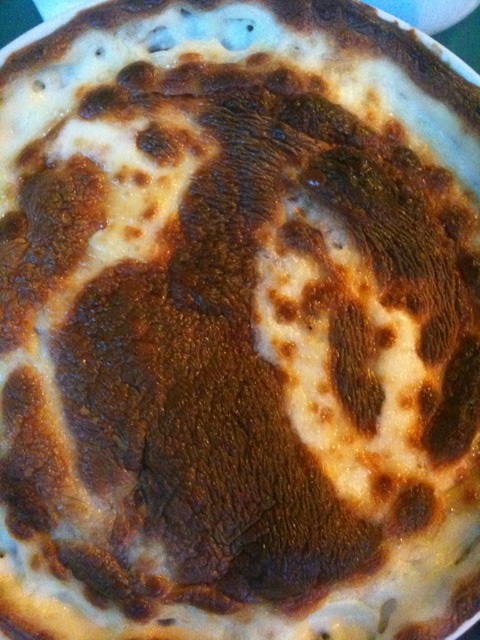
18:00: After another long day, we finally make our way to Academia da Cachaca (26 Rua Conde de Bernadotte Leblon, (021) 2529-2680), where a treasure trove of cachacas (sugarcane liquor) sourced from all points of Brazil awaits. We select several “doses” of this liquor, the names of which will remain locked in an alcohol-induced haze forever, and they all taste of either cloves, allspice, cinnamon, or caramel. We also order acaraje — a sort of kibbee-like deep-fried “football” of beans, accompanied by a fish stew and a “relish” of coriander, spring onion and dried shrimp — and a sun-dried beef escondidinho, which @SpecialKRB describes as a “shepherd’s pie filled with corned beef hash”.

Escondidinho


But our waiter draws the line when we try to get a feijoada completa (bean stew with all the fixings), simply refusing to let us order it. Leonardo agrees (“I am afraid you will DIIIIEEEE. You will simply drop dead”) and seems to think a waiter telling us we have ordered too much is an unusual occurrence. Everyone seems to think that, despite the late hour, we will eat dinner after this (“This is lunch,” says Leonardo with a straight face).

22:00: This is the thing. I love Rio in many ways: its laid-back, freewheeling optimism, its sunny weather, its easy-going and friendly people. But so much of it is the complete opposite of the doddering oldie I am today. Despite exhortations from every Brazilian we know to explore Rio’s vaunted nightlife — (“Don’t go there until 3am. You will find NOBODY,” Leonardo advises as we pass one famous nightspot. “This club is after-hours. You can go there at 6am.” He says later of another. “Come on,” he finally tells us when confronted with our ashamed, vaguely defiant faces. “Don’t be different”) — we cannot find the strength to stay awake. Leonardo is talking to the squarest, most boring people in the world.

Thursday, Day 3

13:00: Leonardo-less today, we finally make it to Casa da Feijoada (Rua Prudente de Moraes 10, (021) 2523-4994) where we get our black bean stew accompanied by braised pig tails, ears and trotters, rice, deep-fried pork rinds, fried collard greens, fried manioc, farofa (roasted cassava flour) and orange slices to cut the fattiness. We get both passionfruit and lime batidas (cachaca with fruit juice and ice) and a bottle of wine. This renders us comatose for the rest of the day. Finally sated, we stumble outside into the bright sunlight, spot vultures circling overhead and consider the beach for the rest of the day. I have not lost weight on this diet by any stretch of the imagination.

Pork rinds

6 Comments

Filed under beef, Brazilian, food, pork, Portuguese, restaurant, rice

Roadside Buffets

The "curry rice" stand on Methenivet Road

While researching the street food book, I spent a lot of time formulating some sort of tried-and-true criteria that could be used to determine the kind of “street food stall” perfect for the book. I did this because I got a hella annoyed at stories that would claim to explore “Bangkok’s most authentic street food”, and then take you to the Food Loft at Central or something. I mean, I like the food there too, but come on. You are supposed to “suffer” for street food. You are supposed to wander aimlessly in the street as people say “there she goes again, that farang” and pretend you don’t understand, acting out the role of “clueless foreigner” in this bizarre trade-off people call “social discourse in Thailand”. You are supposed to sit at a rickety stool as the sweat pours off your face and people point and laugh and say, “Look at how uncomfortable she is! So funny!” or they politely pretend not to notice, which might be worse. Street food is an enterprise where the awards are commensurate with what you put into it. That’s just the way it is. (I know. We are all now wandering aimlessly down the length of this paragraph, wondering “When does this road end? The book did say it was supposed to be RIGHT HERE…”)

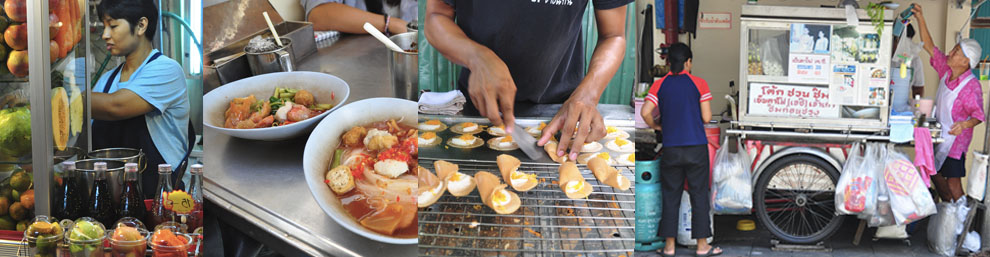
The thing is, I hardly had the wherewithal (or the stomach, to be frank instead of Glutton) to explore all the kinds of proper street food stalls that there are in Bangkok. That included aharn tham sung (made-to-order stalls, marked by raw ingredients arranged in front of the cook) and khao gub gaeng (“curry rice” stalls, marked by ready-made curry vats arranged in a row in front of the cook). I did briefly discuss, amid all the purple prose, the awesomeness of made-to-order stalls in a post here. Now, I’d like to talk about the tantalizing roadside buffet that is the khao gaeng stall.

Of all the stalls out there (except for maybe the nam kaeng sai, or iced dessert stalls), curry rice stalls are the most inviting Thai stalls around. Their purpose is to beckon to the grumbling stomach — here, you could be having this RIGHT NOW — instead of suggesting the promise of the future, as a made-to-order stall does. It appeals to the immediate in all of us, which is why our book features a particularly famous one on its cover (Mae Malee at Aor Thor Kor).

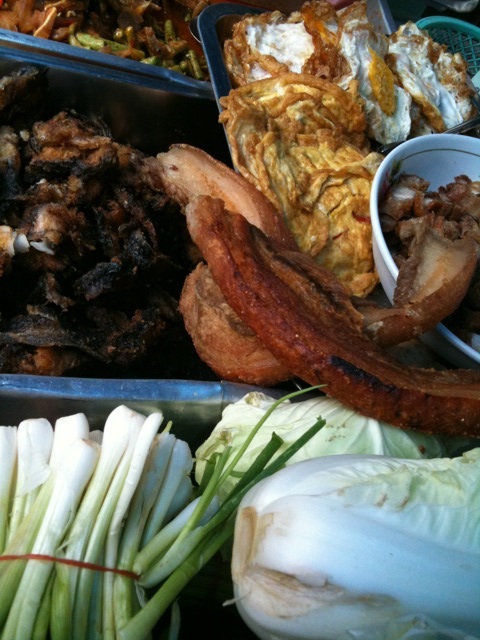
That said, there are so many stalls out there, on practically every street corner, most offering a variation of the following: green basil curry, usually chicken and/or chicken feet; stewed bitter melon stuffed with minced pork in a clear broth; stir-fried long beans in red curry paste; some sort of stir-fried Mama noodle or glass vermicelli with pork and chilies; stir-fried veggies; fried pork with garlic and black peppercorns; and fried eggs, yolks ready to break open at the slightest slash of a spoon. If it’s a particularly good one, you’ll also get maybe a yum (spicy sour salad), usually seafood, a gaeng jued (bland clear broth soup to counteract the spiciness of everything else) and something cool and ornamental, like kai luk kuey (son-in-law’s eggs, which are deep-fried and slathered in a sweet sauce. I once wrote a story about Thailand’s “foreign son-in-laws” for, oh, let’s call them Schmeuters, and my editors misunderstood and thought I was referring to “luk [something else]”, which was really, really annoying. Minds in the gutter, much? Anyway.)

Because I love eggs: krapao at a made-to-order stall

You might be wondering where the best place to find a khao gaeng stall may be. I would once have said the one on Sukhumvit 24, across the street from Emporium, but it has since disappeared, taking its green curry spaghetti with it. So let’s go with Krua Aroy-Aroy (it’s a favorite of Ferran Adria’s, after all!) at Thanon Pan, across from Maha Uma Devi Temple (Wat Kaek), 081-695-3339, open 8:00-21:00 daily. The laminated menus are gone! The massaman curry and nam prik platu are still there … just don’t order the nam ngiew (I’m sorry. I can’t help myself. It’s a sickness).

14 Comments

Filed under Asia, Bangkok, curries, food, food stalls, rice, Thailand