Pet Peeves

Chicken grilling at Mae Nong in Nong Song Hong

I have written about pet peeves before. Unfortunately, I have already named this post and can’t be bothered to move the cursor back up to the title bar. Also, no one will notice. Besides, my pet peeves have changed since then.

Yes, I have new pet peeves. Like people who use the word “woke”. Or those who get their news from Tik Tok. People who stop at the end of an escalator (you’d be surprised). And when someone texts you and they start with just your name. Like, just give me the whole message, jesus christ. Am I supposed to be in suspense? Are they waiting for an invitation to text more? Soooooooo annoying.

As some of you may know, I am also a fan of Korean YouTube videos, particularly the ones that have jazzy, relaxing music, beautiful lighting, and lots of flowers in an airy, Scandinavian-like space. Usually they seem to make really delicious food, except for sandwiches, which they do not seem to understand. I mean, the sandwiches are ludicrously, preposterously high, and filled with things like peeled grapes. How on earth does one unhinge one’s jaw far enough to shove one of these clementine-and-whipped-cream sandwiches in, unless one is an anaconda?

But that’s not my pet peeve about these videos. My pet peeve is that the chicken, when they roast it, is lying on its breast, like someone has made fun of it and it died right there in the oven from shame. Then everyone proceeds to pick at the chicken, STILL BREAST DOWN, like there isn’t a huge spine, etc that is in their way. Is this normal in Korea?! Please serve your chicken breast up, like God obviously intended!

Thankfully, I live in Thailand, where we don’t have to worry about serving our chickens breast up or down, because we grill them. And if you are really, really serious about your chicken, you make it like they do in Isan, stuck in aromatic wood of some kind and cooked slowly-but-surely over a fire coaxed by charcoal.

There are three major chicken grilling towns (“towns” is being generous), where people converge for delicious chicken (and all the other stuff that goes with it, like sticky rice, jaew, and som tum). One of these is Khao Suan Kwang (Deer Park Mountain), located almost exactly halfway between Udon Thani and Khon Kaen. Here, the chickens are very clearly free-range and local (gai baan), even — it must be said, in the eyes of someone who grew up on American chicken — scrawny. But people love this chicken for its pure chicken flavor, perfect grilling, and beautiful smoky aroma, partly imparted by the bamboo with which these chickens are cooked.

Khao Suan Kwang chicken

It’s a whole street, lined entirely with chicken vendors, and even friends will refuse to name a particular vendor to patronize, simply saying “go anywhere, it will be good”. You and I know that this probably isn’t true, but this might also be due to the probability that they have completely forgotten which vendor they stopped at, like I did. I can only say that we chose the vendor patronized by local government officials in uniform, because of course we did.

Vendors at Khao Suan Kwang

Another, admittedly far less well known, street that I recently visited is called Nong Song Hong (Two-Roomed Pond), between Udon Thani and Nong Khai and praised for its meatier, fattier chickens. I am here to say that this is very true. Cooked similarly to its brethren at Khao Suan Kwang, the chickens boast crackling skin but juicy flesh, and is truly the stuff of my dreams. Even better, they make great som tum.

Som tum Lao (with pla rah and white popinac seeds)

And even even better, I can name the place where we went, because it was very recent and my memory is not that bad yet. It was Mae Nong, easily the biggest place on the street (with an air-conditioned room), and yes, once again patronized by some government officials in uniform.

Specials of the day

There is a third place that is famous for its grilled chicken, and that is Wichianburi, in Petchabun province on the border between Isan and the North. Alas, I have yet to go, but obviously it’s going to happen. I have heard that this grilled chicken mecca places a lot of importance on its sauces, which is extremely intriguing to me. Next stop: home to the King Naresuan the Great shrine.

Leave a comment

Filed under Uncategorized

Getting Nutty

Testing a recipe for pad mee with egg

(Photo by Lauren Lulu Taylor)

I am losing a step. Actually, I believe the technical term is “becoming an idiot”. To be honest (“At least you’re being honest!” says my friend Chris, champion of dad jokes), … wait a minute, I forget what I was going to say. Maybe it will come back to me later.

It comes slowly, and then all at once. I have always had a problem with double-booking appointments, or forgetting appointments completely if they have not been written down in my real brain, the calendar on my phone. Now I find myself triple-booking, even after checking my calendar the first time around. I will tell myself that I have to buy kimchi after seeing it displayed at a corner of the supermarket (it’s too sweet at that corner), only to get distracted by a cheese display and promptly forget what it is I was intending to buy in the first place. Don’t even get me started on words; “thingamajig” and “whatshisface” are common nouns to me, nowadays.

I was alarmed initially, but I am beginning to accept it. After all, once it happens, I won’t remember why I was so alarmed in the first place. I’ve had two grandparents with dementia, on both sides of the family. My hope is to become one of those women who wears flamboyantly eccentric clothes, gets lost in the woods once in a while, and is mostly tolerated by those around her. The more likely truth is that I will join my grandparents’ ranks, forgetting all other (half) languages that I was once able to speak, a stranger in a foreign land once again. I remember visiting my grandmother Jeannette in Chiang Rai on one of the last trips we would see her: “Qui est ce gosse?” she asked her helper, who of course thought she was speaking gibberish. She was speaking of my son. “Pud mai loo luang,” the helper said, feeding her her lunch. This, I know, is my future in Thailand.

Thai noodles have, for a while now, been similarly lacking in the upstairs department. I am speaking, of course, about peanuts. They used to be scattered all over all sorts of noodles, both fried and soup varieties, with peanut powder also provided in the condiments trays along with all the other essentials for noodles, like fish sauce, pickled peppers, and chili powder.

Today, you only see peanut powder (maybe) for tom yum noodles served with minced pork meatballs. Peanuts have been démodé for a while now, relegated to canisters on supermarket shelves and boiled in their shells hawked by intersection vendors, not even served on Thai airplanes on domestic flights. This is a result of many factors, like the increasing number of people who are violently allergic to them. I also thought that maybe Thailand, after embracing peanuts wholeheartedly after the Portuguese brought them in the 1600s, had fallen out of love with them, having witnessed countless restaurants abroad slather peanut sauce willy-nilly over every dish on their menus in a bid to make them “Thai” (and to use up extra satay sauce), when actually (this is my last comma I promise), spicy peanut sauce is Malay.

Today, you don’t see peanuts on noodles that often; you see them on green papaya salads, in massaman curries and in the occasional chili dip. But the reason isn’t because Thais don’t love peanuts anymore. It’s because peanuts and Thais were a bad romance — “une mauvaise romance,” if you will — and for years, peanuts had been deemed “dirty” and prime agents for spreading mold by the government. Yes, peanuts fought the law, and the law indeed won. This reputation has clung to them even now, when even my husband, who won’t pay more than 50 baht for a haircut, will only buy his favorite snack of boiled peanuts at Emporium of all places, at 3 times the price of a vendor on the street.

Maybe it’s time to bring peanuts back. When boiled, they are great with rice against the depredations of a spicy curry, delicious foils when roasted in spicy yum salads, and yes, lovely as a light scattering of powder over a bowl of spicy chicken and bitter melon noodles. They are solid antidotes to chili and integral in providing crunch, aromatic in hot sauces and sweet in chili dips. They are a great protein and filling when you are hangry and have forgotten to eat. For once, peanuts are a case when being nutty is a good thing.

4 Comments

Filed under Uncategorized

What’s Cooking: Pla rah sub

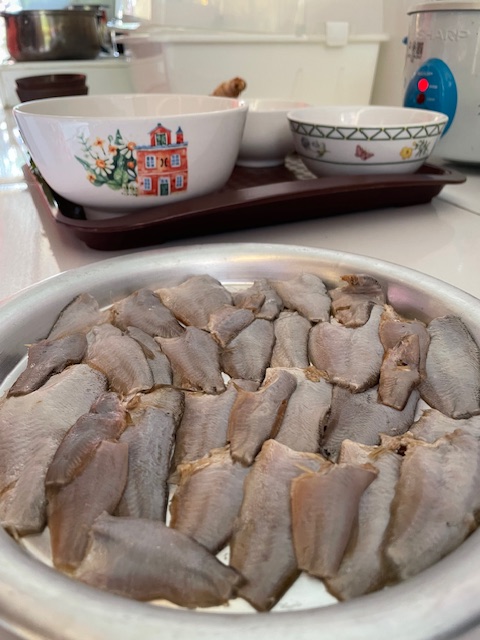
Towards the end of the process

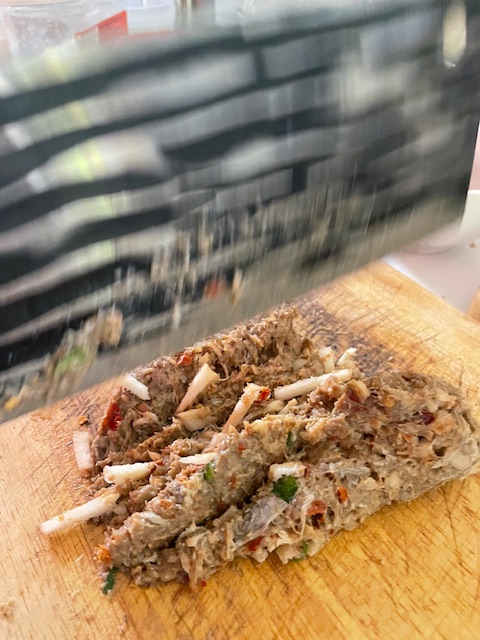
Lauren and I are working on our next cookbook, and just started testing recipes again — me doing the easy ones, Lauren stuck with the hard ones. One of the very easy ones I’ve tested is this pla rah sub (minced fermented Thai anchovy), which is also known among Isan-ers as jaew bong, and even larb pla rah. The only thing you have to do is put your back into it, literally, while you are chopping up this mince into beyond-tartare near-infinitesimal pieces. You want to think of yourself as a super-ninja dealing with their vanquished foe, but maybe that imagery isn’t very appetizing; think more super-ninja preparing a well-earned breakfast.

If you don’t like to make this yourself and live in Thailand (and why would you prepare this yourself, if you live in Bangkok or Isan), then get yourself to your local market or Bangkok’s Aor Tor Kor, where my mother’s favorite vendor sells a great version of this dish. No real need to turn your biceps into jelly unless you really, really need to!

Pla Rah Sub aka Jaew Bong aka Larb Pla Rah

Makes 4. You can eat this with sticky or regular rice, steamed and/or boiled veggies, any kind of fresh leaf like pennywort, mango leaves or even plain lettuce.

Ingredients:

1.75 ounces (50g) pla rah marinated for at least 6 months in salt (or anchovies)

2 tablespoons tamarind juice or crushed tamarind pods

2 tablespoons kaffir lime leaves, chiffonaded

2 tablespoons lemongrass, sliced

2 tablespoons galangal, sliced

2 tablespoons dried red chilies, sliced

1 tablespoons red shallots, sliced

1 tablespoons garlic, crushed

You can sear the pla rah lightly in a pan or use as is. Start by mincing finely with chilies, then add sliced galangal and mince further. The point is to mince it as finely as you can until everything is well incorporated and resembles baby food or a very fine tartare. You will notice that by now a nice, fragrant aroma is emerging from your mush. Add kaffir lime leaves and repeat the process. Then tamarind, then shallots. You are like Sisyphus, but with a cleaver instead of a boulder, and with the reward of a delicious dip at the end. Continue until everything is incorporated.

Scrape into a bowl and serve as part of an Isan meal of grilled meat, soup and sticky rice, or with fresh or boiled vegetables and eggs.

Leave a comment

Filed under Uncategorized