Glutton Abroad: Barcelona, Part 2

Poached egg over chickpeas and ham with summer truffles at Gramona’s family restaurant

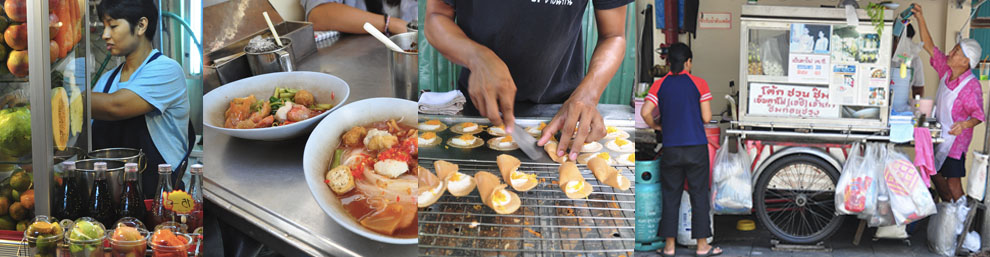
The piece of paper, hastily scribbled in red ink by Chef Jordi, read “12:30 Cerveceria Catalanas”. By the time we’d arrived (a wee bit late, I’ll admit), Jordi and his sous-chef Cordero were waiting near the front of a long, snaking line that double-backed on itself like the Chao Phraya River, in front of an unassuming building that resembled Barcelona’s answer to Kalaprapruek.

This was the famous aforementioned restaurant, representing a different facet of Jordi’s tapas vision: more mass-market, more commercial, way less expensive. According to Jordi, this was the kind of restaurant that might work in Bangkok: “Bread? Tomatoes? Potatoes? This costs very little to buy, but look at how much they are charging.”

Somehow, the customers queueing outside did not seem to mind that the restaurant was getting away with crazy profit margins. The restaurant inside was surprisingly spacious, made up of several rooms, all packed at Ikea-looking tables in a nondescript setting. There were nominal gestures at making the restaurant resemble a traditional tapas bar, with a “hot tapas” counter on one side of the entrance, a seafood counter on the other. The kitchen was made up of several sections, each catering to a different part of the menu — “meat”, “charcuterie”, “things on bread”, what have you. Each section numbered 2-3 chefs. This was less a restaurant and more of a tapas factory.

Taking one of the “daily specials” print-outs from the menu (“Here, it’s for you,” he said as he shoved this into my bag), Jordi said that specials changed every day, numbering enough dishes to make up the entire menu at another, lesser cerveceria. He ordered one special (a mayonnaise-y salad of crab and squid on toast with a pickle garnish) but mostly stuck to the classics for us: a tortilla, tomato bread with ham, and a beautiful mix of charred matchstick potatoes with a runny fried egg and more Iberico ham.
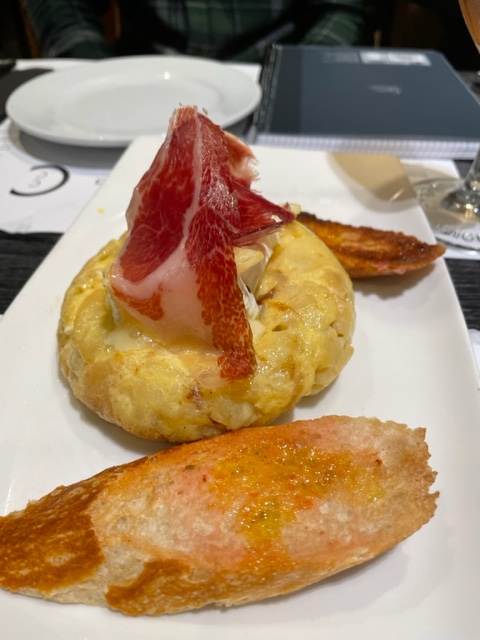
Tortilla with tomato bread
Potato, egg and ham

But we did not linger long over our meal here; ever mindful of the mammoth line growing outside, we left after half an hour, giving me barely enough time to finish my beer before we were back out into the street, Jordi hailing the cab like a lifetime New Yorker with a wolf whistle and a loud shout.

Our second spot was Paco Meralgo , sans the Jay Fai-like line of the first place, but buzzy in a different, quieter way inside. We shared a large table with another group of 4 and did not have to wait long until a procession of dishes arrived: the requisite tomato bread with vinegary anchovies; barely-cooked langoustines dressed in olive oil; baked baby scallops in their shells; raw, meaty clams; horned sea snails resembling the spindle that pricked Sleeping Beauty’s finger; green chilies that were thinner, longer and more pungent than the regular padron peppers.

Jordi showed us how to shuck the “Carril” clams by running our butter knives around the edge of the flesh, while we pried the snails from their horned shells with thick bamboo skewers (this one dish made me miss Thai seafood sauce). To end the meal, the proprietor brought out what was said to be the special of the house, cubes of juicy beef in a clay container, peppered with crisped garlic.

Noticing how I was relishing my langoustines, risking my dentist’s wrath by biting at its legs with my teeth, Jordi said, “You like this?”

“Obviously,” I said, langoustine fat in my hair.

“This is average,” he said. “Are you free tonight? I can take you to the seafood market. We can go at 2 in the morning.”

Now, I love seafood as much as the next person. But I am also 1,000 years old. I need 8 hours of sleep on average every night, which is why I am usually tucked up in bed by 10. In fact, my phone reminds me at precisely 9:14 pm to start getting ready for bed.

But a Michelin-starred chef was asking me to go to a seafood market open only to professionals for a personal tour. Was I literally crazy? Of course I would have to go.

“Can we go tomorrow night?” I asked. “We have to go to Gramona early tomorrow morning”.

Jordi laughed, recognizing that it was ridiculous I was not jumping at the chance to go to the seafood market immediately. “No,” he said. Then he smiled. “OK.”

Our trip to Gramona had also been arranged by our friend Jean-Claude, who, it turns out, is one of their global ambassadors. We had no idea what to expect, but the company had been kind enough to send a car to pick us up, with the added bonus of getting to listen to Simon & Garfunkel the entire way there.

When we arrived, the main viticulturist, Jesus, met us, a warm, genial man who remained friendly even as my son sulked and pouted his way through the vineyard tour. The vineyard was a marvel, having become completely bio-dynamic over the past decade, with horses to work the fields, sheep to help eliminate the weeds and terrifying geese to guard the vines. Every year a man arrived with falcons to keep grape-loving sparrows at bay. The “pesticides” used were completely plant-derived.
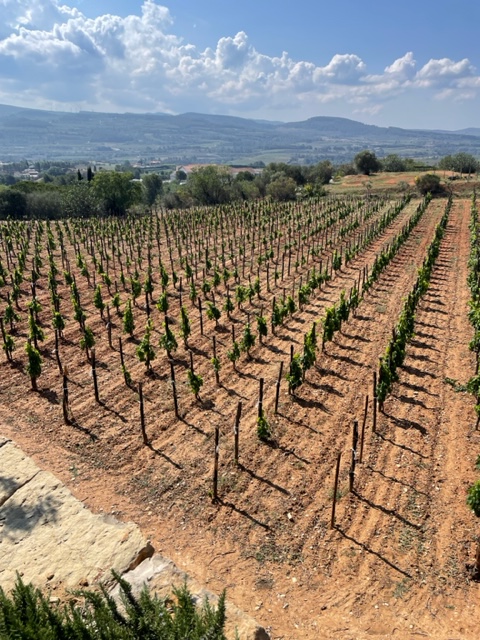
And it was clear that, if there was a man born to grow things, that man was Jesus. He explained that every plant had its own personality, and that a successful grower had to recognize that. “Some plants are productive, some plants are lazy,” he said. “You have to know how to deal with them like people.”

Later, Jesus takes us to what he calls a “nursery”, where young plants are being trained to grow upright, their stems still spindly and small. Some have had the temerity to grow a few grapes, but Jesus says those will have to be clipped. “Their energy needs to be focused on growing up,” he said. “They are not ready to be productive yet.”

All the same, Jesus too was seeing changes to the vineyard wrought by climate change. “The Chardonnay, the Pinot Noir, I don’t know if we can keep growing it,” he said. He showed us a field where the plants looked stunted and gnarled. “These plants are fighting for their lives because they are malnourished,” he explained, adding that rainfall had lessened by more than half over the past three years. “They are doing everything they can to just survive.”

All the same, other plants thrived. When we get to the main chateau, workers are busy harvesting what looks like an entire grocery store shelf of onions. An enormous mastiff pads over to look. A cat, recognizing that my husband is allergic to it, immediately sits on his lap.

Harvested onions

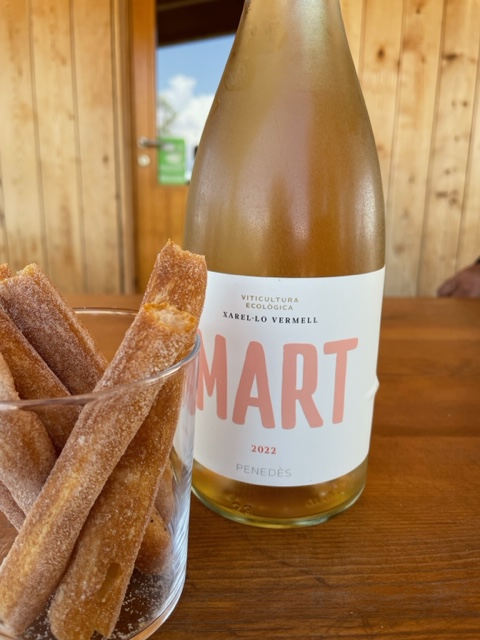
Jesus pads out with a bottle of wine and breadsticks that we immediately devour, as my son sits at a separate table out in the sun, intent on showing his displeasure with our activities. “He isn’t a productive plant yet,” I say, and Jesus laughs.
Before we leave, Jesus takes us to the chicken coop, where he literally lifts plump black hens from their nests to collect the eggs underneath. When he hands them to me, they are still warm from the chickens’ butts. It was one of the best gifts I’d ever received.

2 Comments

Filed under Uncategorized

Glutton Onboard: Disembarking in Barcelona (part 1)

Preparing octopus for the midday rush at Bar Pinotxo

There are cities where you will never feel at home, no matter how often you go or how much you like the friends you have there. San Francisco, unfortunately for me, is one; London is another. As nice as Cape Town seems, I wanted nothing more than to get back onto my ship and sail away; I felt the same way about Charleston, South Carolina, but in that case, it was fleeing by car and Karen was the one who was driving. Some cities just don’t feel right, like you always have to be on your guard, like shoes that are a little too small.

And then there are the cities where you just feel at ease, no matter where you wander. Barcelona is one of those cities for me. The buildings are beautiful and the people wear colorful clothing. The weather is mostly sunny and everyone is for the most part generally friendly. As for the food, well…enough said.

It’s just a shame that I was hoping to lose weight here. After five and a half months on a ship and even longer away from home, I am now the biggest I’ve been since giving birth to my son 13 years ago. My husband has now taken to reflexively patting his bulging belly, which we refer to as his 8-month food baby, whenever he is deep in thought. We are in dire need of a diet.

But Barcelona just won’t let that happen. I don’t know if it’s the result of having been cooped up on a ship where the croissants taste like they came from an airport kiosk, but the bread here is the most delicious manna from heaven that I’ve had in ages. Ditto the olive oil. Then there are the tomatoes. Will this city not just let us be?

We get our first taste of Barcelona where we always do, at La Boqueria market. It has gotten to be a massive tourist draw since I was here last, only 6 or 7 years ago, where the famous Pinotxo Bar was only selling coffee and cream puffs, or xuxo de crema, in the morning. Now there’s a whole bar-long display of food and a full tapas menu offering the usual suspects like pan de tomate and ham, sandwiches, and Russian salad, alongside more unusual dishes like braised bull’s tail stew.

There are now a plethora of other shops selling ready-to-go food arranged in impossibly beautiful ways: olives and peppers skewered to resemble bouquets, slices of meat made into edible blossoms in bowls, and cones of ham and sausages just about everywhere you look. Razor clams and limpets are packaged separately with little wooden forks and wedges of lemon. Figs and avocados are lovingly wrapped individually in big green leaves and displayed like jewels. There is no way you will not be dazzled. I made it out of the market with a box of spicy olives, a wedge of cheese with quince jelly, and a clutch of sausages and pre-sliced ham and considered myself lucky. You can do real damage here.

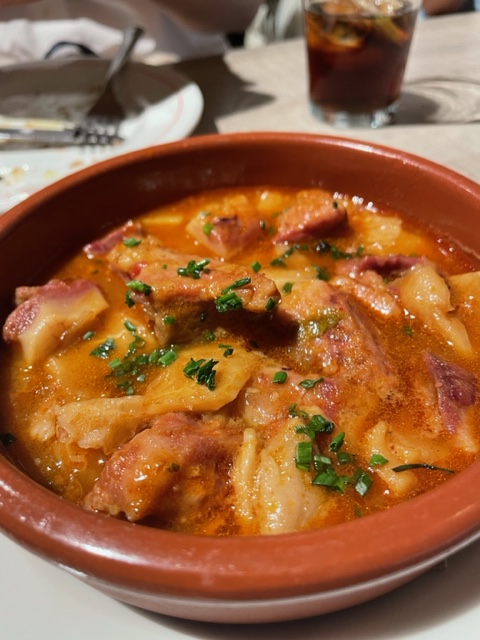
Tender tripe at Madre Taberna Moderna

But little did we know the serious damage (to our waistlines and our wallets) that was to come. After yet another pleasant lunch at Madre Taberna Moderna, we found ourselves at Nectari, recommended to us by our new friend from the ship, Jean-Claude. When we arrived, we knew nothing about what we were going to get; Jean-Claude had simply said that Chef Jordi would prepare something for us.

We arrived, as always, a little early (Karen says our family motto is “Hurry up and wait”) and consoled ourselves with a trip to the fruit stall next door, where I bought avocados, extremely fragrant red onions, and a handful of very sweet mini-plums and mini-pears that looked made for little forest sprites.

Baby pears

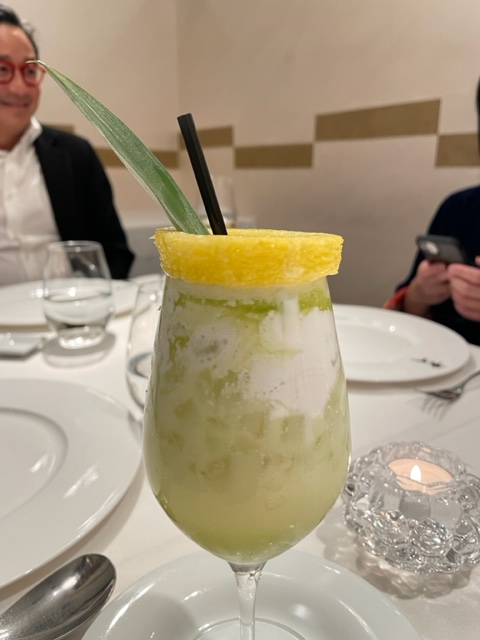
Jean-Claude had made us a reservation at the very unSpanish time of 7:30pm; unfortunately, the restaurant doesn’t even open until 8pm. Luckily, the very accommodating waitstaff allowed us to wait inside at our table. They even attempted to make my son his new favorite drink from the boat, a virgin pina colada (in spite of, I suspect, having never clapped eyes on one before).

Their virgin pina colada

We then met Chef Jordi Esteve, who told us that he wanted to show us his vision of what high-end tapas could be. The meal that followed is one that I can honestly say had its highs and lows: the highs, some of the best bites of food that I’d had in years; the lows, the fact that there was just so much of it. I am not as young as I used to be, and I now have to mentally prepare myself for meals spanning more than 4 courses. I lost track of how many courses we had. I do know that, towards the end, if we were indeed living a high-concept horror movie and being fattened for the kitchen, I would have willingly submitted to the knife and the culinary ministrations of our skilled chef. I was that full.

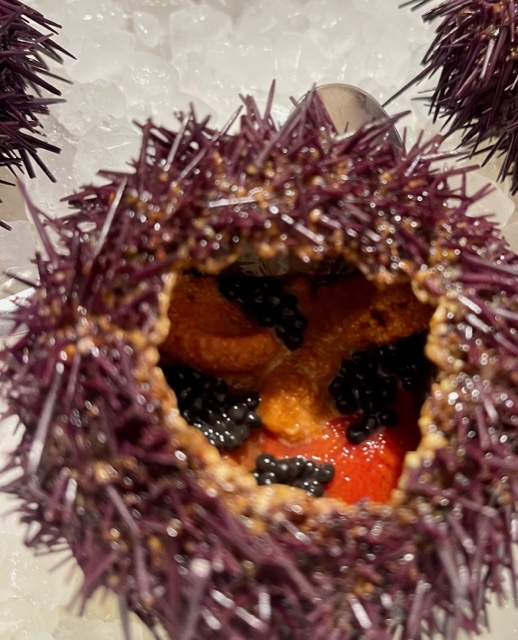
I cannot document everything we had — there were croquettes filled with a chorizo cream, and a Russian salad topped with caviar — but the things that stood out were numerous and varied. There was fresh endive topped with juicy white asparagus, mayonnaise and sea urchin; later, we had that sea urchin alone, topped with more caviar.

There were tiny razor clams in fragile shells so delicate that they were almost see-through, while the meat inside was tender and strangely peppery.

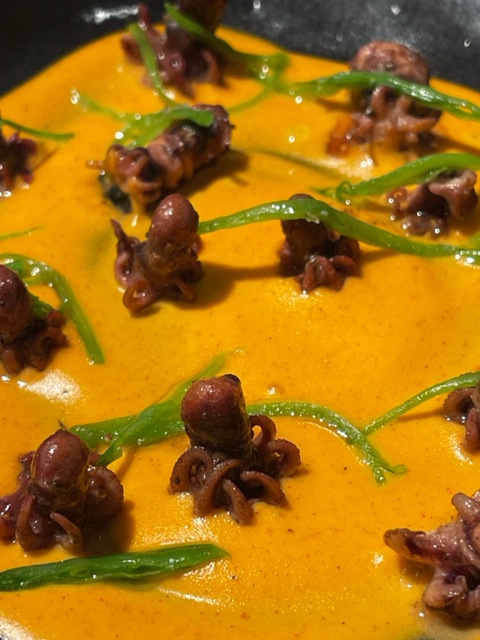
In a course that I described as the “baby” course, Chef Jordi brought out a plate of tiny smoked baby octopus, adrift in a chorizo cream and enmeshed in tendrils of samphire.

At the same time, we also had plates of Spain’s famous baby eels atop a perfectly fried egg in a garlic cream.

Of course we had paella, but in mini-pans, garnished with the fatty underside, or double chins, of fish, breaded and deep-fried.

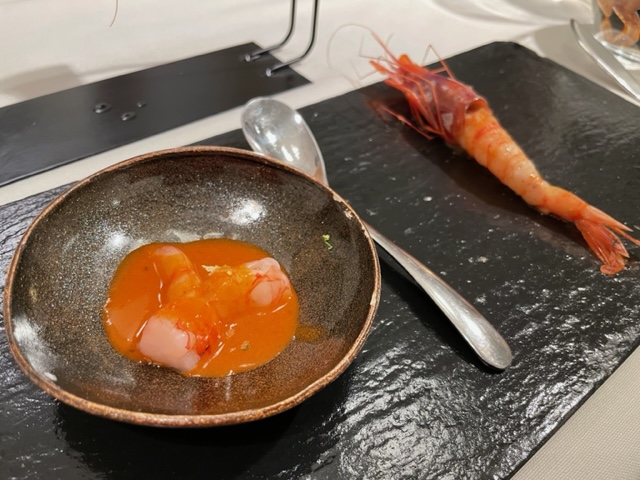
But the dish that blew my mind arrived with this “plancha” of raw red shrimp from Galicia: the raw shrimp head, simply garnished with a dollop of caviar.

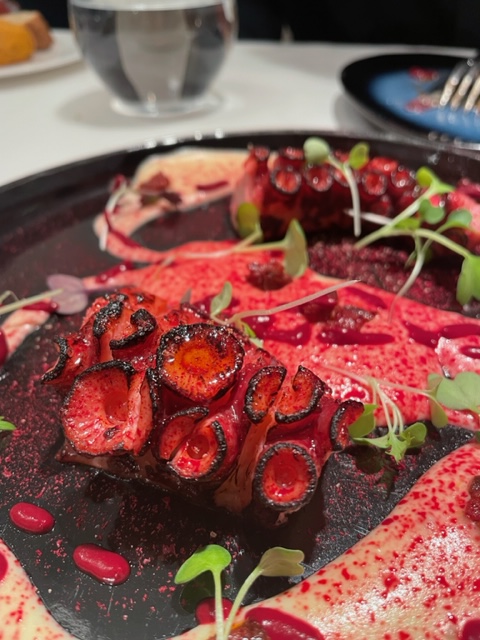
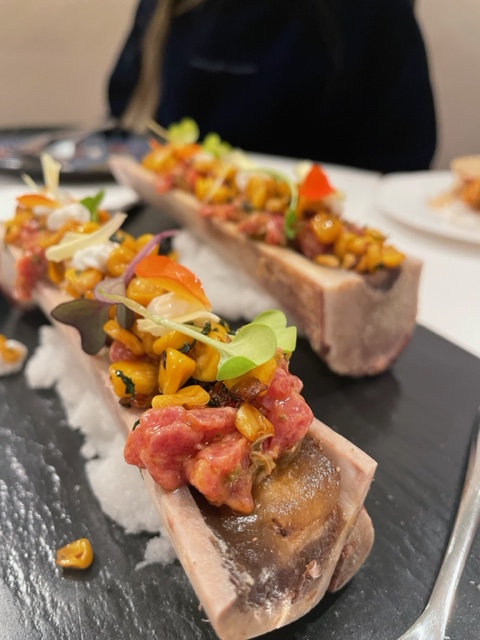
So fresh, so sweet was this dish, I became a convert to Spanish red shrimp for life. But alas, I was emotionally (and physically) spent. The next course, a beautifully seared octopus, as well as the one after, a beautiful steak tartare plated on a perfectly grilled tranche of bone marrow, were only tasted out of a sense of duty.

At the end, the only people able to have the playful golden “hamburger” dessert with raspberry “ketchup” and passionfruit “mustard” was my daughter. It was, I must admit, a terrible shame. But then Chef Jordi offered us a chance to redeem ourselves, by promising to take us out to his favorite tapas places the next day. This time, we would know to arrive very hungry.

12 Comments

Filed under Uncategorized

Glutton Onboard: Into the Mediterranean

Olives at the market in Agadir, Morocco

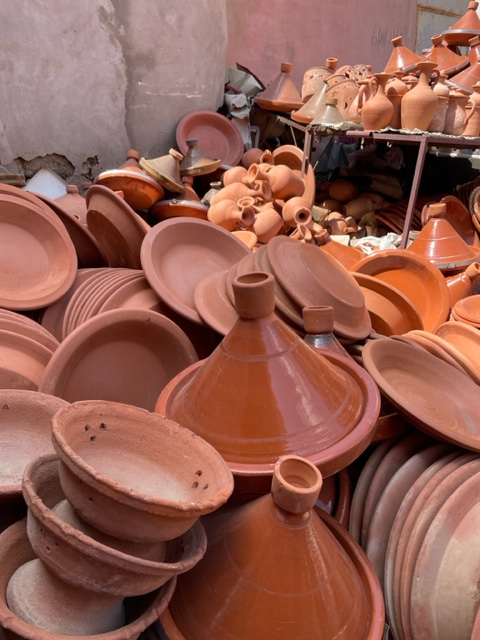
In Morocco, it’s impolite to eat with your own little plate. Everyone must eat together from one large platter, typically a tagine, where the food is cooked over charcoal. These tagines are typically made of clay, because Moroccans feel that is healthier than glass or steel. All of their kitchenware, including the double-handed long-necked containers they use to keep olive oil, are made of it.

A tangle of cookware in Taroudant

Because meat is valuable, it is nestled in among the vegetables — the potatoes, the carrots, any green and leafies — and eaten only after the patriarch breaks it apart himself, dividing it into equal pieces for every member of the family. Everyone eats with their hands, in a circle. Moroccans believe it is a way to strengthen bonds between family members and friends.

I’m thinking of this because Thais eat in a similar way, from common plates set in the middle. No one has their “own” tom yum soup, for example, and absolutely no one orders the same curry, eating it from a platter set in front of them like the biggest Cheesecake Factory entree ever. I’m also thinking about this because in Spain, there are a lot of plates. Small plates, even. You might have heard of them? They are called tapas.

Toast with sweet breadcrumbs and pork belly in Alicante, Spain

Yet tapas also serve as a social glue, probably because they are more often than not accompanied by a lot of wine. You can’t go anywhere in Spain without a tapas bar or two on every block, featuring at least one table of boisterous guests laughing over glasses of beer or, if they’re a tourist like me, red wine sangria. All the same, our tour guide warns us that bars with large photos of the dishes out in front, accompanied by large signs, are places to avoid. I think eateries back in Thailand that look like that should similarly be left alone.

Granada, in southern Spain, is an interesting mix between the Moroccan and Spanish philosophies, having spent a long time under Muslim rule. Its last Muslim rulers, the Nasrids, commanded the last Muslim state on the Iberian peninsula before being taken over by the Catholics in 1492 — but not before leaving Spain with The Alhambra, a gorgeous testament to 16th century Moorish architecture and alternately (with the Sagrada Familia in Barcelona) the most-visited site in the country.

Getting a closer look at the tiles

Like in Morocco, the beauty of a place is hidden behind a mostly plain exterior. I’ve been told many times that it is to keep neighbors from feeling jealous, but I liked our Alhambra tour guides explanation of Muslims being introverted better. I also liked that the complex was made of mostly humble materials: local stone, local wood, even stucco, which through sheer skill was made into a thing of beauty. It must have been a beautiful place to live in at its height in the 16th century, and I understood why the Nasrids would spend so much money to bribe the Christians into staying away. Unfortunately, they did not stay away forever; our guide said that when the Nasrids started planting orange trees, everything started going wrong for the kingdom. The orange trees are still there, but no one eats the fruit.

At least they left behind their food. At Jardines Alberto, you can order their entire roster of Nasrid dishes, as well as a whole other list of what they call “local cuisine”, which is apparently different from Spanish food in general. One of these “local dishes” was an unusual salad of steamed codfish with potatoes, black olives and slices of the aforementioned cursed oranges, harbingers of the Nasrids’ fall. This being Spain, it was all topped with a hard-boiled egg.

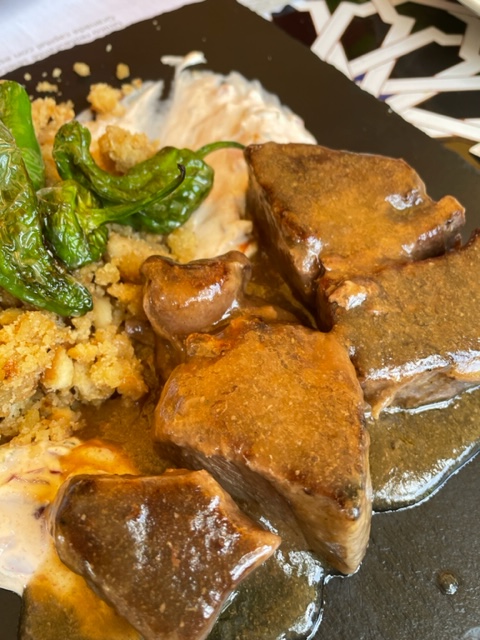
But back to the Nasrids. We ordered a fresh spinach salad scattered with cubed cheese and raisins, and a dish called “vizier’s lamb”, a slow-cooked boneless lamb leg paired with a mountain of breadcrumbs for texture and a mild yogurt sauce. If you just pictured Jafar from “Aladdin” eating this lamb dish, you aren’t alone.

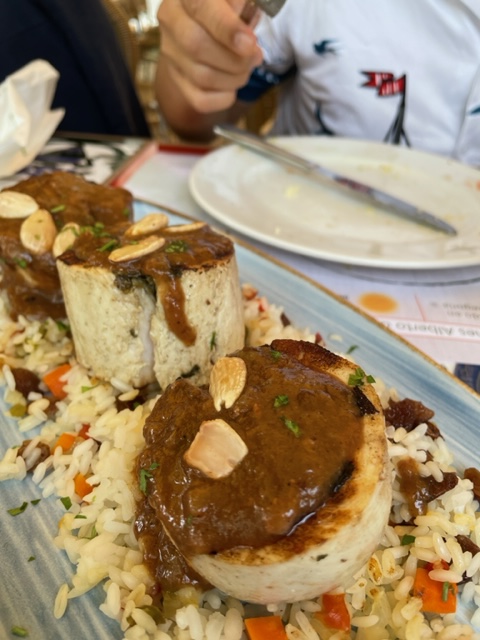
But the specialty of the house is the “Nasrin-style chicken”, tender ballotines made of the breast and stuffed with spinach and garnished with almonds and a honey sauce.

Was it something I’d go back for? Well … no. It looks like I prefer the Christian Spanish food. But it was the perfect punctuation mark to a day full of history, the remnants of a fallen kingdom, left behind for people to share over a common plate.

3 Comments

Filed under Uncategorized