Loei seems like a wild place — even its very name means “beyond” — but it is in actuality very charming and slow. The forests are green and dense, yes, but the mountains are mostly rolling, never imposing, their sides sprouting trees from which all manner of good things grow, like wild tennis-ball-sized guavas (good if you can get beyond the bitter seeds), dragonfruit, and the region’s peculiarly long avocados.
If you know your stuff, the deep forest itself can yield a whole bunch of yummy things to eat as well. This is what we discovered when we initially made plans to go to Namthok Tarnthong, which, while nowhere near its strongest (that would be from August onwards), still presented something of a roar when we veered into the parking lot. But what was meant to be an attempt to dip our toes in some water came a cropper when we were diverted by the parking lot itself, lined with enterprising ladies selling the things they had gathered in the woods only that morning. There were nuts like hazelnuts, encased in a paper-thin skin that rubbed off when you handled them, and of course, the ever-present “exploding mushrooms”, or het pro, which I love when stewed.
Later I would buy a bag of these, only to leave them in my mini-fridge in an Udon Thani hotel room
There was also a large cache of lychee-like mountain “berries”, which Aarya characterized as sweet-and-sour.
We did not buy these
But what ultimately made both Aarya’s and my heart thump padum padum were the mountain mushrooms on display by a couple of vendors towards the end of the line. Indeed, we got so excited that we bought them all without really knowing what they were.
Something orange
Something brown
It was only after we had sped out of the parking lot, booty in tow, that we realized … shit. What now?
Aarya’s friend to the rescue. She had gone to school with friends in Khon Kaen and, unlike me, had kept in touch with them all these years, including a few in Udon Thani where we were fortuitously headed. Could they actually knock something up with these forest mushrooms that we had impulsively purchased?
The answer is: of course. They were so lovely that they asked us to leave our mushrooms at the front desk once we checked in, so that they would have enough time to cook them. They made reservations at a restaurant serving local food that they liked, ChabaaBarn, and told us to expect our mushrooms there.
A few hours later, they did not disappoint.
Meaty and fragrant with Thai lemon basil, with just a hint of pla rah in the broth, the mushrooms were delicious, though I must admit I found the brown ones a little bitter. It was the kind of stew that would only improve with time (then again, what good stews don’t?)
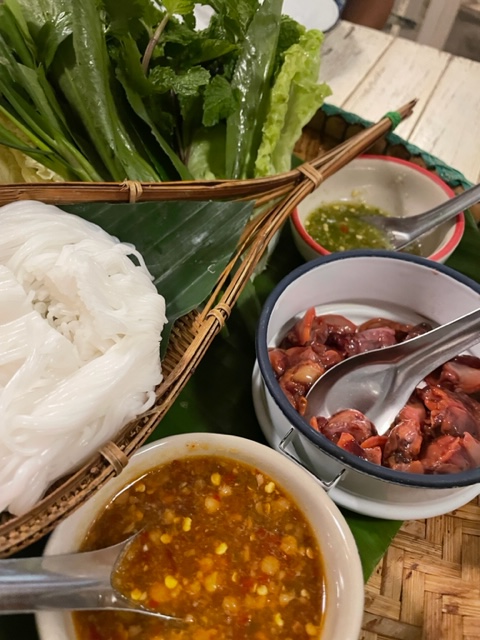
Even more of a revelation were the recommended “Udon Thani” dishes they ordered to accompany the stew, like a frankly delicious chili dip pounded from local water olives and the signature heart cockle miang to be eaten like a grilled fish “miang” would be: stuffed into a leaf with fermented rice noodles like a taco and doused in one or both chili sauces.
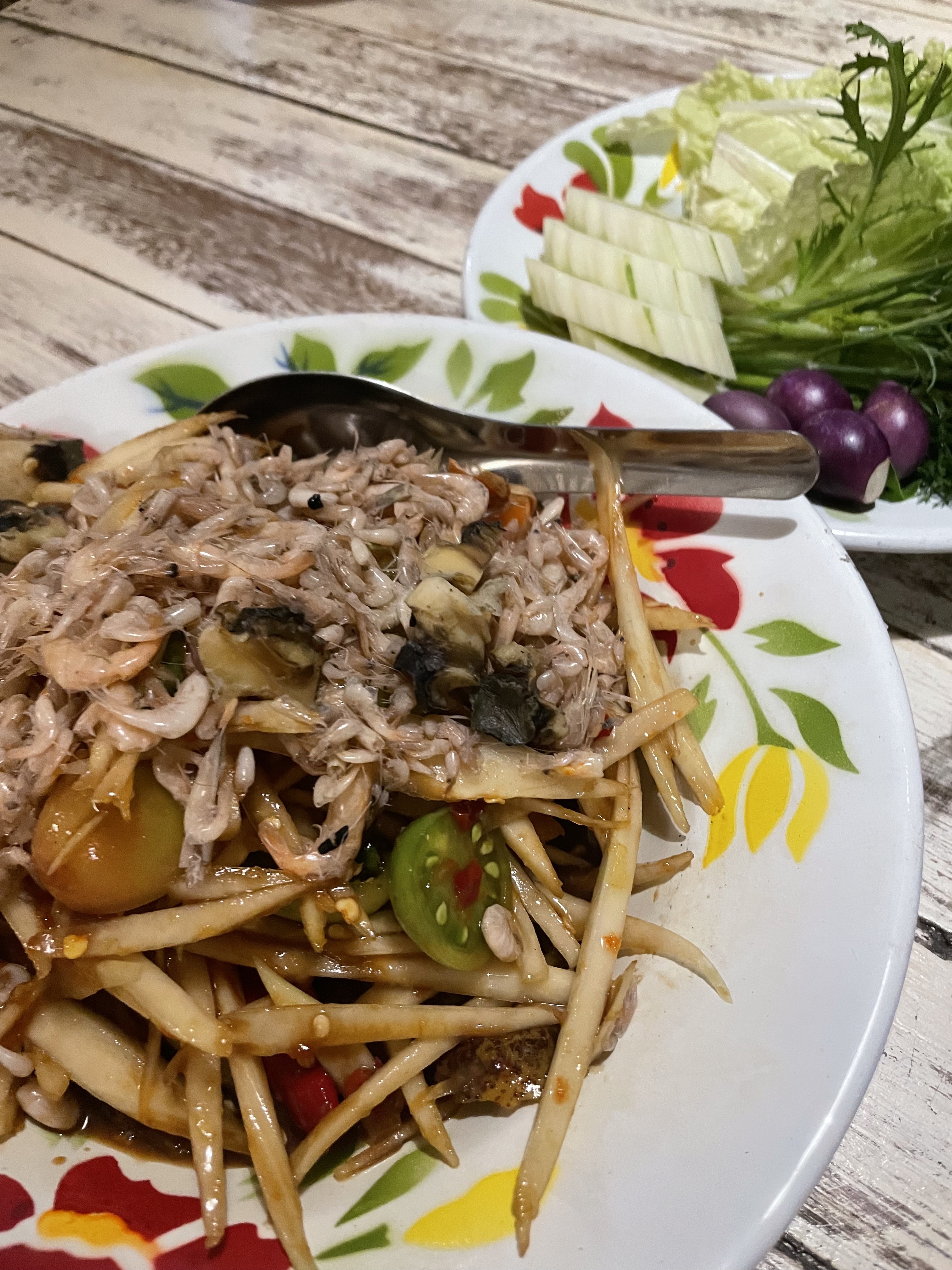
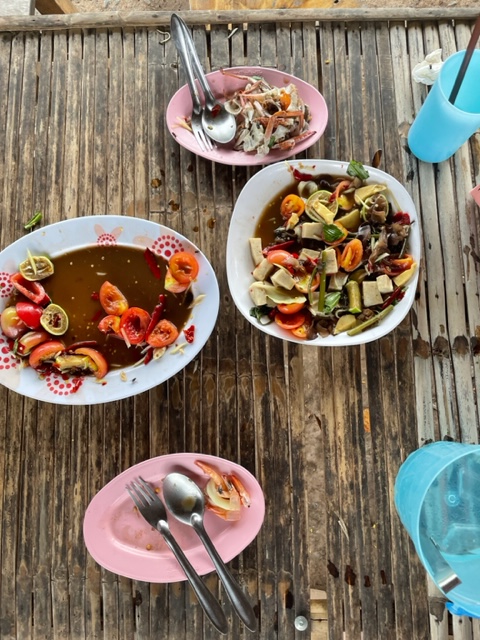
We struggled between choosing a som tum of cut fermented rice noodles or a presumably “Udon Thani”-style one slathered in tiny freshwater shrimp from the river, and ultimately chose the latter.
And, although not really local,, we just had to have the duck larb.
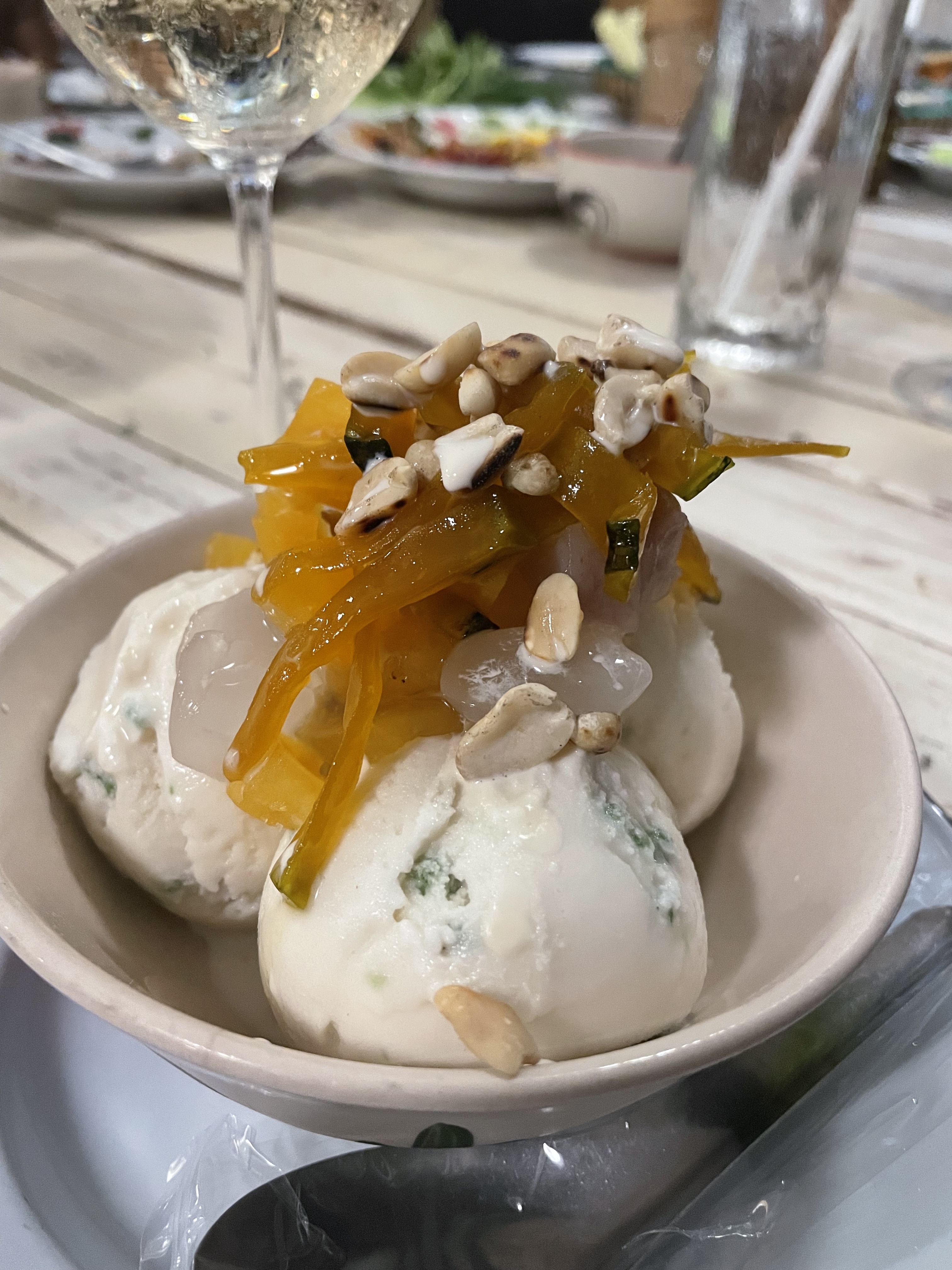
The food and company were so good that I did something that I never do: order dessert.
Shrimp fritter and a local fish larb on the Mekhong
One of the things about turning 50 is seeing — or I should say experiencing — how quickly my eyesight and hearing have deteriorated. Even restaurant menus are beyond my purview; when the lettering is too small, I have to straighten my arms to read, only to discover my arms aren’t long enough. It’s unsettling, after all these years, to not know exactly what you’re going to eat, or to not have a handle on all the dishes available to you.
My hearing is another issue. People frequently say things to me either too quickly or too softly, and I’m pretty sure the problem is with me. This makes me quite angry. But my anger isn’t because I can no longer hear what other people are saying. It’s because people still feel like they have to talk to me in the first place.
All the same, I was excited when I heard from Aarya that she was going to show me her “hometown” in Loei, on the banks of the Mekong River, a place I had never been. So when Aarya invited me on a road trip of her province, I put on my fat pants — which are now just my pants — and followed her there.
We met at the airport, where she picked me up in her blue pickup. We had a big day ahead of us, so we headed off immediately to our first destination, Pa Hin Ngam National Park. Perhaps stupidly, I had not yet eaten breakfast, so I was eager to see the options when we got to the park entrance. Alas, there were none. After traveling a further 2 km and parking in front of a mountain with a rambling metal staircase built around it, we found a bunch of vendor stalls selling piggy banks made out of bamboo, a coffee stall with great iced tea served in a bamboo container that we could take home (there was a lot of bamboo), and a natural medicine vendor who let us sample his “sore throat” tea, but really had tea for every possible ailment: period pains, headaches, arthritis, even hemorrhoids.
But no food … though we did discover an elaborate shrine (including clothing rack full of dresses) set up for the spirit of the mountain, whom, the coffee vendor told us, she’d dreamed of only the night before. “She’s very pale and so so tiny,” she said, describing the spirit’s appearance, which conveniently lined up with the statue of her at the shrine.
Maybe I would get lunch at our next stop, the “Mt. Fuji of Loei” only 15 minutes away. We piled back into our car and drove to the visitor’s center, where there was an “aharn tham sung” (made to order) and noodle stall. Alas, Aarya had no confidence in them. “Let’s wait until the next village,” she said. “They just opened yesterday.”
On the way up the hill, taken by a repurposed tractor with seats added onto the back and in the front where the plow used to be, we passed by avocado, guava and dragonfruit trees, and our guide even let us pick some of the wild guava — shaped and colored like a tennis ball — to taste. They were full of seeds which were a bit bitter, but the flesh itself was fragrant and wonderfully crunchy. We picked a bagful to take home to Aarya’s mother. The trek itself up the hill, made up of three “checkpoints”, was fun if a little alarming in our tractor.
But still no food. So on our drive to our third stop, Phu Kradueng, we insisted on stopping in town — only to discover it in the throes of a rocket festival, a huge (for the village) procession blocking the road as “mor lam” music blasted from the speakers of a truck.
Making merit with dancers and rockets in thanks for the rainy season
When we finally did make it past the procession (after busting some of our fave Thai dance moves alongside a man dressed as a nurse, a woman jabbing a faux penis on a stick into the sky, a couple of children, and a happy monk) everything was closed except for a restaurant called “Thum Loei” which served, obviously, som tum.
The remains of the servers’ lunch
So we of course ordered som tum, a local pad mee (fried noodles) and kanom jeen sot (fresh fermented rice noodles with a dipping sauce) as the sky opened into a downpour and an enormous spider the size of my hand scuttled down the wall behind Aarya.
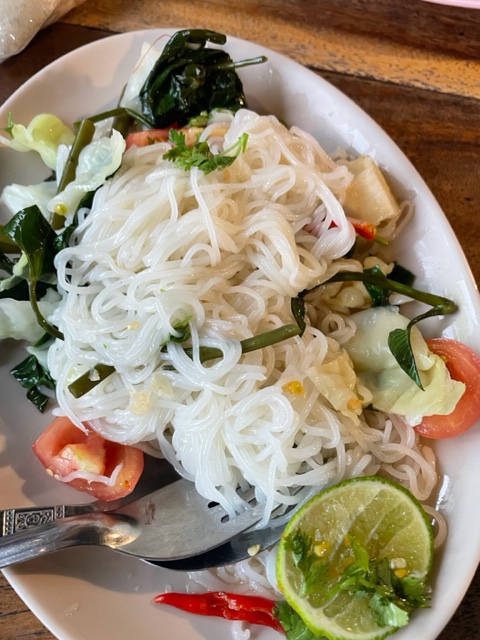
But we were finally getting our food. Our som tum arrived, funky and fresh if a little sweet, as did our Loei-style noodle salad (which we had to send back for more lime juice because frankly it was super-candy-like-sweet):
A post-mix kanom jeen sot
We also had a dish that Aarya says is served all over Isaan in different iterations. Here, it was comfortingly plain, a nice foil to the spice of the other two. Aarya says that her mother makes it with local deep-fried catfish at home, and I was excited to try that for myself.
Pad mee
Heading North towards the river the next day, we made it to the border town of Ha Haeo, where we were told the bridge — rickety, wooden, the kind you see in your nightmares — had been washed out by the rains.
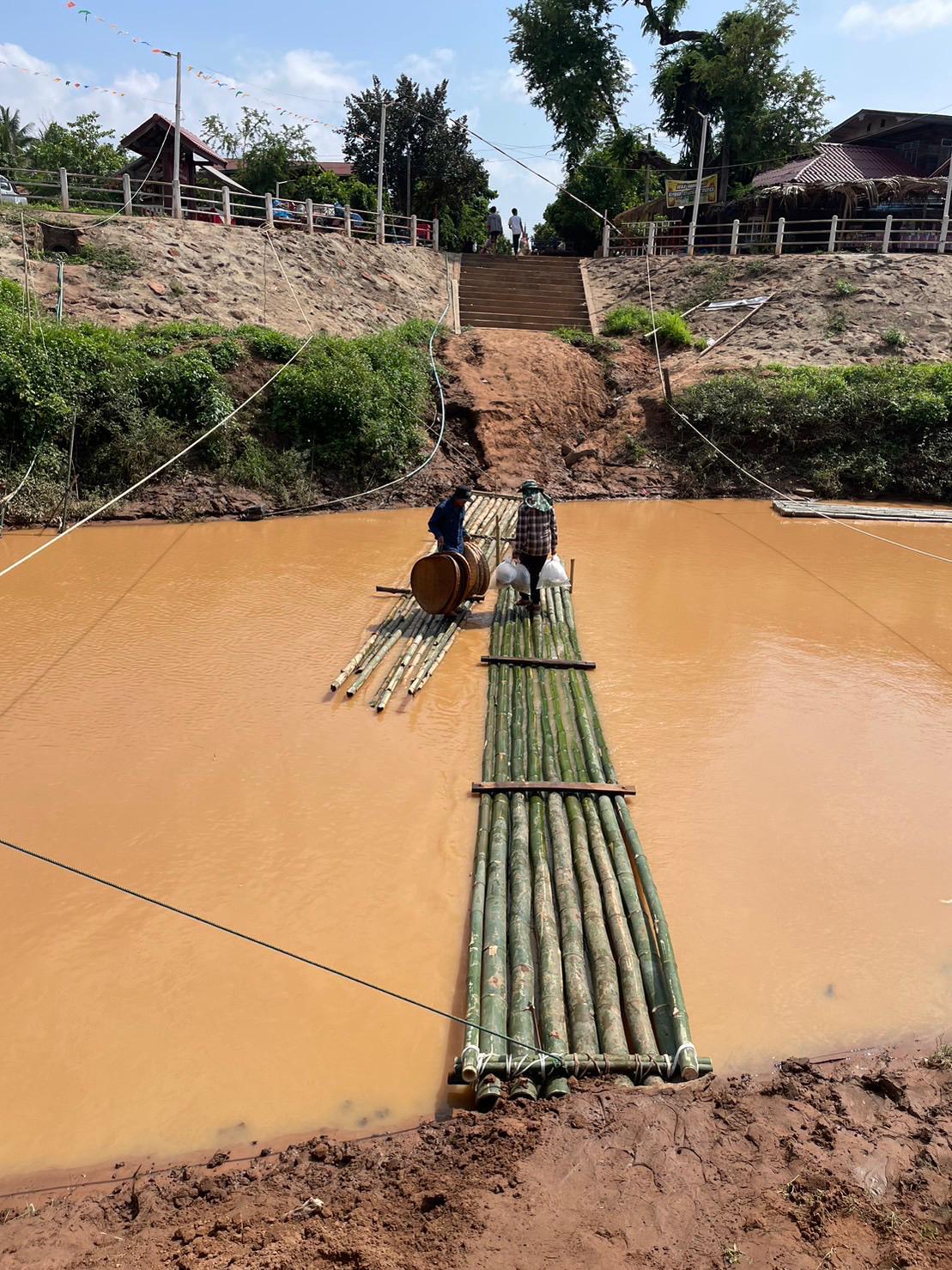
Luckily for us (they said), there was a bamboo “raft” that people were using to cross the river at another juncture. Little did we know that they really did mean a “raft” (or should I say “two rafts, requiring the dexterity of a teenaged gymnast”?)
Obviously, I made such a fool of myself screeching as I teetered over the water that a Laotian woman took pity on me and ushered me to the other side. When we got there, we paid a border crossing officer 90 baht each and were left to our own devices. We were in the middle of a sleepy village where a few people were grilling meat over charcoal as a few others halfheartedly attempted to sell things. A temple, decorated with hand-drawn murals depicting village life (including soldiers and government officials) was the main draw here. Luckily our breakfast awaited just steps away: what Aarya called “pho” and what we just call “guay thiew”: a heaping bowlful of it, leavened with freshly picked morning glory and plenty of Lao Beer to fortify us for the walk back.
Pork pho in Laos
Selection of Beer Lao
Aarya was understandably nervous and, as she had decided to buy a whole case of Beer Lao, two bottles of whisky and two bottles of village-made “lao khao” (white spirits), decided to pay our obliging salesperson to carry the items across the river so that we could edge our way, slug-like, along the raft on our own. It was 10:30 and they were preparing to get rid of the raft, so it was urgent work. That was when, after we had basically crawled across step by agonizing step, we discovered that the water was only knee-high; our salesperson had simply hiked up her sarong and crossed the creek on foot. So much for the raft. It was our first experience with the border crossing in Loei.
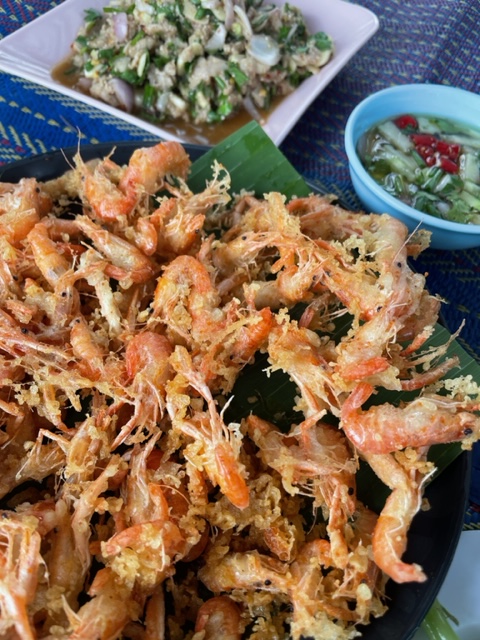
We had better luck later on along the Mekong, a mighty stretch of ochre-colored water across which Laos was clearly visible. At a collection of seafood restaurants specializing in pla nam khong (the local fish) and freshwater shrimp, we stopped at a restaurant advertising its “dancing shrimp” (a spicy salad of live baby shrimp — sorry — with lots of chilies and garlic) and enjoyed a leisurely afternoon by the water with our lunch, happily not balancing over it on a flimsy raft made of lashed-together bamboo.
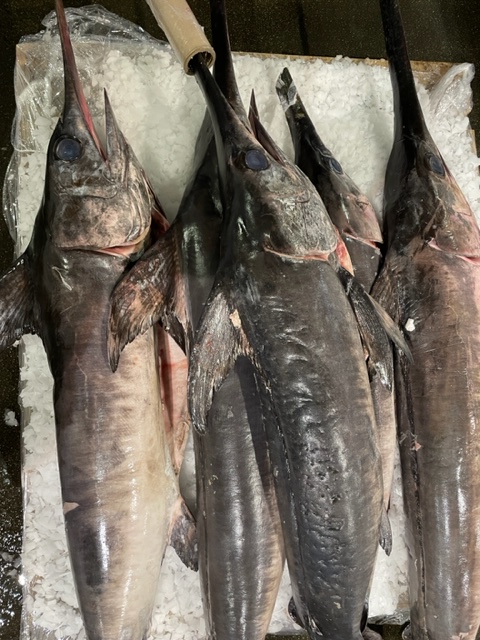
Whole swordfish for sale at Barcelona’s commercial seafood market
I stayed up late after returning from Gramona, mainlining coffee and watching “Below Deck” on the couch in order to stay awake. It was imperative for me to make it to the seafood market, if only for the bragging rights of being able to say I went to a market that would be closed off to me under normal circumstances. I imagined that once we got there, we would simply browse through the merchandise as Jordi explained to us the different types of seafood from around Spain. I did not expect to have one of the greatest meals of my life.
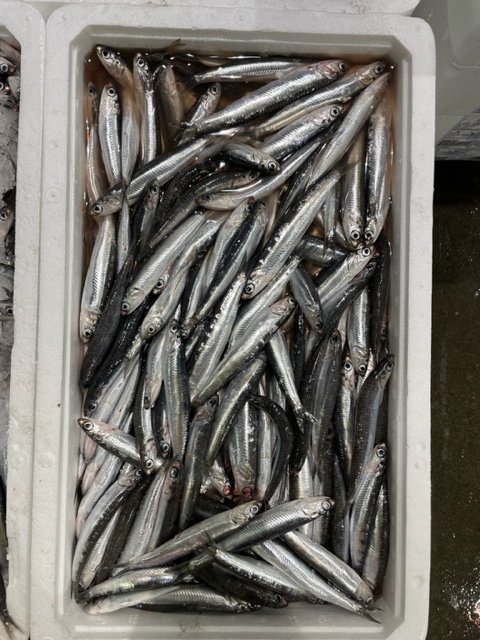
Cordero, who originally hails from Bolivia, said to me that his trip to this market truly opened his eyes to the breadth and variety of seafood available to Barcelona. What I will say is that, although we Thais are quite spoiled, seafood market-wise, Barcelona’s is a great market, full of great products from all around the world — Icelandic salmon, Maldivian tuna, local sardines as glittery as any jewel.
We arrived at 2 in the morning, and although the market was presumably in full swing, the walkways were mostly taken up by beeping box-movers (I do not know the term for this vehicle) and the occasional roaming pack of smoking men. There were no lookie-loos besides us, as entrance is supposed to be strictly limited to people with a professional badge. All the same, they did not give us trouble in spite of the fact that we were very obviously tourists, here to get in everyone’s faces with our idiotic questions and invasive iPhones.
Jordi explained that he expected us to choose what we liked best out of the floor, and then we would take it upstairs to be cooked at one of the three tapas bar/restaurants upstairs (Jordi preferred the middle one). But in doing so, we would have to walk the expanse of the market, which was roughly the length of two football fields. We saw various large tuna in different stages of breakdown; countless big cuttlefish in their ink; and Jordi picked up a few feisty lobsters — one from France, one from Canada, one from Spain — to demonstrate their desirability. He then showed us how to pick a good fish with various snippets of advice, some of which we already knew (bright eyes, red gills, shiny, non-slimy scales) and some that we didn’t (picking up a fresh fish and it remaining somewhat stiff is the sign of a strong swimmer with good and delicious muscles).
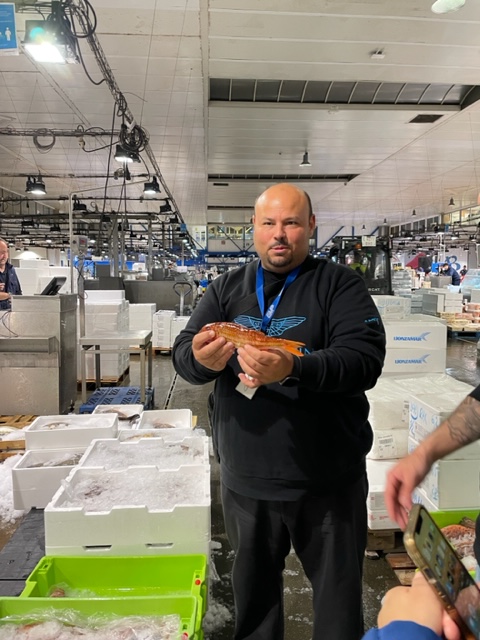
Jordi discussing the merits of this channel rockfish
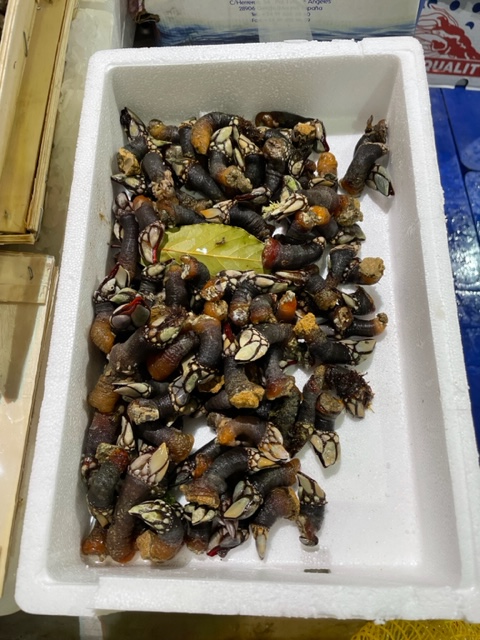
All the while, Jordi is greeted by various people who seem delighted to see him, and we have to wait more than a few times, shuffling uncertainly from foot to foot in our cold-weather jackets (the temperature inside is understandably brisk), as Jordi discusses this or that manner of business with one of his many market friends. It becomes evident that we need to make a decision as quickly as possible, so I point to the limpets — known as “lapas” in Spanish — and say, “What about those?”
Jordi seems less than enthused, but picks one up for me to suck at. “Do you know how to eat these?” he asks, and to be honest, I think I’ve had them before, but I don’t remember. Right there on the market floor, he breaks off the “horned” part of the limpet before handing it to me, instructing me to suck the coral-colored stuff inside the rubbery “stem”. As for the scaly cloven side, he tells me to break it apart with my hands, picking at the pink meat with my fingers. It is all very sweet and indescribably fresh. There is juice on my face and hands. I look around for a trash can. There isn’t one. Jordi tells me to just drop the remnants onto the floor.
He directs my interest instead to the langoustines, which we tried yesterday and which Jordi declared to be “mid”, as the kids would say (I spent 6 months with kids, so I know all about “mid” and “riz” and am now cool by association). We watched a seller “unpack” langoustines from Scotland by picking them, live, from tiny tubes lined in paper like candies, tossing them unceremoniously into a bin on the floor. Jordi picked one up, showing me how to run my finger along the shell: “It needs to feel smooth, not slimy,” he explains before bending the langoustine a bit to show the skin underneath the rim of the shell. “The meat needs to be thick and strong here, or when you cook it, it will break apart. This langoustine is no good,” he declares, tossing it back into the bin before the vendor picks it up himself, breaks off the head, sucks the head, and peels the tail to enjoy as a sort of mid-early-morning snack.
We decide to follow suit, picking up langoustines that Jordi deems much better, like the one above. There is obviously something transgressive about eating a vendor’s wares raw right in front of him, but the taste of the langoustines made it worth being rude: the tail sweet and briny, the head like good sea urchin.
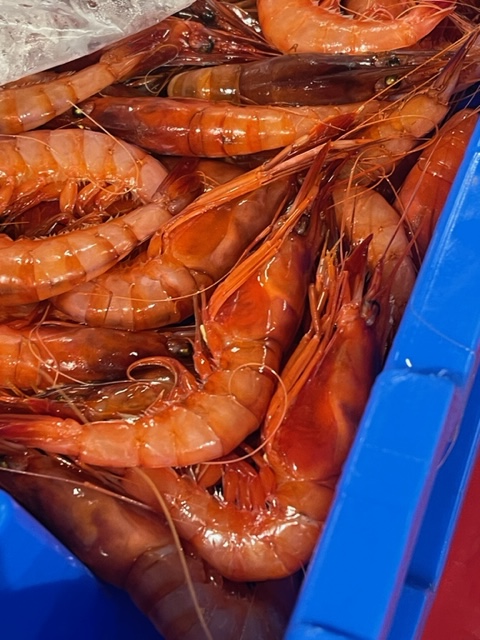
Obviously we pick up a pack of these. We also, on Jordi’s suggestion, pick up another set of red prawns from Galicia, Jordi choosing them himself from a large box nearby. “See? No water,” he says, explaining which ones to buy. He tells us to steer clear from langoustines and prawns languishing for hours in a pool of melted ice. “Choose like this,” he says, pointing to his selections.
Of course, we have to sample these raw on the market floor too. The prawn heads are almost better than what I’d tasted at Jordi’s restaurant, when they were topped with caviar.
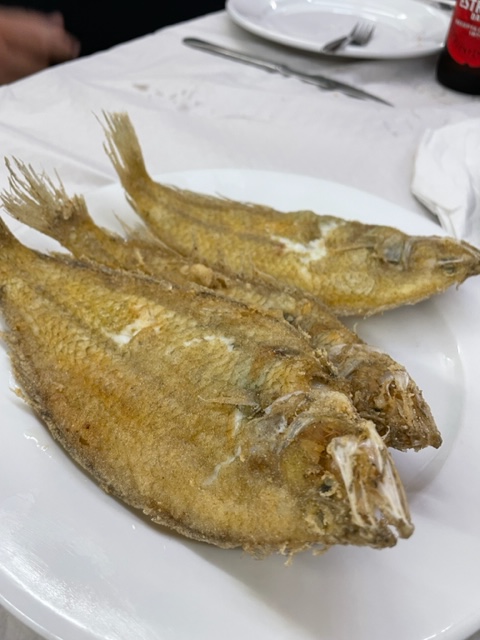
To go with our shellfish extravaganza (to which my husband is actually allergic), we also pick up three baby sole which Jordi says are good for frying, as well as a passel of the unicorn-shell sea snails that we had the day earlier. To end the meal, Jordi selects a large Alaskan cordova — a fish he’d used to demonstrate to us what red gills, bright eyes and glossy scales looked like — with the intention of baking it.
We troop up the stairs with our wares into what looks like a stereotypical tapas bar, but with a view overlooking the market floor. Inside, at 2:30, it’s quiet: most vendors are on a break, chatting over coffee, with only one other person going to town on an enormous plate of scrambled eggs. No one is drinking, but I feel thirsty (for beer, at least) so we all end up ordering a nice pint each while Jordi explains to the chef what he wants done with the seafood and orders us some tomato bread and a large fluffy tortilla to start. I remember that he and Cordero have probably not eaten at all since their dinner service ended at 1 am.
The baby cod arrives first, and it’s as good as Jordi said it would be: the skin crispy and brittle, the meat inside almost cloud-like. We pour olive oil over the white flesh and dine on the fins and small bones delicate enough to crunch in our mouths.
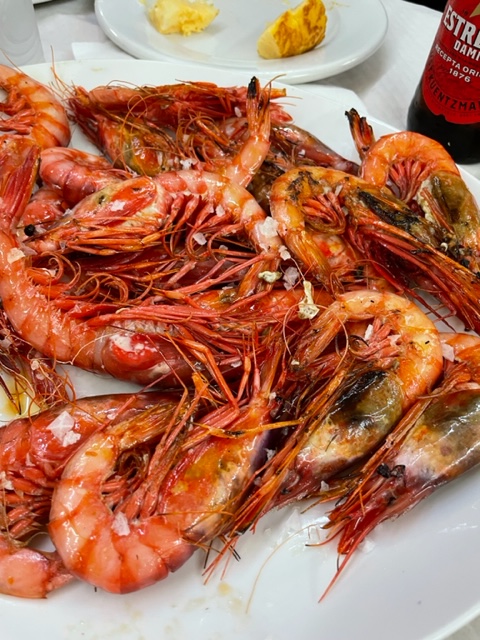
Next came the prawns, which were barely cooked and christened in a generous spray of rock salt. These things, once again, blew my mind. “I don’t know why people talk about lobster,” said Jordi. “These prawns are so much better,” and I have to say, I totally agree. Touched with heat and coarse salt, the heads have taken on a deep umami flavor that my brain translates into tasting like dark chocolate. It is one of the best things I’ve ever had.
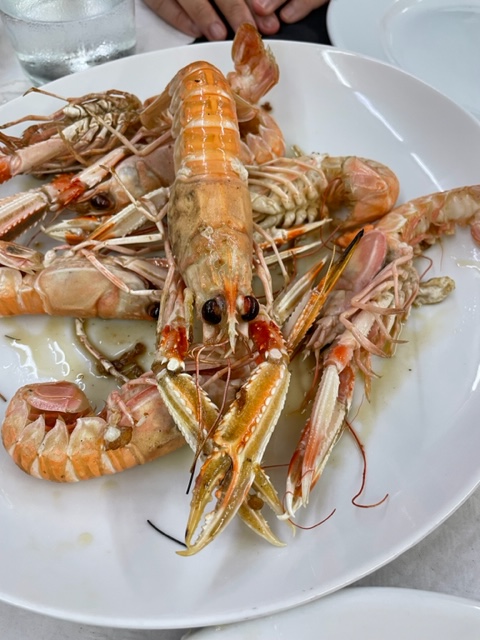
The main point of the evening arrives next, hot from the kitchen, the shells billowing steam. It seems unfair to them that they have followed the red prawns; it’s like Fred Kaps following the Beatles on the Ed Sullivan show. All the same, they are sweet and fresh and everything you’d want from langoustines.
Obviously, Jordi is friends with the proprietor and they exchange pleasantries, as he has with everyone throughout the evening. But Jordi says he had a hard time at first making connections with people, as he was only one small restaurant; most of the customers here are big hotels and restaurant chains. I imagine the Michelin star would have helped things along; besides, the big clients rarely actually make it to the market themselves, preferring to order their seafood for delivery.
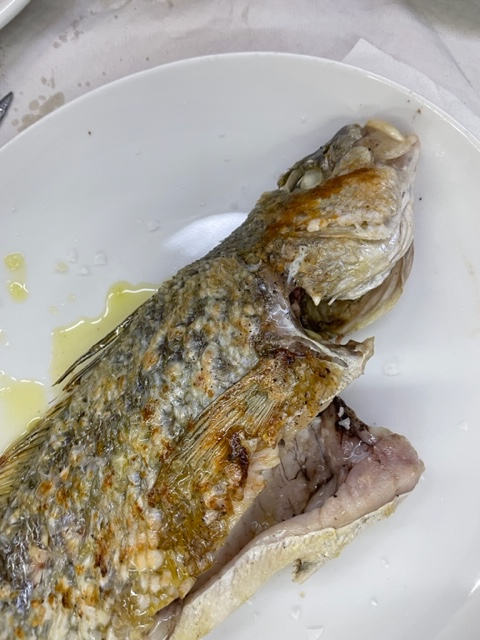
By this time, we are almost full, but Jordi’s special pick, the cordova, is on its way. It comes hot from the oven, skin blistered with the scales still on and in a puddle of fresh olive oil. We summon up what’s left of our appetites and attack, stripping the skin to reveal glistening juicy flesh without need of anything else (although, being Thai, I wouldn’t turn a seafood dipping sauce down). By the time we are done, only the carcass is left and even the head has been dismantled. The cost of the seafood: 160 euros; the cost of the restaurant meal: 70 euros, including beers for all 6 people.
Jordi and Cordero very generously drive us home, and by the time we get there, it’s 4 in the morning. It’s still dark, but the sidewalk in front of our rental is heaving with as many people as there are when it’s 4 in the afternoon. I understand that the meal I just had was a once-in-a-lifetime deal, which makes the meal even more special; the guidance of a Michelin-starred chef is similarly unlikely. Or maybe it’s the incredible seafood. In any case, I will always remember this meal, even though it has thrown my sleeping patterns off for the foreseeable future.







 Bangkok Glutton