The Comfort Bowl

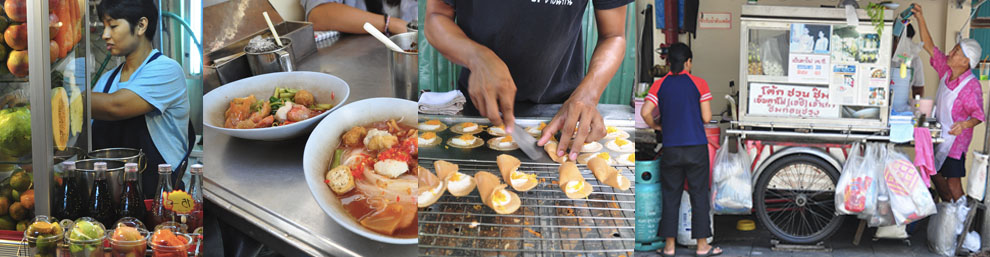
Rice noodles smothered in pork gravy at Rot Thip Yod Pak

I was hospitalized recently for salmonella and I gotta say, it’s like restaurants are taking revenge on me for writing about street food so much. It is the second time I’ve gotten seriously ill from food — not on the street, mind you, but in an air-conditioned dining room with a dress code and old aunties who look askance at your Uniqlo/Marimekko muu muu because hey, you just want to live your life. This time, it was guay thiew nuea sub (rice noodles with minced beef) topped with a nice raw egg that felled me. I spent the rest of my week eating plain rice porridge in a hospital room and feeling sorry for myself.

Needless to say, when I was finally discharged, I wanted to be really careful, because I was not eager to relive that experience. It wasn’t spending the whole day in the hospital that got me down, or even the loneliness, since nurses are bustling in at all hours to take your heart rate and oxygen levels. It was the gloom that descended when it got dark, and even though my husband was staying with me, I still dreaded falling asleep in that hospital bed. I don’t want to repeat my stay in the hospital any time soon. Time to head back out onto the street.

I am going over final edits on the third iteration of my Thai street food book. This was a book that was supposed to have come out earlier this year, but, as with most plans that were hatched for 2020, it was inevitably delayed. Going over the entries, I was struck once again by how many great places there are in Thailand still (and how many more could have been named). One such place that I had not been to for several years now is Rot Thip Yod Pak in Baan Mor (02-223-4562, open 8.30-17.00 daily).

Baan Mor is the old center for electrical appliances and car parts in Bangkok, and it still has that same chaotic, anything-goes vibe. Multi-colored wires hang into the street, pirated DVDs lurk past open doorways and bad techno music pounds the eardrums. It is like the Asian equivalent of Mos Eisley, but without any cool jazz bands or decent drinks. You can, however, find a vibrator and all the lady-focused porn your heart could ever desire. To get here, you simply need to exit the Old Siam shopping center from the McDonald’s side, cross the street, walk through the market for 50 meters, and turn left into the open shophouse room with the light blue walls.

Here at Rot Thip Yod Pak, the Chinese-inspired dish guaythiew lard na (rice noodles with gravy) is the typical calling card, although their khao na moo grob (rice with crispy pork) is also popular. The last time I went here, I focused on the lard na with crispy egg noodles (sen mee grob), but today, I want what would amount to comfort in a bowl. I order the lard na sen yai (thick rice noodles in gravy) instead. This is my comfort in a bowl, the thing I used to get when I was by myself in college and needed a taste of home in the only Thai restaurant near campus.

It arrives to the table like a soup, murky and gelatinous, a single slab of pork visible, obscuring the green fronds of Chinese kale beneath. Set out in front of me, it visibly jiggles. It resembles a nightmarish caricature of the Blob, only edible. Luckily, with a judicious sprinkle of pickled red chilies in vinegar, it tastes a lot better than it looks.

“The Coffin Dance” is blasting in the alleyway as I depart, but I don’t care. I leave in a better mood than when I arrived. I don’t even feel like I need to go to the hospital. Isn’t that all any of us ask for?

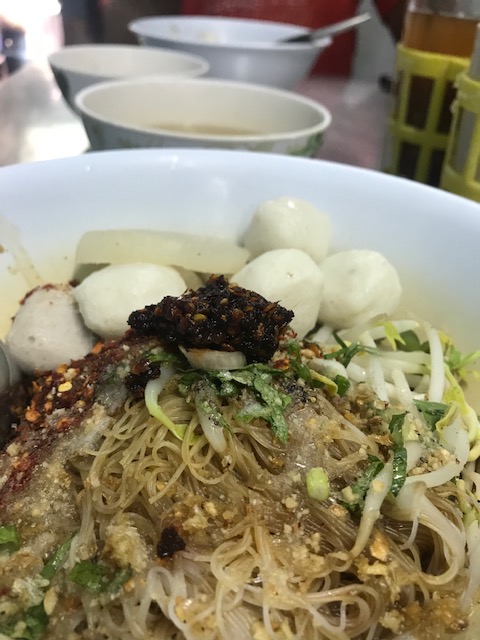
Winner’s crispy pork on rice with a dash of dark soy sauce and hard-boiled egg

3 Comments

Filed under Uncategorized

What’s Cooking: Sticky rice

My parents, celebrating my dad’s birthday and their Northern Thai heritage at Maan Mueng Restaurant

My father just turned 75, and to celebrate that day (after a COVID-caused delay) he booked out the restaurant Maan Muang, where my family believes the best Northern Thai food in the city is served. Being a Chiang Rai native, my father of course believes he is the expert on this subject, and that his hometown (and my birthplace, incidentally) serves local cuisine of a far superior quality, flavor-wise, to the more generic Chiang Mai. (Although the people at Maan Muang hail from Lampang, not Chiang Rai, I feel obliged to add).

I do love Maan Muang, although I would personally stick to the dishes that are, well, meant to go with sticky rice, and not the noodle dishes like khao soi (curried Northern Thai-style noodles) or kanom jeen nam ngiew (fermented rice noodles in a minced pork stew).

Fermented pork slices, pak waan (sweet vegetable) stew, green leaves stir-fried with egg, beef larb, and pickled cabbage stew, all with sticky rice

The sticky rice at Maan Muang is red and mildly glutinous, treading the fine line between not too loose and not too gummy. This rice is a staple in the North and Northeast, where food is commonly rolled up into a ball with fingers (an act called pun khao or “rolling rice”) and dipped into the stew, soup, relish, salad or strip of meat (already parceled onto your own plate, of course) of your choice. Food scholars say sticky rice (khao niew) is and has always been considered the staple of the plebs, whereas jasmine rice (khao suoy, or “beautiful rice”) is the purview of the aristocrat. That may be so, but if I had to choose between the two, I would always choose sticky rice.

Many people think that sticky rice is a simple affair made in a rice cooker, but in my household, where this dish can make or break a meal, it is always cooked traditionally, in a huad or woven basket, set over a pot of boiling water and topped with a lid. It’s perfect for allowing air to circulate between the rice grains, ensuring that the grains are not soggy, and for grabbing at each end and tossing, mid-cook.

pastedGraphic.png

A traditional Thai sticky rice steamer

But if you don’t have access to a huad, don’t despair. You can simply use a fine-mesh sieve, or a traditional steamer lined with cheesecloth. For the purposes of my upcoming book, I used a sieve, which the French very un-P.C.-ly call a chinois

pastedGraphic.png

But before you get to that point, you have to soak your sticky rice grains overnight in room temperature water (or in boiling hot water for 20-30 minutes before cooking). Drain and wash three times before pouring a potful of boiling hot water to cover.

Stir grains to keep them from sticky together for 5 minutes or until grains are slightly translucent. Drain and set to steam in your sieve or lined steamer for 20-30 minutes over a boiling pot of water. Cover with a lid big enough to cover all the grains. If there is a gap between the edge of the pot and the lid because of the sieve, set a towel over the lid but beware of setting the towel on fire.

After 10 minutes, take off the lid and toss the grains or give them a good stir.

After 20-30 minutes (or when the grains are tender), spread over a wet flat surface like a tray to cool, making sure to turn occasionally with a rice paddle in order to get rid of trapped steam. This ensures the rice is not soggy.

pastedGraphic_1.png

Your rice is now ready to eat. If you’re not ready, put it in a bowl and cover loosely with plastic wrap, or even better, in your woven sticky rice holder, which has holes that allow steam to escape, but are not too big that the sticky rice will dry out. For such a simple food, it can be a bit temperamental.

pastedGraphic_2.png

Enjoy your sticky rice! One of my favorite meals on earth is a gob of this with fried chicken and a good dollop of a garlicky, heady chili dip like nam prik tha dang (red-eye chili dip), especially if it comes from Midnight Fried Chicken in Chiang Mai.  

6 Comments

Filed under Uncategorized

Gone South Again

Snail green curry at Bang Cham in Phatthalung

One of the few good things about the global pandemic — and I mean, very few — is that we are now doing so many more road trips, discovering places we had never gone to before. One of those places is Phatthalung, a southern province in the “tail” of Thailand that gets less notice than its neighbors because it is landlocked.

Despite its landlocked location, it is still famous for its fishing and water attractions, thanks to the Songkhla lake it shares with Songkhla province to the east. One of the must-see things to do when you’re a tourist in Phatthalung is to take a sunrise tour of the traditional wooden fishing traps on the lake, built like oil rigs on spindly sticks (or in some cases, steel) and scattered at various intervals across the lake like leaves. When the fisherman pushes down on the lever, lifting the giant net up into the air, it is filled with freshwater fish that in a few hours will be deep-fried and slathered in a green mango slaw or steamed with lime and herbs. The fishermen do this all day, from sun-up to sun-down, in a bucolic setting where lily pads grow in chaotic profusion and the water is so calm that the long-tail boats leave a wake that resembles the creasing of a silk sheet.

But I’m here for the food. Not surprisingly, one of the major ingredients featured here are water lily stems, either stir-fried quickly with black peppercorns or oyster sauce, or tossed lightly in a spicy-tart salad.

Local lily stems with surimi, squid, tomatoes, Thai celery and chilies

The lily stems are light and refreshing in the summer heat, and perfectly soak up the broth or sauce of any curry or stir-fry that they are thrown into. They are like the best guests at any dinner party, able to get along with anyone, making everything feel less serious and weighty.

Another featured ingredient are the tiny dried fish, called “baer” fish in the local dialect, which are either deep-fried with turmeric or served in yet another spicy salad, a perfect accompaniment to a cold beer.

Tiny local fish with green mango and roasted peanuts

Don’t forget the snails, though, in case you were thinking of doing that. These homely gastropods may make you feel icky things when you watch them making their way slowly along the driveway, but when they find their way into a curry, they suddenly become Troy and Abed offering you a guest spot on their morning show.

Snails in a “gang kua”, or mild red curry

And finally, there are the ants. I did not have ants in Phatthalung, but I did have them — for the first time in a thin coconut curry called “gang kati” — along with their eggs and a generous portion of local “mieng” leaves in neighboring Krabi in a restaurant that we just happened upon en route to Phuket. Restaurants like these are all over the south, serving lovingly made home cooking with all local ingredients, and I wish I could have had more time with them.

Ant coconut soup at Raan Ruea Khao in Krabi

While the ant eggs are mostly tasteless, added for their springy texture, the ants themselves are quite tart, counterpoints to the sweet coconut broth. We had them with tiny fish deep-fried with turmeric, seabass stir-fried with holy basil and hella chilies, a turmeric soup with free-range chicken (“gai baan”), and a sour curry (“gang som”) of farm-raised frogs (called “gob lieng”. We were told that the wild-caught frogs, or “gob tong”, are tastier but not available). Of course, nearly everything was ear-ringingly spicy. It’s a small price to pay for the cost of admission, but a price nevertheless the morning after.

8 Comments

Filed under Uncategorized