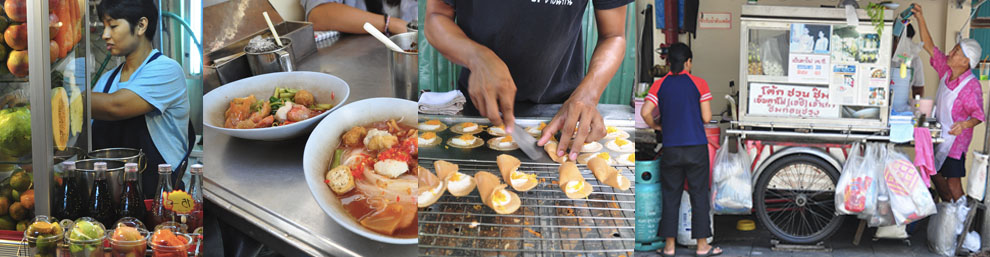
A variety of fish meatballs with egg noodles at Yoo-Nguan Pochana
It’s hard to believe, but it’s already eating-your-face-off season in Bangkok, and my scale is dearly paying for it. Again. As much as I appreciate the clinking of glasses and rivers of champagne that go with the happiest time of the year — as well as the surprisingly decent weather and traffic (!) — there does come a time when one needs to reset the tastebuds a bit, take a breather, and chill.
So when your tongue wants a reprieve from the prickly tom yums and greasy curries of your normal day-to-day ventures to the trough, you can’t do much better than these fish noodles on the much-loved-but-still-underrated Chan Road. Known as Yoo-Nguan Pochana (Chan Road 18/7), the open shophouse, patronised but not too crowded, is the ideal spot for a quick breakfast that fills you up for surprisingly longer than you’d expect. Although the standard range of rice noodles is available, the bamee were said to be the best, and even though I did not try any other noodle, they were: silky and buttery in a way that I’ve only seen at the original Bamee Sawang, formerly at Hua Lumphong but now on Petchburi Road, RIP (*takes hat off and bows head*).
The meatballs, meanwhile (I ordered ruammitr, or a mix) boasted the qualities that Thais value in their fish balls: springy and resilient to anything but the mightiest mash of the back teeth, qualities credited to the vendor’s mix of bigeye snapper and cutlassfish, according to Khao Sod English.
But look, if a more “traditional” breakfast (something that really doesn’t exist in Thailand) is more your jam, you can get all up into the variety of toasts on offer, served with common Thai toppings like coconut custard, sugar and butter, or yes, jam.
You will have plenty of time to be sorry for your rigid view of breakfast and return for a bowl of fishball bamee later. These folks have been here for a while and will still be there when you go back.
In most horror movies, the protagonist is facing a life-or-death struggle that is made doubly scary by the inability of the people around them to acknowledge that anything weird is actually happening. This is why most of those horror movie protagonists are women (famously referred to as “final girls”, a trope created by Jamie Lee Curtis in “Halloween”) or children (think the little girl in “Poltergeist”, Danny in “The Shining”, or Linda Blair in “The Exorcist”). When men are in danger, it is usually due to a real, tangible existential threat like in “The Thing”, “Predator” or “Alien” (although Sigourney Weaver ultimately becomes a final girl, too). In contrast, the observations of women and children are easy to dismiss.
These observations are so easy to dismiss, in fact, that women often end up dismissing the little pricks of worry about the maybe-monsters in their own lives. The truth of the matter is — and I think deep down we all know this– monsters are real. They are the ones who are OK with getting their friends and family sick as long as the stock market goes up. They are the ones who are fine with children being in jail as long as they don’t know them personally. Even more commonly, they are the ones who hurt us in our day-to-day lives, but cry victim when confronted with their abuses. They turn their outrages against us in upon themselves, fashioning themselves the heroes in our own horror stories. With blood made of acid and snapping jaws that protrude, they cast themselves as Ripley, turning us into John Hurt choking on glass noodles, secondary players in the “Alien” movie of our own lives. And we allow this to happen. We think we are too smart to be twisted or turned or manipulated. We gaslight ourselves.
I know about this because I once loved monsters, and willingly welcomed them into my life. Even after I discovered them for what they were — the vampires and big bad wolves of the forest — I figured that I deserved whatever depredations they saw fit to grant me, a form of emotional cutting. I fancied myself the ultimate giver. But that was a while ago. Like the lifting of a curse sent by an evil fairy, it takes a long time for the enchanted villager to realise that they need to protect themselves if they want to keep from falling asleep for another 100 years.
I am writing this on the day before Halloween, in the run-up to the U.S. election. Obviously I have particular monsters in mind. But I’ve also been thinking of the monsters I’ve known personally, and the time and energy it took to finally vanquish them. It takes a lot of energy, guys. The kind of energy that you can only get from the very best comfort food that you can find.
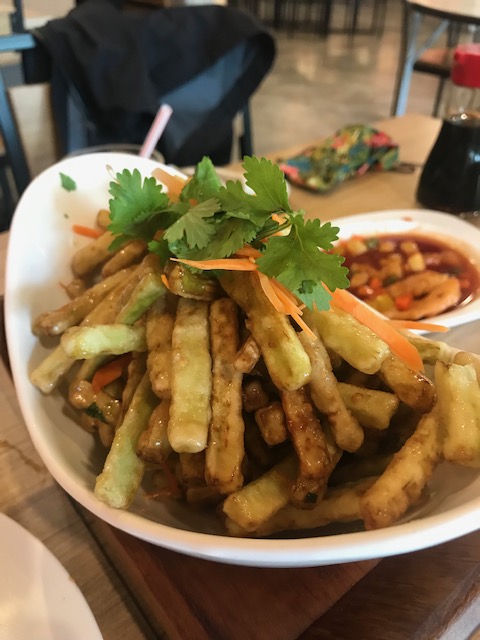
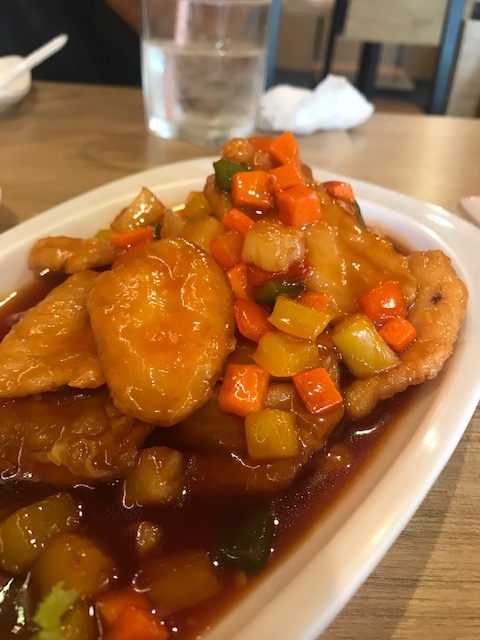
Everyone’s A-1 comfort food is different, but for me, Chinese-American junk food is the sort of thing I turn to when I feel like how Don Lemon looks right now, in the homestretch to election day. The PTSD from 2016 is real, yinz. So to shore up our magical defences and the steely resolve of Ripley in a power loader, I binge on fried eggplant sticks, lacquered to a glossy sweet sheen, and sweet-and-sour chicken, similarly glazed but with a bright, citrusy tang. I get these things at Panda King (80/5 Chula 46, Phayathai Rd., 084-210-6522), which is not the platonic ideal of American-Chinese food (the mapo tofu is soupy, the fried dumplings resemble a cervical pillow) but is good enough when the spiritual wolves are howling at the door. A quick meal here and you are ready once again to set ablaze your very own alien egg chamber. Just make sure not to ignore the little voices in your head next time.
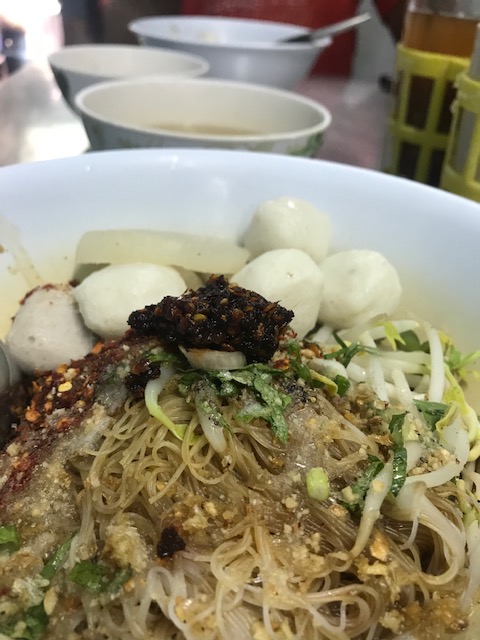
A bowl of “Taiwan” noodles, dry, with fish and beef meatballs
Out of all of the guitar heroes in the rock pantheon, Eddie Van Halen may have been the most revered. I have not designed a survey, so I am obviously talking out of my ass, but judging from Twitter at least, the segment of rock fandom that is most vocal — the middle-aged man, rock music’s most ardent acolyte — appears to have mourned, genuinely and deeply, EVH’s untimely passing. For once, a brief blissful second during these fraught times, people seemed united (with just a few bizarre outliers): EVH gone, bad; Van Halen (with David Lee Roth), good.
Cool dude
It’s no mystery as to why EVH was the most loved of the world’s guitar heroes. Jimmy Page was a Satan-worshipping weirdo; Robert Johnson lost his soul at the crossroads; Yngwie Malmsteen and Steve Vai, chilly technicians both; Carlos Santana, always talking about angels; and Stevie Ray Vaughn, his work corrupted by beer commercials and football shows.
Meanwhile, the biggest hero of them all — “The Bat”, “The Creeper”, “Jimmy James” Hendrix — murmuring incantations over a flaming guitar, seemed too much of a literal rock god. No one could hope to truly mimic what this man did on the stage; one could only think to gape in awe and pretend they were there, wherever “Buster” was, when he was conjuring up musical magic, so self-serious and self-contained.
EVH may have had formidable skills, but he still presented a more accessible contrast to the esoteric, the strange, the weird. Unlike the black-clad nihilists or makeup-caked pretty boys of his time, EVH could have been you or me, dressed in the way that we would be if we were also on stage with David Lee Roth, avoiding one of his high kicks. Sunny and optimistic, EVH melted faces with an amiable smile, presenting a form of “hard rock” that could still be played in front of your mom. Indeed, my favorite Van Halen song is “Running With the Devil”: an ominous, pulsating low tone suggesting the beginning of a robot insurrection, the soaring guitar riff kicking in moments later, only to recede into a pop song that anyone could play at their 14th birthday party.
Ultimately, EVH was American in the way that Americans wanted to see themselves (even though EVH was Dutch). He wasn’t in music to get girls, or to get rich, or to get famous. He didn’t even really sell out in his old age, start shilling for Donald Trump, or go on a cynical world tour featuring “reinterpretations” of his greatest hits (although there was the Sammy Hagar era. Remember “When It’s Love”? Were they trying to be the hard rock Chicago?) It was obvious to everyone who saw him that this was the only thing he could have done. EVH was the real deal.
People also like Thai soup noodles for different reasons. Obviously, those reasons are not to get girls, get rich, or get famous. There is a purity in the clear-brothed fishball noodle, all the hard work involved in hand-whipping the ideal meatball that will bounce. There is tradition in every bowl of egg noodles, the Chinese callback to the garnish of crab claw and barbecued pork, a little shower of chopped fresh coriander when you want to feel fancy. Then there’s the heady, steakhouse luxury of a bowl of stewed beef noodles, the essence of the cow alive in every spoonful of broth, maybe thickened with drops of cow blood.
But no noodle is as Thai as the tom yum noodle, flavoured with hints of lemongrass and lime leaves and of course chili. Not even the boat noodle, created by the Chinese when they began to ply the canals with their wares, is as Thai. The tom yum noodle is a bowl of Chinese soup noodles with a Thai face. It has all of the flavors that Thais prize: sunny acidity, flashes of fire, a quicksilver sweetness, with a pervasive undercurrent of funk.
But no tom yum noodle I’ve found tastes like the one at this place on Asoke, crammed into what looks like was originally an empty space between two buildings:
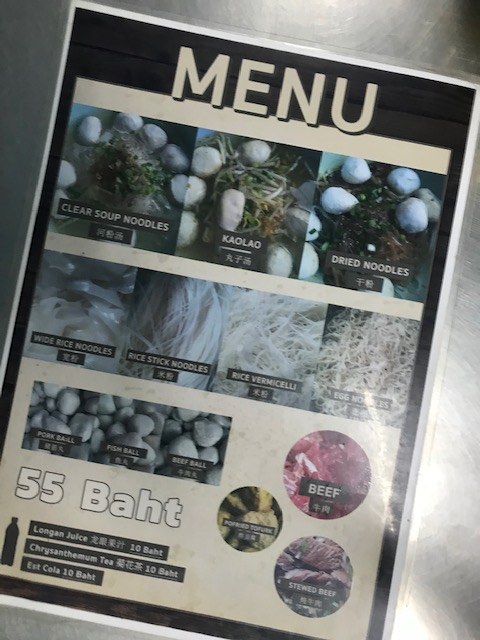
Called “Guaythiew Luk Chin Taiwan Moo Nuea Pla” (Taiwanese noodles with pork, beef and fish meatballs), this spot next to Grace Baptist Church on Sukhumvit 19 serves noodles that bear no resemblance to the noodles I’ve tasted in Taiwan. They do, however, taste overwhelmingly of the Thai provinces, of the chili-laden back alleys, of the fish-sauced waterfronts. I say this with admiration. They are noodles for lovers of Thai noodles.
There are more variations than would be the norm here, not apparent on the menu above. You can have soup (nam) or without (hang). You can have noodles (thin, wide, egg or rice vermicelli) or without (gowlow). You can have with a clear soup (nam sai) or with blood (nam tok). You have have fish (pla), pork (moo), beef (nuea) or a mix thereof. You can even have tofu for 15 baht a piece. But I say go for the tom yum noodles and get a faceful of roasted chili paste, paired with whatever else is necessary to turn that dollop of paste into a bowl of noodles.
There is apparently another branch on Sukhumvit 22, but my friend Andrew, who lives nearby but dragged me in the rain to Sukhumvit 19, did not know this. Perhaps that branch is like the original, placed somewhere strange, where a noodle shop shouldn’t be. I guess, like the budding guitarist with dreams of girls and fame, noodle poseurs will be discouraged by all the work involved to search for it. Only the true enthusiast need apply. Neck scarves optional.