
One of the few good things about the global pandemic — and I mean, very few — is that we are now doing so many more road trips, discovering places we had never gone to before. One of those places is Phatthalung, a southern province in the “tail” of Thailand that gets less notice than its neighbors because it is landlocked.
Despite its landlocked location, it is still famous for its fishing and water attractions, thanks to the Songkhla lake it shares with Songkhla province to the east. One of the must-see things to do when you’re a tourist in Phatthalung is to take a sunrise tour of the traditional wooden fishing traps on the lake, built like oil rigs on spindly sticks (or in some cases, steel) and scattered at various intervals across the lake like leaves. When the fisherman pushes down on the lever, lifting the giant net up into the air, it is filled with freshwater fish that in a few hours will be deep-fried and slathered in a green mango slaw or steamed with lime and herbs. The fishermen do this all day, from sun-up to sun-down, in a bucolic setting where lily pads grow in chaotic profusion and the water is so calm that the long-tail boats leave a wake that resembles the creasing of a silk sheet.
But I’m here for the food. Not surprisingly, one of the major ingredients featured here are water lily stems, either stir-fried quickly with black peppercorns or oyster sauce, or tossed lightly in a spicy-tart salad.

The lily stems are light and refreshing in the summer heat, and perfectly soak up the broth or sauce of any curry or stir-fry that they are thrown into. They are like the best guests at any dinner party, able to get along with anyone, making everything feel less serious and weighty.
Another featured ingredient are the tiny dried fish, called “baer” fish in the local dialect, which are either deep-fried with turmeric or served in yet another spicy salad, a perfect accompaniment to a cold beer.

Don’t forget the snails, though, in case you were thinking of doing that. These homely gastropods may make you feel icky things when you watch them making their way slowly along the driveway, but when they find their way into a curry, they suddenly become Troy and Abed offering you a guest spot on their morning show.

And finally, there are the ants. I did not have ants in Phatthalung, but I did have them — for the first time in a thin coconut curry called “gang kati” — along with their eggs and a generous portion of local “mieng” leaves in neighboring Krabi in a restaurant that we just happened upon en route to Phuket. Restaurants like these are all over the south, serving lovingly made home cooking with all local ingredients, and I wish I could have had more time with them.
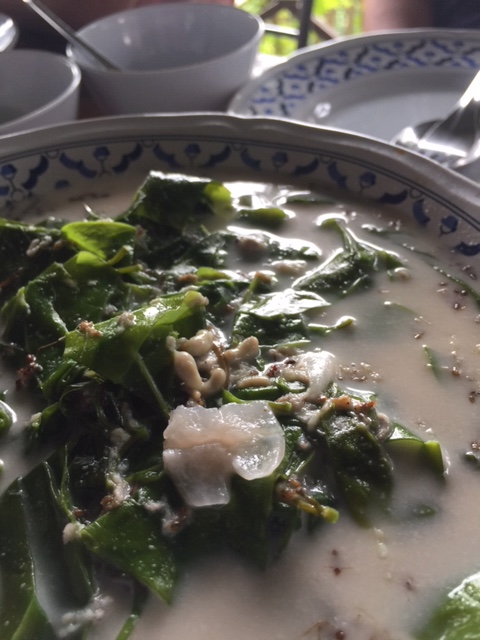
While the ant eggs are mostly tasteless, added for their springy texture, the ants themselves are quite tart, counterpoints to the sweet coconut broth. We had them with tiny fish deep-fried with turmeric, seabass stir-fried with holy basil and hella chilies, a turmeric soup with free-range chicken (“gai baan”), and a sour curry (“gang som”) of farm-raised frogs (called “gob lieng”. We were told that the wild-caught frogs, or “gob tong”, are tastier but not available). Of course, nearly everything was ear-ringingly spicy. It’s a small price to pay for the cost of admission, but a price nevertheless the morning after.

 Bangkok Glutton