What’s Cooking: Help

mee-krob

Silom Pattakan’s old school mee krob

Because I am a die-hard horror fan who watches everything on Netflix under the “Horror” genre, I watched a Thai movie the other night called “The Maid” (top trending in Thailand, yo) that actually got me thinking. No, not about the “scares” (it’s scary if you think The Sixth Sense was scary. Actually, not even then.) It’s because the movie is basically a revolutionary manifesto calling for the taking of the country back from upper-class Thais who style themselves like foreigners, as well as farang and their Thai enablers. I would, clearly, be doomed in this scenario to (SPOILER ALERT) getting stabbed through the temple or injected with bleach by the homicidal namesake maid who is seeking revenge for her murdered sister. But all the same I feel like it’s unfair. Is it my fault I’m a colonized person?

My mother tongue is not really mine; I speak a foreign language more fluently. When my family meet up in a restaurant, we speak in a language from abroad even though our faces are local, sparking strange looks from surrounding tables. The songs I love are not mine; many of the movies I love — other than horror — are the same. Not even my comfort foods are not my own. When I think, I think in English. I am Thai, but I am American: through my mind, through my heart, through my stomach. Neither side claims me as their own. I have been colonized.

Thailand, famously, has never been colonized. But people rarely focus on the efforts Thailand made to keep itself from doing so, instead focusing on the wiliness of its officials or the luck of its location. In order to keep from being colonized, Thailand had to sort of do it to itself. Thais began incorporating Western, Victorian-style blouses into their outfits. Later the sabai, a one-shouldered shawl covering the torso, was actually banned in the mid-1900s in a bid to make national dress more modest.

Thai food changed, too. Grand households in the Rattanakosin era imported cooks from the Hokkien region, considered the best in the world for food. Those cooks created their own cuisine, influenced by both their native Chinese roots and Western aspirations. The grand houses and embassies entertained foreign dignitaries who could take heart in the comfortable surroundings and familiar-ish dishes — all requiring knowledge in how to use a knife and fork, of course. The descendants of these cooks set up restaurants of their own: Silom Pattakan, Agave, Meng Lee, and Florida Hotel Restaurant among them.

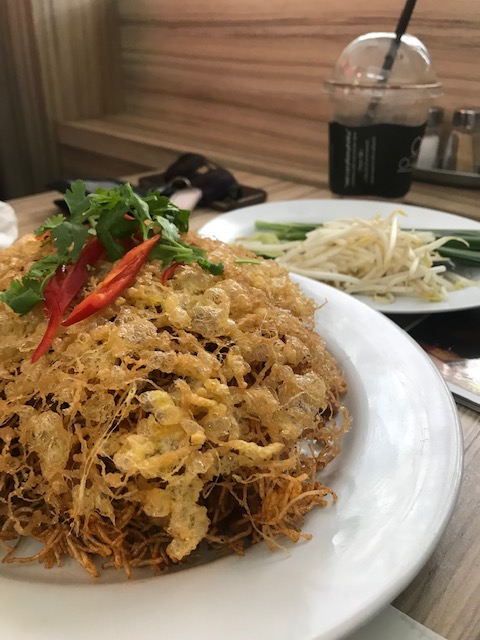
No one knows why mee krob (fried rice noodles in a sweet-sour sauce) always features prominently on those menus, but here we are. You can’t go to one of these old-school fusion-y places without encountering it on the menu. The dish itself has changed with the times — from a plateful of loose, dry noodles to something far more sculptured and sticky — but I prefer the old-fashioned version, as seen above at the old Silom Pattakan. The Florida Hotel one is pretty tasty though.
meekrob-1

Florida Hotel Restaurant’s mee krob

The recipe I’ve found, which I’ve inserted into my book proposal, comes from the funeral cookbook of my husband’s family: specifically, the funeral book of Longlaliew Bunnag, who used to be the F&B Manager at the Royal Bangkok Sports Club. Strangely, it doesn’t call for tamarind sauce, relying on plain old white vinegar for the tartness.

I sent the recipe to my friend Lauren Taylor in New Zealand, who is an accomplished cookin her own right. She made her own valuable alterations to a dish that really is far more difficult to make than it seems. This version is pasted below.

Now, before I send off my book proposal, I was wondering if anyone else has the time to try out this recipe and see how it works. Consider it the first in a series of test runs for a book that I am optimistically pitching as a Thai cookbook, made up mostly from funeral cookbook recipes from my attic. Any help is greatly appreciated!

Mee Krob for a dinner party where you are trying to avoid being colonized

Ingredients:

  • 2 cups rice vermicelli, pre-soaked in warm water until soft. Make sure the noodles are dry by draining them in a sieve or strainer.
  • 4 eggs
  • 1/2 cup pork loin, diced into small pieces
  • 1/2 cup fresh shrimp, diced into small pieces
  • 1/2 cup chicken breast, diced into small pieces
  • 1/2 cup crabmeat, boiled, shell picked out
  • 4 Tbsps red shallots, thinly diced
  • 2 Tbsp garlic, minced (6-8 cloves)
  • 1/2 cup hard tofu, patted dry with paper towel and diced into small cubes
  • 3 Tbsps white vinegar or to taste
  • 2 Tbsps fish sauce or to taste
  • 2-3 Tbsps palm sugar or to taste
  • 1 Tbsp tamarind paste
  • 2 Tbsps fermented brown bean sauce (tao jiew)
  • 7 Tbsps vegetable oil
  • 3 cups oil for frying noodles
  • Pickled garlic (for garnish)
  • Thai long chilies (prik chi faa, for garnish)
  • Bitter orange peel (som saa), or regular orange peel if not available
  • Fresh cilantro leaves
  • Raw bean sprouts
  • Fresh limes
  • Garlic chives

Method:

Make sure to prepare all ingredients before commencing frying.

Gently pull apart noodles and  rinse quickly in warm water. Make sure the noodles are dry by draining them in a sieve or strainer and pat dry. You want semi-flexible, but not fully rehydrated, noodles. Should yield approx 2 cups of rehydrated noodles. 

In a large pot or wok, heat 3 cups of oil until hot, (between 375 F and 400 F). Test the temperature by placing a noodle in the oil. The noodle should puff up right away. Make sure noodles are completely dry or else the oil will splatter. Place the vermicelli in small batches into the hot oil. Do not stir the noodles while they are cooking. As soon as oil stops sizzling, take out noodles.  Remove from oil and drain in a colander or on paper towels and set aside.

Next, remove all the oil except 2 Tablespoons. If you do not wish to handle hot oil, 2 tablespoons of the leftover oil from the pot may be placed in a separate large pan or pot.

Cook eggs in oil. Make sure the egg yolks are broken and scrambled. Once cooked, remove eggs and set aside.

Add 4 Tbsps of oil (this can be taken from the leftover frying oil) to the egg pan. Add shallots and garlic and cook until aromatic. Add brown bean sauce and pork and chicken and cook for 5 minutes, then add shrimp. Saute until cooked and then add fish sauce, vinegar, sugar and tamarind. Add crab and tofu and cook for a few more minutes. 

Taste for seasoning. Make sure it’s not too salty!  The sweet and sour tastes should come first.

Keep cooking until liquid evaporates, less moisture will result in a crunchier noodle. The  consistency should be dry and a little sticky, almost like a thick molasses. Add cooked eggs. Gently toss the noodles into the pan making sure not to overmix as to retain crispiness.

Serve on a plate immediately, garnishing with pickled garlic, julienned chi fa chilies, coriander leaves and julienned bitter orange peel (som saa). If available add as well: raw bean sprouts, slivered fresh limes and garlic chives. The bean sprout and lime add a nice freshness to the dish.
 

10 Comments

Filed under Uncategorized

Bamee Road Trip

Tom yum noodles in Chumphon, Thailand

I recently learned that the famous egg noodle vendor featured in last year’s season of “Street Food” on Netflix has closed down, maybe permanently, due to a spinal injury suffered by one of the cooks. It is a shame, but the vendors had been attempting — several times — to retire for a while now. So, enjoy your retirement, guys. I hope your back is better now.

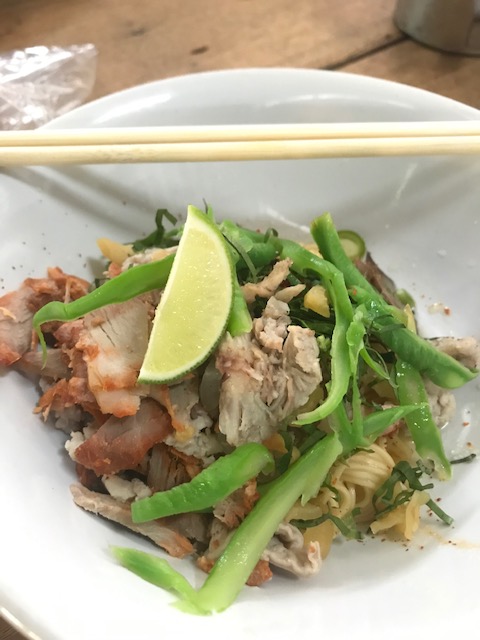
A bowl of egg noodles with crispy pork at Bamee 38, at its last location

Perhaps because bamee, or egg noodles, have been on my mind lately, I’ve been especially susceptible to suggestions that we stop at various famous bamee spots whenever we go on a road trip. Thailand has been pretty good at fighting COVID-19, but as with many other spots, it has not completely stamped it out yet, so I am still wary of getting on a plane. On recent trips to Chiang Mai and Phuket, we ended up traveling by car, which was tedious, yes, but also afforded plenty of opportunities to get our bamee on.

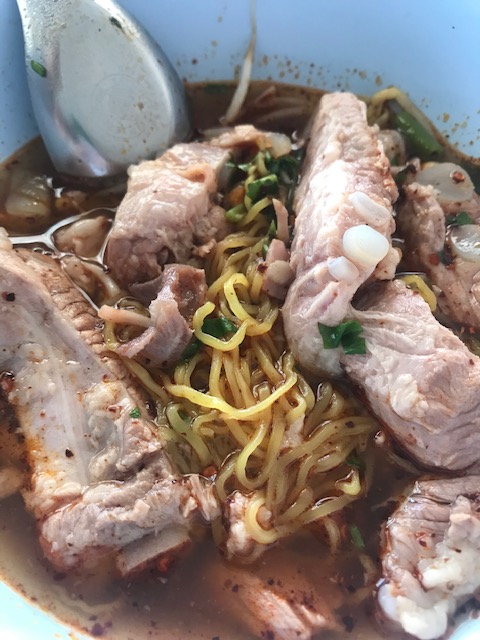
The first spot we tried was in Kamphang Phet on the way back to Bangkok from up North, called Cha Kang Rao Noodle (Ratchadamnern 1, 055-712-446). Here, egg noodles flavored with tom yum (spicy lemongrass) seasonings are the name of the game, and luckily for me, they are my personal favorite when it comes to bamee. The noodles are house-made, silky-smooth and substantially hefty, reminiscent of Japanese noodles. They float in a spicy-salty-sweet broth peppered with chili flakes, minced pork and plenty of chiffonaded coriander leaves which normally annoys me (those coriander leaves get gray and lifeless so quickly in hot broth) but added a great aroma to the dish.

A standard bowl of bamee in soup At Cha Kang Rao Noodle

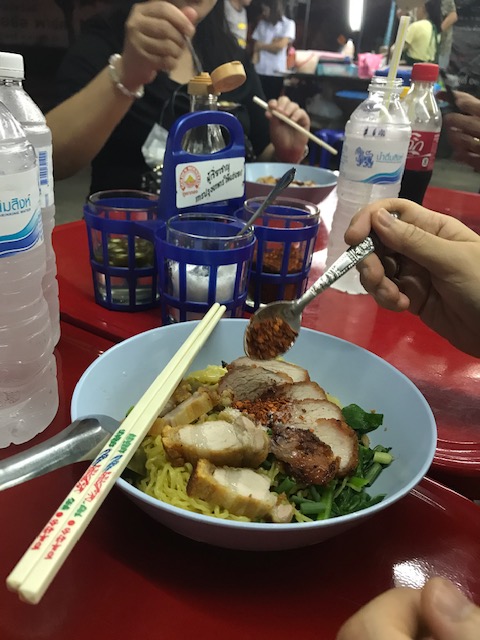
As for me personally, well, it’s too damn hot. And when it gets too damn hot, I order my noodles broth-free, hang, or dry. Those broth-free noodles don’t come flavor-free, however. There’s plenty of pork, both barbecued and stewed, accompanied by the julienned green beans you see all over bowls in Sukhothai and a fresh glistening wedge of lime, famous in this area.

“Dry” bamee in Kamphang Phet

You have your choice of the egg noodles and/or the hand-tucked dumplings, plus thin (sen lek) or fat (sen yai) noodles, but if you go to the trouble of gettng here, why wouldn’t you have the homemade egg noodles, right? Each bowl is available at the kingly sum of 30 baht.

That’s not to say the South doesn’t boast great tom yum noodles either. I have to say, though, the regional differences really show. Whereas the North is more mannered, with silky lovely noodles and a shower of blanched greens, the South seems to be fully out there, shaking its moneymaker for all to see.

What I mean when I say that is, Tha Pi Sut Noodle in Wang Mai (283/1 Moo 9, Petchkasem Rd., Wang Mai, Chumphon, 080-873-2874) is Patti LaBelle belting “Stir It Up” at the top of her lungs right in your face.

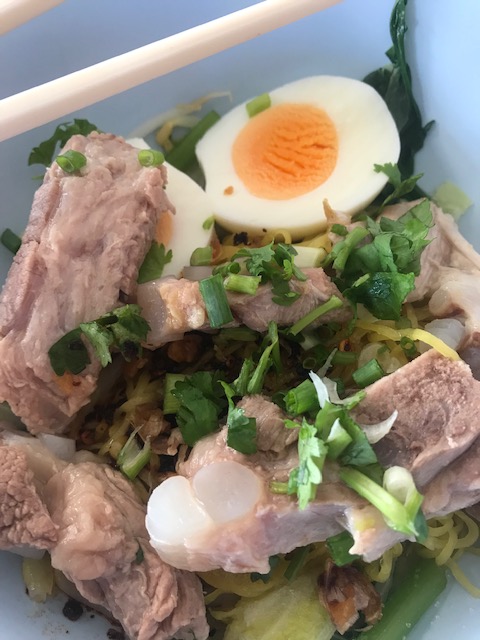
A dry bowl of egg noodles with pork tendon and boiled egg

There’s a dizzying range of choice here, starting with the protein: crunchy pork tendon, seafood (shrimp and squid), “mixed” seafood (shrimp, squid and fish), minced pork with meatballs, or “mixed” (everything). The broth can be tom yum or clear (the choice here is obvious), as well as how much broth: dry, with broth, or nam kluk klick, which means half-full. There is a reason why half-full is an option and it is because a full bowl of this broth is simply Too Much: so much umami, sweetness and spice battling it out that it feels like Kill Bill in your mouth. Brothy noodles lovers should go with nam kluk klick; the ridiculous sounds that one must make while ordering it are worth the fleeting embarrassment.

4 Comments

Filed under Uncategorized

Impossible Dream

There has been some valuable discussion lately on the need to diversify viewpoints in the world of food publishing, sparked in part by a story in the New York Times. I have absolutely nothing of value to add to this conversation. What I will add is that, to friends who send me links to NY Times stories about Thai food: This is probably a waste of your time. I will not read it. And it’s not solely because the NY Times will never publish me. It’s because I’m not the intended audience for this article. If your friend Tracy comes to Thailand, you’re happy to see her, even if she brought an extra suitcase full of goldfish crackers and candy bars with her, “just in case” because you know, Thailand. Tracy is still a kind, smart person and a beloved friend with a great sense of humor and a lot to add to conversations. But if she went back home and wrote something about the food she ate while she was here, I confess I would only pretend to read it, because I want to avoid as much cringe in my life as necessary that is not of my own doing. No offense. I love Tracy. She’s just not very adventurous when it comes to food.

giphy

Guess I’m not pitching to the New York Times

(via GIPHY)

What I also love is that this sparks a discussion, all of it important, about what is and what is not possible when it comes to writing for a wide audience now. The NY Times comes under fire often — the “both sides” headlines, the horrible Tom Cotton op-ed — because it is the accepted authority on “everything that’s fit to print” among Americans, and an important news outlet for English speakers around the world. That’s cool when sources are all too happy to be interviewed by you, but not so cool when people start to dissect what you say. Everything that is being consumed all over the world — media, entertainment, and yes, food — is being reexamined and the old ways of writing about other cultures, genders, even politics, are no longer cutting it. There is an ad on CNN for Michael Smerconish that never fails to irritate me because he asks, “Whatever happened to when we were united against a common enemy?” The answer to that is,  minority people simply weren’t saying anything because they had more than one enemy. What he’s really saying is, whatever happened to when people kept their mouths shut?

One story that I absolutely loved in the New York Times Magazine by Isabel Wilkerson talks about how this reawakening has led to a necessary examination of the old structure that has held up this status quo for decades in the U.S. She likens the American race problem to systemic rot that has seeped into the foundations of a home, threatening to send it all toppling down if not addressed. But one of my favorite moments was of her recollection of attempting to interview a Chicago store owner for a NY Times “Miracle Mile” story, and being brushed off by him because the NY Times reporter was due “any minute now”, refusing to acknowledge that Wilkerson herself was the reporter he was so eagerly awaiting. Things like this have happened to me many, many times, and I don’t even write for the NY Times. I saw myself in that moment, on that page. That doesn’t happen very often to me there.

As a middle-aged woman with all the life draining from me as we speak, I had come to accept that my cultural limbo — an Asian with a hard, inedible little American core — was ultimately a story that’s been “told before”, worthy of hearing only once before heading to the next “OMG durian!” or “bargirls eating bugs!” story. To hear that there may be more places for this “novelty” point of view, as well as many others, is something that I never dreamed possible.


8 Comments

Filed under Uncategorized