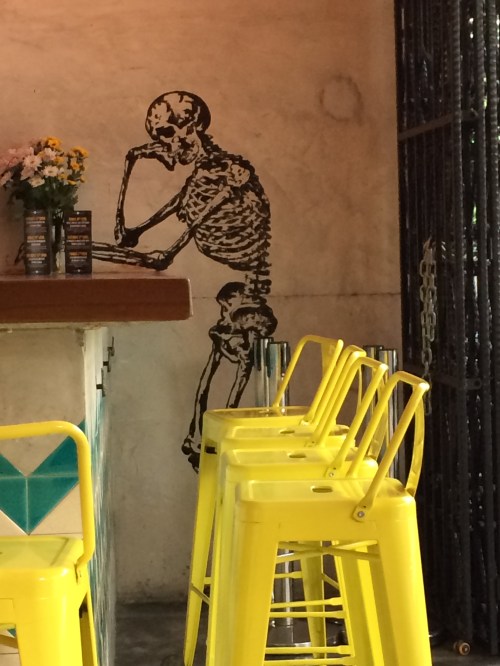
Me waiting for the end of my meal
Having recently returned from Japan, I find myself with nothing to do, having succumbed to government directives to self-quarantine for 14 days. Even though I am bored and watching episodes of “Friends” over and over again (still on Thai Netflix!), I still cannot bring myself to update my blog. The effect of SSRIs on the creative drive is real, folks.
Being at home has given me plenty of time to ponder the important questions in life. Why do young women in the prime of their lives want to wear “Mom jeans”? How did beards become so ubiquitous? What is Shawn Mendes?
But if you think this time gives me the chance to, say, finally read “War and Peace”, catch up on an Akira Kurosawa film, or learn about economics, well, you will be disappointed. These things would ultimately be enriching to my life, no doubt. But why? Why would I do this? Do I really want to spend my time this way?
So I watch, for maybe the 15th time, Ross finding out that his sister is dating his best friend (SPOILER ALERT). It is enjoyable to me. It is a big fluffy blanket to drape over myself when I want some comfort in the world. It is listening to Haim in my kitchen when I’m preparing a meal. It is a big bowl of spaghetti Bolognese, don’t ever ever hold the cheese. Is life long enough that we can spend our time doing the stuff that gives us cool points in the eyes of others instead of what we really want? Will I ever stop writing rhetorical questions? Of course the answer is no.
I am thinking about this because I had a conversation with a friend who visited Chicago recently. She went to a famous restaurant there and had the menu with wine pairings. This was, of course, a once in a lifetime opportunity. But it was a slog, and towards the middle, she wanted to quit. At the end of the meal, she realized that she hadn’t enjoyed it at all. That realization ended up making her feel bad.
At the end of the day, isn’t enjoyment ultimately — Instagram and Facebook be damned — the point of going out for dinner? You know the answer to that.
For all restaurants with fine dining pretensions (Bangkok included), a set menu is par for the course. This is the vision of the chef, after all, and as long as you are not deathly allergic to something on the plate, the vision of the chef is what you will get. The wine and liquors that accompany the courses only enhance the experience.
But that experience can often be long. And when you are prepping for a restaurant like a runner before a marathon — maybe training your stomach and tolerance with more quantities than usual, fasting for hours ahead of time so you can get your money’s worth, wearing your stretchiest pair of pants so you’re not tempted to unbutton yourself at the table — the onus falls on you to make the most of the experience that you yourself have paid for. You become the person who is responsible for carrying out the chef’s ultimate vision: the completion of the meal by the guest in a way that frames you as grateful and amazed. Failing that, you have become the disappointment, not the chef.

Me after a many-course meal
I’m not saying that every fine dining experience for me has been a slog. Believe me, I have had plenty of life-changing meals in fine dining restaurants with set menus. But I have occasionally fallen victim to these types of meals as well. After an 18-course meal in New York, my sister claimed the restaurant was actively trying to kill us. In Paris, another 18-courser, my husband chastised me for sighing when presented with an extra tart, “compliments of the chef”. These are wonderful restaurants, with enormously talented chefs and staff, world renowned for their food and hospitality. But they were also taxing experiences to go through. They were the equivalent of an Ingmar Bergman marathon, when all you really want to do is kick back and watch “Clueless” for the 20th time; listening to Sonic Youth and Television when Lizzo is right there in your playlist; reading Proust instead of JK Rowling. “Go on,” the world says. “It’s good for you.” It’s the spinach of the soul: edifying, no doubt, but such a chore.
This is my last rhetorical question of the day: is fine dining supposed to be this way? I thought the purpose of going out was to enjoy yourself. And I’m sure plenty of people do enjoy themselves; I’m not saying everyone is the same. But for me, and for my friend at least, there are times when the culinary fiesta becomes a food marathon, a Bintan death march for the senses. In the chef’s desire to showcase the kitchen’s prowess, the only thought for the diners is how to dazzle them, not how to make them comfortable.
There is a movie that I tried to watch that I still think of a lot: Michael Haneke’s “Funny Games”. It is about intruders who come to a house and terrorize all the inhabitants. It is a cruel movie, meant to make fun of people like me who actually enjoy horror movies. In the middle, I realized that the audience is just like the terrorized family, held captive to the filmmaker, like the family is to the intruders. Unlike the poor family, the audience actually has a choice. The audience can leave. Which is what I did.
Here is where I say that not all fine dining restaurants (#notallmen) offer these types of draconian choices to their diners. Places like Paste offer a la carte options; not everyone has to do the set menu. And some set menus, like 80/20’s new summer menu, are crafted with the weather in mind, made lighter to suit the oppressive climate. It’s these kinds of options that are the way forward for fine dining patrons who, frankly, can’t hack the entirety of the chef’s unique vision. And aren’t those kinds of choices what hospitality is all about?






 Bangkok Glutton