Noodles from a gentler age

noodles.jpg

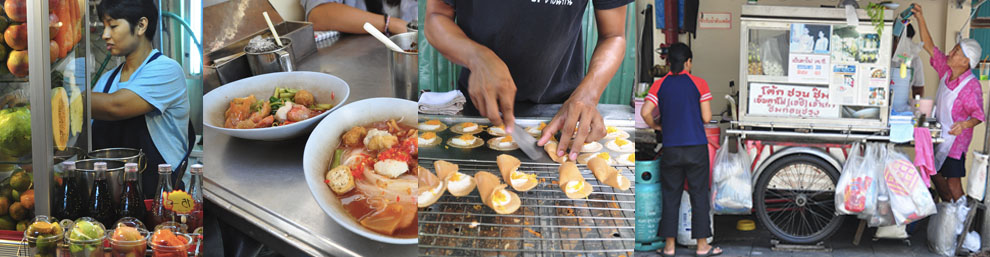
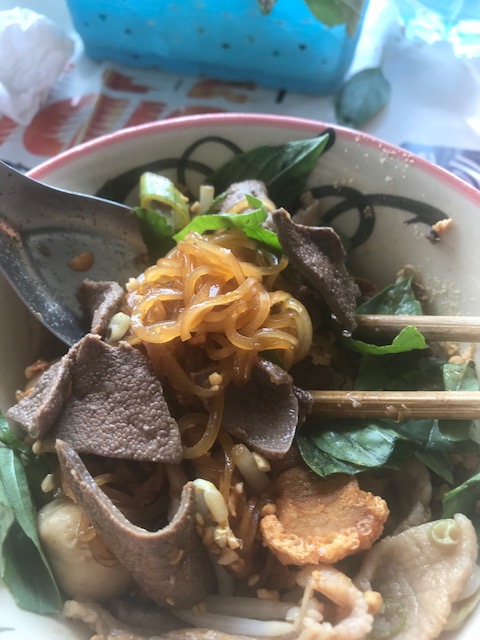
Boat noodles without broth at Guaythiew Ruea Gati Sod

I left my house this morning in a foul mood following a few hours’ worth of CNN, prepared to kick in the face of any man who gave me cause. After reaching my destination and spending a mere few minutes discussing the ins and outs of Thai food, I returned home in a far rosier mindset. Food can do that for you. That’s what I like about it. It’s the equivalent of puppy and kitten videos and an afternoon spent watching Youtube videos of people attempting yoga moves that are far too advanced and falling, but not falling so badly that they seriously injure themselves, because we are nice people and not gaslighting douchebags who get defensive when asked about beer.

There goes my mood again. Let’s focus on some other things that make us happy when we’re in a bad mood, like (many) glasses of wine or 45 minutes of extremely mild cardio. Watching Lifetime channel specials featuring gourmet detectives or witches with magical powers whose most serious problem is when a rare flower gets cut in the public park. Listening to Aretha Franklin’s version of “I Say a Little Prayer”. Hugging my children. Did I mention wine earlier?

And of course, stuffing my face. What is so great about Thailand is that there are so many different ways to go, and they are all good. One of these ways is boat noodles, which sprouted up around the 1940s as small bowls served by canal-faring vendors who thickened the broth with a splash of pork or beef blood. These noodles remain popular, renowned particularly in the Victory Monument area, but they also have a following in other waterborne areas such as Ayutthaya.

Nakhon Nayok is another such place, generously studded with waterlogged rice paddies and shot through by the (what else) Nakhon Nayok River. Not surprisingly, then, boat noodles also figure here, but there is a type of boat noodle that is not served anywhere else. Called “Guaythiew Ruea Gati Sod” (boat noodles with fresh coconut milk), the vendor claims to make it from an “ancient recipe”, but a little questioning will tell you that she actually invented the noodles herself.

Adding the coconut milk to the noodles is not for everyone: it smoothes over all of boat noodles’ hard edges and sweetens the broth, sort of like khao soy without all the texture or garnishes. But if you are looking for something different, or if you prefer your noodles sans broth, simply a good bowl of boat noodles, trek over to Thanon Yai Lumlukka between Klongs 9 and 10, soak in the view out over the river, and treat yourself to a bowl or three of noodles, both with broth and without. You will probably leave in a better mood than when you came.

noodles2

In coconut milk broth, with shredded basil leaves


1 Comment

Filed under Uncategorized

Back to the Future

samosas

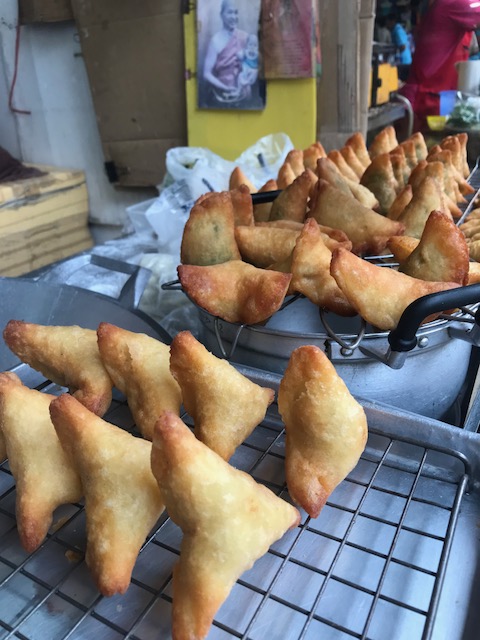
Samosas at Klong San Market

Whenever I tell people I am a freelancer, someone invariably busts out the decrepit old joke about “working hard, or hardly working hahahahahahah” like I have never heard that one before. I think of it now because I have barely been able to post much over the past few weeks, and the normal temptation is to say that I have been hard at work. The truth is, I have been hard at work watching Netflix. Specifically, the show “Lords & Ladles”, with which I am obsessed in the way that Naomi Osaka is obsessed with “the villain from Black Panther“. As in, totally.

If you don’t have as discerning taste in Netflix shows as moi (or don’t have Netflix, I’m sorry), let me fill you in: It’s three Irish chefs with a nice, easy rapport who cook old-ass recipes from dinners held in centuries past at old-ass ancient houses. It’s a brilliant concept because it’s food porn, Fear Factor-grossness porn (offal plays a big part in every meal), real estate porn and snooty family history porn all wrapped up in one, and it is irresistible. I cannot stop watching it.

Here is where you realize that: 1) Aspic really does play a huge role in these meals; 2) Testicles loomed large as a source of protein; 3) You can eat lambs’ ears if you work really, really hard at it; 4) “Hedgehogs” are the name for a type of dessert; 5) Anything can be served if you encase it in dough; 6) Everything was served “a la Francaise” (all the dishes of a particular course served all at once instead of in succession, which makes me look more favorably on Suhring’s tasting menus); and 7) Booze has always been an important source of calories.

In the last episode I watched, “pepper pot” was served as the first of 13 dishes, which is freaking insane because pepper pot is basically chili con carne with a bunch of crazy-ass off-cuts thrown in. In the US, pepper pot is most associated with Philadelphia — a bone-warming stew of tripe, veal knuckles and whatever vegetable you could lay your hands on, said to sustain George Washington’s troops as they endured winter at Valley Forge. That would become a huge enough selling point that vendors could sell it on the streets of Philadelphia years later, when those sorts of things were still sold on the streets.

This is food ephemera in the way that recalls the origins of the dish “syllabub”, another former street food of sugar and bourbon enriched with a splash of milk straight from the udder of the street vendor’s cow.  This particular dish was so popular that the vendors (and their cows) would be invited to dinner parties so that the syllabub could be made as fresh as possible. A good hostess would often milk the cow herself. Street food in old-timey America was something else.

Today of course, street food in America is often characterized as something slapdash and dirty, meant for tourists or people with little time or respect for themselves. It’s not something you travel a long way to seek out; the stuff you travel for, like pizza in New Haven, a burger at Shake Shack or Chinese food in Flushing, has long passed the point where it could be considered street food. Also, the existence of places like McDonald’s make working hard for your “street food” to seem incredibly self-indulgent, something for a dilettante with nothing better to do. And of course, many people in America no longer depend on that street food to survive.

This would be a nice future for Thailand, when street food would be an optional thing that could be sampled as part of Thailand’s rich cultural heritage and a fun pastime for tourists. We aren’t there yet, however. We are still at a place where a vast majority of Thais buy something off the street every day. Occasionally, Bangkok authorities get the message. After public outcry following the decision to “clean up” Khao San Road (please check out the tags on this linked Bangkok Post story), the Bangkok Metropolitan Administration has reportedly capitulated and decided to leave it as is.  But the message has not been lost: if developers have major plans for an area, the BMA — like reverse-Samwise Gangee-type handmaidens, or real estate Dementors — can be called on to assist them on their quests.

Few projects have as much potential impact for an area as Icon Siam, expected to open later this year (!) on the Thonburi side of the river. Fang Thon (the Thonburi side) has been percolating for a while now, thanks to new developments like Duangrit Bunnag’s Jam Factory and Lhong 1919, establishing the area as a true hipster successor to crowded Aree and played-out Thonglor/Ekamai. The opening of a huge mixed-use shopping mall like Icon Siam will tip the area over into a real hub, a full-day destination just like Siam and Emquartier have become.

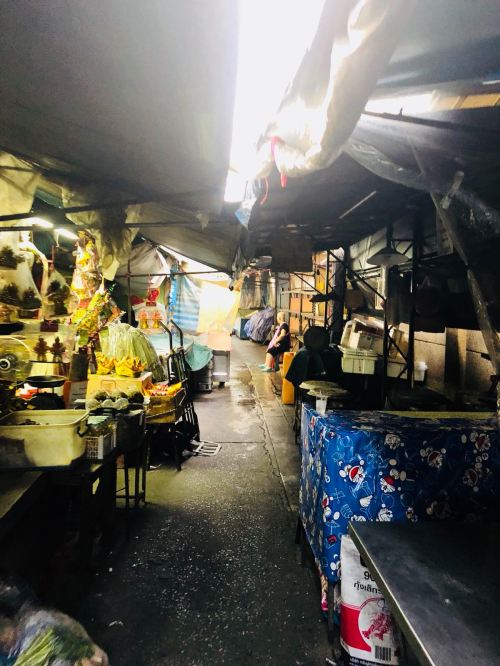
Of course, this inevitably means gentrification. So the stakes facing long-time markets like Klong San Plaza are high … but you wouldn’t be able to tell from asking the vendors there. A former railroad station for goods on their way to Bangkok, Klong San is today the kind of covered market you see increasingly less of: earmarked exclusively for Bangkok locals on the lookout for crazy-good deals. Think jeans at 250 baht, designer knock-offs, discounted makeup, and the inevitable scourge of streetside Thai-style sushi, you get what I’m saying.
fish

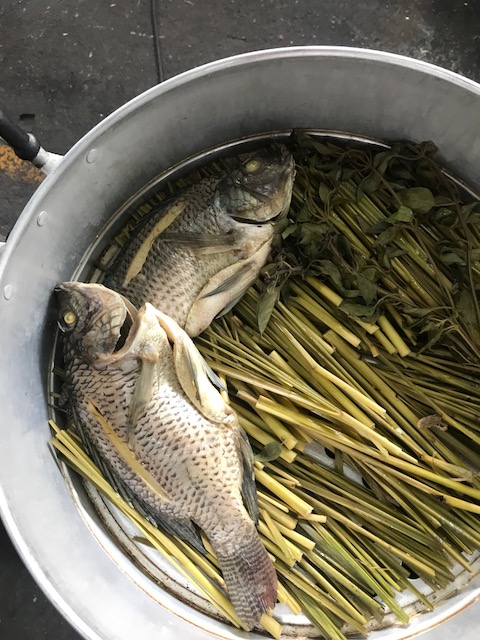
Isaan-style steamed fish

The vendors here, who pay a fairly hefty rent at around 18,000-30,000 baht a month depending on your proximity to the river, obviously see enough foot traffic to make it all worthwhile. To them, Icon Siam and Klong San are two completely different markets, aimed at two completely different segments of the public. They can only serve to help each other. But the fear among people like my friend Trude, who is studying commercial spaces, is that Klong San’s “hyper-local” nature is what makes them so vulnerable to being taken over eventually by a neighbor with far more money, eventually to be replaced by an ersatz “street market” that really markets to the hipsters that occupy Jam Factory. Eventually, the market for bargain-hunting locals will be only what is siphoned off to them by big corporations like 7-11 and its myriad instant noodles. Think chicken rice courtesy of Burger King, congee a la McDonald’s, sticky rice and Thai-style fried chicken from KFC. Don’t pretend you haven’t already seen it.

Until then, Klong San will give you culinary bright spots like any other local market: southern Thai-style samosas stuffed with cauliflower or bamboo shoots; Isaan food catering to the construction workers next door offering spicy chili dips, pork intestine spicy soup and herb-stuffed steamed fish with sticky rice; the usual soup noodles and crispy pork on rice alongside goong ob woon sen, or steamed river prawns in glass vermicelli. And, if you have had your fill of the cheap snacks and knick-knacks, finish your jaunt across the river with something a little more substantial at — you guessed it — Jam Factory, because gentrification is here to make noobs of us all and we are nothing but the human handmaidens to our corporate overlords, but at least in this case they are Thai corporate overlords and not Hilton Worldwide. Yes, the winged bean salad is that good.

salad

Winged bean salad at Never Ending Summer


3 Comments

Filed under Uncategorized

The Natural

crab

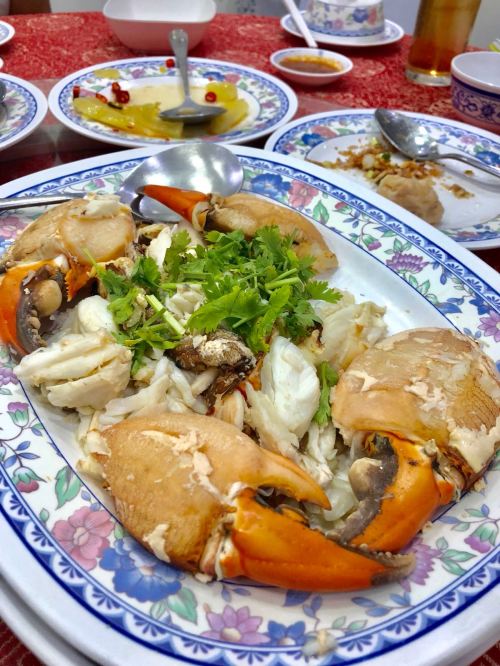
Crab from the Crabman

(Photo by Chatree Duangnet)

I have not posted in a while because my laptop was being held hostage by my son, who used the tail end of his summer holiday to make numerous Google slide presentations for his own amusement. I have to admit I appreciated the excuse to stop writing. Unfortunately, he is back at school so I suppose I will have to start up again.

Also during the summer holiday, I was lucky enough to be tapped to do some research work for a documentary on street food. This led me to various restaurants, not all of them street food, where for some reason or other (such as, they were not street food) they did not make the final cut. One of those non-street food places was “Jok Tho Diew” (“One Table Jok”), also known as Jok Kitchen.

Jok Kitchen has been around for a while, a little over 10 years now. From the very beginning it was a success, winning write-ups from various publications and months-long waiting lists. The funny thing about this (Alanis Morrissette would call it “ironic”) is that Chef Jok came to the success of his one-table restaurant fairly late in life, after decades of kicking around Asia doing anything but cooking.

Born 65 years ago in Chinatown to a Chinese-Thai mother and a father who had immigrated to Thailand from Shantou, Jok spent his earliest years in the hospital, cared for by nurses because of a rare allergy to his mother’s milk. Fed on a mixture of chocolate and rice water, he was given the name “Jing Jok” (Thai for gecko lizard) by the nurses because although he didn’t eat much, he wouldn’t die.

This early ailment may explain why he remained the apple of his parents’ eyes well into adulthood. Gregarious and talkative, Jok was deemed unsuited to the traditional support roles in the family business, which was one of the most prominent suppliers of crab in the country. So instead of following his siblings into management, Jok became a delivery boy.

Watching what the cooks did with the crabs he delivered sparked his interest in food. His first taste of steamed fish in soy sauce, the signature dish of famed Thai-Chinese eatery Hai Tien Lo, sealed it. Determined to make the dish himself, 12-year-old Jok convinced his father to let him apprentice with the chef, Meng Jai, igniting a pattern of incorporating, adapting and improving others’ dishes that he continues to this day.

snowfish

Fried snow fish on lettuce, inspired by a meal at Fuji

 (Photo by Chatree Duangnet)

Never at a loss for friends, Jok honed his kitchen skills by cooking for his friends, starting a “cooking club” where he would attempt to replicate dishes that he and his friends admired at famous restaurants. Even as he took on a more peripatetic lifestyle, embarking on various ventures in Indonesia, Vietnam and mainland China, the cooking club remained a near-monthly occurrence, his interest in food unrelenting. “You should start a restaurant,” was a familiar refrain from friends that he kept touch with, childhood friends who had since grown into positions in the military, banks, police, media, and of course, in neighboring shops in Chinatown.

This would become key later on, when his parents passed away and he was left to fend for himself. After a brief and acrimonious stint maintaining a food outlet at Suvarnabhumi Airport (he quit after one month over rent issues), he decided to essentially monetize his supper club, opening up the table typically reserved for guests to his house to food-loving members of the general public willing to make the trip down the dank, dark alleyway to his door.

alley

By day, a bustling market. By night, the entranceway to Jok Kitchen

The concept was irresistible to Bangkokians: one table, reservation only, serving high-end Thai-Chinese food that was championed by big-name mucky-mucks in all corners of high society. Since then, Jok Kitchen has expanded to a back room next to the kitchen that easily fits two more tables; at maximum capacity, Jok Kitchen can accommodate six. The repertoire has also expanded, including special requests from guests if made far enough in advance (although his signature dish remains the beautifully steamed, fresh crab.) Other dishes are a map to his own experience: “Prosecution Fried Rice”, a delicious mix of perfectly wok-cooked Chinese sausage, egg, and Chinese kale was hatched during a late night session with lawyers working on the prosecution case against Thaksin Shinawatra; his “hangover soup”, a clear seafood soup with pomfret, ginger and pickled plum, was born after an evening spent overindulging on whisky.

The kitchen, however, remains tiny, a condominium-sized cubbyhole with four burners and a shelf full of homemade condiments, including his own version of a famous oyster sauce from a restaurant in Hong Kong. This is used to best effect in his steamed fish dish, inspired by that first bite of steamed fish in soy sauce at that restaurant in Chinatown years ago.


2 Comments

Filed under Uncategorized