Spring Cleaning

curryrice

My curry rice place for now

I saw the movie “Get Out” maybe a week ago, and like many people have said themselves, I am still thinking about it. After reading this wonderful Jezebel interview with the actress Betty Gabriel, who played “Georgina” in the movie, it got me thinking even more … about Thai street food.

To me, “Get Out” is a literal illustration of what cultural appropriation is. It also serves as a tidy metaphor for colonization. This is what empires did: taking over foreign lands, cherry-picking the most valuable bits, and co-opting them as their own to their economic benefit. This is frequently seen as an example of the bad old days, when powerful Western countries were less enlightened than the progressive nations they are today, having safely been enriched by those bad old days already.

But some say a hidden type of colonization still exists. Of course, this belief is often derided as coming from arch-conspiracists and the sort of non-American ethnonationalists who rail against the evils of McDonald’s and Hollywood. I would say, however, it’s not that far off (*adjusts tin foil on head*), because that is something like my experience with McDonald’s and Hollywood. Just because we aren’t asking God to save the queen every time we make a toast or saluting a foreign flag doesn’t mean we aren’t in thrall to a foreign way of thinking — a way of thinking that makes us, deep down inside, hate ourselves and see ourselves as the enemy. And just because that isn’t your experience doesn’t make it untrue. We, me, a non-white on the rural Western edge of Pennsylvania: from very early on, we see in magazines like American Vogue or movies like “Ghost in the Shell” (“Oh God,” ScarJo sighs, sipping a margarita poolside in Cabo. “This again.”) that white is prettier. Smarter (if not in a nerdy sense, then at least in a “street smarts” way). More rational. More relatable. More interesting. And, if you are Asian, more manly. More important. The blue-eyed, blond “anak” dude in the Philippines tourism commercials on CNN: the world is there for him to explore, to be given free sweets, to be treated like family, smiled at and coddled even if he makes a mistake. How lovely for that guy. How often I’ve wished that “anak” meant “moron” or “dickhead”.

In “Get Out”, people are just like suits, identities to be discarded when the next “in thing” rolls around (is that a spoiler alert? Aw, sorry, anak). It’s assumed that they’re not as important as the stars in everyone’s show.  And that does something to us, we, me. We start making ourselves the supporting actors in our own head-movies: at best, the funny best friend in “Crazy Stupid Love”, perhaps, or Nicki Minaj in “The Other Woman.” At worst, we are Georgina, the shell hiding an entirely person on the inside, a person who hates and fails to identity with her outside (in Betty Gabriel’s words, “the worst kind of assimilation.”) That begs the question for us-we-me: where do we fall on that spectrum? Am I Georgina? Probably sometimes. How could I not be? Why wouldn’t we want to be a part of the stronger team, and how far would we go to get there?

Let me revert to nerd-speak for a moment. Georgina is like Sansa, before Ned’s sentencing in front of the Great Sept of Baelor. Sansa, who wished to marry Joffrey, and rushed to tell Cersei of her father’s plans to leave King’s Landing. How we all hated Sansa and claimed to identify with Arya, just like all those Harry Potterheads who think they are Gryffyndors (although one could argue that Arya is her own kind of Georgina, rejecting her own “feminine” qualities to take on the “active,” “strong” characteristics of the far more powerful men). Maybe, to paraphrase the movie “The DUFF”: Everyone is someone’s Georgina.

Including Bangkok. See, I finally did get there. Bangkok appears to have internalized the image of Asia as written by people like Rudyard Kipling: a collection of rickety warrens filled with dirt and squalor and bleating live animals, populated by untrustworthy, nattering natives (not to mention the things they get up to when left to their own devices on what to eat — bugs, intestines, yuck!). In other words, we’re a background to whatever Indiana Jones is doing at the moment. Bangkok thinks of itself as a city of extras. It is Georgina-ing itself, of its own volition.

bamee

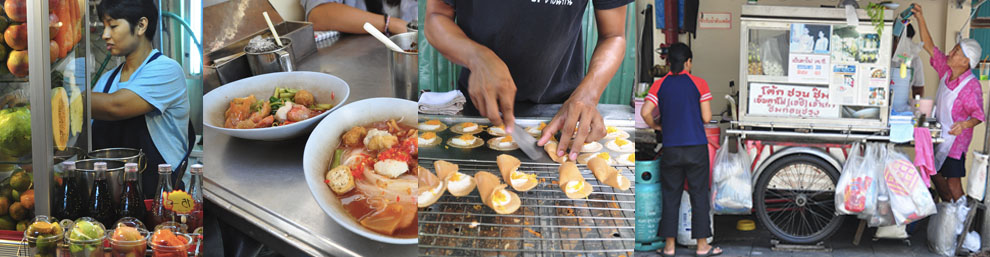
Streetside food on Ekamai in happier times

Maybe that is why, in the interests of “cleaning up” the streets and imposing some “order”, Bangkok authorities are methodically clearing away the “mess” on the sidewalks that the authorities never walk on, simply telling vendors to move elsewhere … until they have to be moved again. Presumably, the idea is to make Bangkok more like modern-day Singapore, an artificial city built as a commercial port for the British empire. The problem is that, when trying to turn yourself into someone else, you will invariably become a pale imitation of the original. Sure, you can try to become Singapore, but Singapore will still speak better English and, sorry, remain far more efficient than you. Just sayin’, Bangkok.  Don’t get so upset. Why do you always have to take things so hard? You had your own things that make you pretty, too. Isn’t that what we always tell little girls? You were pretty in your own way, Bangkok.

The latest area to be “tidied” is Ekamai, Thonglor and Phra Khanong. Unlike Sukhumvit 38, where both local residents and tourists ate, this latest clearing is really a strike against the regular people who work the many restaurants, shops, banks etc in the area: the regular working Thai. Where are they to eat? I guess Emquartier/porium, where all the Bangkok authorities eat? But where will they really eat? Undoubtedly 7-11. Bangkok is condemning these workers to a diet of instant noodles, cream-filled buns, white bread mayonnaise sandwiches, and sausages of dubious origin. That’s better food, right? It’s “cleaner” and certainly “tidier”. It’s more “progressive”. And if a cursory look at what’s available by the highways nowadays (Starbucks, Burger King, McDonald’s, and of course 7-11), it’s the food of the future.


1 Comment

Filed under Uncategorized

Glutton Abroad: KL is trying to kill us

panipuri

Delicious panipuri at Ganga Cafe

I love visiting Kuala Lumpur, but at the same time, I can’t help but view each trip with a bit of trepidation. After all, May is our host — the same woman who took us to a char siu place, a laksa shop next door, and then bought two pork meatballs for me to eat on the road because I would be without food for 15 minutes. This woman. She hosts us. And, although we are immeasurably grateful, there is no way for us (me, really, who cares about the others) to prepare for the immense mountains of food awaiting us.

This trip is no different. Perhaps anticipating the gluttony in store, my husband (with good intentions) orders me a gluten-free breakfast on Thai Airways, which ends up being a wildly overcooked poached egg next to a smattering of unseasoned sautéed mushrooms. So I am hungry when we enter Fuego, but it is the last time we are hungry for the next three days.

Fuego does a very brisk business serving up snazzy cocktails, creative South American-inspired tapas, and a lovely view of downtown KL that has only recently been obscured by construction for the new Four Seasons Hotel. It doesn’t really matter though. It’s all about the food: a handful of guacamole and ceviche iterations, different arepas, smoked quail eggs on a seaweed and vegetable nest. A ho-hum-sounding salt-baked potato with foie gras is actually the best thing I can remember having this year, covered in a sage hollandaise made with whole butter and so delicious that I will never attempt to make it on my own. A grilled watermelon salad with fried halloumi is refreshing; the lamb ribs toothsome and meaty; and the Malabar fish stew surprisingly light. We finish everything, and it is only after 3 or 4 (or 5) Sangrias (including Nat’s) that I remember to take a blurry photograph of our half-eaten churros dessert, served with a salted caramel espuma.

churro

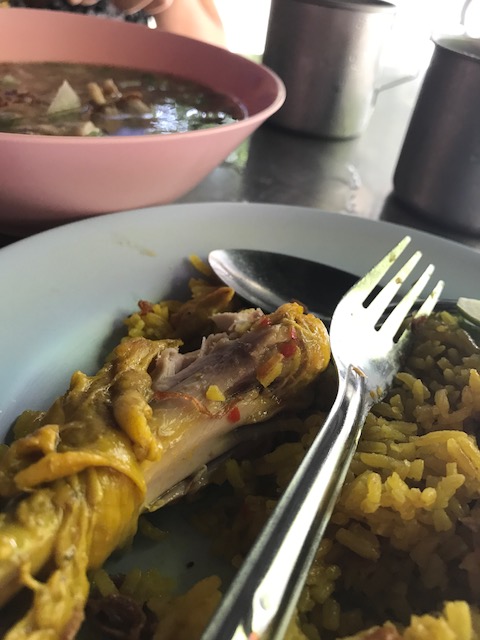
The next day, I am not hungry, but that doesn’t stop us from following May’s advice to “pick up a roti” at Sri Paandi (37 Jalan Date Mahmud 11/4, 46200 Petaling Jaya). The roti ends up becoming a chicken biryani or two, because let’s face it, we don’t really understand what they are saying to us and “biryani” was the only word we recognized.

biryani

Chicken biryani at Sri Paandi

We take everything they offer to us, different curries and dhals from buckets and tiny bowls of yogurt and whatnot, so it’s a surprise that they don’t offer the best-looking stuff of all, whatever this is:

indian2

But we are already headed somewhere else. Kumi Cafe (21, Lorong Setiabistari 2, Bukit Damansara, 50490 Wilayah Persekutuan, +60-12-651-1182) specializes in Malaccan Eurasian cuisine, a mix of local Malay and Portuguese cooked by chef Ruben Moissinac. There are expected staples like curry seku, a Goan-Portuguese dry curry thickened with coconut milk, otak-otak (a steamed fish paste similar to Thailand’s hor mok) and a stew made with keluak (sadly unavailable that day), a nut that is poisonous on the tree but edible after it is buried in volcanic ash for three months and soaked for one week in water that is changed daily.

hormok

Kumi’s otak-otak

But the best dishes were unexpected, like the savory pie stuffed with dry sambal chicken.

captainpie

Don’t worry. When we finished, it was only a couple of hours before dinner, which would be at our friend’s house. There, a Nonya-style pork curry would prove so delicious that we could not help but stuff our gorges yet again, only to bitterly regret it later on when we cannot sleep.

The next day, dark circles under my eyes, the first thing I eat is lunch, because I cannot imagine even the hint of food anytime before noon. Too bad for me lunch is a dazzling Indian vegetarian at Ganga Cafe (19, Lorong Kurau, Taman Bukit Pantai, 59100 Kuala Lumpur, +60-32-284-2119) and I once again can’t help myself — I have to have as much stuff as possible. We have thosai, light flaky stuffed crepes made with rice flour and paired with coconut chutney, but also something from the display in front, sweet pumpkin stuff and spicy chick pea something-else and dhal and bracing tamarind soup in a silver cup. There’s also panipuri, little cups of fried dough filled with chili, potato, onion and chickpeas. It’s left to you at the last moment to pour a little bit of coriander-flavored water into your “cup” before putting it into your mouth and enjoying the perfect bite: crunch that explodes into something tart, salty and just a little bit sweet.

indian1

Some of the spread at Ganga

That night, we eat where we always eat when we are in KL: Overseas Restaurant. But to mix it up a little bit, we eat a succession of different things that now blur when I think of them, because we also had a lot of wine. We had perfectly stir-fried lettuce leaves with touched with a hint of fermented tofu and a fish soup that reminded me of Thai gaeng som, or sour curry. Of course, we had the roast suckling pig, served the way only Overseas does, with a side of sticky rice and plenty of curry sauce. There were other things that I no longer remember, but I’m sure we gamely tried them all. We didn’t end up exploding in KL, but it wasn’t for lack of trying.


7 Comments

Filed under Uncategorized

Glutton Abroad: HK Hustle

jelly

Wall of cooling turtle jelly


In all my trips to Hong Kong, Causeway Bay has consistently been my least favorite place to go. The reasons seem obvious: 1. I always get lost 2. I don’t know where to go 3. Did I mention it’s confusing and I invariably get lost there?

What I was missing was a neighborhood guide. Tadd, a Cantonese Singaporean who has lived in Causeway Bay for years, is the perfect person for the job. This is a woman who clearly loves this place, a study in contrasts that hosts not only the most expensive retail space in the world (in fact, Tadd says McDonald’s had to move a few blocks because it would have had to sell 16-17 hamburgers/second to make up for its rent), but is also home to a Hong Kong that, to its long-time residents, is becoming more of a distant memory: chaotic, Byzantine, busy, and yes, easy to get lost in.

Luckily, there are lots of delicious places to use as landmarks. A turn down every alleyway yields a wonderful place for rice porridge, a good stop for pineapple buns, delicious Macau-style egg tarts that are lightly charred on the outside and runny within, gently braised bits of cow lovingly layered over rice or noodles. Up yonder is the best store for fermented tofu; next to rice porridge is the store to go to for every variety of pickled plum imaginable. Tadd walks us to what she says is her daughter’s favorite wintertime restaurant, and it turns out to be snake soup (Se Wong Ke, 24 Percival Street, Causeway Bay), its different varieties meant to address different ailments such as coughs, a cold or I-don’t-kn0w-I-just-don’t-feel-like-it-anymore — what I would have ordered).

snake

I guess I’ll have one of those?

And culinary discoveries are not the only ones to make here — under the bridge, at the invisible border where Causeway Bay meets Wanchai and the “spicy crab under the bridge” restaurant, elderly Chinese ladies await customers who flock here especially to curse enemies or ward off those who would curse them, with the help of some candlelight, figurines and the sturdy sole of a shoe to batter someone’s written-down name with. On a busy night, the intersection rings with the sounds of shoe heels battering plastic, over and over again.

street

Ready for business

But we’re here for the food. As is always the case with Hong Kong, it’s almost impossible to fit everything inside your stomach that you want to stuff it with, because no one ever has enough time or room for that. But some standouts included Chiu Chow Garden, where we feasted on crazy-fresh fried fish, an assortment of perfectly stir-fried greens, the “famous” roast chicken, and stewed goose on a bed of fried tofu to soak up its juices “because in Hong Kong, you must eat goose”, says Tadd. Although the Chinese in Thailand are predominantly Chiu Chow (or Teochew) and the Chinese-Thai food in Bangkok is supposed to reflect that, nothing we had in Hong Kong reflects anything we’ve had in Thailand, including the introductory and closing servings of bitter tea, meant to aid digestion.

eggplant

Cold eggplant in a stellar sesame sauce at Chiu Chow Garden

After dinner, to settle our stomachs, Tadd takes us for “dessert”, which should never be referred to as dessert ever forever, because that would hugely disappoint anyone with images of sugarplum anything in their heads. It’s called guillinggao, or turtle jelly, and it’s traditionally made from powdered turtle under-shell mixed with different Chinese herbs to correspond to your ailment. Yes, it’s medicine, just like snake soup, and HK people eat it for “dessert”, because they are that sort of good person that exercises on their holidays and appoints themselves designated driver even before anyone threatens to tell their mom.

Wikipedia says turtle pudding became a thing after an emperor almost cured his smallpox with it (before abandoning his treatment and dying). Today’s versions probably don’t really contain actual turtle shell (only herbal approximations), but tell that to all the people who stop by Kung Wo Tong on their way home from work, or after a run (!), or during a date (?) — not only for one of the different kinds of turtle jellies, but for a healing tea, or bracing “liver detox” that tastes like a mix of wood polish with raw turnip. I get the “cough” one, which ends up being less bitter than the others with a slight peppermint aftertaste, palatable enough to eat half a cup of on a full stomach. Emboldened by the fact it isn’t as awful as I had originally envisioned, I even joke that I will be there the next morning to try it again. I don’t, though. I have braised beef brisket on silky egg noodles, because duh.

beef


Leave a comment

Filed under Uncategorized