Tomorrow’s street food

table

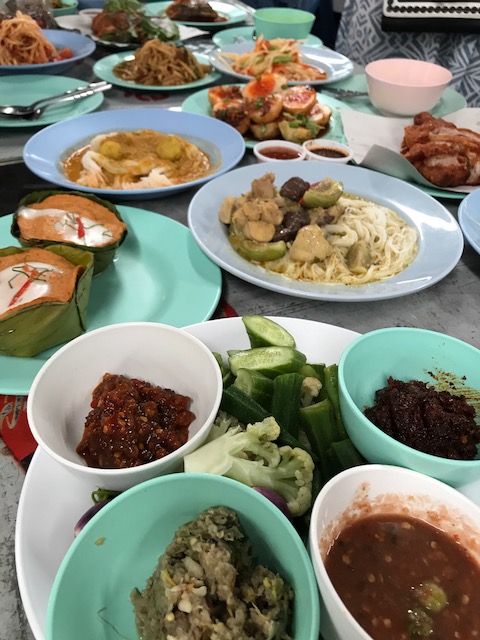
A table full of food as everybody goes crazy at Thalad Ruamsap

Barbecue was the glue that held the American South together. Served at political rallies as a way to lobby for votes and at church parties as a way to lure lazy congregants, barbecues became associated with celebrations and a surefire way to deliciously dispose of the hordes of wild pigs that lived in the forests at the time.

The production of pork became a mark of Southern American patriotism, a way of making sure the South was self-sufficient. Attending a barbecue was not considered especially patriotic, because of course you would attend a barbecue, who wouldn’t, unless you were crazy and had no friends. The “whole hog” was used — this was no time for getting queasy about pig parts — so diners could get their choice of cracklings, Boston butts, bacon, ham hocks, fatback, ears, tongue, spleen, feet, tails, smoked intestines stuffed with sausage, and souse (an indiscriminate mix of the hearts, lungs, skins, etc). The lucky pig was cooked slowly through indirect heat from wood or coals that had to be painstakingly replaced every 10 or 15 minutes, in a smoky shack built over the pork situation just for the occasion.  The resulting meat, after 10 hours of work, was served with lemonade and whisky, because a party’s a party. These barbecues were considered “class-blind” occasions, a place that served as the glue for Southern society. The story of barbecue — a tradition that became entrenched in the 50 years before the Civil War — turned into the story of America.

It doesn’t take a great leap to say that Thai street food could once have been considered roughly the same thing, the glue that held Thai people together. There were places that were, quite obviously, closed to no one — staffed with plastic stools and steaming hot vats of something edible and, ideally, a grumpy person who would put you in your place — but clamored over by everyone, because the food was that good (and cheap, but mostly good, because you don’t have a cook and you can’t cook, don’t pretend). The knowledge of the best of these places among Thais was like scrapping over baseball cards with a bunch of nerds, something that either solidified or obliterated your personal street card. Plus one if your knowledge extended beyond your personal neighborhood; +5 if it included a different city (usually Chiang Mai); -10 if it involved a different country, because who cares. The idea of this mix, and this glue, was what drew me to Thai street food in the first place: that I could easily insert myself into the “we” of it all, if I could just pick up a pair of chopsticks and march out onto the sidewalk.

And the stories behind street food, I loved those too. How it turned some families into millionaires over the course of one generation; how it enabled record numbers of women to join the workforce, and others to gain financial independence and flexible hours if you were good enough in the kitchen and had good kids to help you, like Ian Kittichai’s mom. The “American dream” could actually exist, in Thailand, if you were good enough or smart enough. You could become just like that moo ping dude on Silom Road, probably the most durable success story in all of Bangkok street food-dom. Who would not want to become Hia Owen?

But when people talk about becoming an adult, a lot of it involves resigning yourself to stuff and accepting “reality”. Like, I accept that I will never see the White Stripes or Prince play live. I accept that my blonde hair makes me look like the crazy albino guy who stalks Whitney Houston in “The Bodyguard”. I accept that George RR Martin will probably never finish “A Song of Ice and Fire”, so I will have to finish it in my head, knowing that everything I choose is the right way for the series to end. Street food will change, because time changes everything, and progress is inevitable, whether it’s artificially induced or not.

So when our friend Matt came to Bangkok to write about street food, it only made sense to check out something that would, in all likelihood, become one of Bangkok street food’s futures: the “thalad” (market), a collection of many street vendors under one roof, sharing tables and resources. Vincent showed us one of his favorites in his ‘hood, Asoke, called “Thalad Ruamsap”, a lunchtime standby for all the office workers in the area.
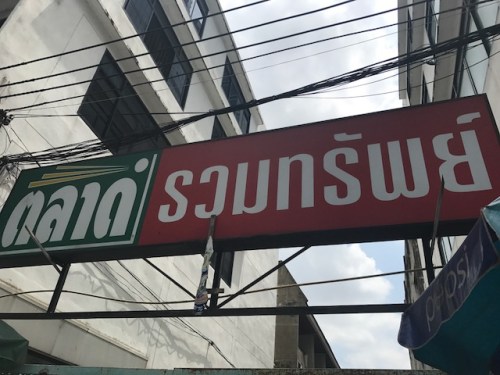
sign

The entrance to the “market”

Inside, you get two interlocked “food courts” featuring a plethora of choices, from the very basic (rice with fried omelet) to the harder-to-find (a chili dip station; Northern Thai food; fermented rice noodles with different curries and fixings). We, naturally, went hog wild, picking everything we could find until our table was a heaving mass of bounty that drew side-eyes from every Thai who passed us by.
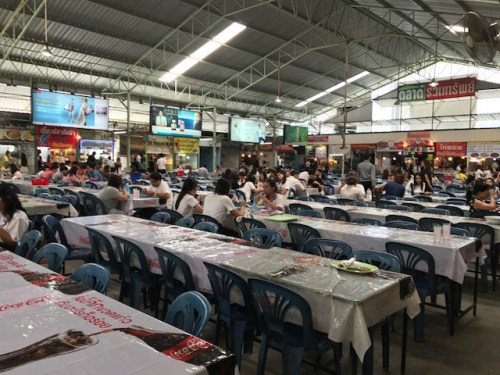
diningroom

One of the two “dining rooms” in the market

Was it good? That seemed beside the point. There were “son-in-law” eggs, steamed savory seafood custard in banana leaf cups, chili dips, charcoal crepes, pretty awesome fried bananas. That the market displayed food that appeared to have some degree of care put into it seemed good enough. That you wouldn’t have to traipse an hour out of the city center seemed good enough. Good enough, and without the threat of some clipboard-wielding policeman coming in to bust everything up. That’s where we are now, in the world of Thai street food. That’s a sign of impending adulthood, right?
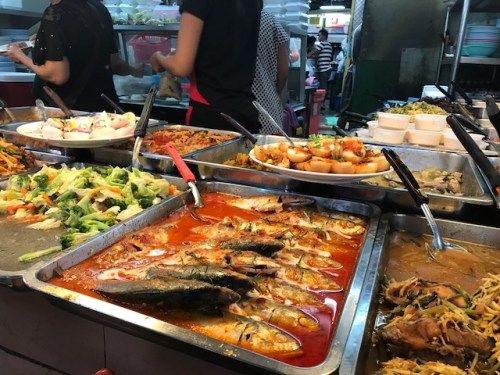
curryrice

You can get to Thalad Ruamsap by crossing Asoke Road from the Mor Sor Wor University and entering the alleyway next to Ochaya.
 

11 Comments

Filed under Uncategorized

The future is now

thaibbq

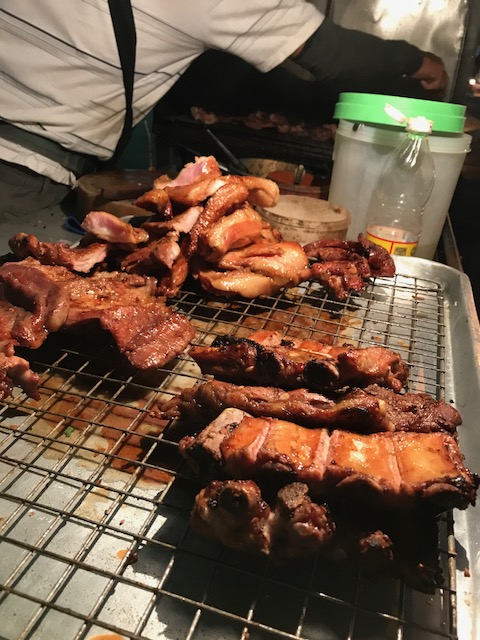
Grilled pig parts vendor on Suan Plu

We can rage against the dying of the light all we want but progress continues apace, bringing with it a Starbucks and 7-11 on every corner. Soon we will become the shopping mall utopia that our ancestors had always dreamed of. Until then, we will still have to contend with food that does not come in plastic wrapping. The future cannot come soon enough for New Bangkok.

When I heard through the grapevine that Suan Plu was the next street to be cleared, I was confused. After all, this street is home to both the Immigration Office and the district police station. Why would they want to get rid of the places where they themselves eat, and where their own wives work? Not to mention that the quality of street food on Suan Plu is very, very good. But then I remembered that we live in Thailand (see: Thonglor) and that our corporate overlords progress is not to be denied.

And then when I heard that a new market would be opening up on the corner of Suan Plu Soi 3 (right behind Isaan hotpot vendor Jay Ouan Moo Jum), and that it would be charging vendors 30,000 baht a month for a 2×3 meter area, it all made sense. This would be the new street food model to be followed in New Bangkok — how better to make money than from street vendors who need space to stay downtown?

So when Trude and I went to Suan Plu to check out the space earmarked for the market, we were surprised to find out (from the local grapevine, our friend Jason) that plans had gone Thai-style kaput: quietly, with no information on why. After pouring concrete and marking out the plots, the owner had decided to fence off the entire space. Rumor now has it that the lot will become a much-needed hotel.

But we still needed to eat. After asking a very accommodating server at a nearby wine bar (where else would I be) where to go, we learned that the cart vendor just across the street was improbably popular, setting up at around 6 in the evening and usually selling out by 8pm. She claimed it was the best place in the entire neighborhood for grilled pork parts: tongue, ears, short ribs and most importantly, pork neck.

I have always thought that the best pork neck on Suan Plu was Jay Ouan. For an idea of what I’m talking about, here it is:

porkneck

Pork neck at Jay Oun Moo Jum

It’s fatty and slightly sweet, paired with a spicy tamarind sauce. It’s what you’d expect from a good Isaan place in Bangkok.

But we probably figured out we were in for a treat when people kept cutting in line to place their orders to the pig parts vendor (unfortunately, I do not have a name and he does not have a card, but he is across the street from Wine Out and Smalls, which is on the corner of Suan Plu Soi 1). Don’t worry, I lost my temper and complained. And fear not, he was smart enough to tell me that we were next. I was very hungry, you know.

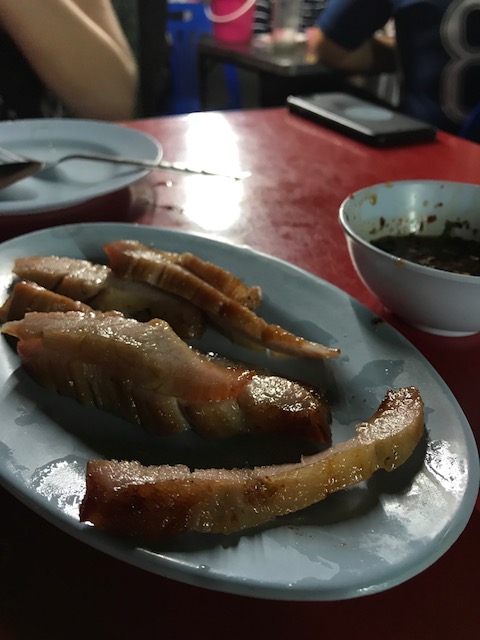
They had run out of pigs’ ears by the time we had gotten there, so we got grilled pork tongue and asked for pork neck served nam tok style (spicy salad garnished with shallots, chilies, fresh mint and roasted rice grains). He asked us how spicy we wanted it, which is a question that vendors rarely bother to ask, especially busy ones with a long line in front of their cart. I always ask for “klang”, or medium (which actually amounts to one half ladle of dried spice and ended up being not spicy enough).

We took our stuff and ended up eating it furtively at Jay Ouan, which was slammed with customers and didn’t have time to see what we were doing. We agreed: pig parts guy was the superior pork neck, fattier and redolent of smoke. The grilled pork tongue, too, smoky and chunky with just enough resistance to make chewing fun. And the tamarind sauce, sweeter and thicker than Jay Ouan’s, if you like that sort of thing.

To grab your own bag of delicious grilled pig, make your way to Soi Suan Plu on a day that is probably not Monday, after 5:30 but well before 8 in the evening. Find the mobile cart outfitted with a silver chimney thing about 5 minutes in, on the left hand side if you are walking from Sathorn Road. And if someone cuts in line in front of you, jai yen yen. 


1 Comment

Filed under Uncategorized

The ones who were moved

marketsign

Saphan Phut Market, off of Rama IV Road

When the latest stab at this street food ban thing started, my husband said everything would return back to normal by year-end. The assumption was that the political will to kick out vendors over and over again would eventually run dry, allowing them (although maybe not the old ones) to come back to the spaces they were once forced to vacate.

This has sort of happened at Asoke Intersection, prime street food real estate that once commanded up to 30,000 baht “rent” a month from the police. I don’t know what (or who) the vendors are paying now, but they are (almost) all back: the chicken bitter melon noodles, the pad Thai, the egg rolls, the strange mayonnaise-forward salads with hard boiled eggs, and most importantly, the fried chicken. The only one I am missing is the Isaan vendor in front of Maduzi, who made wonderful larb when she wasn’t fighting with her husband. I fear — like the curry rice vendor and made-to-order vendors on my own small soi — I will never see her again.

But, as of right now, the move towards progress continues apace. Forward, ever forward, spaces that have been cleared last year — Siam Square, and the Saphan Phut area next to the Flower Market — remain so, saving space for the eagerly anticipated projects set to join the city skyline. And the vendors themselves, trusting in the powers that be, have been moved to spaces set aside for them by various government agencies, with varying results.

siammarket

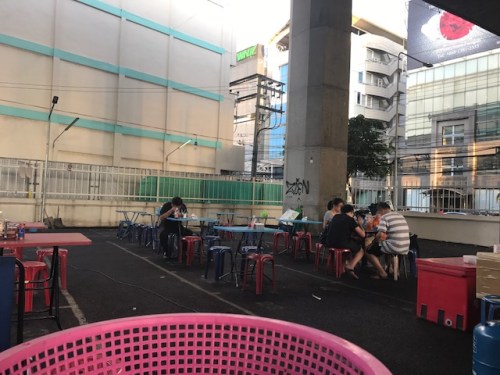
Diners at the new Siam Square Market

Trude, who is actually researching Siam Square, showed me this market the other day, a sweaty 10-minute walk from the BACC (Bangkok Art and Culture Centre) past Jim Thompson’s House. Set under a highway bypass, there was once high hopes for this place, literally illustrated by the lines and numbers marking where each vendor was supposed to set up. Today, five food vendors (two beverage, one congee/chicken rice, one soup noodles with pork, one made-to-order) remain in an area originally meant for around 50; a generously-sized dining area has been placed in the corner.

Despite the promise of a full year rent-free, most of the vendors have moved to other markets like Klong Toey, said one of the beverage vendors, Sumet. “Since we are old, we thought we would just stay for the year and then decide what to do,” he said. Customers trickle in from time to time, and there is none of the urgency that you’d imagine you might feel from vendors who sell far less than they had expected. It’s easy-going, quiet, actually peaceful; worth bringing a book and lingering over a Thai coffee when it isn’t raining. That’s not to say that this market isn’t doomed, because it is.

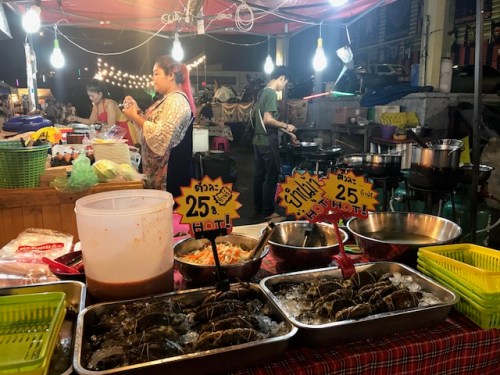
The prognosis is murkier for the Saphan Phut Market, moved from its riverside location to a former parking lot next to the Boat Pier (Tha Ruea) off of Rama IV Road. That’s because it just might work. Marvel- and Star Wars-themed t-shirts, hair accessories, women’s underwear — you see these things everywhere, sure. Pad Thai, soup noodles, sweet waffles, and, oddly, plenty of yum mamuang (mango spicy salad). Even more optimistically, seafood cooked to order, ready to be folded into omelets or, yes, mixed with lime juice and chilies into yet another salad:

seafood

There are even the standard culinary aberrations one would expect to stumble upon at any Thai night bazaar, like innocent fried chicken, cruelly doused in “tom yum” , pizza or BBQ spices:

chicken

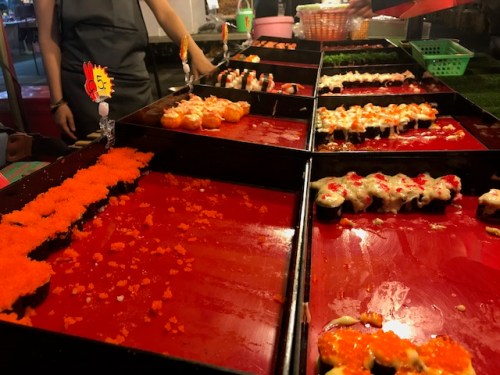
Or my personal nemesis, Thai street sushi, featuring heroic amounts of shrimp roe, imitation crabmeat and mayonnaise:

streetsushi

Someone ate this

That’s not all: a string of bars, music blaring loudly enough to rival that of any establishment on Khao Sarn Road, shows that market organizers have every intention of making a real go of it here, cleaving to the “Talad Rot Fai” model as best as they can. But attendance is spotty because of the rain. And the vendors are starting to fall away, after only six months of the market’s opening. If the market can hold on until the cold season of Nov-Feb, the vendors might tell a different story. But right now it feels like the backyard barbecue of your least favorite co-worker, the kind of party Ted Cruz might throw, only with booze and no soup.

31 Comments

Filed under Uncategorized