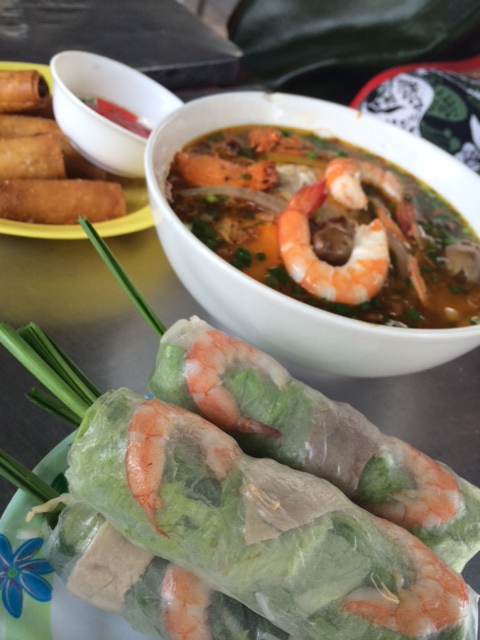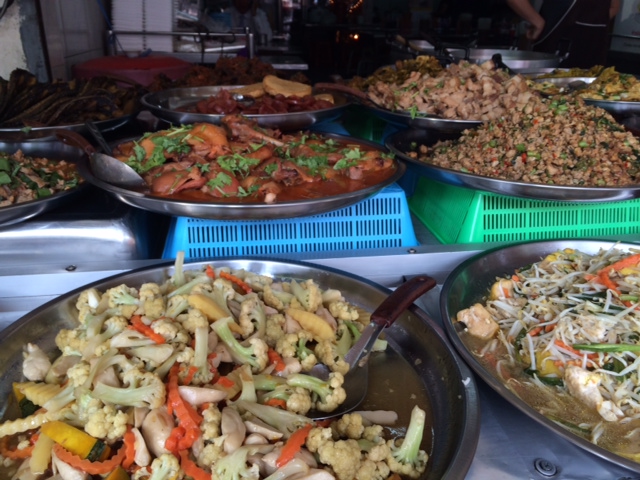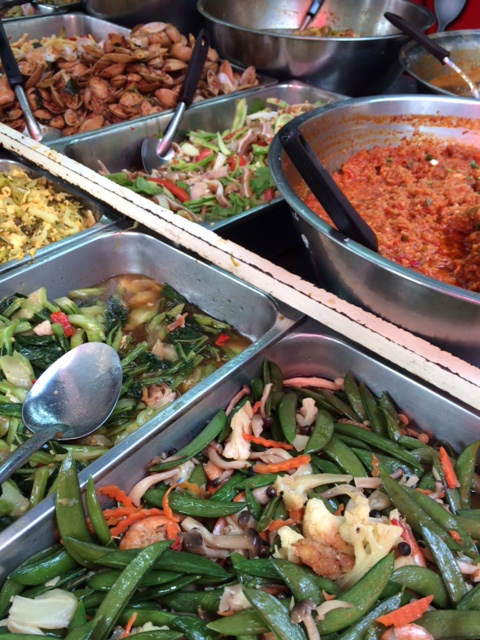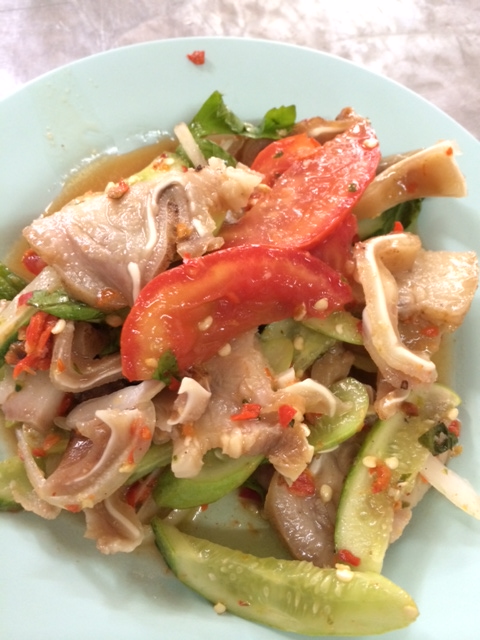
What’s Cooking: Khao yum

Khao yum, pre-mix

Khao yum, pre-mix

I rarely talk music with other people. This is because most other people have terrible taste in music. I realize this is because people my age don’t have any time to trawl through iTunes looking for something they will really love, so content themselves with whatever it is that is playing on the radio right now. Usually, that is Taylor Swift, some teenager, or Taylor Swift.

When did it become a thing for middle-aged people to listen to One Direction? Or 5 Seconds of Summer? I’m talking grown-ass women and men. What happened? I mean, as long as U2 are still making albums, “old people music” will still exist. Arcade Fire, Black Keys: old people are still being marketed to! We have wallets too. It’s not a draconian world of Either/Or, where either you listen to Justin Bieber or you end up consigned to a dustbin of Air Supply and Kajagoogoo.

I’m sorry to say this, yet again, but this kind of stuff didn’t happen in my day. My dad wasn’t getting all up in my Duran Duran while I was growing up. My mom wasn’t drooling over Robert Smith and singing along to “Head on the Door” while doing the dishes. Come on now. Let’s resist shedding our old-fart identities, disintegrating into some mass-marketed stew of wannabe youth-dom, doomed to an ever-expanding wardrobe of Hot Topic, a cultural diet of Teen Wolf reruns and a never-ending trudge towards What Kids Are Doing Today. This, from the lady with the dyed mallrat hair.

My favorite Thai dishes are the ones in which each ingredient is free to sing clearly on its own merits. You can still identify each and every taste. This is why I love every type of yum, those spicy-tart salads that play with flavor and texture, and retro DIY snacks like mieng kum, which usually involves betel leaves and pairs them with an assortment of dried shrimp, flaked coconut, slivered peel-on lime, cubed ginger, sliced chilies, roasted peanuts and a gloppy sweet dipping sauce that manages to enhance rather than mask all the goodness underneath.

Another great dish that leaves the integrity of each ingredient intact? Khao yum, a Southern Thai mishmash of rice and painstakingly julienned herbs, fruits and vegetables, held together with generous lashings of nam budu, a Southern Thai fermented fish sauce used like a punctuation mark in many regional dishes. When Khun Nuraya, a Pattani-based artist, offered to show me how to make the only dish she ever bothers to cook, I naturally jumped at the chance.

In the process of making the salad

Pattani in the house: In the process of making the salad

First off, khao yum requires a LOT of preparation. The prep work will dwarf the actual cooking of this dish, which only requires a little bit of mixing in a bowl. If you don’t live in Thailand, a few of these ingredients will be hard to come by. That’s when your imagination comes into play: as long as it’s tart and/or crunchy and relatively dry (we don’t want soggy rice), it should work. That means things like julienned green apple, asparagus, roasted peanut dust … the sky is the limit.

Ingredients (everything is to taste, so measurements are not set in stone. Also, you want to keep reserves of each ingredient on the side so that diners can add to their own taste. This should make about 4 portions):

— Nam bu du (a southern Thai fish sauce that Nuraya doctors by boiling it with lemongrass, palm sugar, lime leaves, galangal and onion. This can possibly be bought at a large Southeast Asian grocery store. If you are really in a jam, use regular fish sauce or nam pla rah)

nambudoo

— Fresh shrimp, about a handful, cleaned and deveined, then grilled and cut into bite-sized pieces

— Dried shrimp, about 1/4 cup, powdered (can substitute with powdered dried fish, or even peanuts if in a pinch)

— Coconut, about 1/3 cup, desiccated

— Lime, roughly one per person, either cubed with peel on or squeezed into the salad before eating

— Chilies, about a Tablespoonful, sliced

— Cucumber, 2 large, peeled and cut into inch-long shards

— Long beans, about a handful, cleaned and sliced

— Pai leaves (an aromatic herb that accompanies many Northern and Isaan larbs, maybe use shiso in a pinch)

— Yeera blossoms (also referred to as dara. They look like this)

flower

— Winged beans, about a handful, sliced

— Lemongrass, sliced, bulb part only

— Lime leaves, chiffonaded

— Butterfly pea blossoms (optional)

— Pomelo, shredded (optional)

— Rice, mixed with pulverized bai yaw (also referred to as noni leaves, which are boiled, whizzed in a food processor, and then added to the rice cooking water)

noniThe rice will eventually look like this:

rice

Nuraya also adds small Thai mackerel that are pan-fried with lemongrass to rid it of its fishy scent, but a good substitute are dried small fish, which give the added bonus of adding a little texture.

Eventually, all of this is mixed together, but be prudent with the nam bu du if you don’t want a gigantic salad — you don’t want to tip the balance of flavors over in any way. The final product: a fresh, bright, light melange of ingredients that, instead of competing, manage to coexist peacefully without overshadowing anything else. In that way, one can say this dish is everything Thailand says it is.

A bite of the finished product

A bite of the finished product

4 Comments

Filed under Uncategorized

Duck noodle fans unite

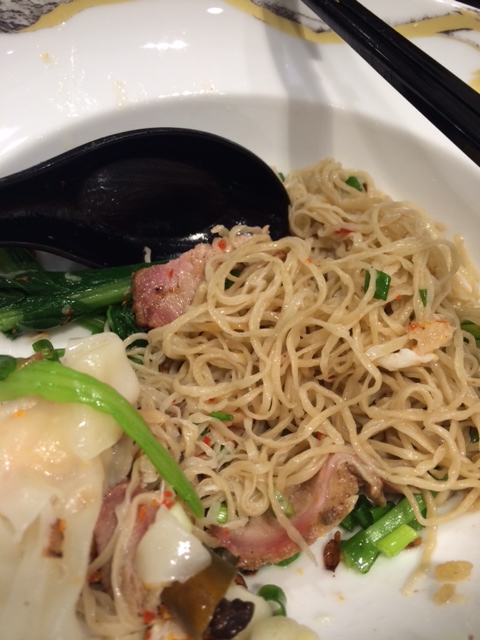
Duck noodles with the condiment tray at Guaythiew Ped on St. Louis Road

Duck noodles with the condiment tray at Guaythiew Ped on St. Louis Road

Karen likes to say that everything on the internet is “public, permanent, and traceable”. Everything, that is, except for my blog posts. I don’t know where my latest one is. I should probably be sad because I spent a lot of time on it. However, it might be God’s way of saying that no one should ever have to see my terrible Anthony Bourdain fan fiction. Bullet dodged, world.

I have been giving a lot more thought to fan fiction lately. This is because I want to make EL James-level bank, see my flaccid scribblings re-enacted on the big screen, and then make a nuisance of myself at numerous, famous people-populated parties. I have narrowed the criteria down to three major points. To write successful fan fiction, one must: 1.) feature a love triangle 2.) have the heroine (who is invariably the narrator and unwitting object of everyone’s affections) possess some ineffable quality that is completely beyond her control and renders her irresistible to her more standoffish (and undoubtedly more handsome) suitor, and 3.) make the heroine dowdy and/or judgmental, because making an effort to look good/being popular with boys makes you a big slut. She must be attractive to every man in the story for some other reason, as long as that reason is not her personality or intelligence, because that is boring and/or hard to write.

There seems to be a set of criteria for the successful Thai food stall as well. These are: 1.) tables that are crowded with “locals” 2.) a gruesome display of animal carcasses either in front or in back, because one must always be reminded of how truly adventurous one really is, and 3.) an abusive and/or harried cook. If the cook is not sufficiently ornery, then the stall must be in a hard-to-find location. The point is to suffer for your food.

Luckily for me, Guaythiew Ped on St. Louis Road (127/44 St. Louis Soi 3, 02-211-1411) fulfills all of these criteria, from the grisly-yet-tasty carcasses:

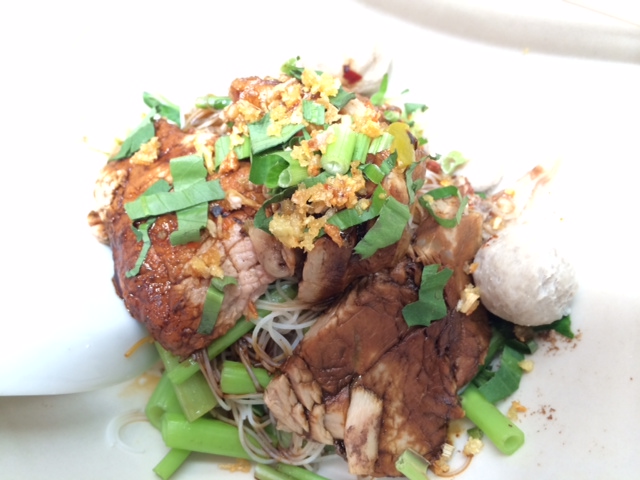
Ducks ready for the noodle bowl

Ducks ready for the noodle bowl

to the crowded tables and harried, frantic cook out in front. Of course, the food stands center stage — yes, the duck in every iteration: its tender gizzards, simmered feet, soft neck, rich liver and tranches of soft meat, cut with a vinegary chili sauce to offset the greasiness of the flesh.

Duck meat without the noodles

Duck meat without the noodles

But my favorite part of my meal is the cubed duck’s blood, not so soft that it disappears into the broth, nor so hard that it resembles sanguinary finger jello: slightly squidgy and giving to the slightest pressure, festooned with spring onions and coriander leaves.

A bowl of duck's blood

A bowl of duck’s blood

Presented with a formidable pile of the stuff, I managed to dispatch of every duck blood cube in maybe 5 minutes.

“You ate that like a vampire,” said Karen, unable to try even a single cube, because I had eaten it all.

2 Comments

Filed under Uncategorized

The Beauty in Bitterness

Sator -- or stink beans, a famously bitter Southeast Asian ingredient

Sator — or stink beans, a famously bitter Southeast Asian ingredient

His name was Aharon. He was very smart, cute, enormously funny, and had great hair, a dark mass of curls. I harbored a crush on this poor boy for what felt like years, but was probably only months. For weeks and weeks, I blathered on to anyone who would listen about my crush on this innocent person, who had not done anything to anyone, in the same way I had bored my fifth-grade lunch table mates with stories about Michael Jackson’s daily workout routine, or how John Taylor’s favorite meal was breakfast. So it was inevitable that one of those friends would take revenge on me by actually telling the object of my affections how I really felt about him.

It was, as Karen likes to say, a sixth-grade nightmare. There is nothing worse than having your secret crush discover the audacity of your affection for him — as if you actually had a CHANCE, as if something like this could even fall within the realm of possibility. The weight of my presumption was made worse by the knowledge that he would be kind, and would not make fun of me or emit “ewww” noises like an actual sixth-grader.  He would be nice. He might even have deigned to give me hope. But that only made it worse. The fact is that someone’s affection for you, even if unreturned, leaves a terrible yoke of obligation that can either be shrugged off gracefully, severed cruelly, or borne patiently. I was sure he would have been patient. But I did not want to be present at anyone’s pity party if I was going to be the guest of honor.

I responded as one would when it is 1995 (e.g. running home and listening to Jeff Buckley’s “Last Goodbye”. We didn’t have Adele in those days). I also decided to tell him that I most definitely did NOT have feelings for him. I mean, I was going to lie. This would relieve him of the burden of having to pretend anything with me, and we could continue to at least be friends. Sixth-grade nightmare averted. So I knocked on his door and that is what I did. He never really spoke to me again.

A male friend of mine, when told this story (I am still boring people with my stupid stories, 30 years later. Welcome to my blog) said I had humiliated my crush. This, when I thought I was doing him a favor. The thought that I would miscalculate to the extent of causing this person actual distress represents a low point in my romantic life. Don’t get me wrong — as all of my ex-boyfriends would attest, there are many, many low points in my romantic life. But this is the one I remember most.

Low points are an inevitability in life. In fact, they are a necessity. Who walks downhill all the time? You need to climb uphill in order to get to that point. They provide the contrast with which the high points can be truly appreciated. Do you know who understand this? You’ll never guess.

Thai cooks are known to understand this. They are able to use low points — bitterness — in ways that manage to amplify the high notes to make them that much more dramatic, like the way blanched bitter gourd is served alongside a tamarind chili dip, or sadao (a Thai riverside herb) offsets grilled snakehead fish with sweet tamarind sauce. They provide the oomph against which the freshness of certain ingredients can be highlighted, like the thin shavings of raw bitter melon in goong cha nam pla, or raw  shrimp marinated in fish sauce. And they lend gravitas and heft to certain dishes, emphasizing meatiness, warmth and substance, like in larb muang, the Northern Thai minced pork salad. Indeed, of all the regions, it is perhaps the Northern Thais who accentuate bitter flavors the most, since bitterness figures prominently in their cooking: echoed in the flavors of the North’s many fresh herbs and leaves, or in the animal bile that figures so prominently in their meat dishes. Bitterness is a major component in the Northern Thai flavor profile, a deep, dark thrum against which salt, chili and animal fat can play.

It’s a common misperception that, to make something more authentically Thai, one simply has to dial up the spice to 11. I don’t find that to be true of either central or northern Thai cuisine. Thailand, as any long-term expat can tell you, is never that easy to work out. Instead, to make something more Thai, all the flavor facets — sweet, salt, sour, spicy, bitter — have to be represented and balanced. Sadly, this is becoming less of an imperative, even in dishes where it figures importantly, like in gaeng jued mara yad sai (bitter melon stuffed with pork and stewed in a pork bone broth). This is because the Thai palate is changing to reflect globalized tastes: becoming sweeter, saltier, spicier. In other words, more amped, more MSG’d. What this means is that dishes are actually changing, leaving out the bitter melon in goong cha nam pla or threatened with extinction, like sadao nam pla wan (Thai river herb with grilled fish and sweet tamarind sauce).

This results in the nature of Thai food changing. And no, it’s not because of farang chefs, or McDonald’s, or the media, or anything that people like to blame when things change. It was simply a matter of time. Low points — at least in food — have been swapped out for a vista of downhill rambles, a glossy world of ease and convenience where everything is a quick, Rot Dee-assisted stir-fry away from the table. But bereft of our culinary sixth-grade nightmares, how will we appreciate life’s occasional sweets?

Kua kling with fresh stink bean, courtesy of @chilipastetour

Kua kling with fresh stink bean, courtesy of @chilipastetour

3 Comments

Filed under Uncategorized