Tag Archives: food

What’s Cooking: Jay Fai

Image

On the menu at Jay Fai

It was an interesting proposition: turn out some recipes inspired by my favorite street food stalls. Of course, I would never get the exact recipes from these folks, however lovely they are; in the street food world, recipes are family heirlooms, to be guarded as insurance for the next generation.  Instead, the recipes we end up with would be approximations, wild guesses, stabs in the dark — love letters to the originals in the hope that imitation really is the sincerest form of flattery.

To aid my on my quest, I enlist the help of my friend Chris Schultz (http://christao408.xanga.com), one of the best home cooks I know. We would do a total of 15 dishes over the course of three months. Some would be simple, chosen for their (expected) ease. Others would take more work refining. All would, eventually, hopefully, fingers-crossedly, be delicious.

There is no question that Jay Fai (327 Mahachai Rd., 02-223-9384) is one of my favorite street food vendors. A middle-aged lady in a woven beanie and a slash of lipstick, Jay Fai plows through an extensive repertoire of made-to-order favorites, solo and with the help of two searing hot woks. Her fried noodle dishes are to die for: punters frequently argue over which is her best, wavering between her “drunken noodles” (guaythiew pad kee mow, so called because the grease and spice are good hangover remedies) and her crispy noodles in seafood gravy (guaythiew lard na talay). Her crabmeat omelet, currently holding at 900 baht/serving, is a Japanese-inspired eggy roll stuffed with mammoth chunks of white, juicy crabmeat; hers is the only kitchen in town to serve a “dry” congee (jok hang), a gelatinous splay of broken-in rice grains topped with a tumble of shredded ginger and scallion. I could go on.

But it’s possibly her spicy lemongrass soup with prawns (tom yum goong, priced at an astronomical 1,500 baht/bowl) that intrigues me most. It’s a dish that everyone knows, but I suspect few bother to tinker around with. Have you ever made a tom yum? I ask because, despite the “infusion”-style broth that simply calls for throwing a handful of bruised herbs into water at a rolling boil, this soup is hard to excel at.

Boil 6 cups water, toss in a handful of bruised galangal, 7-8 kaffir lime leaves, 4 bruised lemongrass stalks , a shallot or two, a couple of green peppercorn branches and 4 chilies; a few minutes later, throw in 3 Tablespoons fish sauce and at least 3 limes’ worth of juice, take your pan off the heat, and add your 8 cleaned and shelled jumbo shrimp; stir around in the muck until your shrimp blush a deep red, then garnish with coriander leaves — this is tom yum made the traditional way. Yet the flavor is … underwhelming, warmed-over Lean Cuisine after two days in the refrigerator. Where is the heat? Where is the tart? I was missing the fireworks, but without sticking an entire forest of dreck into the broth, what was I to do?

Image

Jay Fai’s tom yum goong

The verdict: I can’t hope to replicate even half of the flavor Jay Fai gets with her tom yum by doing a straight-up infusion. There is a chili paste in there somewhere. In the coming days, I will pound fresh chilies, garlic, shallots and herbs with my mortar and pestle and see where that gets me; I’ll also roast the chilies, garlic and shallots before pounding a second batch and compare the two. I’ll try another with roasted chili paste (nam prik pao), and in yet another, I might even add a dash of coconut milk. What do you think? There is a grocery store’s worth of places where this can go. 

Until then. The leftovers beckon.

Image

My tom yum

14 Comments

Filed under Uncategorized

Mr. Right Now

Image

The khao soy vendor’s kanom jeen nam ngiew

Like a dog at a bone, I am constantly worrying at my love for the northern Thai dish kanom jeen nam ngiew, watching it fray at the edges as I sample dish after watered-down dish, chasing after the What when I don’t have the Where, Who or How. Because, you see, I live in Bangkok, where street food is wonderful, but northern Thai street food sometimes less so.

The Bangkok attitude to the north appears to be how Northeastern Americans view people living in the Southern US. They may be “charming” and “quaint” at best, or characterized as “rural” or “backward” at not-best. Both regions might house poorer residents and nurse chips on their shoulders about being looked down upon by the “educated elite”. The people of both areas might speak more slowly, in voices that might sound like sticky drawls. And both places certainly have incredible food where meat plays a major role, yet their cuisines might be looked at askance by the less adventurous as “weird” (please Google “The Ravenous Guide to Eating Like Elvis”) or just plain bad for you (ditto).

But the stomach-minded — and there are many of us out there — may see this food as achingly exotic. That is the case for me when I’ve been in Bangkok for a while. And although there is plenty of tried-and-true Isaan food to be had (the real stuff, not the sugary red candy posing as grilled chicken or pork shoulder at some Bangkok stalls) thanks to the city’s many Isaan residents, for some reason (and no, I don’t really know why this is), northern Thai food here is not as well represented.

So when a northern Thai food stall turns up just around the corner from the end of my street, in a barren expanse of concrete next to what appears to be a government compound, it’s exciting to me, the way a barbecue place in New York might be exciting to someone else. And it might not really be the same as what you’d find in its home setting (think of that NY barbecue place), but it’s good enough. Meet khao lad gang (curry rice) stall Khao Soy Chiang Mai (71 Ajnarong Rd., 02-672-7711) and its collection of northern Thai specialties like gang hang lay (Burmese-style pork stew), gang ho (northern Thai-style goulash), sai oua (northern Thai sausages), nam prik ong (pork-and-tomato chili dip), excellent larb moo kua (minced pork salad), and of course, khao soy and kanom jeen nam ngiew, without which northern Thai street food would be irreparably hobbled. Competent renditions all, with some green curry and shredded fish curry to go with your kanom jeen when you’re just not feeling the northern Thai food at the mo.

Image

The sign for Khao Soy Chiang Mai

It’s that little watering hole in the desert. The exit from a crowded dance floor. The guy who invites you out at 6:30pm on a Friday night. It’s not the end-all be-all. But it’s good enough for now.

6 Comments

by | 02/22/2013 · 10:51 am

Curry wishes and deep-fry dreams

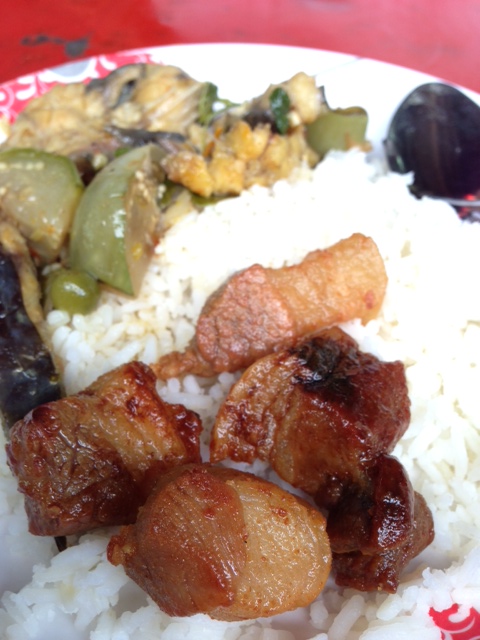
Deep-fried pork belly and curry on rice at Mae Awn

Deep-fried pork belly and curry on rice at Mae Awn

Nearly every Thai food lover I know professes a deep affinity for Thailand’s street food. Never mind that it is frequently infuriating, with its occasional long waits, its heat and smoke, its intermittent inconsistencies. It’s the grime, the capricious grumps who serve as owners, the odd feral cat or two that turn street food from a sweaty, hurried interval spent pouring rice down your facehole into a quick “immersion in the Thai culture”, set in romantic, picturesque squalor.

I’m not saying the pursuit of street food is an exercise in culinary Orientalism — unless you think the locals are guilty of doing this too. Because, as much as some people think the fetishization of street food equals a food-centric depiction of the so-called “Noble Savage”, the truth is still very simple: much of Thailand’s best food is still on the street, and those plastic stools and dingy shophouses are still dominated by Thais. Thais love good Thai food. Visiting Thai food lovers want to eat what Thais eat. It is as easy as that.

Nothing quite captures the freewheeling, exuberant quality of Thai street food quite like khao gaeng (or khao gub gaeng, or khao raad gaeng, all of which mean “curry on rice”). These streetside “buffets” are actually excuses for people to act like frigging maniacs aka Lindsay Lohan in a jewelry store — a free-for-all where the ultimate reward is a pleasantly full tummy. A tableful of curries awaits; you pick up a plate of rice and choose anywhere from one to three curries … or more if your vendor is willing.

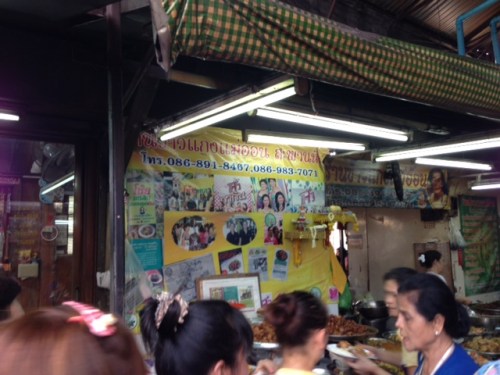
My friend Winner, who — despite his curious allegiance to the 49ers — knows Banglamphu street food better than anyone I know, is a huge fan of khao gaeng. His favorite: Raan Khao Gaeng Mae Awn, moored in the shadow of Saphan Lek and kitty-corner to the Mega Plaza. Its sign looks like this:

Look for this sign

Look for this 

Despite winning plaudits from various lady-cenric morning shows, this stall still retains its street cred — a credibly crabby lady doling out rice and curries, a handful of tables with plastic stools and a layer of grease, and the requisite crowd keen to jab you in the ear with their elbows as they pass by. Why Winner likes it: the superiority of their thom jeud (clear soup, because no Thai eats rice without some kind of soup), the popularity of its moo kem (deep-fried pork belly) and the sheer diversity of their daily offerings.

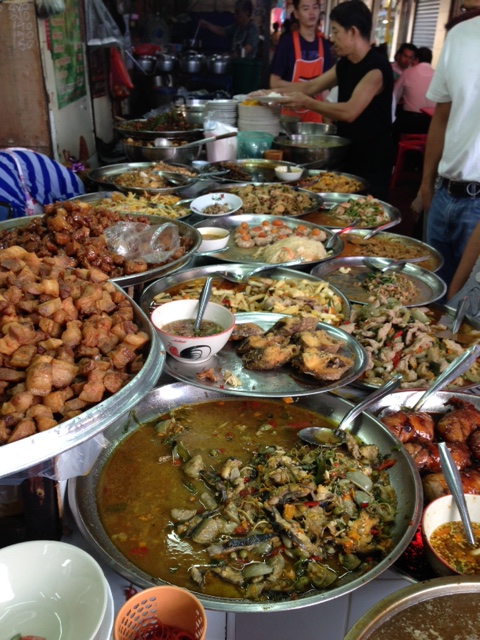
A (sort of) moveable feast

A (sort of) moveable feast

It’s a curry (and stir-fry, and deep-fried tidbits) bar, quite possibly the best kind. But no need to skulk off to Banglamphu to get some good curry action; there is an array of rice toppings (of varying sizes) at nearly every major intersection and street corner in the city. The one I frequent is next to Benjasiri Park, behind Emporium, while next to Emporium on Sukhumvit, a mammoth curry rice stand doles out food on Sundays. Find your own favorite.

2 Comments

Filed under Asia, Bangkok, food, food stalls, pork, Thailand