Category Archives: food

Glutton Abroad: Falling in Nagano

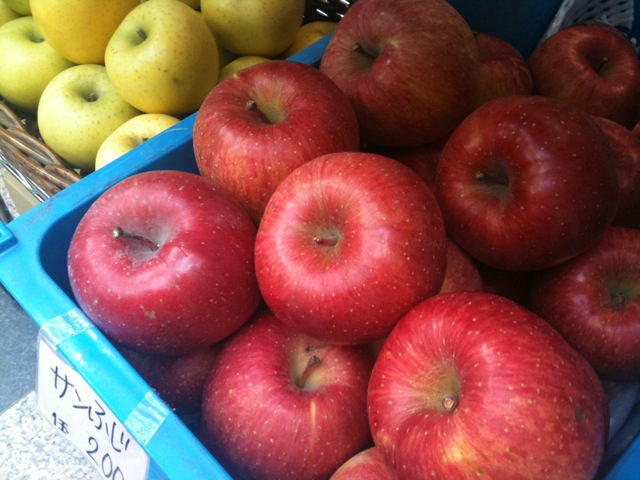
Apples, a Nagano specialty

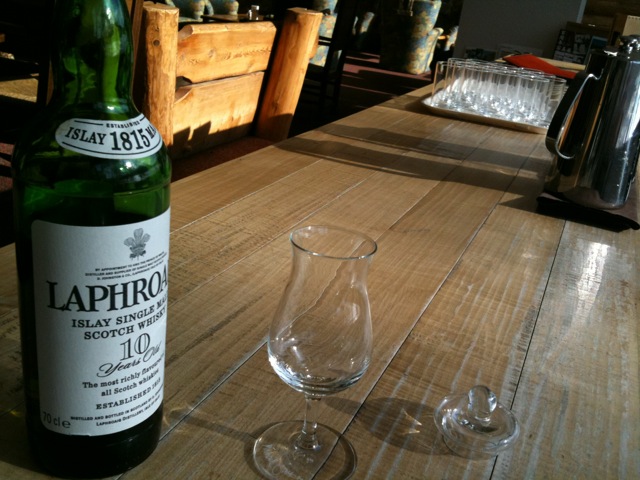
Japan gets a lot of snow. Every year, we are re-surprised by the amount of snow awaiting us at Shigakogen, where we regularly go in a feeble attempt to look semi-athletic once a year (uh, in my case at least). Some people ski for the exhilaration of breezing down a mountain face, the sharp chill hitting their cheeks as they successfully navigate this or that mogul. I ski as payment for the reward that will come after:
Shigakogen, like the rest of the Nagano region, forms part of Japan’s “snow zone”, which makes up fully half of the country, according to the Japanese tourism board. Tons of snow are dumped on the country every year when the cold winds blowing across the choppy Sea of Japan meet the towering mountains that form a big part of the “spine” running through Japan’s islands. Hence, the knee-deep white bounty that transforms me into the flailing autobot that everyone must navigate around in the mornings. Chilly winter wind can be good for the complexion. Direct contact with a fluffy mound of snow, not so much. Perhaps with this in mind, the Japanese brew amazake during the colder months; the hot mix of rice and sugar is very warming — and exceptionally filling.
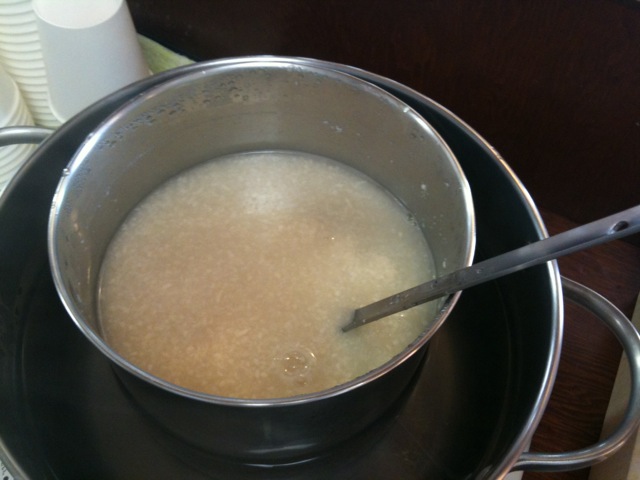
Amazake in the making

But when Nagano isn’t busy getting dumped on, it’s actually busy producing yummy things to eat with the fertile soil it hides underneath all that snow in the winter. Like Thailand’s Central plains, Nagano’s valley produces a veritable shopping cart of produce: apples, blueberries, mustard greens, mushrooms, mountain yams, buckwheat — all are readily harvested by Nagano-ites in greener times. That is probably why certain buckwheat products are considered specialties of Nagano — soba manjyu, a sort of steamed dumpling formed from buckwheat dough and stuffed with various fillings like meat or pickled greens, and of course soba, the hearty buckwheat noodle served either hot in a broth or cold with a dipping sauce, accompanied with a pitcher of the soba cooking water to drink afterwards so that none of the nutrients go to waste.

My favorite place to go, anywhere in the world, is the supermarket. It’s the best place I know of to figure out a place’s culture — or, at least, the way it views food. Are the shelves brimming with fat-free cakes and ready-made scrambled eggs and bacon, like in the States? Is there a gigantic, fresh-looking produce section, like in France? In Japan, there’s this: gargantuan, monstrous fruits and vegetables looking a little like something out of “Land of the Lost”; entire sections reserved for various types of dried fish; and unusual variations on commonplace things, like eggs.
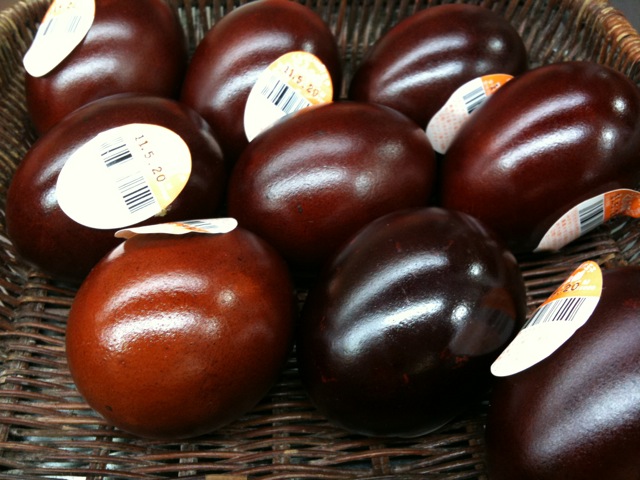
Eggs for sale at Nagano's Tokyu Food Show

Almost everything is seasonal: mushrooms in the fall, shirako and uni in the winter, berries in the summer. But some things have become year-round staples: strawberries as big as a toddler’s fist and super-sweet “fruit tomatoes”, like tomato candy. These we had on our first meal there, sprinkled with a little Okinawa salt.

The Japanese are gifted in the art of naming — somehow, the English-language names they give are strange yet evocative, and always memorable. That’s how you get something like “Tokyu Food Show”, the best name I’ve seen yet for a supermarket; that’s also how you get “Ichigo no Musume”, or “strawberry daughter”, the name for a mochi (rice dough) dumpling stuffed with whipped cream instead of the usual red bean paste and anchored with a giant strawberry in the middle. I would show a picture, but I am not good enough to capture things in flight … in this case, the dumplings that were flying into other people’s mouths when my back was turned. Did I get a bite of these magical dumplings this year? No sirree, I did not.

I did not miss out on the apple beef, however. A certain breed of fatty cattle similar to Kobe, the Nagano cows are fed on the region’s special apples, which are supposed to impart a certain sweet flavor to the beef. I’m not sure if that is really the case, but the beef is extremely delicious — not too fatty to turn into a grease-fest, but tender enough to melt in the mouth. Our favorite place to try it: Sukitei (600 m SW of city center Nagano, +81 26-234-1123), as much of an annual pilgrimage as the snowy, ankle-twisting doom offered by Okushiga Kogen. Aside from steaks festooned with the local mushrooms, there is sweet sukiyaki, warm and healthy shabu shabu, and a handful of delicious beef-based appetizers like salt-crusted beef cubes grilled on a skewer, gently poached beef slices served cold in a pickled plum sauce, and various types of beef “sashimi”. Here, the fattiest, decorated with edible blossoms (the yellow one is NOT GOOD) and accompanied by grated wasabi, garlic and ginger:
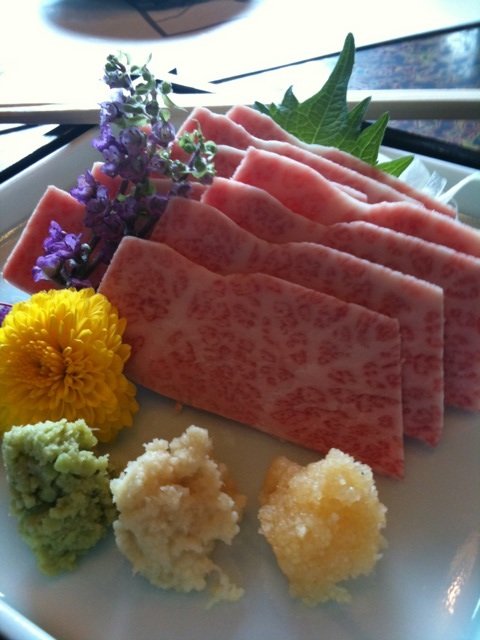
Sukitei's fatty beef sashimi

6 Comments

Filed under Asia, beef, dessert, food, Japan, markets, noodles, restaurant, rice

Glutton-related matters: Sick

I am sick. Actually, I am more than sick: I am a walking cesspool of germs, a petri dish with legs and arms. And although I know it could be worse, I am still very busy feeling sorry for myself, especially since my “mean” Singapore sometime-overlord is making me jump through hoop after hoop before I leave for Japan in two days.

My current state of sick is not the same as the sickness that comes from eating at a food stall. That is a scary sort of sick that goes beyond concerns about the “curry tummy” into the realm of the potentially lethal. The jury is still out on whether this terrible death was definitely food-related, but the bottom line is: you risk getting sick any time you eat food not prepared by you. Most food stalls are relatively clean, and as Richard Barrow points out, there are ways of minimizing your chances of getting ill.

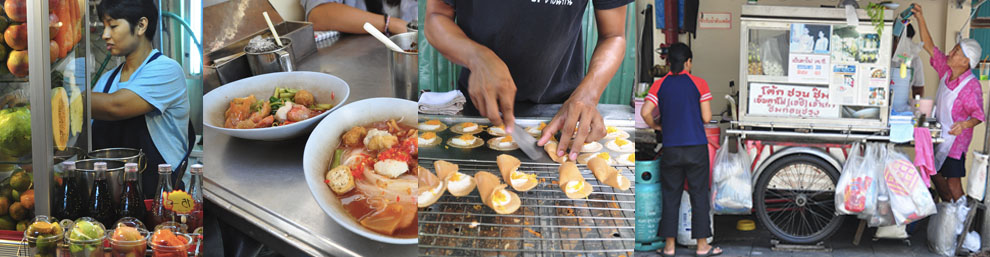
But, no. My sick is the kind that turns my nose into a runny faucet and renders conversations frustrating exercises in mumble-roaring. Naturally, there is a plethora of home remedies from garlic to ginseng to chicken soup, but the Thais have their very own way of dealing with these things, and it involves bombing the crap out of your cold with chilies:

Tom yum from mushroom lady on Sukhumvit Soi 24

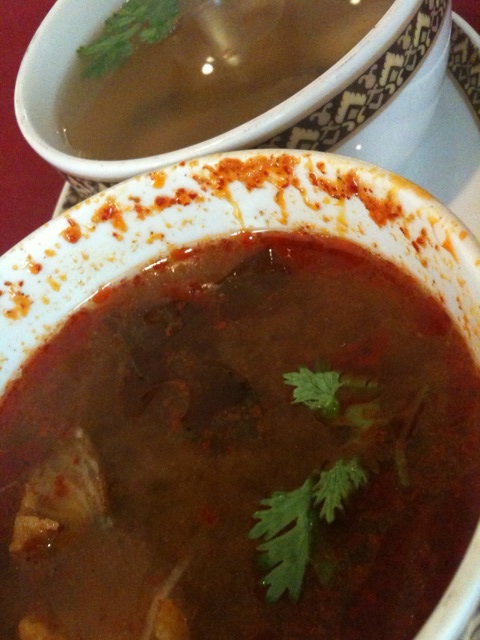
There is something about that heady mix of chilies, kaffir lime leaf and lemongrass that somehow cuts through the traffic jam in your sinuses, bringing you back to the land of the living. But if the street isn’t really your preferred culinary ‘hood, you can still get relief from a bona fide “fancy” place: Bussaracum, which specializes in “royal Thai cuisine”, even provides a “menu from 120 years ago” cobbled together from recipes straight out of @kanitthaifood’s old books. Here, a tom yum from a century ago and the modern interpretation (which one is which?):
Guess which one is which?

The old-school version includes roasted chili paste and mango for acidity (so if you guessed the thick, chili-looking one, you were right!). The entire menu is 690++ baht for seven courses, so head on over there if you want to try any of their other boran dishes side-by-side with their modern-day counterparts.

And if you are sick, like I am, bring a hefty supply of tissues.

6 Comments

Filed under Asia, Bangkok, curries, food, food stalls, restaurant, Thailand

Eating in the Year of the Rabbit

Tan Jiao Sua, ancestor to the Chinatown Bunnags

Every Chinese New Year, I look forward to coming to Yaowaraj, or what Thais call their Chinatown. I am not of Chinese descent, so every little ritual —  the burning of mini-replicas of cars and money, the praying to the ancestors, the giving and receiving of tiny little envelopes — holds a particular fascination for me. How did I go through my 70+ years without ringing in the year of the dragon or tiger or pig? How could I have missed out on those years of silky noodles, wobbling pork legs, glistening oranges?

New Year's offerings

So at the crack of dawn we bundle up and make our way down to Chinatown in the hopes of reconnecting with other family members and paying homage to Tan Jiao Sua, the ancestor of my husband’s particular branch of the Bunnag family, descended from Somdet Chao Phraya Pichaiyat. The Bunnags are a very large family with a gigantimongous number of branches, but all historical accounts point to Persian merchant Sheikh Ahmad, who moved to then-Siam in the 17th century, as the first Bunnag ancestor.

Now, the various branches are designated by where they come from: there are Thonburi Bunnags, Ayutthaya Bunnags and Chinatown Bunnags, descended from  Tan Jiao Sua, a former bottle seller in Chinatown who made his fortune after siding with the government during the Chinese uprising. He eventually saw his only daughter married to a Bunnag, and the Pichaiyat branch was born. At the height of their wealth, this family’s holdings included half of Yaowaraj; today, the “company” is all that is left.

But while the history is interesting, what really brings me here is the prospect of stuffing my face. Every year, at the “company” — what my husband’s family  members call their building in Yaowaraj — stands are set up offering oyster omelettes, chicken noodles, Chinese-style rice porridge and braised fatty pork leg. Later in the day, the family elders throw fist-sized gold coins into the air, sending all us “young” people scrambling, abandoning all pretense at dignity as we elbow three-year-olds out of the way to our booty. Later, as those crybabies weep into their baby formula, we gloat and hoot and let the heavy, shiny coins slide through our fingers, counting as we go.

I might be kidding about the last part. Really I am looking forward to the food. But this year, we arrive too early to get at the stands and their bounty. Instead, we are met by a bitter, harassed cleaning lady who says she is working all alone and needs help to get everything ready. So we do what any responsible adult would do and run far away, hiding in the second-floor cafe where we gorge on buttered, white toast and sausage of indeterminate origin, squealing at the occasional cockroach.

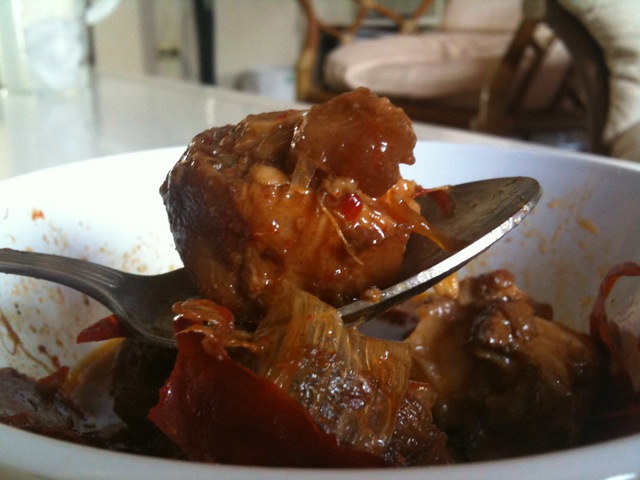
Later we go home before most of the family members arrive and are met with a welcome sight: the kind delivery of a vat of braised fatty pork leg, some bowls of clear bamboo shoot soup, and rice. So that is what we have, thinking that the Year of the Rabbit, so far, isn’t so bad after all.

4 Comments

Filed under Asia, Bangkok, Chinatown, Chinese, food, pork, rice, Thai-Chinese, Thailand