Category Archives: markets

The other Chiang Mai

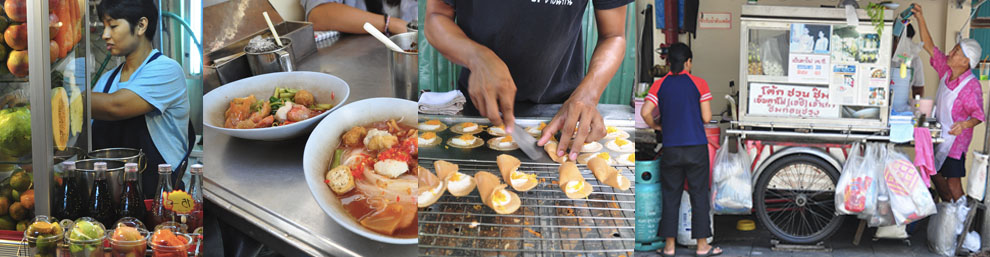
Rot duan at Suthep Market

Sometimes you don’t feel like treating Chiang Mai like a non-stop food safari. Sometimes, the usual parade of big names — Huen Phen, Lamduan Faham, Samerjai, OMG! — makes you feel all weary inside after thinking of the inevitable throng of people in line for a bowl of khao soy. And sometimes, you just want to eat where all the other jaded Chiang Mai-ers eat.

Because sometimes, Chiang Mai people are sick to death of aharn nuea (Northern Thai food), just like how Hua Hin people get sick of crab (unbelievable, I know, but it happens). And when that happens, they go to places like Yen Ta Fo Sri Ping on Suthep Road, where the chipped plastic bowls feature al dente thick, thin or glass vermicelli noodles liberally swimming with a garishly pink, chili-flecked seafood sauce crowned with a single, perfect fried wonton (35-40 baht).

Sri Ping's yen ta fo

There is also the requisite tom yum noodle (30-40 baht) and egg noodles with red pork and dumplings (40-50 baht), but nothing is as deliciously saucy as the namesake yen ta fo, a dish sure to get on your shirt and all over your face. And yes, I did rub my eyes after eating, and yes, severely regretted it for hours afterward.

I would argue that the namesake dish at Guay Jab Nam Khon Sam Kaset, right by the city’s monument to the three kings, is not the best dish here, although it is light and peppery and includes plenty of luk lok, a sort of soft porky sausage (50 baht). The gow low (broth without noodles) centers on a richer broth that tastes of beef and plenty of coriander (50 baht), and the khao moo krob is as good as anything you would find in Yaowaraj: a mix of crackle and fat, a thick sweet sauce enveloping the rice grains (50 baht). What can I say? I really like sauce.

Crispy pork rice at Guay Jab Sam Kaset

But if it’s something light and fresh you desire — Thailand via Hanoi rather than Hong Kong — there is always Raan Fer Wiengjan on Rachadamnoen Road. You have your choice of chicken (30-40 baht), fish (40-50 baht), tofu (30 baht), and the Northern delicacy moo yaw (30-40 baht), a pork “pate” originally created by Chinese-Thai chefs seeking to replicate French meat terrines.

Pho moo yaw

Vegetarians, don’t despair: Chiang Mai is thinking of you too. Or, specifically, Raan Jay Yai on Nimmanhaemin Road is. Anything on the regular menu can be made “jay” (a stricter Thai form of vegetarianism), including great versions of khao kluk kapi (rice fried with “shrimp paste”, 35 baht), guaythiew kua “gai” (noodles fried with a chicken substitute, 30 baht) and pad see ew (stir-fried noodles in soy sauce, 30 baht).
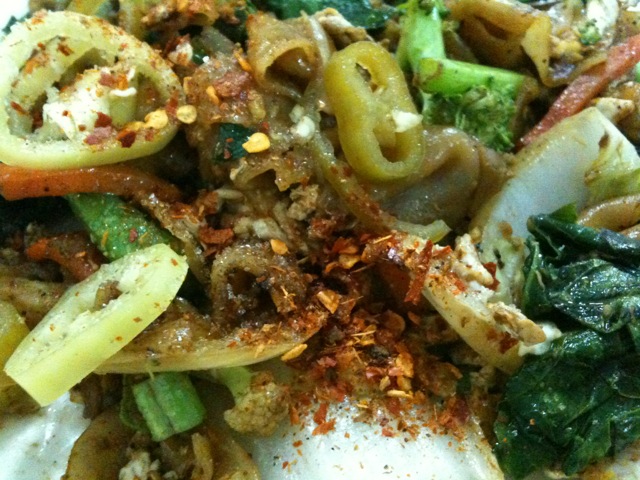
Jay Yai's pad see ew

This is all well and good, but did you really think I went to Chiang Mai without having ANY Northern food at all? What am I, an idiot? (Don’t answer that). Of course I went, and filled my face with nam prik ong and thum kanoon and sai oua and shrieked and gurgled as every Northern dish passed me by on the way to someone else, and wished myself stuffed full of everything that was good in the world. So that is how I found Haan Tung Jieng Mai (Northern dialect for Raan Tung Chiang Mai) on Suthep Road by the Chiang Mai University campus.

Khao pad nam prik num at Haan Tung Jiangmai

It’s a typical aharn tham sung (made-to-order) stall, but made achingly cool by the scraps of paper doodled by bored university students coating the tables and the kitsch-retro furnishings. That said, the food is solid, if slow, including rice fried with young green chili dip, pounded young jackfruit, and a nam prik ong that tasted suspiciously like shrimp paste (in the landlocked North, most recipes call for tua now — fermented beans, or nam pu — the juice of pulverized rice paddy crabs, instead of kapi).  Plus, there was a perfectly cooked kai ped yang matoom, a duck egg boiled just enough so that the yolk is “sticky”, like rubber sap.

No, our trip wasn’t all about food. I DO have other interests, you know. For instance, the PURCHASING of food. That is where the Saturday morning organic market off of Nimmanhaemin Road comes in. Organic producers of vegetables, fruit, rice and ready-made foods meet once a week to sell their bounty to the general public, and it’s a shame something comparable isn’t happening in much-bigger Bangkok.

Whole-wheat salapao at the organic market

Food for thought, maybe, for an organized and responsible food lover? (Not me). Maybe, just maybe, we can bring in something from Chiang Mai that doesn’t involve hastily-taped cardboard boxes and a few anxious moments by the baggage claim carousel.

Or maybe not.
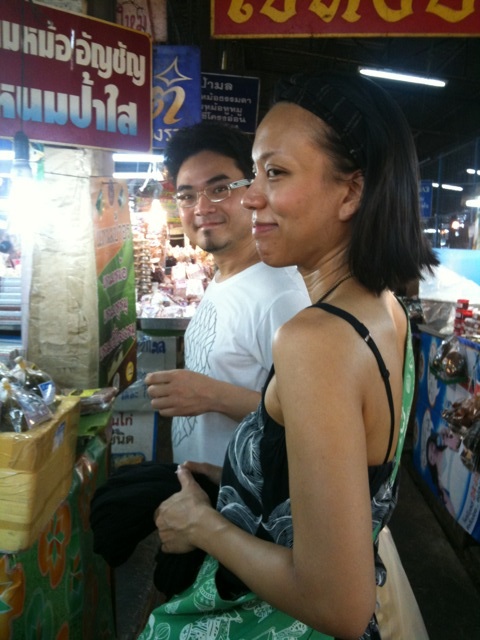
@anuntakob and @aceimage caught haggling at Suthep Market

10 Comments

Filed under Asia, food, food stalls, markets, noodles, Northern Thailand, pork, rice, shopping, Thai-Chinese, Thailand

Glutton Abroad: Tokyo Drift

Hanging in Tsukiji

I love Tokyo. Unlike Madame Bangkok — always striving to keep up with the Lees, obsessed with what the “neighbors” might think — Tokyo is unself-consciously, unabashedly itself: scruffy in patches, unafraid to be a little seedy, but always surprising in the best kinds of ways. It has its glam side, its traditional “Nihonjin” side, its gaijin side. But you have to look actively for all of it. And at the center of all this, the spirit of the city somehow remains the same, never-changing. Of course, the flip side to this is that Tokyo can also be crushingly lonely. Alienation is also very “Tokyo”.

Well, you may not know it, considering the inexplicable fondness harbored by the Japanese for KFC, but Tokyo is a food town. The great friendships I have made here started out of food or drink. A tranche of sweet white fish simmered in soy sauce at a cooking class; a mentaiko/mayonnaise dip with snow peas before that week’s showing of Paris Hilton in “The Simple Life”; a brimming shotglass of something quick ‘n vile at Geronimo’s — these are all ageless reminders of a specific person.

As is the incredible bounty at Tsukiji fish market. Also known as the Tokyo Metropolitan Central Wholesale Market, this is the biggest wholesale seafood market in the world, handling more than 2,000 metric tons of seafood a day (according to Wikipedia). The market has been doing this daily since 1935; it, like much of the rest of Tokyo, remains constant.

Mollusks on display at the market

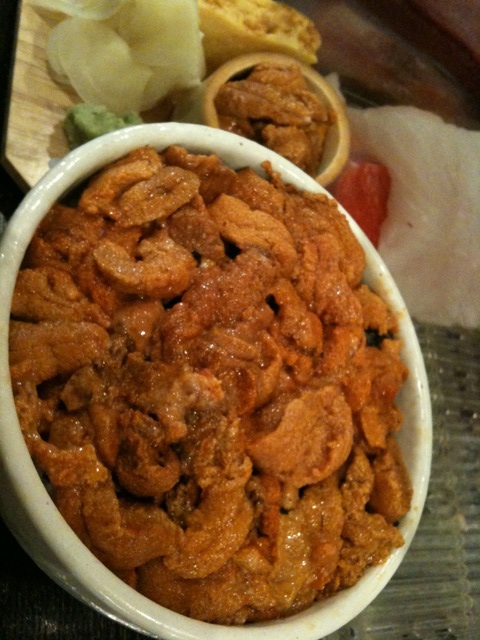
Aside from the seafood for sale, there is a cluster of sushiya on the far end of the market that we would visit on a regular basis for a quick breakfast before heading off to work. Turning right at the kooban (police box) into what looks like the parking lot for a football stadium, walking about 200 m and turning left into an alley leads you to “aisles” 5 and 6, where the most famous sushiya in the market are located — most with the kanji for “dai” (big) in some part of their names. The most famous of these is “Daiwa” — where the hostess conscientiously ensures you are lined up properly before heading inside — but there are others, all with their own unwieldy, intimidating queues. Inside, you might get something like this:

Unidon at Tsukiji

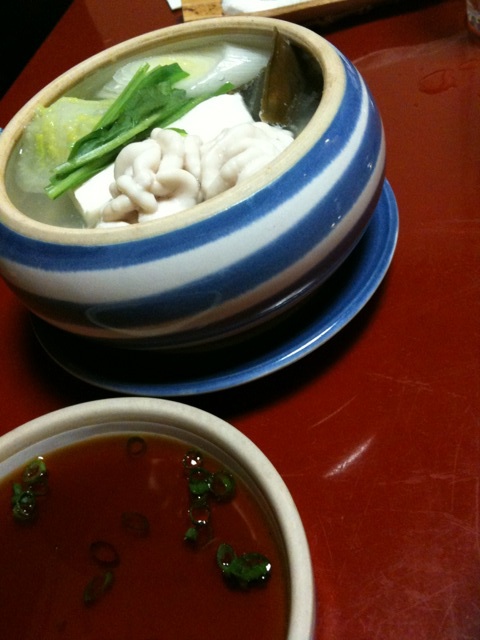
Also in season is shirako, a collection of creamy, mild coils that someone had once told me was fish sperm. Later, a group of Japanese people would tell me that this was not true; someone was pulling my leg. And then after that, I would look up shirako in the Japanese-English dictionary and discover that shirako is “milt; fish semen”, usually taken from the cod, anglerfish, or fugu (pufferfish). So there you have it. Shirako is not fish sperm. It is, as one kind Japanese waitress explained, “man eggs”.

Shirako for sale at Tsukiji

Somehow, that did not turn me off of this seasonal delicacy. Another popular way to have it is simmered gently in a nabe, a sort of catch-all term for anything that is served in a hotpot, like shabu shabu or sukiyaki. Or this, served as part of an incredible eight-course “washoku” menu at tempura specialist Uofuji in Ochanomizu (+813-3251-5327).

Helmed by a husband-wife team (the husband cooks, the wife is hostess), this is one of many husband-wife restaurants serving “washoku” (traditional Japanese cuisine) across the country. But the search for this unassuming restaurant is worth it: the tempura is light and fluffy and the menu changes daily, depending on what the husband has found in Tsukiji. On that particular day, there was sea cucumber in a pool of ponzu, freshly made shiokara (fermented squid innards), a single gigantic miso-glazed oyster. And while service is a little bit slow, the waitresses sure are free-handed with the sake samples and “tastings”. Leaving the restaurant that evening remains a blur; I believe Kiguchi-san had to escort us to the taxi herself, God bless her.

But it’s hard to pry me away from the sushiya for long, especially one where a meal can be an elaborate string of yummy fish-based mini-dishes. Sushiya no Yoshikan in Gakugeidaigaku (+813-3793-6261) is well-known for their otsumami (appetizers), which they continue serving you until you indicate to them you are ready for the sushi. We managed five: shirako, grilled this time with a salt crust; tuna “shabu” in a sweet miso sauce; poached sea eel in a pickled plum sauce; an oyster in a sabayon; and best of all, a freshly-grilled scallop in a “sandwich” of nori seaweed.

What I took away from all this, however, was the ever-present fact that I am getting old. I couldn’t keep up with my friends at the sushi counter — too soon afterwards, I was signalling for the soup (apparently osuimono, or clear broth soup, is what traditionalists say goes with sushi best, although everyone prefers miso nowadays). What can I say? Some things do change.

2 Comments

Filed under Asia, fish, food, Japan, Japanese, markets, restaurant, rice, seafood

Glutton Abroad: Falling in Nagano

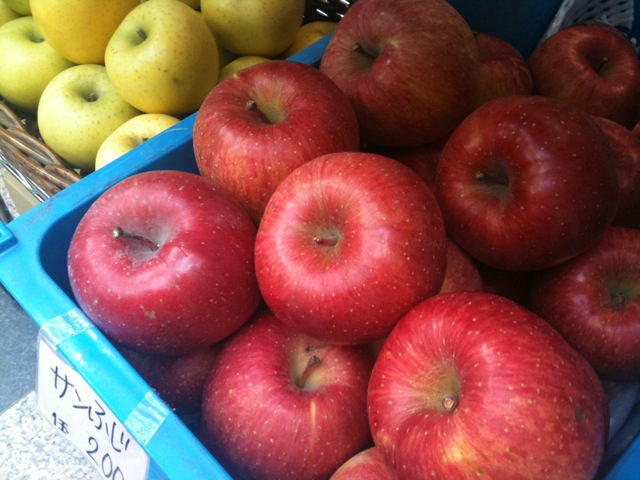
Apples, a Nagano specialty

Japan gets a lot of snow. Every year, we are re-surprised by the amount of snow awaiting us at Shigakogen, where we regularly go in a feeble attempt to look semi-athletic once a year (uh, in my case at least). Some people ski for the exhilaration of breezing down a mountain face, the sharp chill hitting their cheeks as they successfully navigate this or that mogul. I ski as payment for the reward that will come after:

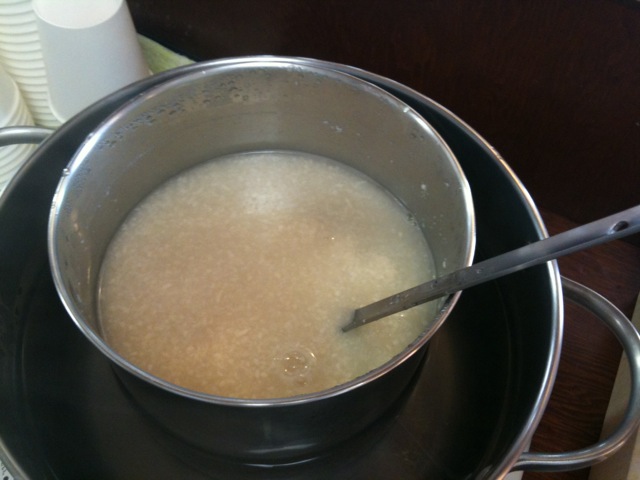
Shigakogen, like the rest of the Nagano region, forms part of Japan’s “snow zone”, which makes up fully half of the country, according to the Japanese tourism board. Tons of snow are dumped on the country every year when the cold winds blowing across the choppy Sea of Japan meet the towering mountains that form a big part of the “spine” running through Japan’s islands. Hence, the knee-deep white bounty that transforms me into the flailing autobot that everyone must navigate around in the mornings. Chilly winter wind can be good for the complexion. Direct contact with a fluffy mound of snow, not so much. Perhaps with this in mind, the Japanese brew amazake during the colder months; the hot mix of rice and sugar is very warming — and exceptionally filling.

Amazake in the making

But when Nagano isn’t busy getting dumped on, it’s actually busy producing yummy things to eat with the fertile soil it hides underneath all that snow in the winter. Like Thailand’s Central plains, Nagano’s valley produces a veritable shopping cart of produce: apples, blueberries, mustard greens, mushrooms, mountain yams, buckwheat — all are readily harvested by Nagano-ites in greener times. That is probably why certain buckwheat products are considered specialties of Nagano — soba manjyu, a sort of steamed dumpling formed from buckwheat dough and stuffed with various fillings like meat or pickled greens, and of course soba, the hearty buckwheat noodle served either hot in a broth or cold with a dipping sauce, accompanied with a pitcher of the soba cooking water to drink afterwards so that none of the nutrients go to waste.

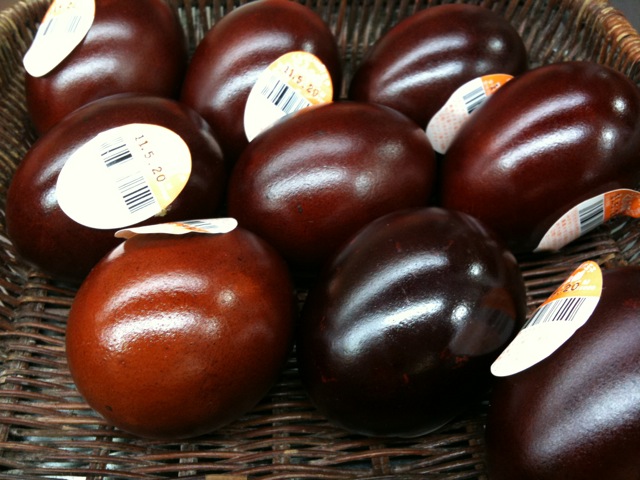
My favorite place to go, anywhere in the world, is the supermarket. It’s the best place I know of to figure out a place’s culture — or, at least, the way it views food. Are the shelves brimming with fat-free cakes and ready-made scrambled eggs and bacon, like in the States? Is there a gigantic, fresh-looking produce section, like in France? In Japan, there’s this: gargantuan, monstrous fruits and vegetables looking a little like something out of “Land of the Lost”; entire sections reserved for various types of dried fish; and unusual variations on commonplace things, like eggs.

Eggs for sale at Nagano's Tokyu Food Show

Almost everything is seasonal: mushrooms in the fall, shirako and uni in the winter, berries in the summer. But some things have become year-round staples: strawberries as big as a toddler’s fist and super-sweet “fruit tomatoes”, like tomato candy. These we had on our first meal there, sprinkled with a little Okinawa salt.

The Japanese are gifted in the art of naming — somehow, the English-language names they give are strange yet evocative, and always memorable. That’s how you get something like “Tokyu Food Show”, the best name I’ve seen yet for a supermarket; that’s also how you get “Ichigo no Musume”, or “strawberry daughter”, the name for a mochi (rice dough) dumpling stuffed with whipped cream instead of the usual red bean paste and anchored with a giant strawberry in the middle. I would show a picture, but I am not good enough to capture things in flight … in this case, the dumplings that were flying into other people’s mouths when my back was turned. Did I get a bite of these magical dumplings this year? No sirree, I did not.

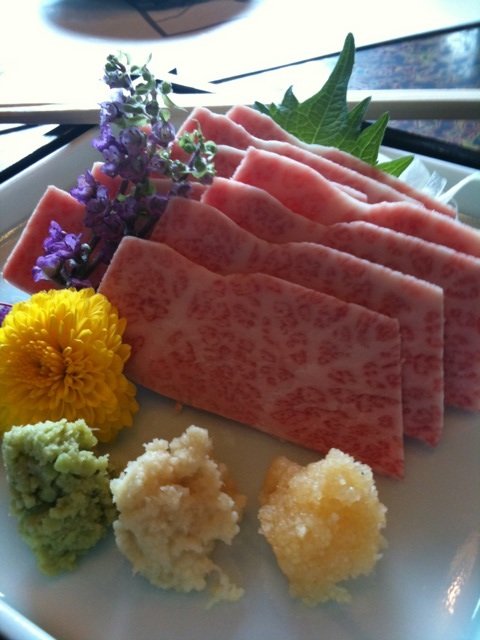
I did not miss out on the apple beef, however. A certain breed of fatty cattle similar to Kobe, the Nagano cows are fed on the region’s special apples, which are supposed to impart a certain sweet flavor to the beef. I’m not sure if that is really the case, but the beef is extremely delicious — not too fatty to turn into a grease-fest, but tender enough to melt in the mouth. Our favorite place to try it: Sukitei (600 m SW of city center Nagano, +81 26-234-1123), as much of an annual pilgrimage as the snowy, ankle-twisting doom offered by Okushiga Kogen. Aside from steaks festooned with the local mushrooms, there is sweet sukiyaki, warm and healthy shabu shabu, and a handful of delicious beef-based appetizers like salt-crusted beef cubes grilled on a skewer, gently poached beef slices served cold in a pickled plum sauce, and various types of beef “sashimi”. Here, the fattiest, decorated with edible blossoms (the yellow one is NOT GOOD) and accompanied by grated wasabi, garlic and ginger:

Sukitei's fatty beef sashimi

6 Comments

Filed under Asia, beef, dessert, food, Japan, markets, noodles, restaurant, rice