Category Archives: rice

Roadside Buffets

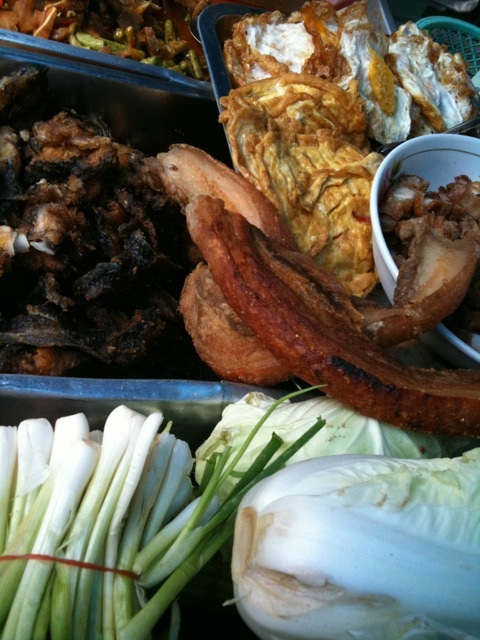
The "curry rice" stand on Methenivet Road

While researching the street food book, I spent a lot of time formulating some sort of tried-and-true criteria that could be used to determine the kind of “street food stall” perfect for the book. I did this because I got a hella annoyed at stories that would claim to explore “Bangkok’s most authentic street food”, and then take you to the Food Loft at Central or something. I mean, I like the food there too, but come on. You are supposed to “suffer” for street food. You are supposed to wander aimlessly in the street as people say “there she goes again, that farang” and pretend you don’t understand, acting out the role of “clueless foreigner” in this bizarre trade-off people call “social discourse in Thailand”. You are supposed to sit at a rickety stool as the sweat pours off your face and people point and laugh and say, “Look at how uncomfortable she is! So funny!” or they politely pretend not to notice, which might be worse. Street food is an enterprise where the awards are commensurate with what you put into it. That’s just the way it is. (I know. We are all now wandering aimlessly down the length of this paragraph, wondering “When does this road end? The book did say it was supposed to be RIGHT HERE…”)

The thing is, I hardly had the wherewithal (or the stomach, to be frank instead of Glutton) to explore all the kinds of proper street food stalls that there are in Bangkok. That included aharn tham sung (made-to-order stalls, marked by raw ingredients arranged in front of the cook) and khao gub gaeng (“curry rice” stalls, marked by ready-made curry vats arranged in a row in front of the cook). I did briefly discuss, amid all the purple prose, the awesomeness of made-to-order stalls in a post here. Now, I’d like to talk about the tantalizing roadside buffet that is the khao gaeng stall.

Of all the stalls out there (except for maybe the nam kaeng sai, or iced dessert stalls), curry rice stalls are the most inviting Thai stalls around. Their purpose is to beckon to the grumbling stomach — here, you could be having this RIGHT NOW — instead of suggesting the promise of the future, as a made-to-order stall does. It appeals to the immediate in all of us, which is why our book features a particularly famous one on its cover (Mae Malee at Aor Thor Kor).

That said, there are so many stalls out there, on practically every street corner, most offering a variation of the following: green basil curry, usually chicken and/or chicken feet; stewed bitter melon stuffed with minced pork in a clear broth; stir-fried long beans in red curry paste; some sort of stir-fried Mama noodle or glass vermicelli with pork and chilies; stir-fried veggies; fried pork with garlic and black peppercorns; and fried eggs, yolks ready to break open at the slightest slash of a spoon. If it’s a particularly good one, you’ll also get maybe a yum (spicy sour salad), usually seafood, a gaeng jued (bland clear broth soup to counteract the spiciness of everything else) and something cool and ornamental, like kai luk kuey (son-in-law’s eggs, which are deep-fried and slathered in a sweet sauce. I once wrote a story about Thailand’s “foreign son-in-laws” for, oh, let’s call them Schmeuters, and my editors misunderstood and thought I was referring to “luk [something else]”, which was really, really annoying. Minds in the gutter, much? Anyway.)

Because I love eggs: krapao at a made-to-order stall

You might be wondering where the best place to find a khao gaeng stall may be. I would once have said the one on Sukhumvit 24, across the street from Emporium, but it has since disappeared, taking its green curry spaghetti with it. So let’s go with Krua Aroy-Aroy (it’s a favorite of Ferran Adria’s, after all!) at Thanon Pan, across from Maha Uma Devi Temple (Wat Kaek), 081-695-3339, open 8:00-21:00 daily. The laminated menus are gone! The massaman curry and nam prik platu are still there … just don’t order the nam ngiew (I’m sorry. I can’t help myself. It’s a sickness).

14 Comments

Filed under Asia, Bangkok, curries, food, food stalls, rice, Thailand

Glutton Abroad: Tokyo Drift

Hanging in Tsukiji

I love Tokyo. Unlike Madame Bangkok — always striving to keep up with the Lees, obsessed with what the “neighbors” might think — Tokyo is unself-consciously, unabashedly itself: scruffy in patches, unafraid to be a little seedy, but always surprising in the best kinds of ways. It has its glam side, its traditional “Nihonjin” side, its gaijin side. But you have to look actively for all of it. And at the center of all this, the spirit of the city somehow remains the same, never-changing. Of course, the flip side to this is that Tokyo can also be crushingly lonely. Alienation is also very “Tokyo”.

Well, you may not know it, considering the inexplicable fondness harbored by the Japanese for KFC, but Tokyo is a food town. The great friendships I have made here started out of food or drink. A tranche of sweet white fish simmered in soy sauce at a cooking class; a mentaiko/mayonnaise dip with snow peas before that week’s showing of Paris Hilton in “The Simple Life”; a brimming shotglass of something quick ‘n vile at Geronimo’s — these are all ageless reminders of a specific person.

As is the incredible bounty at Tsukiji fish market. Also known as the Tokyo Metropolitan Central Wholesale Market, this is the biggest wholesale seafood market in the world, handling more than 2,000 metric tons of seafood a day (according to Wikipedia). The market has been doing this daily since 1935; it, like much of the rest of Tokyo, remains constant.

Mollusks on display at the market

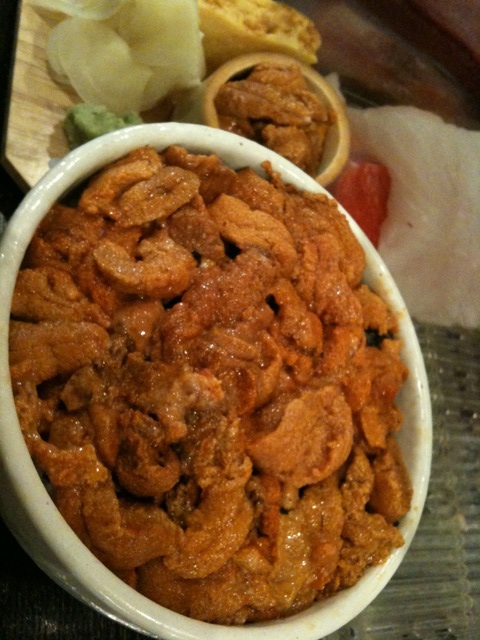
Aside from the seafood for sale, there is a cluster of sushiya on the far end of the market that we would visit on a regular basis for a quick breakfast before heading off to work. Turning right at the kooban (police box) into what looks like the parking lot for a football stadium, walking about 200 m and turning left into an alley leads you to “aisles” 5 and 6, where the most famous sushiya in the market are located — most with the kanji for “dai” (big) in some part of their names. The most famous of these is “Daiwa” — where the hostess conscientiously ensures you are lined up properly before heading inside — but there are others, all with their own unwieldy, intimidating queues. Inside, you might get something like this:

Unidon at Tsukiji

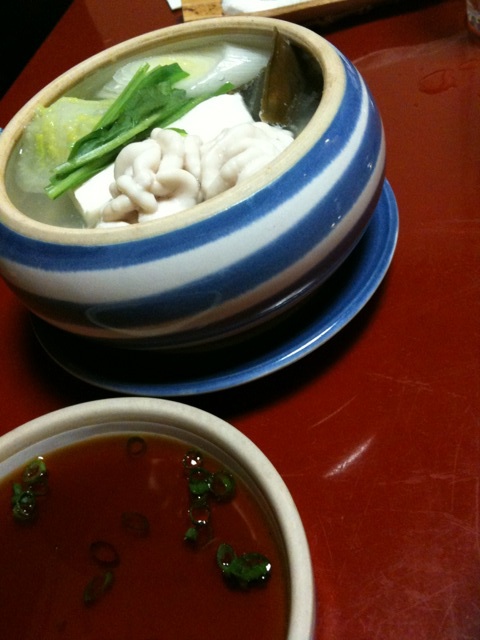
Also in season is shirako, a collection of creamy, mild coils that someone had once told me was fish sperm. Later, a group of Japanese people would tell me that this was not true; someone was pulling my leg. And then after that, I would look up shirako in the Japanese-English dictionary and discover that shirako is “milt; fish semen”, usually taken from the cod, anglerfish, or fugu (pufferfish). So there you have it. Shirako is not fish sperm. It is, as one kind Japanese waitress explained, “man eggs”.

Shirako for sale at Tsukiji

Somehow, that did not turn me off of this seasonal delicacy. Another popular way to have it is simmered gently in a nabe, a sort of catch-all term for anything that is served in a hotpot, like shabu shabu or sukiyaki. Or this, served as part of an incredible eight-course “washoku” menu at tempura specialist Uofuji in Ochanomizu (+813-3251-5327).

Helmed by a husband-wife team (the husband cooks, the wife is hostess), this is one of many husband-wife restaurants serving “washoku” (traditional Japanese cuisine) across the country. But the search for this unassuming restaurant is worth it: the tempura is light and fluffy and the menu changes daily, depending on what the husband has found in Tsukiji. On that particular day, there was sea cucumber in a pool of ponzu, freshly made shiokara (fermented squid innards), a single gigantic miso-glazed oyster. And while service is a little bit slow, the waitresses sure are free-handed with the sake samples and “tastings”. Leaving the restaurant that evening remains a blur; I believe Kiguchi-san had to escort us to the taxi herself, God bless her.

But it’s hard to pry me away from the sushiya for long, especially one where a meal can be an elaborate string of yummy fish-based mini-dishes. Sushiya no Yoshikan in Gakugeidaigaku (+813-3793-6261) is well-known for their otsumami (appetizers), which they continue serving you until you indicate to them you are ready for the sushi. We managed five: shirako, grilled this time with a salt crust; tuna “shabu” in a sweet miso sauce; poached sea eel in a pickled plum sauce; an oyster in a sabayon; and best of all, a freshly-grilled scallop in a “sandwich” of nori seaweed.

What I took away from all this, however, was the ever-present fact that I am getting old. I couldn’t keep up with my friends at the sushi counter — too soon afterwards, I was signalling for the soup (apparently osuimono, or clear broth soup, is what traditionalists say goes with sushi best, although everyone prefers miso nowadays). What can I say? Some things do change.

2 Comments

Filed under Asia, fish, food, Japan, Japanese, markets, restaurant, rice, seafood

Glutton Abroad: Falling in Nagano

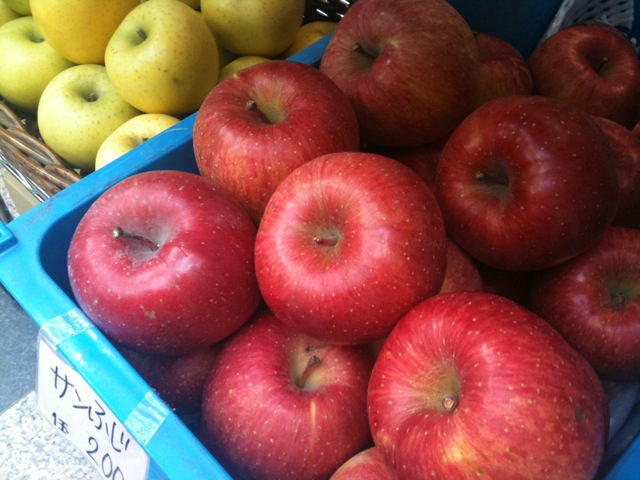
Apples, a Nagano specialty

Japan gets a lot of snow. Every year, we are re-surprised by the amount of snow awaiting us at Shigakogen, where we regularly go in a feeble attempt to look semi-athletic once a year (uh, in my case at least). Some people ski for the exhilaration of breezing down a mountain face, the sharp chill hitting their cheeks as they successfully navigate this or that mogul. I ski as payment for the reward that will come after:

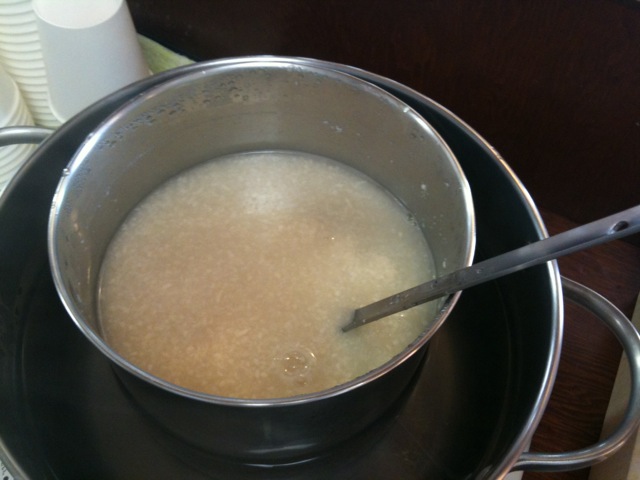
Shigakogen, like the rest of the Nagano region, forms part of Japan’s “snow zone”, which makes up fully half of the country, according to the Japanese tourism board. Tons of snow are dumped on the country every year when the cold winds blowing across the choppy Sea of Japan meet the towering mountains that form a big part of the “spine” running through Japan’s islands. Hence, the knee-deep white bounty that transforms me into the flailing autobot that everyone must navigate around in the mornings. Chilly winter wind can be good for the complexion. Direct contact with a fluffy mound of snow, not so much. Perhaps with this in mind, the Japanese brew amazake during the colder months; the hot mix of rice and sugar is very warming — and exceptionally filling.

Amazake in the making

But when Nagano isn’t busy getting dumped on, it’s actually busy producing yummy things to eat with the fertile soil it hides underneath all that snow in the winter. Like Thailand’s Central plains, Nagano’s valley produces a veritable shopping cart of produce: apples, blueberries, mustard greens, mushrooms, mountain yams, buckwheat — all are readily harvested by Nagano-ites in greener times. That is probably why certain buckwheat products are considered specialties of Nagano — soba manjyu, a sort of steamed dumpling formed from buckwheat dough and stuffed with various fillings like meat or pickled greens, and of course soba, the hearty buckwheat noodle served either hot in a broth or cold with a dipping sauce, accompanied with a pitcher of the soba cooking water to drink afterwards so that none of the nutrients go to waste.

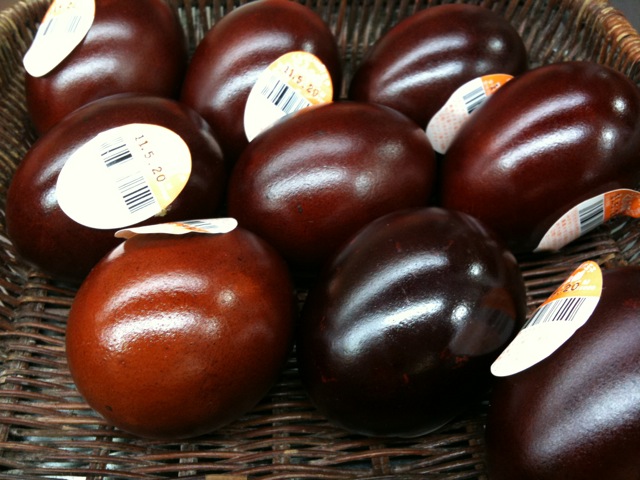
My favorite place to go, anywhere in the world, is the supermarket. It’s the best place I know of to figure out a place’s culture — or, at least, the way it views food. Are the shelves brimming with fat-free cakes and ready-made scrambled eggs and bacon, like in the States? Is there a gigantic, fresh-looking produce section, like in France? In Japan, there’s this: gargantuan, monstrous fruits and vegetables looking a little like something out of “Land of the Lost”; entire sections reserved for various types of dried fish; and unusual variations on commonplace things, like eggs.

Eggs for sale at Nagano's Tokyu Food Show

Almost everything is seasonal: mushrooms in the fall, shirako and uni in the winter, berries in the summer. But some things have become year-round staples: strawberries as big as a toddler’s fist and super-sweet “fruit tomatoes”, like tomato candy. These we had on our first meal there, sprinkled with a little Okinawa salt.

The Japanese are gifted in the art of naming — somehow, the English-language names they give are strange yet evocative, and always memorable. That’s how you get something like “Tokyu Food Show”, the best name I’ve seen yet for a supermarket; that’s also how you get “Ichigo no Musume”, or “strawberry daughter”, the name for a mochi (rice dough) dumpling stuffed with whipped cream instead of the usual red bean paste and anchored with a giant strawberry in the middle. I would show a picture, but I am not good enough to capture things in flight … in this case, the dumplings that were flying into other people’s mouths when my back was turned. Did I get a bite of these magical dumplings this year? No sirree, I did not.

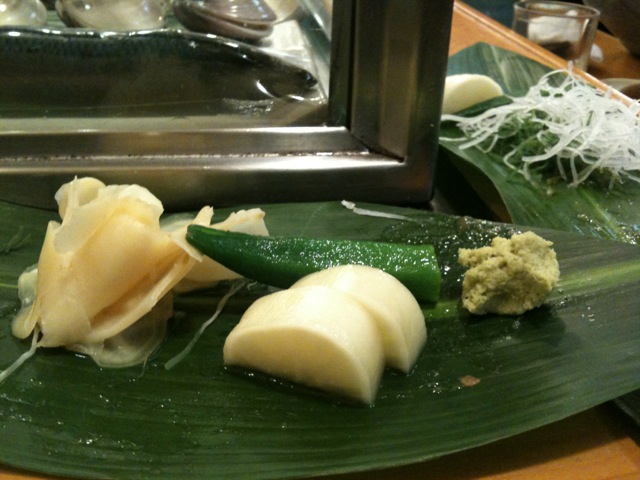
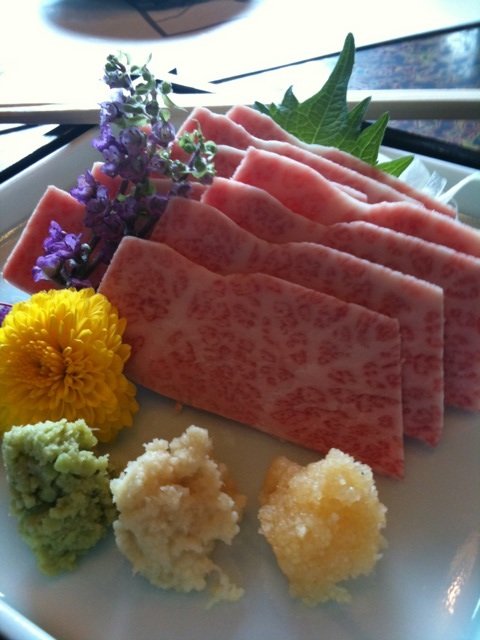
I did not miss out on the apple beef, however. A certain breed of fatty cattle similar to Kobe, the Nagano cows are fed on the region’s special apples, which are supposed to impart a certain sweet flavor to the beef. I’m not sure if that is really the case, but the beef is extremely delicious — not too fatty to turn into a grease-fest, but tender enough to melt in the mouth. Our favorite place to try it: Sukitei (600 m SW of city center Nagano, +81 26-234-1123), as much of an annual pilgrimage as the snowy, ankle-twisting doom offered by Okushiga Kogen. Aside from steaks festooned with the local mushrooms, there is sweet sukiyaki, warm and healthy shabu shabu, and a handful of delicious beef-based appetizers like salt-crusted beef cubes grilled on a skewer, gently poached beef slices served cold in a pickled plum sauce, and various types of beef “sashimi”. Here, the fattiest, decorated with edible blossoms (the yellow one is NOT GOOD) and accompanied by grated wasabi, garlic and ginger:

Sukitei's fatty beef sashimi

6 Comments

Filed under Asia, beef, dessert, food, Japan, markets, noodles, restaurant, rice