What’s Cooking: Gang Om

As part of a nutritious Isan meal

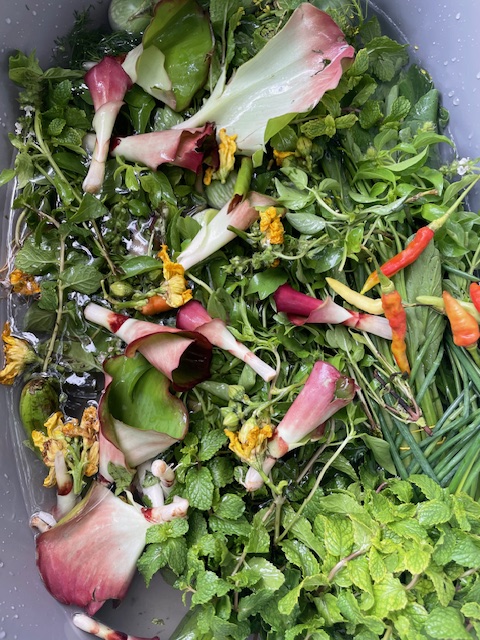
I like to say that Isan food is the Platonic ideal when it comes to cooking: big flavors coaxed out by fairly minimal effort. Well, I’m now here to tell you that this is all bullshit. When you are on the banks of the Mekong River and hauling your own water in buckets — not to mention all of the produce, chicken and fish that you’ve impulsively bought at the nearest market — you are exerting plenty of effort. There is a charcoal brazier to set up. There are plates to somehow rustle up out of thin air. There is sticky rice to steam. And of course, there are all those veggies to wash.
As for the plates, no worries: Chin of Chili Paste Tour has kindly purchased a stack of bai goong for us to eat on, anchored by great handfuls of sticky rice as Buddha intended.

Chin hiding behind a leaf

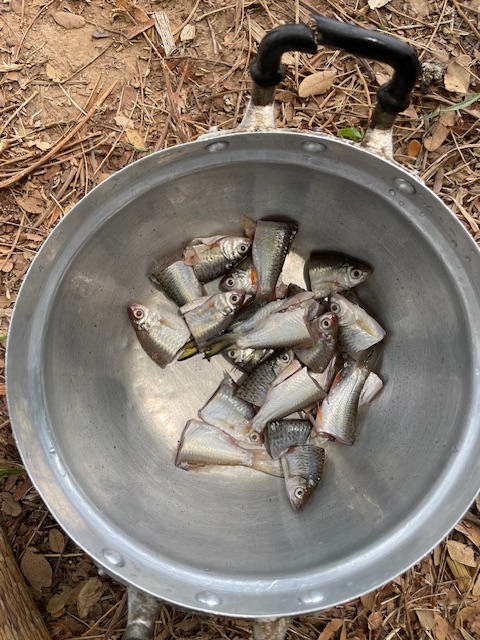
We even have another “main” dish planned, as our friends from the riverside village of Woen Boek (roughly, “full of fish”) brought bagfuls of Mekong River fish of all persuasions, including tiny silver fish meant to be steamed inside of a bamboo container over an open flame with a chili paste and more herbs.
And, of course we have dessert covered, in the form of orange mangosteen-like fruits that Chin purchased at the spur of the moment on the side of the road. Have we ever tasted them before? Hell no! But we did learn that they were called bakyang.

Little did I know, there is a reason why gang om — the super-herbal soup made with pork or beef or chicken or, really, anything you can find — is a celebratory dish, served alongside larb (spicy minced meat salad) for village parties. It’s not that it’s particularly complicated, but it does require care and maybe even a little verve. There’s a chili paste to pound, herbs to layer, and protein to cook on the bone to ensure it doesn’t dry out. There’s slaving over a hot, steaming vat of goodness to make sure the flavors are all right, even after the Mekong River breezes dry up under the midday sun. There are curious cows to shoo away and rocks to pick out of your Birkenstocks. This is back-breaking work.

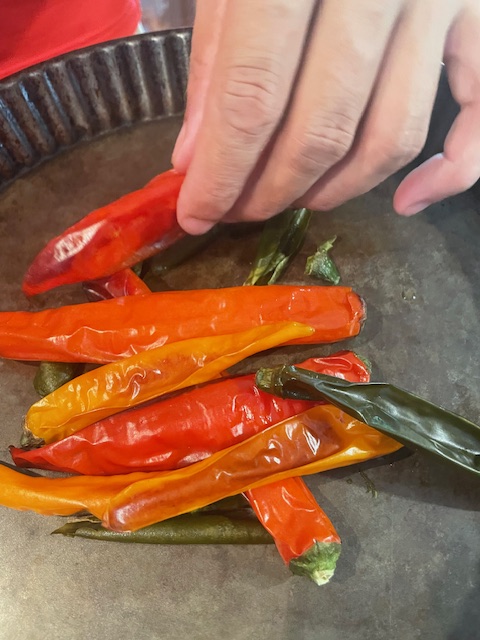
First, there’s the chili paste to pound. In this part of town, exactly where the Mekong River and Mun River meet, and where the two colors (the Mekong’s brown and the Mun’s dark blue) used to meet but not mix before a huge Chinese dam turned the Mekong the same shade of blue, bird’s eye chilies are not enough. Here, we use kalieng (Karen) chilies, bumpier and fatter than the bird’s eye, but also twice as hot. A handful of those go into a clay mortar along with a pinch of salt, and I am given a wooden, som tum-style pestle that is not really suited to pounding chili pastes, but here we are by the river and beggars can’t be choosers.

Here’s my one and only useful Thai food tip: when you are making chili paste and you need to really make it into a paste, pound it ingredient by ingredient. Make sure it’s a paste before you move on to the next ingredient. That way, you can ensure that everything is pulverized equally.

This is not the way the chili paste ingredients are presented to me. Everything — shallots, lemongrass, galangal, chilies and salt — has already been placed in the mortar, and lightly bruised as if we are at a spa and the ingredients are getting a foot massage. It’s up to me to mash everything, and so I set to it with serious intent. In fact, I am so serious about it that I break the mortar; only the bottom of the mortar, thank goodness, so that there’s a small hole at the bottom and only a little bit of the paste is lost.

This paste is meant to go into a pot of water, into which we also add the chicken, some cubed pumpkin, quartered Thai eggplants, chopped green onions, and halved bottle gourds (and their flowers). That will be set to stew along with the aromatics: dill, makrut lime leaves, pla rah (fermented fish sauce) and, mistakenly, some soy sauce. We leave this pot along for a little while. But my work isn’t done.

Breaking the mortar has convinced everyone that I am meant to be pounding chili pastes, for the rest of all eternity. Somehow, another clay mortar is produced, but sadly not a different pestle. I am given the same ingredients to pound (my way this time) for the fish in the bamboo container, and then a nam prik ki gaa (crow’s poo chili dip) to pound, this one with, of course, Karen chilies. We start with chilies and a little salt, add some shallots, some pla rah, a couple of dashes of fish sauce, and (gasp!) some brown sugar to fight the heat. I manage to keep the second mortar intact.

After about half an hour, the chicken is surely cooked through and the veggies are soft. We taste for seasoning and agree that it tastes great, even though I mistakenly added soy sauce. I am then asked to add more water as the level is too low, but not to adjust the seasoning (pro tip: adjust the seasoning). While we are doing this, our villager friends are grilling more river fish.
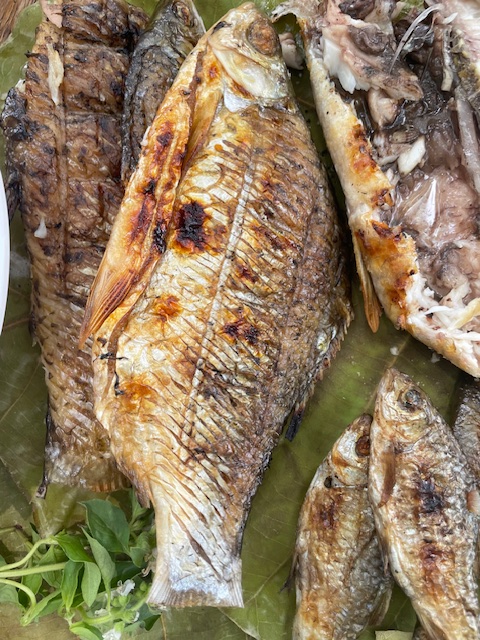
Finally, it is time for lunch, once the gang is deemed completely finished. We decant our stew into a another bamboo container, with the water at the perfect level for gathering up the goodness with a ball of sticky rice and a thumb. It’s herbal and fresh and (if we say so ourselves after cooking al fresco for a few hours), utterly satisfying.

We spend the rest of the day as we’re supposed to: on woven mats, dining on fish with stew and plenty of fresh greens and sticky rice. We don’t even turn (too much) of a stink eye on the bakyang, which do not taste like mangosteens, but like water olives that are very, very sour. It is a good, if somewhat tiring day. When we finally make it back to our hotel, having rebuffed attempts to lure us to a 2-hour hike, Lauren and I agree: this recipe is definitely going into the book.

Gang Om

  • 4 chicken thighs/legs, cut into 2 pieces each to make 8 pieces
  • 5-10 chilies
  • 2 shallots, peeled and chopped
  • 2 lemongrass bulbs, bruised
  • 2 inches galangal, peeled and cubed
  • 1 teaspoon salt
  • 3-4 green onions, chopped
  • 2 small bottle gourds or 1 zucchini, chopped
  • 3 Thai eggplants, quartered, or 2 handfuls of regular eggplant, chopped
  • 2 cups of pumpkin or squash, peeled and cubed
  • 1 handful of dill, stemmed
  • 4-6 makrut lime leaves, central stems removed and torn
  • 2 Tablespoons pla rah (fermented fish sauce) or regular fish sauce
  • 2 teaspoons soy sauce
  • Water or chicken broth to cover ingredients (about 3-4 cups)
  • 3 lemongrass bulbs, chopped
  • 2-3 Tablespoons of khao kua (toasted rice kernels, powdered) (optional)

First, make your paste. Pound chilies in a mortar and pestle with 1 tsp salt. When chilies are well mashed, add shallots, then continue with the process on through to lemongrass and galangal. Make sure everything is well pounded before adding the next paste ingredient. Stop after galangal and set aside.

In a stockpot with a lid over medium-low heat, add chicken, green onion, gourds (or zucchini), eggplant, and pumpkin. Add water or stock to cover, then add paste. Add your aromatics and seasonings next: dill, makrut leaves, pla rah (or fish sauce), and soy sauce. Taste for seasoning and adjust if necessary. If water levels have gotten too low, add more water but remember to readjust seasoning.

Allow to boil until everything is cooked through (about 30-40 minutes depending on your source of heat). Taste for seasoning again. Once you’re ready to serve, scatter chopped lemongrass and rice kernels on top for added aroma and stir into the soup.

Serve with sticky rice as part of a great Isan meal.
5 Comments

Filed under Uncategorized

Don’t diss Chantaburi

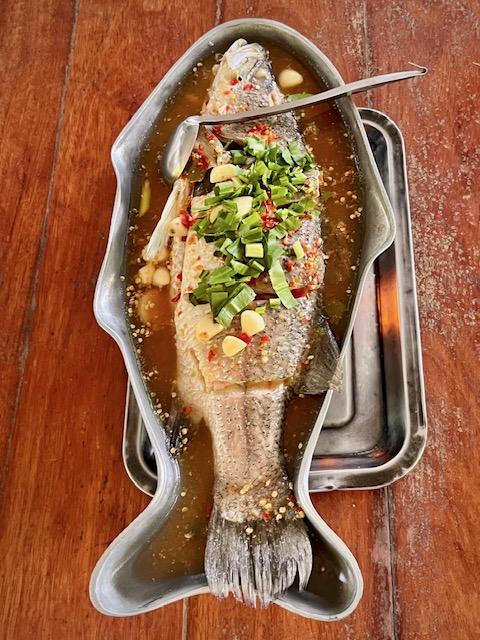
Steamed fish with chilies and lime at Uncle Kong in Klaeng

(Photo by Lauren Lulu Taylor)

There is a sign that shows cool people when a certain discourse or meme is no longer cool … that it has “jumped the shark”, if you will. That sign is when uncool people start having opinions about said discourse or meme. Of course, I am one of those uncool people.

Which is why I now have opinions about the Drake-Kendrick Lamar rap battle. I really, really shouldn’t. As a middle-aged Asian woman, I am probably the last person in either of these artist’s intended demographic. All the same, here I am, with my crappy opinions. Which I will now unload onto you.

Opinion number one: I have never liked Drake’s music. So there. Opinion number two: I am so out of it that I thought Kendrick Lamar already released a Drake diss track, called “King Kunta”. Apparently, it is not a Drake diss track (but I feel like I was misled, because why are you talking about a rapper with a ghost writer, wtf happened?) Opinion number three: Kendrick Lamar won. Now, obviously I am not an expert on rap beefs, and you can probably make a very good case about how I am completely wrong. But please, let me talk up in here in my own space on this subject, just like how I let white guys tell me about Thai food over street food tables at rice porridge shops in Chinatown. This is my blog, after all. Go talk about what you like on your own blog.

I decided Kendrick Lamar won, not after watching a lady performing Indian classical dance to a track called “BBL Drizzy”, or listening to a Japanese man rap over the same track, but after reading a tweet on Twitter (never X) asking Kendrick Lamar to write a diss track about the tweet writer’s own ex, and providing useful bullet points, like “he never pays for food” and “he never does his own laundry”. This is funny to me, imagining Kendrick Lamar sitting in a dusty old office in downtown LA, pen in hand, awaiting his next commission. So I’d also like to ask Kendrick to help me (in this scenario we are on a first-name basis, because this is my blog) (please don’t write a diss track about me, Mr. Lamar) diss something, but artfully. I’d like to diss Chantaburi food.

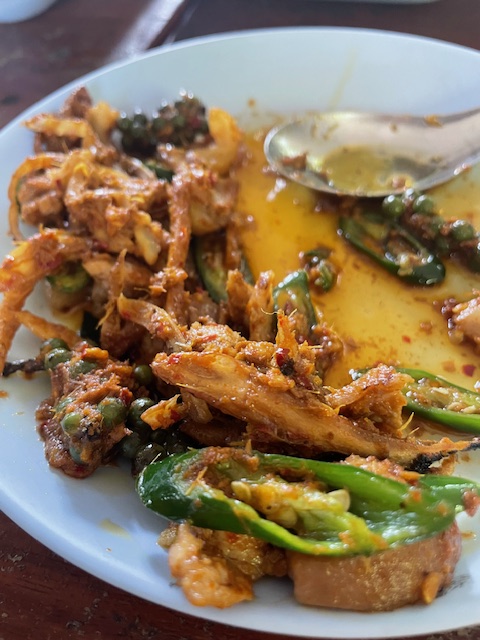
I’ve been to Chantaburi before. And I didn’t really like it. Everything was too sweet, but when I say it out loud, I remind myself of my most annoying relative. In Klaeng, we meet with really lovely people on restaurant grounds over which each table is ensconced in its own air-conditioned room. What is there not to like? There’s even stir-fried boar, better than what we get in Hua Hin, with plenty of wild ginger and green peppercorns:

For dinner, we have all the seafood we can handle, including enormous local oysters with all the trimmings; a hot-and-sweet soup of seabass; raw shrimp with seafood sauce; freshly fried pomfret with fish sauce; a creamy and disconcertingly sweet chili dip of crab eggs; and a yum of three kinds of eggs, including crab and catfish:

Mr. Lamar, I was too full to enjoy any of it. The ingredients were top-notch and the cooking was carefully considered, but it just left me with a heavy feeling in the pit of my stomach. My appetite had absconded off with its secretary, unsure of whether it wanted to return. Mr. Lamar, can you find a way to diss my appetite?

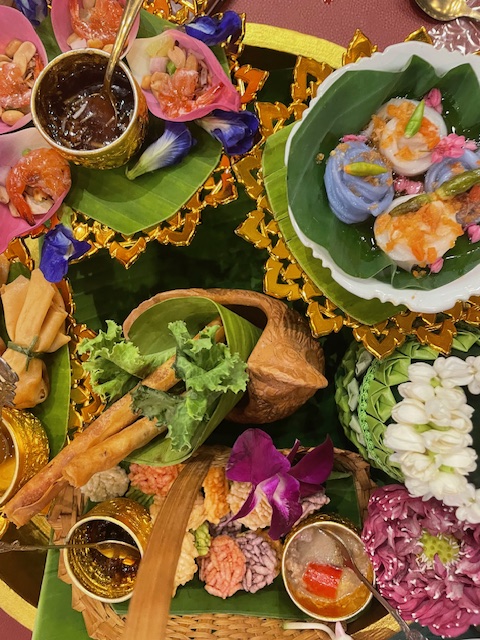
The next day was little better, sent off to a restaurant that looked like it belonged in a suburban Florida strip mall and inundated with elaborate reimaginings of “royal Thai” dishes like “money bags” and mieng kum with lotus petals:

Faced with the prospect of having more of this food for dinner, I just could not do it. In Sukhothai, I had subjected myself to a litany of noodle dishes, many of them cloyingly sweet, and now I was facing the prospect of a thick massaman curry studded with durian and yet another iteration of pork stewed with cowa leaves. Imagining the meal ahead of me, I saw my face in the mirror and caught a glimpse of what Drake may have looked like while watching the reaction videos to “Not Like Us”. No more, I say!

So I simply refused to leave. It was as simple as that. We stayed at the table where we had been nursing strong (but good) mojitos, watched the sun go down, waited for Lauren to take some pictures, and stayed some more. We ordered another mojito. We watched the lights turn on by the water. And then we ordered some dishes — quesadillas stuffed with boiled chicken and cardamom shoots, garnished with an unholy heaping of sour cream, and nachos topped with pork stewed with cowa leaves, avocado, and more sour cream.

Quesadillas and nachos at Easterly in Chantaburi

And it was exactly what we (I) needed, this nincompoop fusion of the most touristic of Tex-Mex dishes and traditional local cuisine. The nachos weren’t even tortilla chips, they were Doritos. The quesadillas came with a fresh tomato salsa that did absolutely nothing for the cardamom shoots and chicken. But here I was, savoring every bite like Kdot saying “A minorrrrrrr”. It was embarrassing but true.

The next day, my appetite returned, chastened but ready. I had pork congee for breakfast, then a second breakfast of jungle curry with deer and lots more fresh cardamom, a whole stewed Thai mackerel, and some stir-fried mustard green pickles. I devoured fish, squid and an aggressively briny fresh shrimp chili dip by the water for lunch. And now I’m about to finally tackle that massaman curry with durian. And all it took was a touch of, well, junk.

2 Comments

Filed under Uncategorized

What My Grandmother Made

A Northern Thai table with Northern-style prik nam pla (upper left)

I remember being in Bangkok during one Thai New Year’s and watching a poor Western woman get completely drenched — groceries and loaf of bread and all — in a tuk tuk that slowed down just enough so that revelers could pour an entire wastebasket’s worth of water on her head. After witnessing this silent moment of complicity between the tuk tuk driver and the water-splasher, I vowed to never get caught in the streets of Bangkok during Songkran again. Which is why I’m here, now, cowering on my couch, riding the holiday out until the last water gun has been emptied and consigned to a storage bin for next year.

Since this couch is my home for the next two or three days, my thoughts have been turning to my family, currently in Nakhon Nayok, where they are hosting my mother’s entourage of friends (like a rapper, she rolls 10 deep). These ladies, from my parents’ university days, enjoy 1. remarking on how much weight we have gained or lost, and 2. warbling traditional Thai songs on karaoke. So it may not come as much of a surprise when I admit that I am happy right where I am, right here in this couch in Bangkok.

If only someone would cook for me.

I was shocked a few months ago when my mother, during one of her rare reminiscences of her childhood, talked about her mother’s cooking. I had never heard of my grandmother cooking before. In fact, my grandmother NOT cooking was a major reason given for why my mother did not cook. And yet here we were, with stories about my grandmother cooking. Now, I love my grandma, and visit her every time I’m in Chiang Mai (I get really bad dreams if I don’t). All the same, I was sad to have missed her food. Although my grandmother lived to be 102 years old, she never cooked for me.

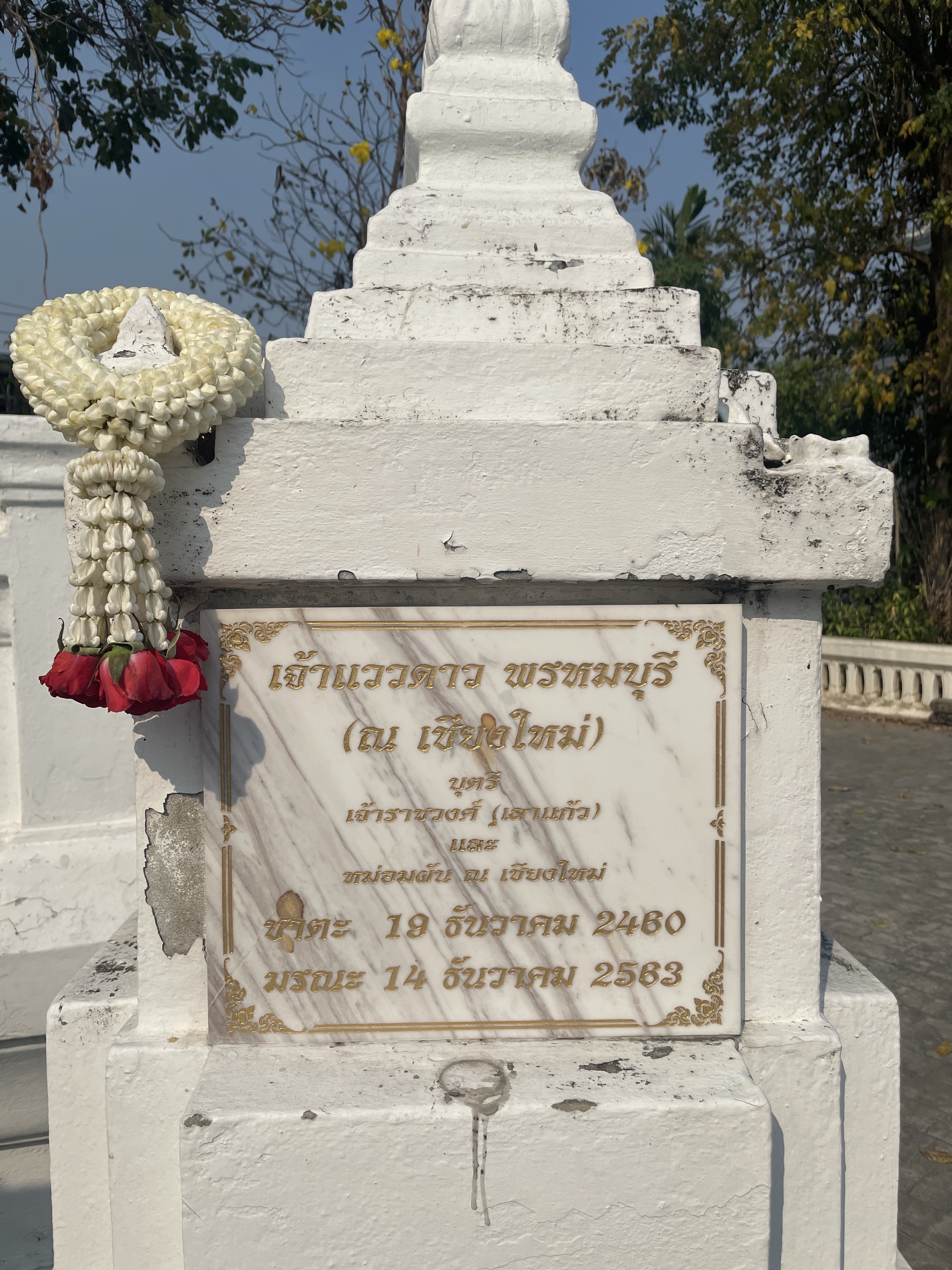
My grandmother Waewdao

You see, my grandma was from Chiang Mai, but married a Central Thai man and moved to Bangkok, where they frequently had Central Thai food. Occasionally, when my grandma was tired of all the palm sugar and coconut milk, she would seek comfort in the dishes of her homeland, with flavors that were straight and true. My mother told me about a prik nam pla that was Northern-style, made with grilled, peeled and deseeded banana peppers doused in fish sauce seasoned with garlic and lime juice. She also told me about a pork dish cooked only for Northern Thai aristocracy called moo hoon, or pork with lots of turmeric and lemongrass (a recipe that will be in our upcoming cookbook!)

And then my mother said she would make her own nam prik kee ga (crow’s poo chili dip), which I believed to be Central Thai until the moment when my mother told me this story. My grandma would make it with prik chee fah, or goat/spur chilies, raw garlic, and salt, pounding it herself and eating it with sticky rice, alone. These were the only dishes she made.

So, stuck in my house as the water wars raged outside, I sought to follow in my grandma’s footsteps and make some crow’s poo of my own. First, I had to get some chee fah chilies, which I bought a few days before Songkran in preparation for this very moment.

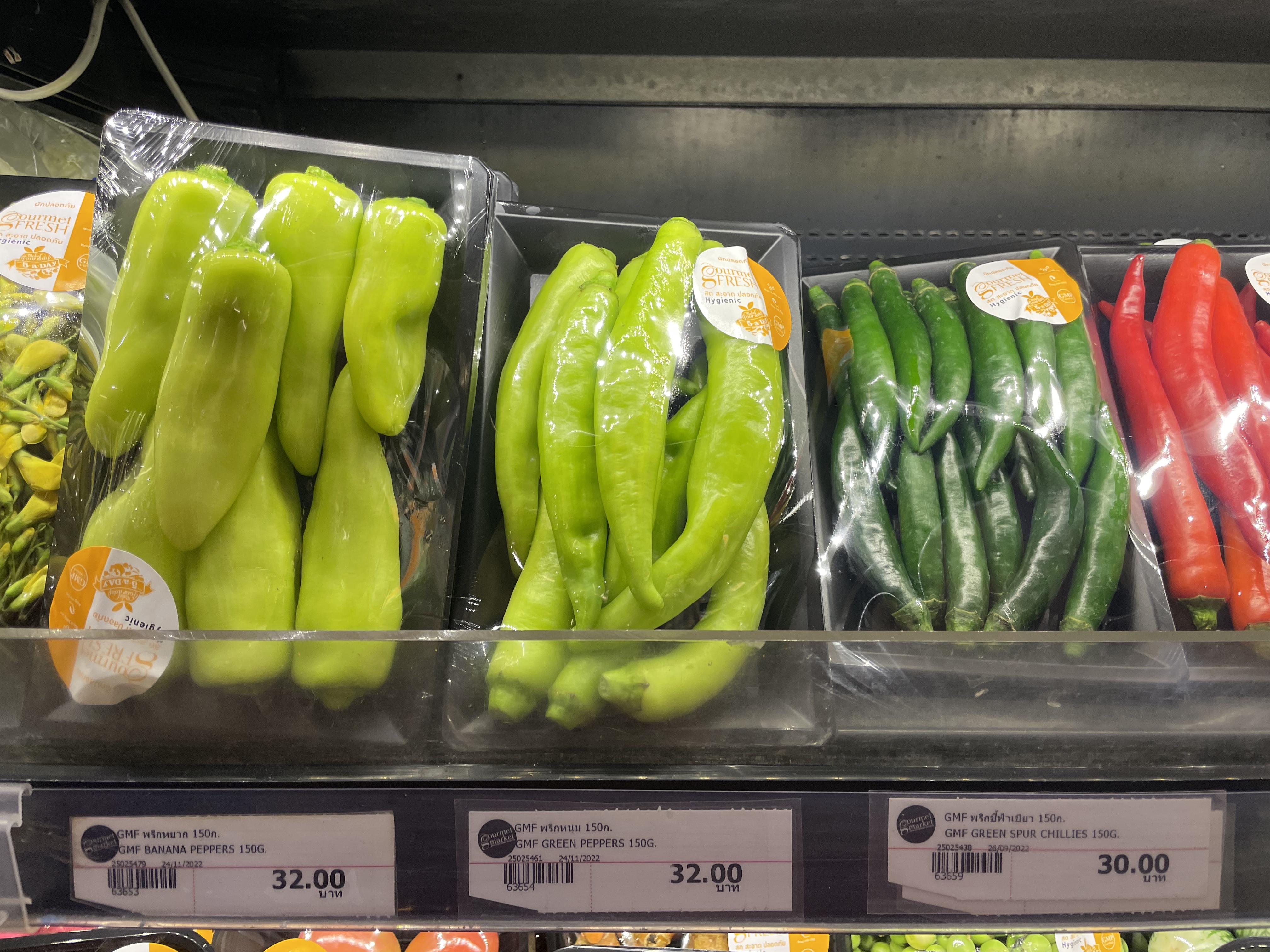
A comparison of chilies: banana peppers on the left, young green (num) chilies in the middle, and chee fah chilies on the right

I lined a baking tray with aluminum foil, turned my oven grill up to full power, placed a handful of spur chilies of each color on the tray and slid them in when the oven had heated. Then I readied my work station for the only workout I was ready to do that day:

My garlic, on a wooden thing meant to heat up baguettes but has never been used to heat up baguettes

I pounded three cloves of raw garlic with a teaspoon of sea salt in readiness for my chilies. It took them about 15 minutes to get properly softened and lightly charred, and then I peeled them while they were still hot, grimacing and flailing like a serial groper on a Tokyo commuter train during rush hour.

Chilies post-oven, pre-peel

Once peeled, they looked pathetically meager, about 3 Tablespoons worth of chili “meat” — just enough for lunch.

This was it

So I stuck them in the mortar and pounded, and, really, it was incredibly easy. The chilies, by now thoroughly depressed by the direction in which their lives had taken, simply gave up after a few loud thumps, and the chili dip was ready in seconds.

Game over

I tasted it and found it just salty enough (though my housekeeper Tai, ever the critic, complained it was too salty). We ate it for lunch with just-boiled eggs, stir-fried snow peas, kak moo (pork bits left over after rendering pork lard, stir-fried in roasted chili paste) and, of course, freshly steamed rice. My Central Thai husband said it was good.

1 Comment

Filed under Uncategorized