The New North

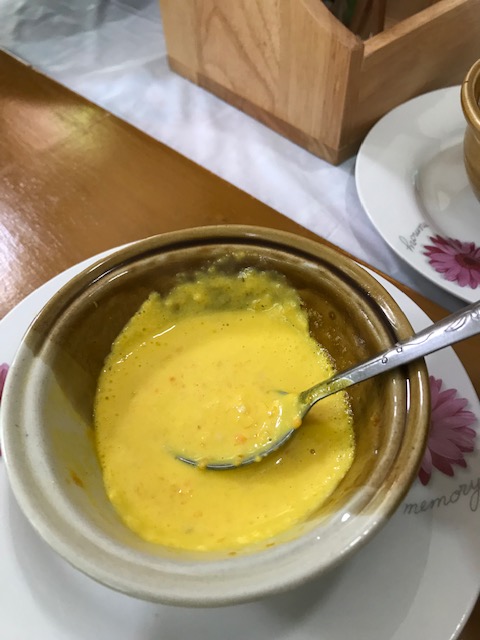
khaosoy

Khao soy at Ong-Tong

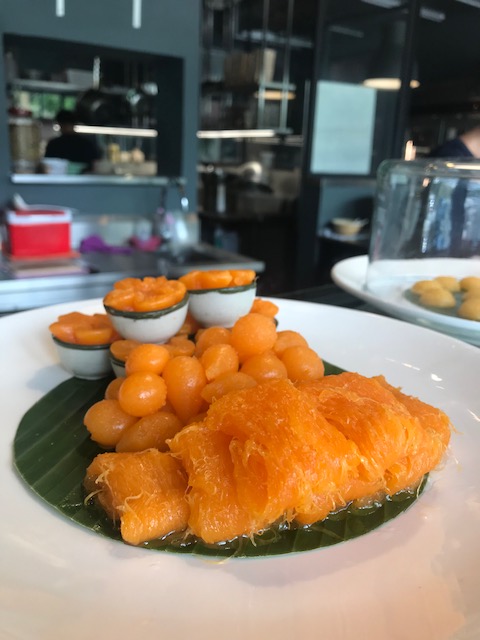
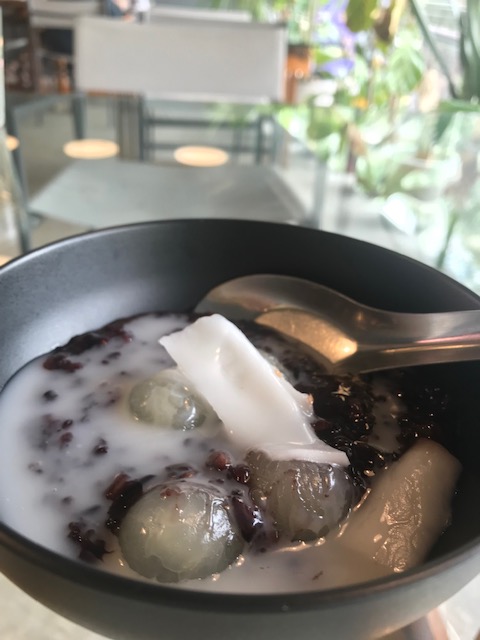
Before Winner left to visit his family in California, he took me to Maliwan Kanom Thai (Ari Soi 1) to buy 20 bags of their pandan-flavored kanom chan (layered jelly of sticky rice flour and coconut milk). It’s just one of a bunch of great street food stalls on the street — and incidentally, part of an area that was saved from being cleared by the government thanks to the vendors banning together to petition City Hall. In case you are ever lost on Ari Soi 1 and in desperate need of some Thai street dessert, you will always be able to pick out Maliwan by the long line of people waiting patiently for a shot at their sankaya fuk tong (pumpkin stuffed with coconut custard) or khao niew dum kati (sweet coconut milk-covered black sticky rice). Although the kanom chan is probably the most popular offering at Maliwan, I am embarrassed to say we completely cleaned out their store of the green ones, although the purple (butterfly pea) and brown (original) were still available. Not that this information will help you in any way today.

kanomchan

Maliwan’s pandan kanom chan

Despite Ari Soi 1’s cup overflowingeth with great street food choices, we could not pass up the chance to try the new(ish?) Northern Thai spot Ong-Tong Khaosoi Ari (17 Phahonyothin Soi 7, 02-003-5254), since Winner knows I love to complain about things and am rarely satisfied by Northern Thai food in Bangkok.

I will start out by saying that I have recently come back from braving the toxic air in Chiang Mai, where I indulged in old favorites at Huen Jai Yong (which I’ve written about before).

pakwaan

Pak waan stew at Huen Jai Yong

I also had a chance to try the new “face” of the Northern Thai food scene a la Blackitch Artisan Kitchen, where local food celeb Chef Black is turning Thai ingredients into exciting new dishes, with the help of a pioneering spirit and a willingness to experiment.

fermentation

Works in progress at Blackitch: a silkworm fish sauce, fermenting shrimp heads, pickling Sichuan peppercorns

Ong-Tong doesn’t do this sort of high-concept experimentation, which is OK, because that makes Ong-Tong 1.) way cheaper and 2.) far less crowded (bookings only at Blackitch, and even then, be prepared to spend a lot of time by yourself downstairs in a room that resembles the cellar in a horror movie). The height of CRAY at Ong-Tong is their pairing of dry khao soy with sai oua (Northern Thai sausages), which could sound amazing but sort of lands with an anticlimactic huh on the palate. It’s sort of like Northern Thai chop suey. But you be the judge.

saiouanoodle

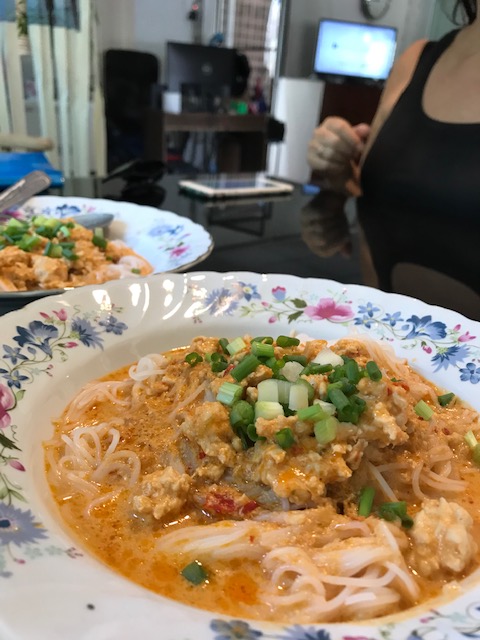
Khao soy sans broth with sai oua

As for the namesake dish, khao soy, well … how bad can it get at this point? It’s egg noodles in a coconut milk-enriched curry broth, right? How can anyone hate on that and not be a total monster? All the same, I feel a little (a lot) like this dish, as lovely as it is, as much like the most popular and nicest sorority sister at the state university as it is … is sort of becoming the pad Thai of the millennial age. Ubiquitous, everywhere, inoffensive, universally loved. All hail, Asian Taylor Swift in noodle form.

giphy

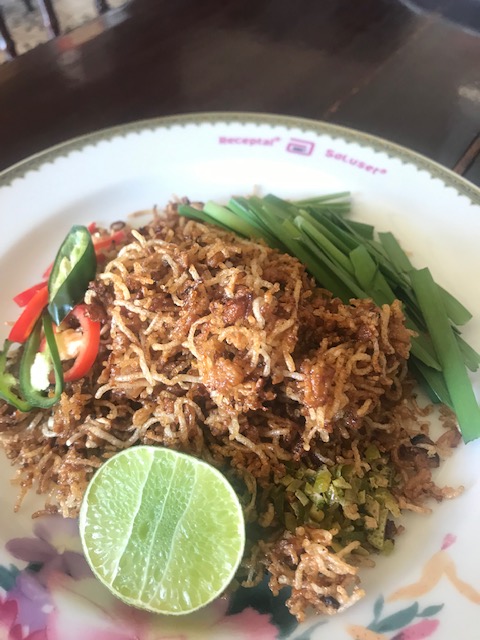
Not to say that this place is one big meh. A personal favorite — and something I like to complain about almost as much as GOT’s Benioff and Weiss or Donald Trump’s face — is kanom jeen nam ngiew, a fermented rice dish that features a thick pork stew (in Chiang Mai they add tomatoes, which flattens the flavors out a bit) seasoned with fermented beans (tua nao). And at Ong-Tong, hey, it’s good! I know I wasn’t expecting it either. The trick is lots and lots of deep-fried garlic.

namngiew

I’m thinking it will take a couple more decades for this dish to be as played out as pad Thai and khao soy — after all, there is still kua gai (stir-fried chicken noodles), kanom jeen nam ya (Southern-style rice noodles in fish curry) and even tum sua (somtum with rice noodles) waiting to be unleashed on the world. Until then, I can find plenty of other stuff to complain about.

2 Comments

Filed under Uncategorized

100 percent Thai

oysters

A spicy oyster salad with horse tamarind leaves at Fah Mui. I was afraid it wouldn’t end well for me, but I’m fine thanks for asking

For the last week or so, I have been following the controversy around Lucky Lee, the “clean” Chinese-American restaurant founded by Arielle Haspel, who is not Chinese-American. There are several takes on this, but my favorite is probably the one on Eater, which can break down why and how the controversy.

Cultural appropriation is a tricky thing. The idea that a white chef shouldn’t cook Asian food is ridiculous, as it is when it’s an Asian chef cooking Western food. Brought to modern music, it’s even worse — all forms of modern music were appropriated from black people, for example (do you remember when Eric Clapton did “I Shot the Sheriff”? He was the Cliff Richard of the ’70s.) When you get to clothing and who gets to wear a sari or cheongsam, it becomes completely bewildering, especially from the eyes of Asians living in Asia, who think anyone willing to spend money for any of their stuff is A-OK.

But then when you seek to “improve” on the “yucky” food of a minority group, you rightfully get into trouble. That is because it doesn’t come from a place of love or respect, and it builds on a long history of devaluing other cultures in favor of the ruling one. I once attended an exhibit on the history of the Chinese-American restaurant in New York and it detailed very clearly how, from the very first restaurant in San Francisco, the food had to be marketed as cheap and convenient in order to compete. Burgers and steaks still had to be on the menu, along with “fusion-y” creations like chop suey. The first fortune cookies were actually a Japanese-American creation, but after the inventor was put into an internment camp, the Chinese took over.

Despite the kitschy, “inauthentic” connotations ascribed to it now, Chinese-American food became a thing that people genuinely love, and an example of how a community assimilated and survived by adapting its culture to that of its new host. The changes that were made to it as time passed (or in some cases, the gradual reversion to the real thing) serve as historical documents themselves.

Thais are doing this now, with the inclusion of Chinese dishes on their menus and a change in flavors that may have dismayed some native-born Thais to such an extent that they invented a a food tasting robot (I will never forget). But it, and the Chinese-American food that came before it, is still only really accepted if it knows its place, asking for less money than its Western counterparts.

“Leave the fine dining to the Europeans,” someone once wrote on a message board controversy sparked by a story I wrote on Bangkok’s new fine dining restaurants (LOL at old people who can’t read timelines). I don’t remember the problem with the story — aside the fact that people think I am a poorly paid 25-year-old intern. HELLO I am a poorly paid 75-year-old intern! — but I will always remember this stupid dumbass comment, and feel rage. This comment is racist. If you don’t see it, I’m not going to help you. I’m done with that. Asian food is just as good as anyone else’s food, and should cost what it’s worth. That is why I so admire ladies like Jay Fai and Pen, who despite a lot of pressure have kept their prices at a place where they feel properly compensated, and have kept their food at a high quality as a result.

The restaurant I’m writing about today is not an expensive one though. Hahaha.

It is, however, very good, an example of a cuisine that, even when you leave it alone at home, still manages to evolve and change. I’m talking about Thai food in Hua Hin, specifically at Fah Mui (20 Naresdamri Road, 082-587-4659). I’m talking about their gaeng prik nok (bird’s eye chili soup). Tell me this is an old-age Hua Hin thing, because I have never seen this before, and I have been to Hua Hin a time or two or three.

The sign looks like this. It’s kind of hard to find because it’s just a door (decorated with a bull’s skull with red balls for eyes). Look for the mayom fruit tree. The door will lead you through a narrow walkway to the restaurant behind, which looks out over the water. It’s basically an aharn tham sung (made to order) stall with a view.

sign

The soup comes from this paste, which the cook tells me is just shallots, shrimp paste and chilies, just like a regular gaeng som (sour curry). It’s not, of course. It’s tart, salty and spicy like sour curry, but there’s definitely plenty of sugar, and an added bonus of fresh holy basil leaves that echo the sweetness and make it resonate (I am writing like Jewel sings, kill me now).

chilipaste

The paste turns into this soup, bristling with fresh seabags and fish eggs. I only remembered to take this photo at the very end because I have better things to do than taking photos all the time, like fighting off my family for more soup:

soup

There’s more stuff that I don’t remember, but I do recall these fish egg sacs fried with garlic and meant to be dipped in a sweet chili sauce, but come on, that’s just gilding the lily:

fisheggs

Fish eggs with garlic

There is also a terrifying gaeng pa (jungle curry) and succulent deep-fried pork ribs. There is whole deep-fried seabags in more garlic. There is more, but I have forgotten, because there was so much. It is food that is a perfect historical document of the times we are living in right now. Too bad it’s all in my stomach.


5 Comments

Filed under Uncategorized

Glutton Abroad: They juice bitter melons in Taiwan, don’t they?

bittermelon

Taiwan’s white bitter melons

By now you will have probably already seen the viral clip of The Cure’s Robert Smith interviewed by journalist Carrie Keagan at this year’s Rock and Roll Hall of Fame Induction Ceremony. If not, well, I’m not sure which one to link to, and where have you been anyway, it’s everywhere, even Piers Morgan has covered it. Morgan even claims to have wooed his wife with The Cure songs (instead of dancing alongside her and eventually biting her neck, like other lizards would normally have done). This must be very horrifying for Robert Smith, sorry, you can rest in peace now, our thoughts and prayers are with you.

The interview is most often pitched as an illustration of the differences between Britons and Americans, but like Jordan Peele’s new movie “Us”, I think it serves as a Rorschach test for the viewer’s own prejudices. In my case, I was convinced Carrie Keagan was the alternative music version of a social-climbing parvenue, the kind who listens to the “Wish” album and then proclaims herself a mega-fan, versus a long-suffering misfit who had to eat lunch with their one friend at school and listened to “Pornography” before bed in order to make themselves feel less alone (Hmmm? What’s that? I’m not talking about myself you’re talking about myself.) It turns out she is a “Japanese Whispers” fan and, although it’s technically considered a singles collection, whatever, I have to eat my words and pretty, ebullient people like Carrie Keagan can also be closet Goths even though they probably never had to pay any of the social cost for it, what, I’m not talking about myself why are you so obsessed with me.

The Cure are a good band to consider when it comes to discussing a wide-ranging, even surprising, fandom. They appealed to everyone from the likeliest (Trent Reznor, I feel you) to the unlikeliest of music fans (Piers Morgan) and everyone in between, thanks to the universality of Robert Smith’s songwriting and unvarnished voice, and some really stellar musicianship that never really gets a lot of attention because everyone is paying attention to Robert Smith (not his fault). Watching The Cure’s set from the induction ceremony, I was struck by how generous they were in playing for this smug peroxided bunch of phonies who represents everything in music that The Cure have always hated (and will probably induct a band like Poison any year now, just you wait).

Wait, what was I saying? Oh yes, a wide-ranging fandom. Yes, really, that was what I was talking about, not about how rock music has become equated with the oppressor Donald Trump types of the world and has lost all credibility as a resistance art form as a result. Oh wait, I mean a wide-ranging fandom …

… which Taiwanese food also enjoys. What I’m saying is, Taiwanese food appeals to a whole range of people, from the foodie Gluttony types to the junky sweet tooth set to the genuine, food-of-the-people champions — like The Cure’s discography, there’s something for almost everyone there (provided they aren’t Motley Crue fans or whatever).

applebanana

Colored like an apple, shaped like a banana

I’ve been to Taiwan before. I consider that my pure Glutton trip, an attempt to inhale as many of the things I’ve always loved about Taiwanese food in Taipei. This trip was a more wide-ranging jaunt, a budget tour through the island, focused on covering as many stops as possible from Sun Moon Lake to Alishan to Yehliu Geopark and every souvenir shop doling out commissions in between. The food was different from what I would choose to eat in Taipei, but it ended up being a good thing and probably much more representative of what regular Taiwanese people outside of the capital city eat.

hotpot

Open-air hotpot in the mountains

Of course, there is always something new to discover here. In my case, it was the “tea egg”, which our guide said was the only street food allowed to be sold in the Alishan area during Chiang Kai-Shek’s time because the vendor was a widow with children. Besides this story, tea eggs are simply the perfect snack, savory nuggets of protein stewed in a broth of tea, soy sauce and Chinese five-spice powder for long enough to form the characteristic marbled pattern on their surfaces, reminiscent of how Tom Hardy looks when Venom is taking over.

teaegg

Tea eggs on the street

Because they are such perfect snacks, tea eggs are pretty much everywhere, on the street, in tea shops, even in the 7-11. But it took finally arriving in Taipei to suss out what I had been wanting to try the whole time: Taiwan’s supposedly ubiquitous fried chicken (I love fried chicken, did I ever mention that?). This magic stuff is like a half of a chicken pounded flat through sheer WTFery (bones be damned) and then lightly breaded, fried to a face-sized slab and cut into squares to allow for easy grazing from a paper bag. It comes in normal and “spicy” (which is a lot like Nashville’s “hot chicken” in flavor) and is so delicious that I forgot to take a photo until the very end, when I was finally able to stop myself from eating for long enough to snap a picture.

friedchicken

Fried chicken on Hanzhong Street

Also delicious: bubble tea. I know we all say we’ve had bubble tea, but the fact is that no one has had bubble tea unless they’ve had it in Taiwan, the actual birthplace of bubble tea. The inventor of “pearl milk tea” is said to have been Chun Shui Tang, but count us as Tiger Sugar converts, thanks to the addition of dark brown sugar syrup to its signature drinks.

bubbletea

Praise be Tiger Sugar


And then there are the bitter melon juice stands. Like Robert Smith’s hair, the sight of several rows of bitter melons lined up like soldiers at the front of a juice stall could appear intimidating. But these gourds are not the light green variety commonly adorning eggy stir-fries and pork broth-based clear soups elsewhere in Asia. Fortunately (unfortunately?), Taiwan’s produce is almost unparalleled (gorgeous guavas and rose apples, etc) and its fat white bitter melons — said to be milder than their green counterparts — are no exception. The juice is augmented with honey and ice cubes and is a bittersweet jolt to the senses, the Goth shadow to the ebullient lightness enjoyed by the happy and uncomplicated fangirls of the world. Just like The Cure (YAY I DID IT), bitter melon juice is the darkness by which all the sweetness of the world can be measured.


3 Comments

Filed under Uncategorized